Le Monde Group has chosen Snøhetta as architectural partner, in collaboration with our local partner SRA, to design their new headquarters in Paris.

The evolution of media is in focus and in particular the future relationship between readers and media users, the production of media on different platforms and their connection to the public at large.

The headquarters of the newspaper Le Monde was remodeled ten years ago by Christian de Portzamparc. The Le Monde Group is an icon in the media world and its long standing reputation of integrity and quality is a measure for media houses worldwide.
 

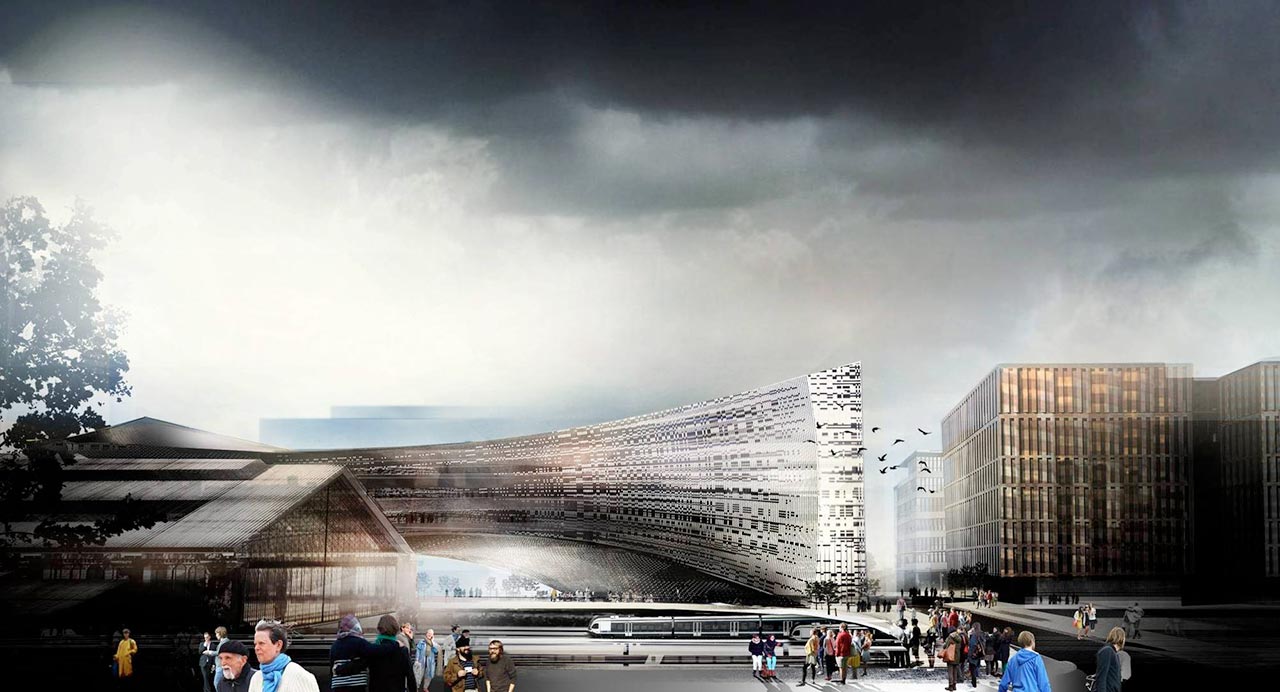
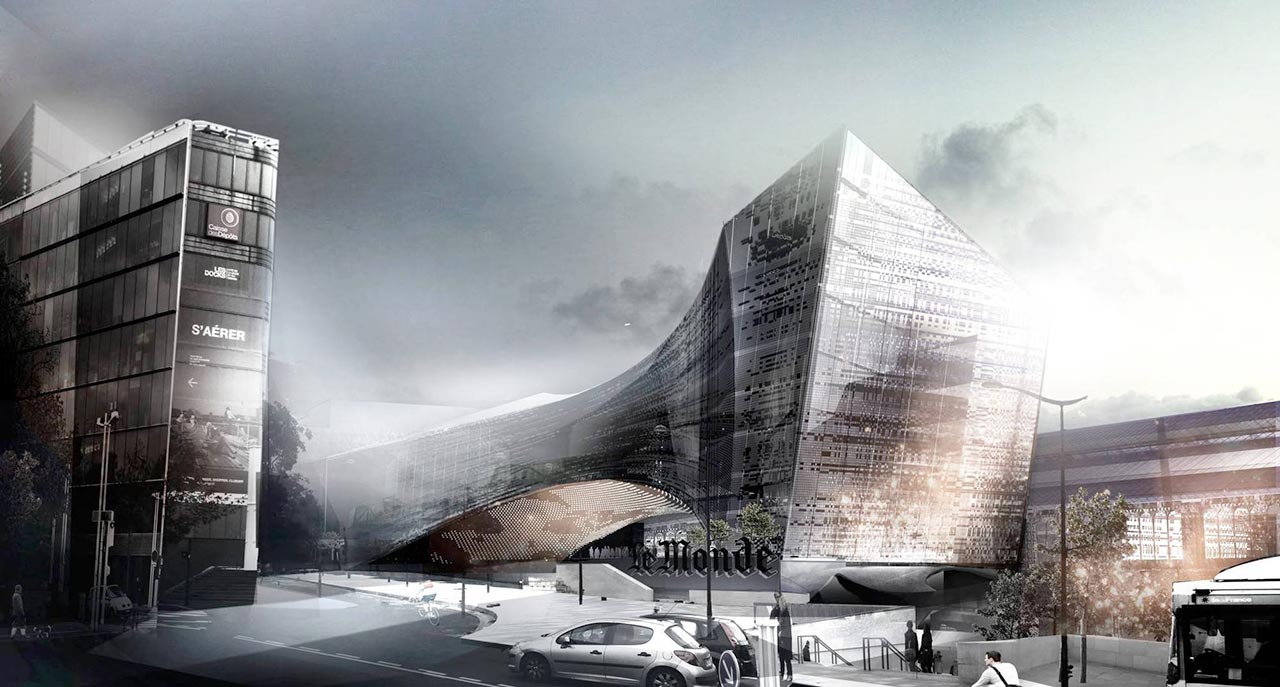
"Structurally, the site is divided in two parts. However, we believe it is important that Le Monde occupies one building. Our approach has been one of subtraction, taking first a block filling the entire site and subtracting volumes to create entrance areas and public spaces. The subtracted volumes also relate to the existing site planning restrictions and the capacities of the structural grid. The result is that the building becomes a bridge, literally spanning across the site, but also representing the bridge between Le Monde and its readers. The occupied bridge allows for direct contact between the different departments in the company. Symbolically the bridge connects the two parts of the city along the Avenue De France.

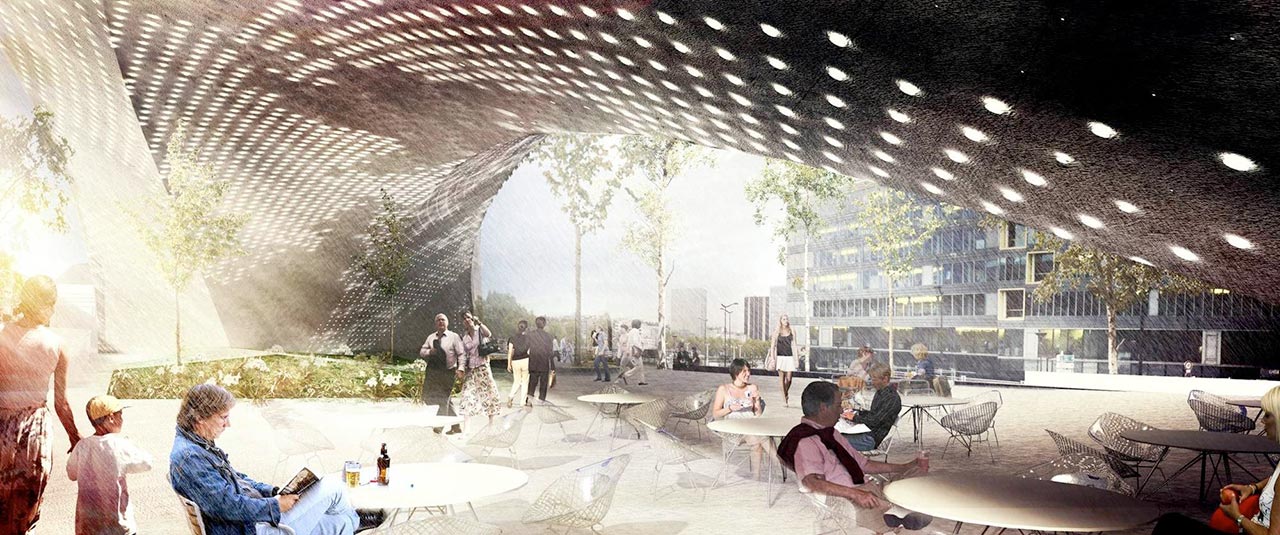
Instead of water passing under the bridge, we have created a public open space; a plaza in two connected halves. One half faces the street and the Seine. It is open, inviting, and activated by a visitor center, auditorium entrance, and staff entrance. The second half faces the railway. It receives more direct sunlight, has a café and more intimate landscaping with seating and green areas.


In contrast, the vaulted ceilings over the plaza represent the transient flow of information like clouds or stars moving across the sky. They are formed from parts of a sphere or globe, and are also part of the overall structural solution. These surfaces will have embedded clusters of LEDs in a relatively low resolution grid that can be programmed to provide more or less abstracted levels of data. They can provide basic illumination or abstract representations of new flow.

The exterior of the building will be clad with a pixelated matrix of glass with varying degrees of transparency, translucency, and opacity. The intention is that the façade gives the building a homogenous character when viewed from distance, but at the same time reveals a greater level of complexity as the view approaches – like headlines and detailed content in a news story. The façade patterns are intended to represent the building as a complete volume, while the distorted pixel map creates a rich tapestry from inside and out."

Snøhetta
Read more
Read less

More information

Snøhetta is an architecture, landscape, and interior design studio with offices in Oslo, Norway, and New York City, USA. Founded in 1989, it is led by Craig Dykers and Kjetil Thorsen. The studio, named in honour of Mount Snøhetta, the highest peak in the Dovrefjell mountains of Norway, has approximately 100 collaborators working on large-scale international projects across a wide range of typologies. Their approach is deeply collaborative and transdisciplinary, bringing together architects, designers, engineers, and landscape professionals to explore multiple perspectives depending on the nature of each project.

Snøhetta has completed a series of world-renowned cultural and landmark projects, including the Bibliotheca Alexandrina in Egypt, the Oslo Opera House and Ballet, and the Lillehammer Art Museum in Norway. Current projects include the National Pavilion of the September 11 Memorial Museum at the World Trade Center site in New York, as well as urban and landscape developments that aim to merge local identity, sustainability, and public experience.

In 2004, Snøhetta was awarded the Aga Khan Award for Architecture, and in 2009, the Mies van der Rohe Award. The studio is the only practice to have won the World Architecture Award for Best Cultural Building twice in consecutive years: in 2002 for the Bibliotheca Alexandrina and in 2008 for the Oslo Opera House and Ballet, consolidating its international prestige.

Kjetil Trædal Thorsen (born 1958 on the coastal island of Karmøy, Norway) is a co-founder of the studio and a multiple award-winning architect. He is a visionary and humanist designer who has redefined the boundaries of contemporary practice. Under his leadership, Snøhetta has produced iconic, sustainable structures that are highly sensitive to their cultural context, combining technological innovation with a profound environmental awareness. Thorsen’s work is recognized for its focus on social interaction, sustainability, and the creation of spaces that foster human connection and sensory experience, establishing a benchmark in contemporary global architecture.

Craig Dykers (born 1961 in Frankfurt, Germany) is also a co-founder of the studio and director of its New York office. Snøhetta has earned a reputation for maintaining a deep integration of landscape, architecture, and urban experience across all its projects. Key works include the Bibliotheca Alexandrina in Egypt, the Oslo Opera House and Ballet, the National Pavilion of the September 11 Memorial Museum in New York, and the redesign of Times Square. Professionally and academically active, Dykers has been a member of the Norwegian Association of Architects (NAL), the American Institute of Architects (AIA), and the Royal Society of Arts in England. He has served as a diploma juror at the Architectural College in Oslo and as a distinguished professor at City College, New York. He has delivered numerous lectures across Europe, Asia, and the Americas, and has undertaken public art installation projects, many of which explore the interplay between context, landscape, and human experience.

Read more
Published on: January 16, 2015
Cite:
metalocus, INÉS LALUETA
"Snøhetta to Develop Le Monde Headquarters in Paris " METALOCUS. Accessed
<https://www.metalocus.es/en/news/snohetta-develop-le-monde-headquarters-paris> ISSN 1139-6415
Loading content ...
Loading content ...
Loading content ...
Loading content ...
Loading content ...
Loading content ...
Loading content ...
Loading content ...
Loading content ...
Loading content ...
Loading content ...
Loading content ...
Loading content ...
Loading content ...
Loading content ...
Loading content ...
Loading content ...
Loading content ...
Loading content ...
Loading content ...
Loading content ...
Loading content ...
Loading content ...
Loading content ...
Loading content ...
Loading content ...
Loading content ...
Loading content ...
Loading content ...
Loading content ...
Loading content ...
Loading content ...
Loading content ...
Loading content ...
Loading content ...
Loading content ...
Loading content ...
Loading content ...
Loading content ...
Loading content ...
Loading content ...
Loading content ...
Loading content ...
Loading content ...
Loading content ...
Loading content ...
Loading content ...
Loading content ...
Loading content ...
Loading content ...
Loading content ...
Loading content ...
Loading content ...
Loading content ...