WERK Arkitekter and Snøhetta together with Oluf Jørgensen, completed the "lantern", a new maritime centre for the coastal town of Esbjerg in Denmark. The team won the competition to design the facility, With space for both water sports clubs, boat storage, training facilities, a large workshop and social spaces, in 2019.

Named ‘The Lantern’ because takes inspiration from the shape and craftsmanship of local lanterns, the centre, a circular building, with an open shape, is a new accessible and inclusive reference point for residents, visitors and those interested in maritime life.
The design, by WERK Arkitekter and Snøhetta, has a rhythm and repetition inspired by wooden boat construction, both outside and inside. The changes in the angle of the panels give varying shadows, inspired by the shapes of kayaks. The wooden rhythm continues on the roof, where solar panels are integrated into a belt around the top edge.

The upper level of the building houses various clubs, including clubs for rowing, kayaking, sailing, diving and triathlon, as well as common areas, an educational centre and training facilities. On the lower level, directly connected to the sea by a bridge, one can find boat storage and workshop space.
 
“The maritime centre has room for everyone; from the experienced diver or professional kayaker to a crab-fishing school class or a random passer-by. The Lantern invites everyone to a peek inside the maritime life and outwards to the sea with its endless horizon.”
Frank D. Foray, senior architect and project manager at Snøhetta

“The goal has been to create a unique destination that lights up the Danish West Coast, so everyone can find their way to new communities at the sea.”
Thomas Kock, Creative Director at WERK Arkitekter.
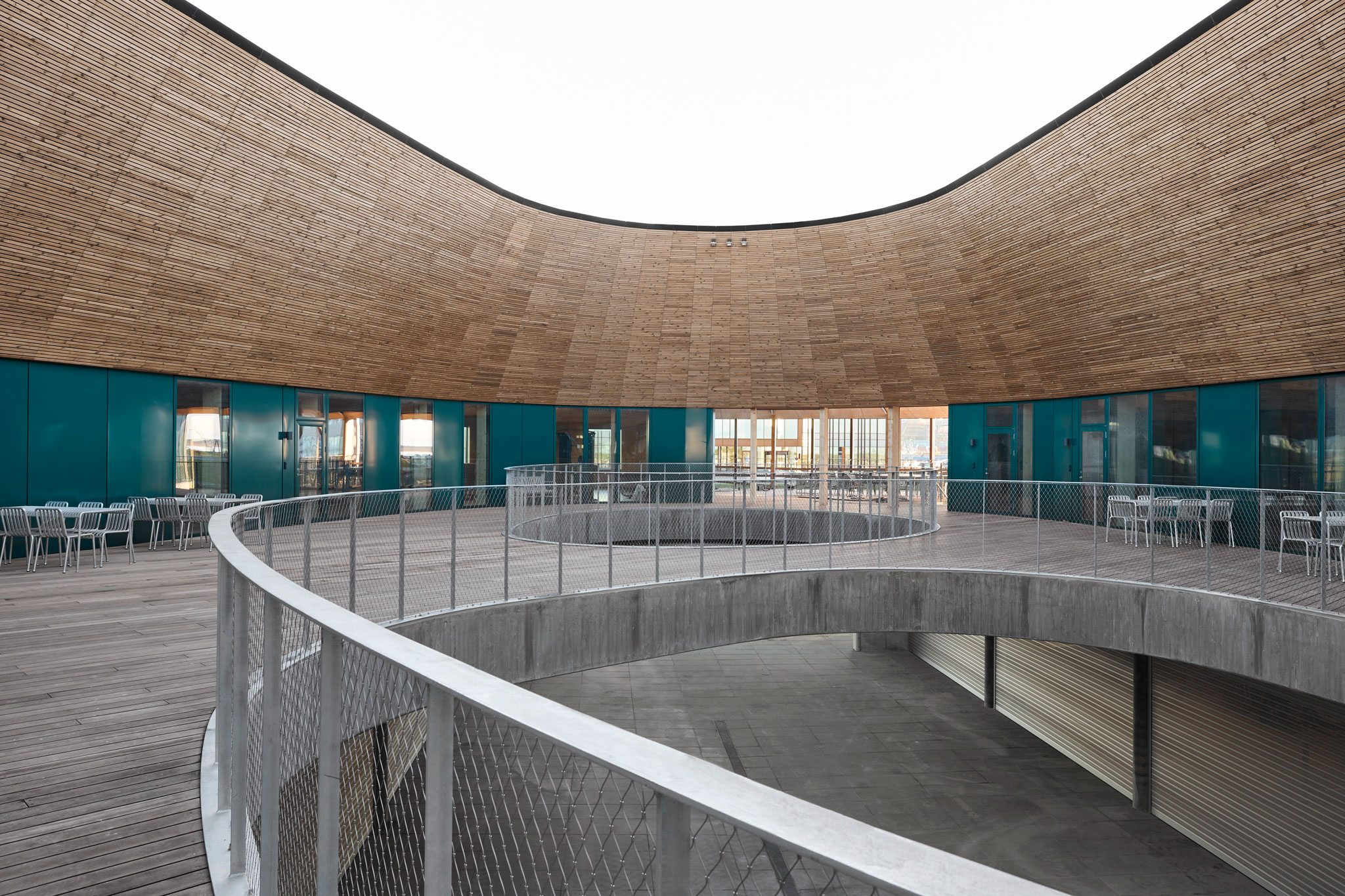
 

Esbjerg new maritime centre by WERK and Snøhetta. Photograph by Wichmann+Bendtsen.


Esbjerg new maritime centre by WERK and Snøhetta. Photograph by Wichmann+Bendtsen.

Esbjerg new maritime centre by WERK and Snøhetta. Photograph by Wichmann+Bendtsen.
 

Project description by WERK Arkitekter and Snøhetta

Room for maritime activities and communities
The upper level of the building houses various clubs, including clubs for rowing, kayaking, sailing, diving and triathlon, as well as common areas, an educational centre and training facilities. On the lower level, directly connected to the sea by a bridge, one can find boat storage and workshop space. Large windows throughout the building’s façade give plenty of daylight and visibility inwards, while also connecting the centre to its surroundings. At night, a warm glow shines through the windows, lighting the centre up like a lantern.

Inspired by wooden boat construction
The building design is inspired by the geometry and craftmanship of boats, paying homage to the maritime tradition and its significance in the port of Esbjerg.

Round-shaped holes between the terrace and the boat storage and preparation area bring daylight down to the ground floor's core and create a visual and social vertical link.

The façade has a rhythm and repetition inspired by wooden boat construction, both outside and inside. It also reflects the water's energy with the pace and horizontal rippling effect experienced when throwing a stone in the water. The changes in the angle of the panels give varying shadows, inspired by the shapes of kayaks. The wooden rhythm continues on the roof, where solar panels are integrated into a belt around the top edge.


Esbjerg new maritime centre by WERK and Snøhetta. Photograph by Wichmann+Bendtsen.

Where the poetical and practical meet
With a vision to create a space that unites the poetical with the practical, the Maritime Center aims to find a balance between the mesmerizing and never-ending movements of the sea and practical everyday chores. A symbiosis between the beautiful and the raw, the elegant and the robust.

The robustness of the center is evident not just in the buildings’ ability to facilitate activities, but also in how it creates shelter from strong winds. The building is planned for high water in case the water exceeds the new surrounding dam. Therefore, the structure up to the first floor is made of concrete, poured in one go. The wooden façade is designed to withstand harsh weather conditions, while the building is designed with areas where visitors can find shelter.

One such area, and the heart of the project, is a lifted, publicly accessible terrace, gathers all the different activities of the building. Connected to the first floor, the terrace is accessible from the two main stairs, creating an amphitheatre. Along these two ​ amphi stairs, visitors can enjoy the view and the maritime activities on smaller wind-protected terraces on the first floor.

More information

Label
Architects
+ + copy Created with Sketch.
- + copy Created with Sketch.
Label
Project team
Text
WERK Arkitekter, Snøhetta.
+ + copy Created with Sketch.
- + copy Created with Sketch.
Label
Collaborators
Text
Oluf Jørgensen A/S Consulting Engineers.
+ + copy Created with Sketch.
- + copy Created with Sketch.
Label
Client
Text
Esbjerg Kommune.
+ + copy Created with Sketch.
- + copy Created with Sketch.
Label
Builder
Text
Esbjerg Municipality, Local and Construction Fund.
Municipio de Esbjerg, Fondo Local y de Construcción.
+ + copy Created with Sketch.
- + copy Created with Sketch.
Label
Area
Text
Approx. 2,800 m² (approx. 3,800m² incl. terrace and boat storage).
+ + copy Created with Sketch.
- + copy Created with Sketch.
Label
Dates
Text
Project planning.- 2019-20.
Performance.- 2020-22.
+ + copy Created with Sketch.
- + copy Created with Sketch.
Label
Location
Text
Esbjerg, Denmark.
+ + copy Created with Sketch.
- + copy Created with Sketch.
Label
Photography
+ + copy Created with Sketch.
- + copy Created with Sketch.

Snøhetta is an architecture, landscape, and interior design studio with offices in Oslo, Norway, and New York City, USA. Founded in 1989, it is led by Craig Dykers and Kjetil Thorsen. The studio, named in honour of Mount Snøhetta, the highest peak in the Dovrefjell mountains of Norway, has approximately 100 collaborators working on large-scale international projects across a wide range of typologies. Their approach is deeply collaborative and transdisciplinary, bringing together architects, designers, engineers, and landscape professionals to explore multiple perspectives depending on the nature of each project.

Snøhetta has completed a series of world-renowned cultural and landmark projects, including the Bibliotheca Alexandrina in Egypt, the Oslo Opera House and Ballet, and the Lillehammer Art Museum in Norway. Current projects include the National Pavilion of the September 11 Memorial Museum at the World Trade Center site in New York, as well as urban and landscape developments that aim to merge local identity, sustainability, and public experience.

In 2004, Snøhetta was awarded the Aga Khan Award for Architecture, and in 2009, the Mies van der Rohe Award. The studio is the only practice to have won the World Architecture Award for Best Cultural Building twice in consecutive years: in 2002 for the Bibliotheca Alexandrina and in 2008 for the Oslo Opera House and Ballet, consolidating its international prestige.

Kjetil Trædal Thorsen (born 1958 on the coastal island of Karmøy, Norway) is a co-founder of the studio and a multiple award-winning architect. He is a visionary and humanist designer who has redefined the boundaries of contemporary practice. Under his leadership, Snøhetta has produced iconic, sustainable structures that are highly sensitive to their cultural context, combining technological innovation with a profound environmental awareness. Thorsen’s work is recognized for its focus on social interaction, sustainability, and the creation of spaces that foster human connection and sensory experience, establishing a benchmark in contemporary global architecture.

Craig Dykers (born 1961 in Frankfurt, Germany) is also a co-founder of the studio and director of its New York office. Snøhetta has earned a reputation for maintaining a deep integration of landscape, architecture, and urban experience across all its projects. Key works include the Bibliotheca Alexandrina in Egypt, the Oslo Opera House and Ballet, the National Pavilion of the September 11 Memorial Museum in New York, and the redesign of Times Square. Professionally and academically active, Dykers has been a member of the Norwegian Association of Architects (NAL), the American Institute of Architects (AIA), and the Royal Society of Arts in England. He has served as a diploma juror at the Architectural College in Oslo and as a distinguished professor at City College, New York. He has delivered numerous lectures across Europe, Asia, and the Americas, and has undertaken public art installation projects, many of which explore the interplay between context, landscape, and human experience.

Read more
WERK is an architecture office, founded by Thomas Koc,  based in Copenhagen, with projects in Denmark and abroad.

WERK comprises a dedicated team of planners, architects, and landscape architects. In a continuous interdisciplinary collaboration, we develop unique concepts and strong visions within urban planning, landscape architecture, urban space, and architecture – always with a strong focus on community and diversity. With a holistic take on all projects, we ensure coherence in the cities – both aesthetically, functionally, socially, and historically.

They take pride in solving planning, building and urban space tasks in complex and visionary contexts. In our eyes, the right design solution makes a significant difference for the people who use a place, whilst taking care of the climate.

They often work with projects that involve many actors and politically driven organizations. We always have great respect for the unique physical and cultural framework surrounding a project. As a result, the core of WERK’s approach is always close dialogue and good cooperation with all parties involved.
Read more
Published on: January 12, 2023
Cite:
metalocus, ANDRÉS BLANCO
"WERK and Snøhetta completed the Esbjerg new maritime centre: a lantern of the Danish west coast" METALOCUS. Accessed
<https://www.metalocus.es/en/news/werk-and-snohetta-completed-esbjerg-new-maritime-centre-a-lantern-danish-west-coast> ISSN 1139-6415
Loading content ...
Loading content ...
Loading content ...
Loading content ...
Loading content ...
Loading content ...
Loading content ...
Loading content ...
Loading content ...
Loading content ...
Loading content ...
Loading content ...
Loading content ...
Loading content ...
Loading content ...
Loading content ...
Loading content ...
Loading content ...
Loading content ...
Loading content ...
Loading content ...
Loading content ...
Loading content ...
Loading content ...
Loading content ...
Loading content ...
Loading content ...
Loading content ...
Loading content ...
Loading content ...
Loading content ...
Loading content ...
Loading content ...
Loading content ...
Loading content ...
Loading content ...
Loading content ...
Loading content ...
Loading content ...
Loading content ...
Loading content ...
Loading content ...
Loading content ...
Loading content ...
Loading content ...
Loading content ...
Loading content ...
Loading content ...
Loading content ...
Loading content ...
Loading content ...
Loading content ...
Loading content ...
Loading content ...