

The display by Neri&Hu, a studio led by Lyndon Neri and Rossana Hu, presents the practice’s research in three concepts, "Reflective Nostalgia", "Recasting Vernacular", and "Ruinophilia/Future Artifact", taking as model three adaptive reuse projects to highlight the studio’s research: Waterhouse at South Bund (Shanghai, 2008-2010), Tsingpu Yangzhou Retreat (Yangzhou, 2015-2017) and Nantou City Guesthouse (Shenzhen, 2020-2021).
Liminality as a construct allows one to traverse both physical as well as allusive temporal thresholds, creating a visceral perception of the intersections of past, present, and future.
As set, the three projects share similar architectural strategies using material contrast, tectonic differentiation, formal assemblage, and surgical grafting.
Using an archaeological approach, each project aboard its own set of issues related to past uses and cultural ways to design.
Liminality as a construct allows one to traverse both physical as well as allusive temporal thresholds, creating a visceral perception of the intersections of past, present, and future.
As set, the three projects share similar architectural strategies using material contrast, tectonic differentiation, formal assemblage, and surgical grafting.
Using an archaeological approach, each project aboard its own set of issues related to past uses and cultural ways to design.
“As we imagine for ourselves what the future holds, we collectively occupy the liminal space of experimentation both in theoretical constructs and in design practice. In today’s post-colonial world, Homi Bhabha speaks about boundaries in culture as a place of liminality or ‘third space’ where translations and negotiations occur. Liminal space and the notion of the threshold represent a space of ambiguity that engenders new possibilities and changes. These spaces become the stage for transitory and frontier events that possess agencies for disrupting and challenging the status quo.”
Lyndon Neri and Rossana Hu, founding partners of Neri&Hu.
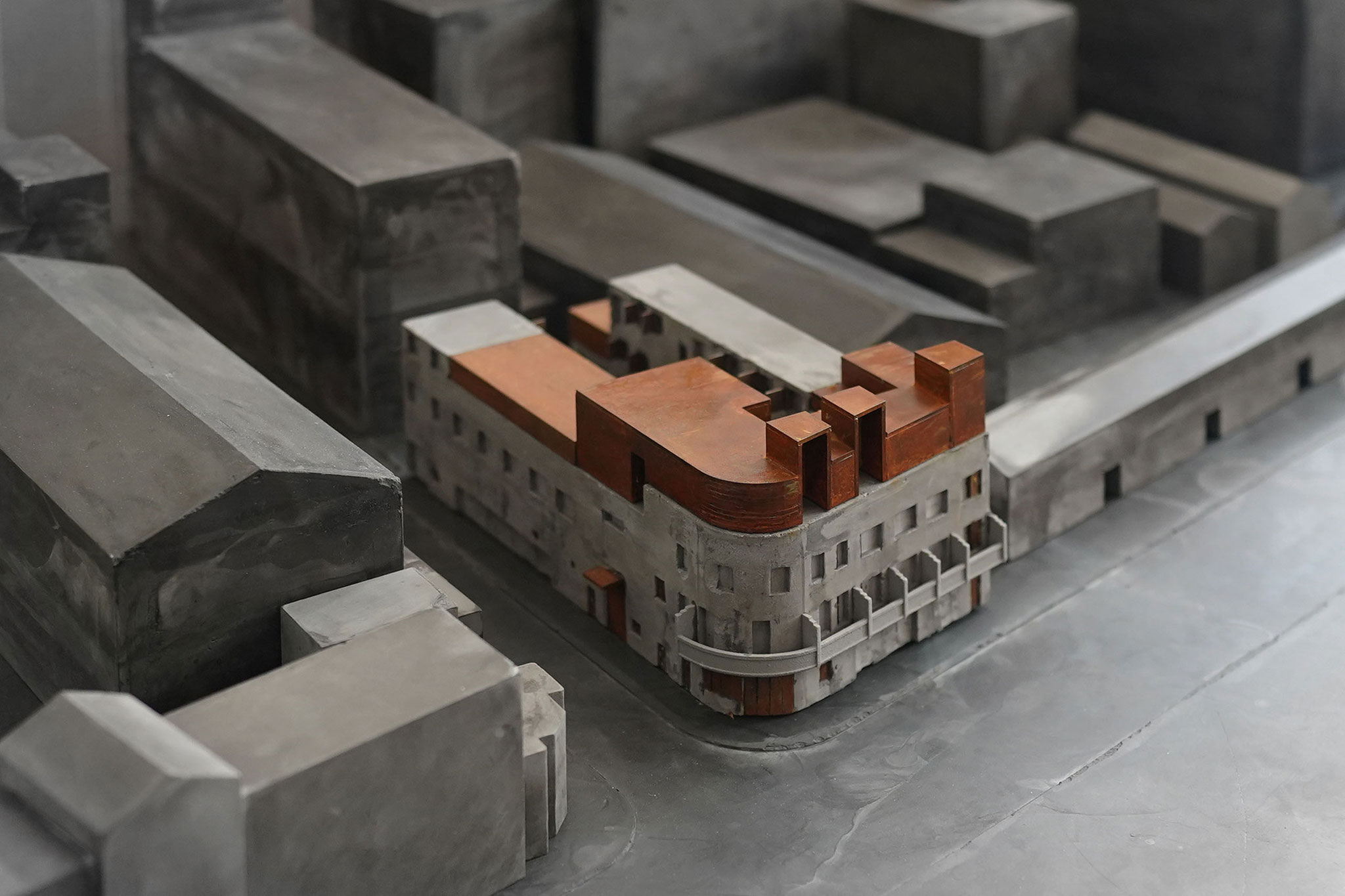
Waterhouse at the South Bund (Shanghai 2008-2010) by Neri&Hu. Photograph by Sanif Xu.
Waterhouse at South Bund questions the typology of a hotel, how one interprets notions of “home” and domesticity in a foreign environment, and how to give meaning to the experience of a traveler. In response to adapting the original structure, a Japanese army building from the 1930s, Neri&Hu exercises restraint in the restoration process by resisting the impulse to cosmetically fix every flaw, intentionally leaving portions of walls crude and exposed, at times even encasing raw wall sections and details behind a glass shield to convey the archival treatment of a museum display. Drawing from the rich experience of a typical Shanghai long tang alley where true privacy does not exist, Neri&Hu challenges conventions of inhabitation, notions of comfort, and the boundaries between public and private.
Tsingpu Yangzhou Retreat (Yangzhou, 2015-2017)
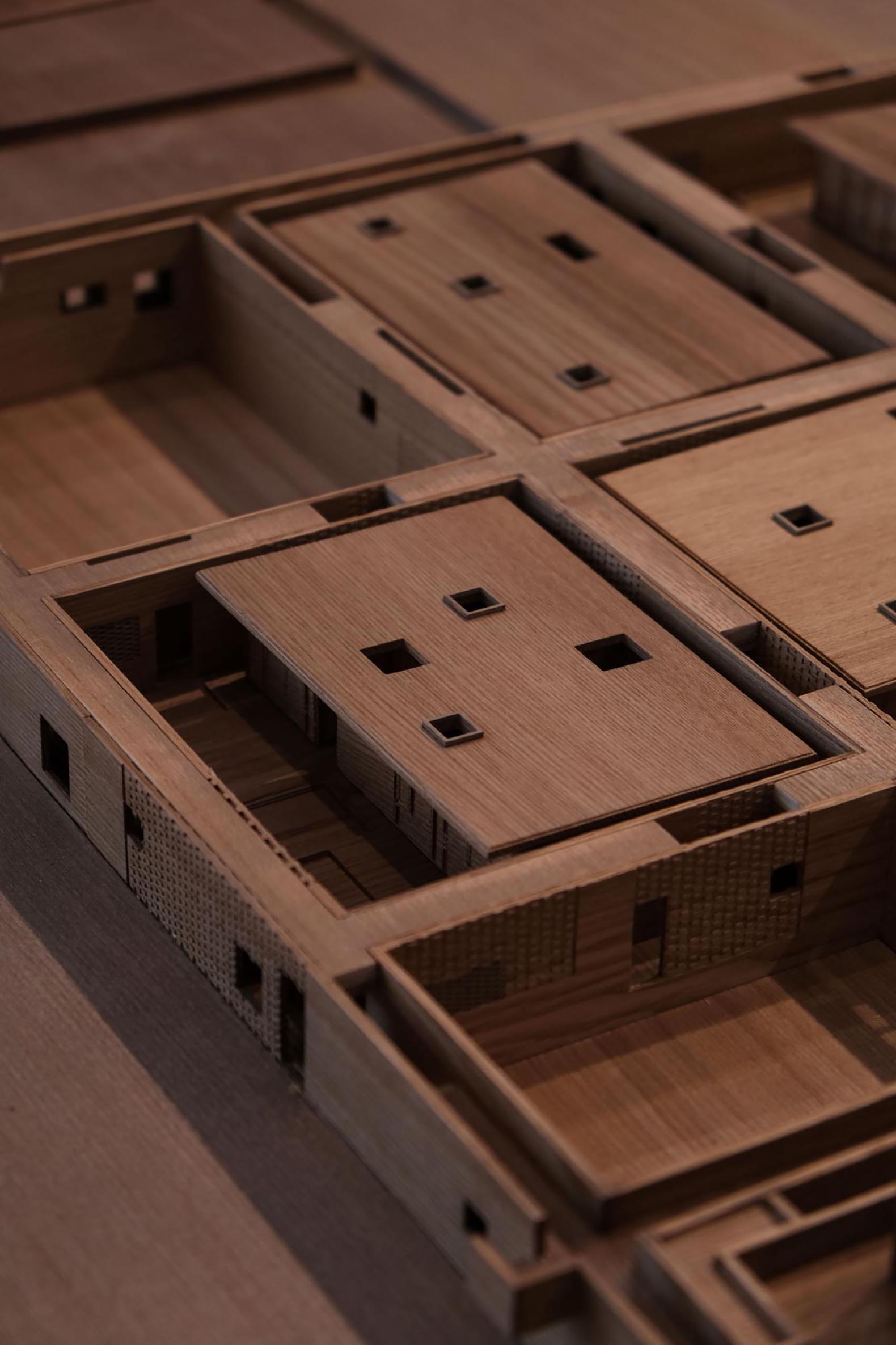
Model. Tsingpu Yangzhou Retreat (Yangzhou, 2015-2017) by Neri&Hu. Photograph by Wu Shuang.
For Tsingpu Yangzhou Retreat, addressing a scenic site dotted with small lakes and a handful of existing ruinous structures, Neri&Hu has overlaid a grid of narrow walled lanes as pathways to integrate otherwise incoherent programs and spaces. The resulting organization creates multiple courtyard enclosures as a modern reinterpretation of the vernacular Chinese courtyard typology and employs an orthogonal landscape strategy that critiques the traditional Chinese garden’s artificial representation of “nature”. Within the walls, which are constructed entirely with reclaimed grey bricks, several of the courtyards are occupied as guest rooms and shared amenities, while others are left unoccupied, serving as pockets of lush gardens.
Nantou City Guesthouse (Shenzhen, 2020-2021)
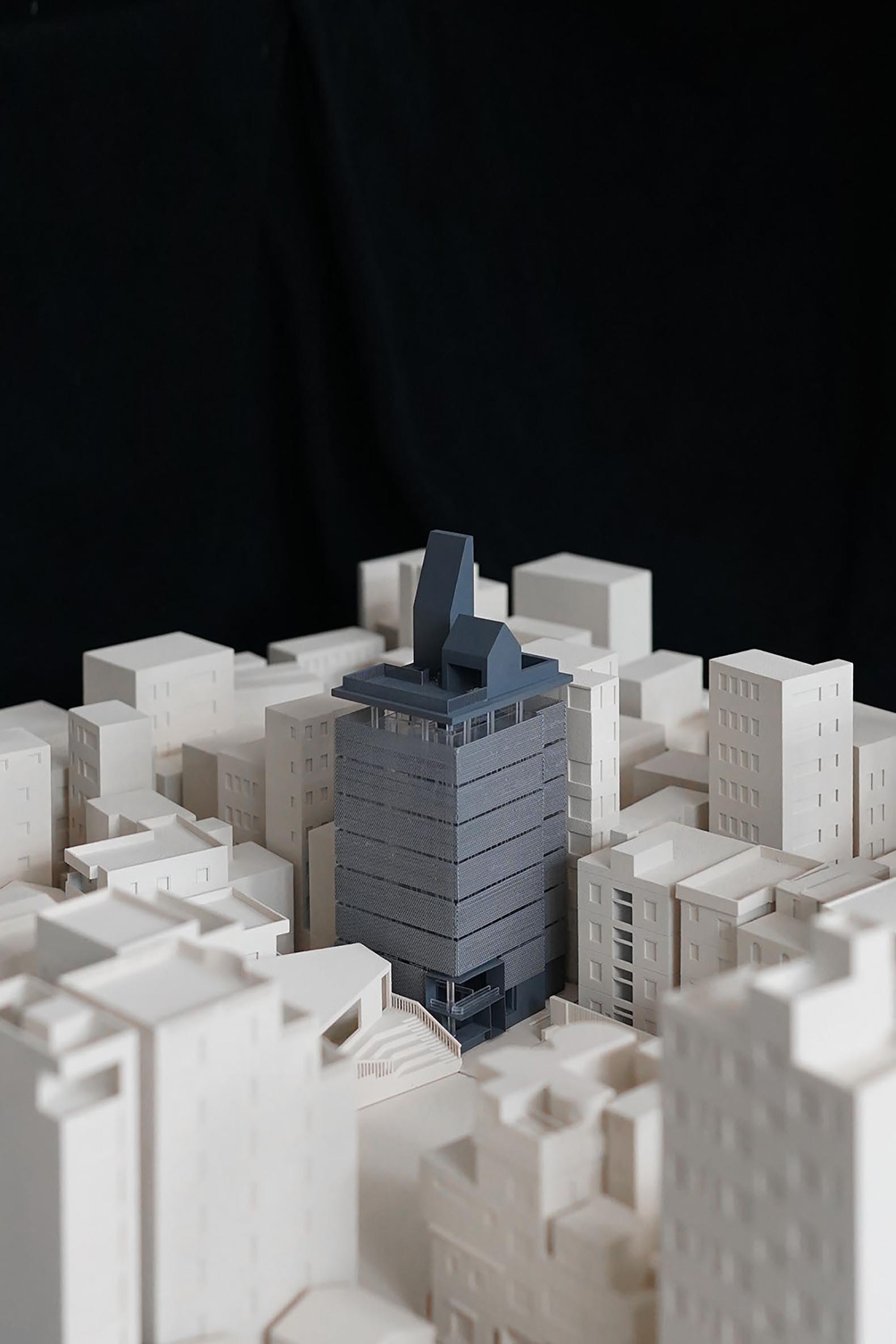
Tsingpu Yangzhou Retreat (Yangzhou, 2015-2017) by Neri&Hu. Photograph by Sanif Xu.
The found conditions, a village cocooned within the hustle and bustle of Shenzhen, compelled Neri&Hu to rethink the notion of interiority across scales: in a city, among densely populated buildings, and within a single structure. At the Nantou City Guesthouse, Neri&Hu devised several ways to shift, overlap, and blur the boundaries of inside and outside to celebrate the vibrant energy and everyday objects in the streets. The existing stairwell is cut open and expanded to create a new vertical courtyard, inviting the urban alleyway and natural elements into the heart of the building. A new lightweight, meandering stair serves both as an architectural promenade and as a social space, where chance encounters take place. The absorption of urban conditions is further intensified by the celebration of ruins, such as existing raw concrete structures and traces of former tenement occupation.
METALOCUS is live reporting from the Venice Architecture Biennale, which takes place from 20 May to 26 November 2023. See METALOCUS Guide LA BIENNALE DI VENEZIA for all the latest information you need to know to attend and know the best events and pavilions in LA BIENNALE.


![Brazil pavilion, Terra [Earth]. Photograph by Matteo de Mayda. Courtesy of La Biennale di Venezia](/sites/default/files/styles/mopis_home_news_category_slider_desktop/public/lead-images/metalocus_brazil-pavilion-earth_venice-architecture-biennale-2023_18_2p.webp?h=92c4ac38&itok=EtvlbNvv "Brazil pavilion, Terra [Earth]. Photograph by Matteo de Mayda. Courtesy of La Biennale di Venezia")


