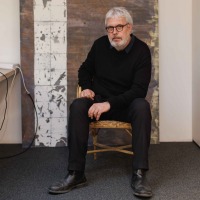
Architecture and City. ¿How to shape the city through architecture?, is the title and subtitle of this exhibition, it will open on monday 3th June at Architectural Gallery DESSA, at Ljubljana, an exhibition on the architect Jordi Badia's works.

This iniciative follows up Jordi Badia’s connection with the city after participating in May 2012 in the Project Studio organized by the University of Architecture Ljubljana Plečnik and publishing the student work compilation of the workshop “Shaping the City”. The exhibition shows a compilation of his architecture through 11 works, public and private buildings focused on the respect for the city, the end user and the context. The exhibition Architecture and City reflects on Jordi Badia particular vision of urban space configuration through the use of the void.

The exhibition consists on 11 large-scale photographs accompanied by a brief explanation of each project that visitors will be able to gather and compose as their own exhibition catalogue. The 11 works cover past, present and future of BAAS architecture. The layout is structured chronologically and reflects on the existence and role of the void in architecture as an asset to preserve in the cities morphology.

A city is built from its architecture.

The collective public space, the city, is just a direct consequence of the sum of private individual projects. The buildings blend into a fabric that gives character to the city and shapes streets and squares. The quality of the city public space depends, to a large extent, on the homogeneity of this fabric. Architecture should step back when necessary, leaving its unique character to embrace the context and work with it collaboratively. It must accept its condition with modesty. A building is just a small piece of a large puzzle that has grown over the centuries, and its role is simply to ensure the continuity and consistency of the urban fabric it belongs to, repairing it when necessary. The city needs physical and morphological continuity, but also historical and social, with great attention to the tradition of place. Therefore, architecture must respect people living in it and its demands for friendly, austere and sustainable spaces.

We are building the city, not just architecture.

Jordi Badia.

Venue.- Architectural gallery DESSA Ljubljana. Židovska steza 4, Ljubljana. Slovenija.
Dates.- Opening, June 3th. Exhibition 3 June to 15 July, 2013. Open, Monday to Friday, 10.00 am - 3.00 pm.

Read more
Read less

More information

BAAS Arquitectura is an architecture practice founded in 1994 in Barcelona by architect Jordi Badia (Barcelona, 1961). He graduated from the Barcelona School of Architecture (ETSAB) in 1989. Between 1989 and 1993, he worked alongside architect Tonet Sunyer before establishing his own practice.

Since its foundation, BAAS Arquitectura has worked on projects of different scales and programmes, including residential buildings, offices, educational facilities, healthcare buildings, cultural spaces and interventions in architectural heritage. Its work is characterised by a careful consideration of the urban context, the use of materials and the relationship between architecture and public space. The restoration and adaptation of existing buildings to new uses also play an important role in the studio's practice.

Among its best-known works are the Can Framis Museum in Barcelona, which received the 2009 City of Barcelona Award and the FAD Opinion Award; the conversion of the former Oliva Artés factory into a branch of the Barcelona History Museum (MUHBA); the renovation of the Alta Diagonal office building; and the FAD headquarters in Barcelona.

Internationally, one of its most notable projects is the Faculty of Radio and Television at the University of Silesia in Katowice, Poland (2017), designed in collaboration with GRUPA 5 Architekci and Małeccy Biuro Projektowe. The building received the Brick Award 2020 and was shortlisted for the 2019 European Union Prize for Contemporary Architecture – Mies van der Rohe Award. More recent projects include the Llull 122 building and the Vall d'Hebron Research Centre (VHIR), the latter developed in collaboration with ESPINET/UBACH.

Alongside his architectural practice, Jordi Badia teaches in the Department of Architectural Design at ETSAB, where he has been a professor since 2001. He has also collaborated with universities in Hong Kong, Ljubljana, Toulouse and Zurich. He has written for the newspaper ARA and served as editor of the architecture blog HIC Arquitectura.

In 2012, together with Félix Arranz, he curated VOGADORS, the exhibition representing Catalonia and the Balearic Islands at the 13th Venice Architecture Biennale. His career brings together architectural practice, teaching and the dissemination of architecture, with a particular interest in the relationship between buildings, the city and its inhabitants.

Read more
Published on: May 28, 2013
Cite:
metalocus, PEDRO NAVARRO
"ARCHITECTURE AND CITY by Jordi Badia" METALOCUS. Accessed
<https://www.metalocus.es/en/news/architecture-and-city-jordi-badia> ISSN 1139-6415
Loading content ...
Loading content ...
Loading content ...
Loading content ...
Loading content ...
Loading content ...
Loading content ...
Loading content ...
Loading content ...
Loading content ...
Loading content ...
Loading content ...
Loading content ...
Loading content ...
Loading content ...
Loading content ...
Loading content ...
Loading content ...
Loading content ...
Loading content ...
Loading content ...
Loading content ...
Loading content ...
Loading content ...
Loading content ...
Loading content ...
Loading content ...
Loading content ...
Loading content ...
Loading content ...
Loading content ...
Loading content ...
Loading content ...
Loading content ...
Loading content ...
Loading content ...
Loading content ...
Loading content ...
Loading content ...
Loading content ...
Loading content ...
Loading content ...
Loading content ...
Loading content ...
Loading content ...
Loading content ...
Loading content ...
Loading content ...
Loading content ...
Loading content ...
Loading content ...
Loading content ...
Loading content ...
Loading content ...