"La construcción de la ciudad a partir del vacío." CAN FRAMIS MUSEUM in 22@

Venue.- MINIM. Avda. Diagonal, 369. 08037 Barcelona.
Exhibition opening.- September 30 (will be open until 15 October).


The new Fundación Vila Casas museum is located in the 22@ District, an area where Barcelona City Hall has promoted a full redevelopment of a former factory/heavy industry zone by substituting premises with light service industries. It is now primarily a high-rise, heavily built-up area housing service/hi-tech industries.

With "Can Framis" we aim to play on contrasts, with a surrounding garden providing a tranquil breathing space away from the hubbub of speed and time. The mainly-paved garden will have many trees and winding paths which will embellish the cloak of ivy which already covers the environs and in the future will enshroud the building and trees.

The two buildings to be preserved have little architectural worth and are currently derelict. Their main interest lies in the contrast of their location, based on the former agricultural sketches prior to the implementation of the Cerdà plan at a level of 1.5m below the current road.

The project consists in restoring the two current factory buildings and constructing a new one which will link them, coinciding with the site of another former warehouse which - as a whole - will form a courtyard, paved with stones recovered from the former factory, which will be the main entrance to the museum.

Visitors will begin on the highest level and continuously move downwards through semi-lit areas, which will then light up to showpiece the exhibited pieces.

Wood appears copiously on window frames, staircases and between the buildings, as well as on the painting support screens, in reference to the material of the canvas frames.

Outside, the lime mortar which blends with the existing stonework merges with the exposed concrete of the new buildings. The façade then becomes a collage of textures, niches and coverings which reflect the different ups-and-downs of the building throughout time.

Read more
Read less

More information

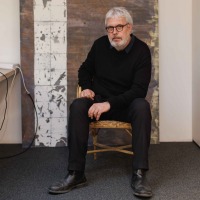
BAAS Arquitectura is an architecture practice founded in 1994 in Barcelona by architect Jordi Badia (Barcelona, 1961). He graduated from the Barcelona School of Architecture (ETSAB) in 1989. Between 1989 and 1993, he worked alongside architect Tonet Sunyer before establishing his own practice.

Since its foundation, BAAS Arquitectura has worked on projects of different scales and programmes, including residential buildings, offices, educational facilities, healthcare buildings, cultural spaces and interventions in architectural heritage. Its work is characterised by a careful consideration of the urban context, the use of materials and the relationship between architecture and public space. The restoration and adaptation of existing buildings to new uses also play an important role in the studio's practice.

Among its best-known works are the Can Framis Museum in Barcelona, which received the 2009 City of Barcelona Award and the FAD Opinion Award; the conversion of the former Oliva Artés factory into a branch of the Barcelona History Museum (MUHBA); the renovation of the Alta Diagonal office building; and the FAD headquarters in Barcelona.

Internationally, one of its most notable projects is the Faculty of Radio and Television at the University of Silesia in Katowice, Poland (2017), designed in collaboration with GRUPA 5 Architekci and Małeccy Biuro Projektowe. The building received the Brick Award 2020 and was shortlisted for the 2019 European Union Prize for Contemporary Architecture – Mies van der Rohe Award. More recent projects include the Llull 122 building and the Vall d'Hebron Research Centre (VHIR), the latter developed in collaboration with ESPINET/UBACH.

Alongside his architectural practice, Jordi Badia teaches in the Department of Architectural Design at ETSAB, where he has been a professor since 2001. He has also collaborated with universities in Hong Kong, Ljubljana, Toulouse and Zurich. He has written for the newspaper ARA and served as editor of the architecture blog HIC Arquitectura.

In 2012, together with Félix Arranz, he curated VOGADORS, the exhibition representing Catalonia and the Balearic Islands at the 13th Venice Architecture Biennale. His career brings together architectural practice, teaching and the dissemination of architecture, with a particular interest in the relationship between buildings, the city and its inhabitants.

Read more
Published on: September 24, 2010
Cite:
metalocus, PEDRO NAVARRO
"VACÍOS PERSISTENTES" METALOCUS. Accessed
<https://www.metalocus.es/en/news/vacios-persistentes> ISSN 1139-6415
Loading content ...
Loading content ...
Loading content ...
Loading content ...
Loading content ...
Loading content ...
Loading content ...
Loading content ...
Loading content ...
Loading content ...
Loading content ...
Loading content ...
Loading content ...
Loading content ...
Loading content ...
Loading content ...
Loading content ...
Loading content ...
Loading content ...
Loading content ...
Loading content ...
Loading content ...
Loading content ...
Loading content ...
Loading content ...
Loading content ...
Loading content ...
Loading content ...
Loading content ...
Loading content ...
Loading content ...
Loading content ...
Loading content ...
Loading content ...
Loading content ...
Loading content ...
Loading content ...
Loading content ...
Loading content ...
Loading content ...
Loading content ...
Loading content ...
Loading content ...
Loading content ...
Loading content ...
Loading content ...
Loading content ...
Loading content ...
Loading content ...
Loading content ...
Loading content ...
Loading content ...
Loading content ...
Loading content ...