

The “doma” marks the place that traditionally serves as an interactive space with guests in traditional Hokuriku architecture. This space is designed as an interior garden that, thanks to its unique roof, captures direct sunlight, establishing a dynamic interior image in relation to the solar cycle, even in bad weather and cold winters.
An architecture built on the basis of layers, a reflection of Japanese culture, blurring and generating ambiguously blurred limits between the interior and the exterior, of elements that lengthen, fragment, and open. A structure built according to traditional methods and contemporary construction techniques.
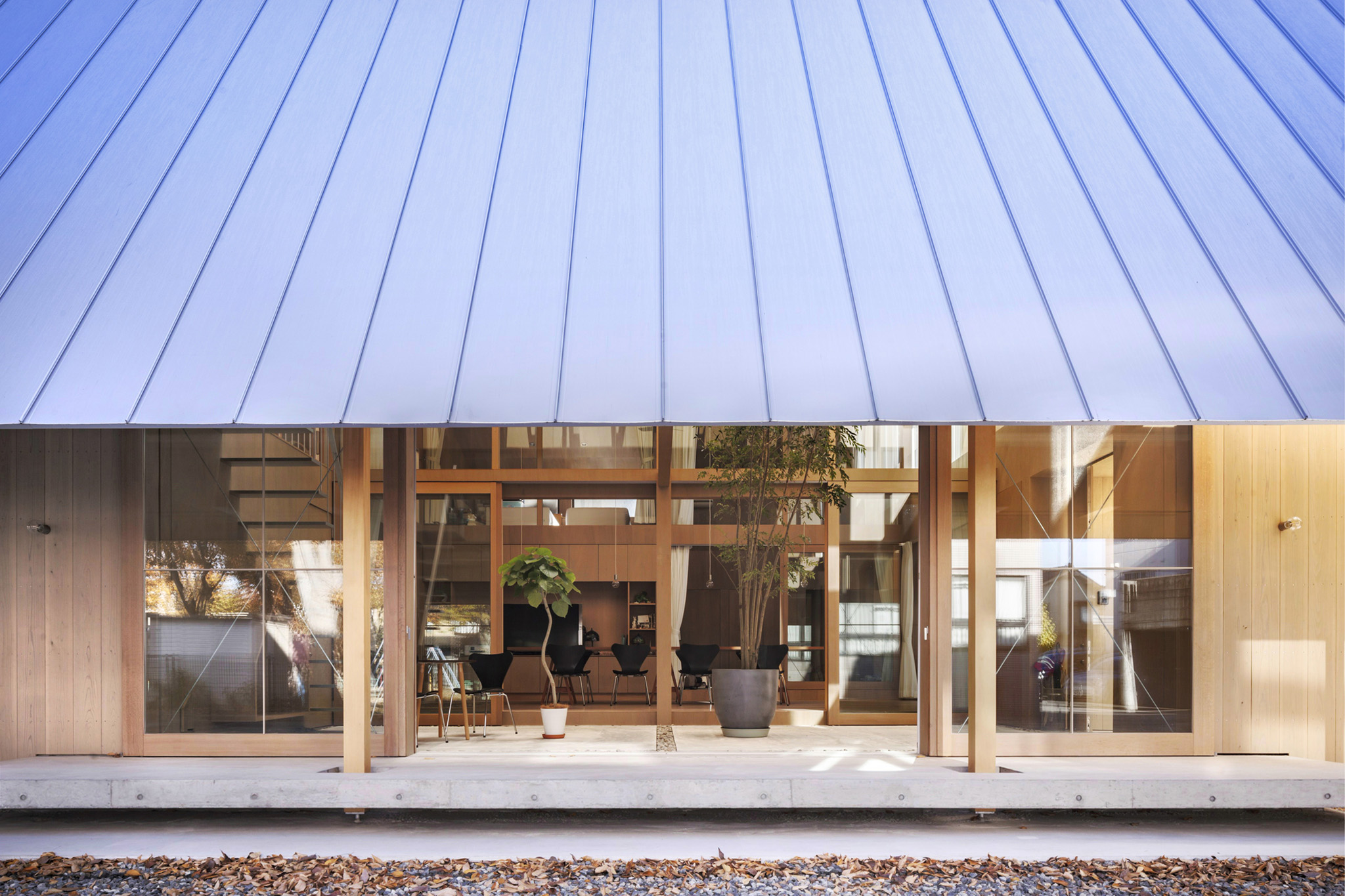
House in Kanazawa by Shota Nakanishi Architects. Photograph by Shinkenchiku-Sha.
Project description by Shota Nakanishi Architects
The house is designed by the Japanese architect Shota Nakanishi and the structural architect Hirofumi Ohno in Japan. The site is a residential area in Kanazawa, Ishikawa prefecture, Japan, in the Hokuriku region. The Hokuriku region has the rainiest days of any region in Japan.
By carefully designing the plan and some environment to suit the owner's lifestyle, while following the architectural structure and appearance of traditional Hokuriku architecture that makes the most of the natural environment, we aimed to create a house where people can live in contact with light, wind, and natural environmental sounds while staying indoors.
In the plan, the doma, which is a place for interaction with guests in traditional Hokuriku architecture, is reimagined as an indoor garden with a large roof that captures sunlight, allowing for open living even in bad weather and cold winters.
The direct light is adjusted for each season, cool in summer and warm in winter. The large roof allows a large amount of morning light to enter, creating a dynamic indoor scene.
As in traditional architecture, "doma" are separated by large fittings at interior and exterior, which can be adjusted to make the sound of wind and rain and the rumbling of thunder seem farther away than the visual distance, allowing us to enjoy the beautiful scenery of movement while sheltering from the wind and rain.
The architecture is built up in layers of many smaller thoughts, which are formulated with the aim of harmonizing the whole environment, including people. In response to the client's request for "a house that makes you want to go home," we proposed a house where the charming memories of each season.


