The umbrella house, which has now been rebuilt on the Vitra Campus in Weil am Rhein, has a peculiar history. It was designed by Kazuo Shinohara, considered one of the most important Japanese architects of the second half of the 20th century, together with the well-known Kenzo Tange. Although his work has had a great influence on architects such as Toyo Ito and Kazuyo Sejima, he is still little known internationally.

Shinohara himself divided his work into four styles, each addressing different issues and challenges. The house is considered a masterpiece of the so-called First Style of Shinohara and was built in Tokyo in 1961, in Nerima, a residential neighbourhood of Tokyo, is the smallest and one of the last remaining residences from his First Style.

The Umbrella House was to be demolished to give way to a roadbuilding project at its original location and Vitra decided to acquire the house and safeguard it for posterity. After the geodesic dome by Buckminster Fuller/George Howard in 1975, and a petrol station by Jean Prouvé in 1953, the project is the third historic building to be reconstructed on the Vitra Campus.

Built using a wooden post-and-beam construction method, the house was carefully dismantled in the summer of 2020 and separated into its individual parts. The wooden structure made of Japanese cypress, Japanese pine and Oregon pine was securely packed along with the other components and shipped to Weil am Rhein. Reconstruction on the Vitra Campus commenced in September 2021 in close coordination with the Tokyo Institute of Technology and was completed in summer 2022.

Kazuo Shinohara on the Umbrella House:
 
"The strength of my conviction that ›A House is a Work of Art‹ was born of the struggle with this small house. I wished to express the force of space contained in the doma (earthen-floor room) of an old Japanese farmhouse, this time by means of the geometric structural design of a karakasa (oiled-paper Japanese umbrella)."
Text on the Umbrella House, Shinkenchiku , vol. 37, no. 10, Tokyo, October 1962 (first published in English in The Japan Architect, vol. 38, Tokyo, February 1963).


Umbrella House, Vitra Campus, June 2022. Image by Dejan Jovanovic / Vitra.

The home with its square layout offered sufficient space for a small family. In designing the house, Shinohara drew on the traditional vernacular architecture of Japanese homes as well as temples, transferring various motifs to residential construction for the first time. For example, the pyramid-shaped roof form used in the Umbrella House had previously only been seen in temple complexes. When building the Umbrella House, Shinohara deliberately employed simple and inexpensive materials, such as the cement fibre boards on the façade. The Umbrella House made a novel and inspirational contribution to the architectural discourse of 1960s Japan.

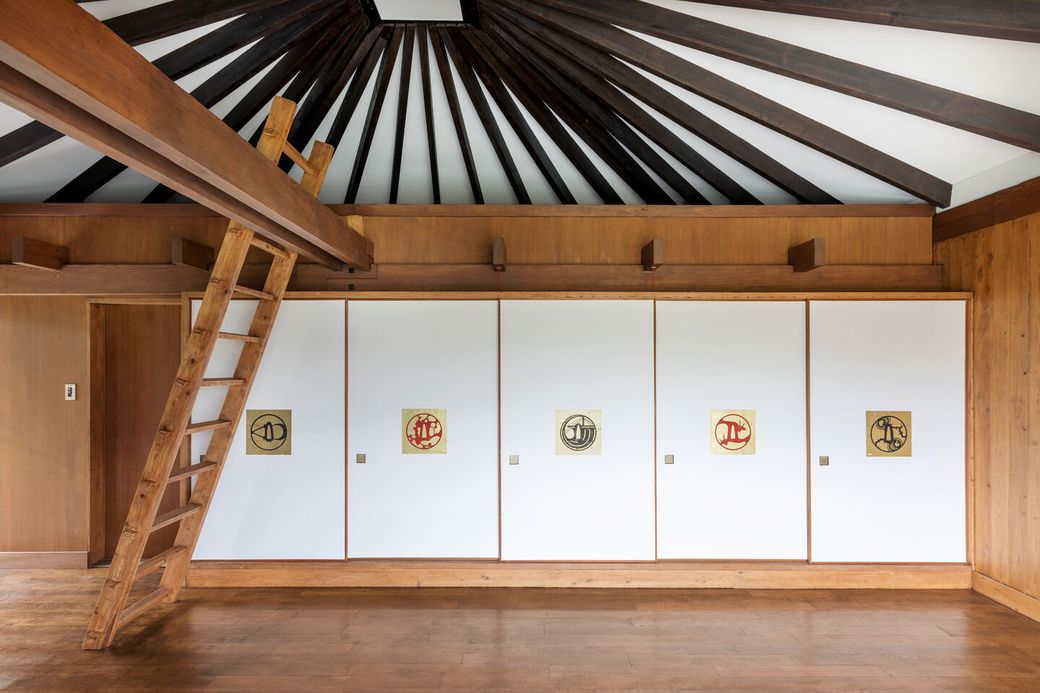
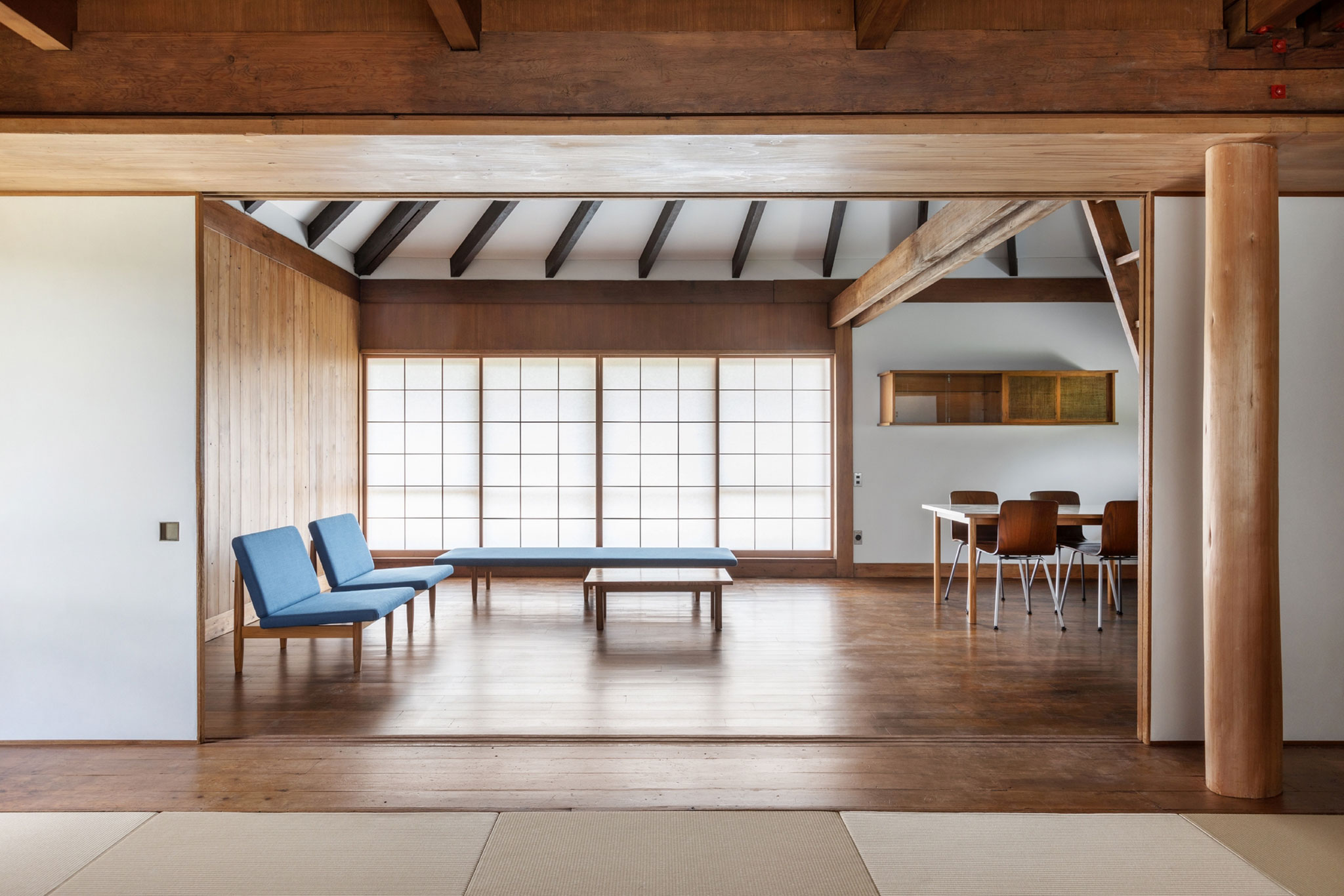
The 55m² floor area accommodates a kitchen and dining table, a living room, a bathroom and a traditional tatami room with 15 half-size tatami mats, which provided living and sleeping quarters for the whole family. Slightly raised with a flat ceiling, the tatami room can be separated from the living room via five sliding doors (fusuma).

The prints by Japanese artist Setsu Asakura on the sliding doors were also executed to Shinohara’s specifications. The visible umbrella structure of the roof spans the interior volume at 4 metres in height, which makes the small floor area appear larger. A ladder provides access to the half-height area above the tatami room, which served as storage space. The furniture was designed by Kazuo Shinohara himself as well as by designer Katsuhiko Shiraishi. Today, the house is furnished with a mix of replicas and original pieces.

The Umbrella House will serve as a venue for small gatherings on the campus, offering visitors insights into modern Japanese architecture.

More information

Label
Project
Text

Umbrella House by Kazuo Shinohara (1961).

+ + copy Created with Sketch.
- + copy Created with Sketch.
Label
Team in Japan
Text

Architectural Direction.- Prof. Shin-ichi Okuyama, Tokyo Institute of Technology.
Project architect.- Masaru Otsuka, Research Associate, Koshiro Ogura and Yutaro Honshuku, Tokyo Institute of Technology.
Project consultants.- Heritage Houses Trust, Tokyo and Prof. David B. Stewart, Tokyo Institute of Technology.
Surveying and conservation.- Prof. Taisuke Yamazaki and Naoto Kizu, Tokyo Institute ofTechnology.
Dismantling and repair.- Hidemitsu Ogura and Yusuke Fuchita / Fuhki
Construction.

+ + copy Created with Sketch.
- + copy Created with Sketch.
Label
Team in Germany
Text

Architectural reconstruction.-  Christian Dehli, Andrea Grolimund,
DEHLI GROLIMUND, Zurich.
Project coordination.- Christian Germadnik, Logad GmbH.

+ + copy Created with Sketch.
- + copy Created with Sketch.
Label
Location
Text

Vitra Campus. Charles-Eames-Str. 2. 79576 Weil am Rhein, Germany.

+ + copy Created with Sketch.
- + copy Created with Sketch.
Kazuo Shinohara (born in Shizuoka on April 2, 1925 and died in Kawasaki, Kanagawa, Japan, on July 15, 2006) completed his bachelor’s degree in mathematics at the Tokyo University of Science in 1947. He decided to pursue a second degree in architecture following a visit to the famous temple complexes of Nara. The historical temples held such fascination over him that he enrolled to study architecture at the Tokyo Institute of Technology (TIT) in 1950. He graduated in Architecture in 1953 and established his own practice in 1954. Shinohara soon became recognized not only for his buildings but also for his reflections on architecture, which gave his work a strong theoretical dimension. Although his production was relatively limited in number, each project was conceived as a precise exploration of architectural ideas rather than as a purely functional commission. He has designed more than 30 houses and some public buildings in Japan, such as the TIT Centennial Hall (1987) and the Ukiyo-e Museum in Matsumoto (1982).

Shinohara also started a teaching career at the TIT in 1970. His academic involvement with the Tokyo Institute of Technology was long-lasting: after joining the school as a young researcher following his graduation, he gradually advanced through different teaching positions and remained linked to the institution for several decades. During this period, he also completed a doctoral dissertation in 1967 focused on spatial composition in traditional Japanese architecture. In addition to a series of theoretical writings, Kazuo Shinohara’s oeuvre consists mainly of smaller residential buildings. Through both his teaching and his publications, he exerted a significant influence on architects of the postwar generation in Japan, among them Toyo Ito, Itsuko Hasegawa and Issei Sakamoto, who were associated in the 1970s with what was sometimes referred to as the “Shinohara school.”

Shinohara has received many national and international awards, with the following especially significant: The Architectural Institute of Japan's great award in 205 and the commemorative Golden Lion of the Venice Biennale in 2010. Across his career, his architectural thinking underwent an important transformation. His early houses explored clarity, geometric balance and spatial order, often drawing inspiration from the compositional logic of traditional Japanese dwellings. These projects typically adopted simple and legible arrangements in which symmetry and proportion played a central role.

During the late 1960s and 1970s, his approach gradually shifted. While maintaining a strong interest in geometry, his designs began to incorporate more experimental spatial organizations and a less rigid internal hierarchy. This evolution reflected a growing concern with the relationship between domestic architecture and the increasingly complex conditions of contemporary cities.

For Shinohara, the dynamic and seemingly disordered character of large urban environments—particularly Tokyo—contained a specific form of aesthetic and cultural value. Instead of attempting to impose strict order on this environment, he argued that architecture should acknowledge and engage with that complexity. Buildings such as the Ukiyo-e Museum translate this position through facades composed of varied geometric elements and interiors that juxtapose different materials and spatial effects.

In the 1980s, he further developed these ideas by proposing that architecture could learn from technological systems and machines capable of operating within intricate and changing environments. This line of thought informed several later projects, including the Centennial Hall at the Tokyo Institute of Technology (1987), whose intersecting volumes and metallic surfaces evoke mechanical imagery while deliberately complicating the perception of the building within its urban surroundings. For Shinohara, such strategies allowed architecture to resonate more directly with the energetic and multifaceted character of the modern city.

Read more
Published on: June 13, 2022
Cite:
metalocus, JOSÉ JUAN BARBA
"Kazuo Shinohara's umbrella house reconstructed at the Vitra Campus" METALOCUS. Accessed
<https://www.metalocus.es/en/news/kazuo-shinoharas-umbrella-house-reconstructed-vitra-campus> ISSN 1139-6415
Loading content ...
Loading content ...
Loading content ...
Loading content ...
Loading content ...
Loading content ...
Loading content ...
Loading content ...
Loading content ...
Loading content ...
Loading content ...
Loading content ...
Loading content ...
Loading content ...
Loading content ...
Loading content ...
Loading content ...
Loading content ...
Loading content ...
Loading content ...
Loading content ...
Loading content ...
Loading content ...
Loading content ...
Loading content ...
Loading content ...
Loading content ...
Loading content ...
Loading content ...
Loading content ...
Loading content ...
Loading content ...
Loading content ...
Loading content ...
Loading content ...
Loading content ...
Loading content ...
Loading content ...
Loading content ...
Loading content ...
Loading content ...
Loading content ...
Loading content ...
Loading content ...
Loading content ...
Loading content ...
Loading content ...
Loading content ...
Loading content ...
Loading content ...
Loading content ...
Loading content ...
Loading content ...
Loading content ...