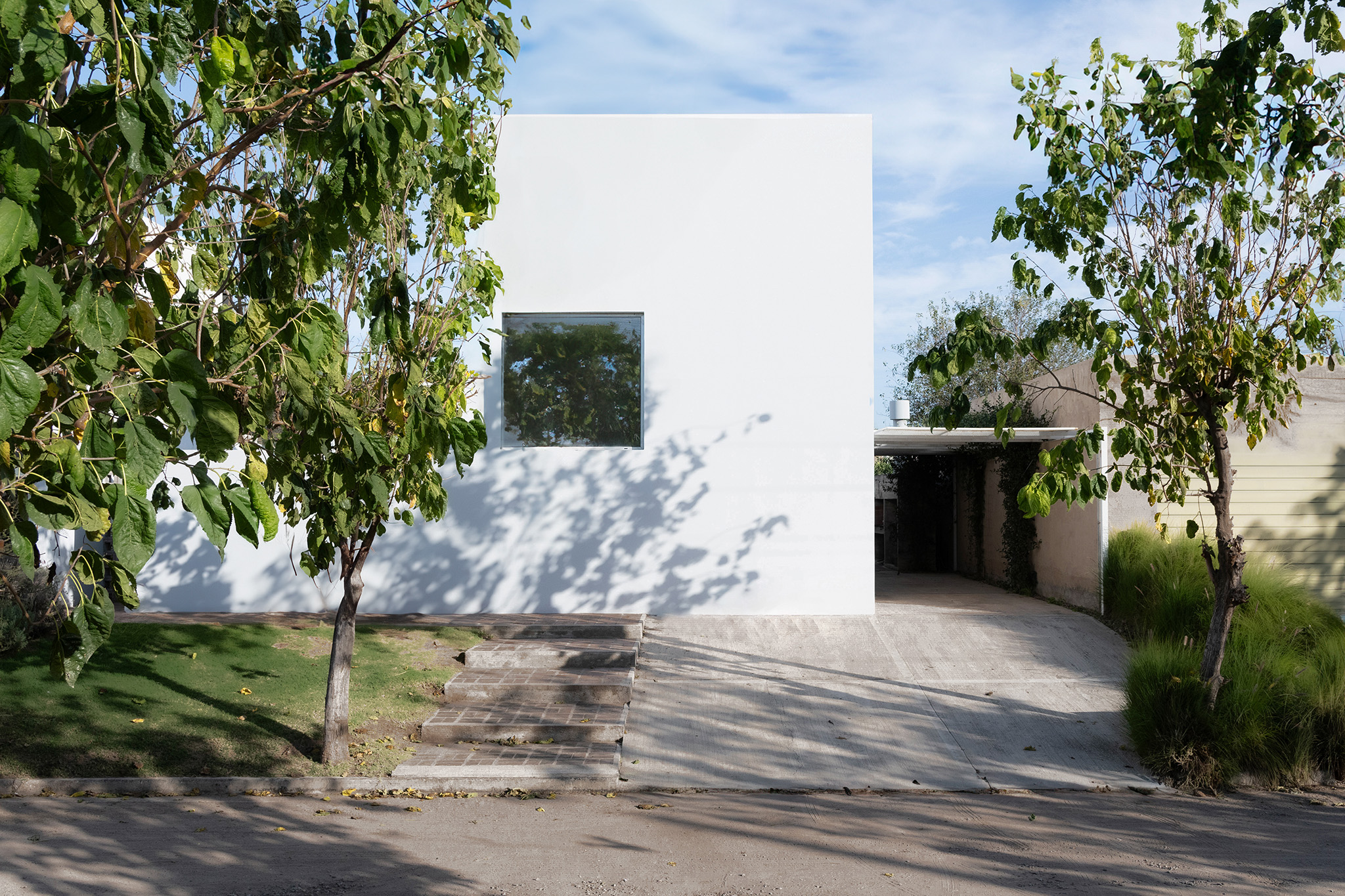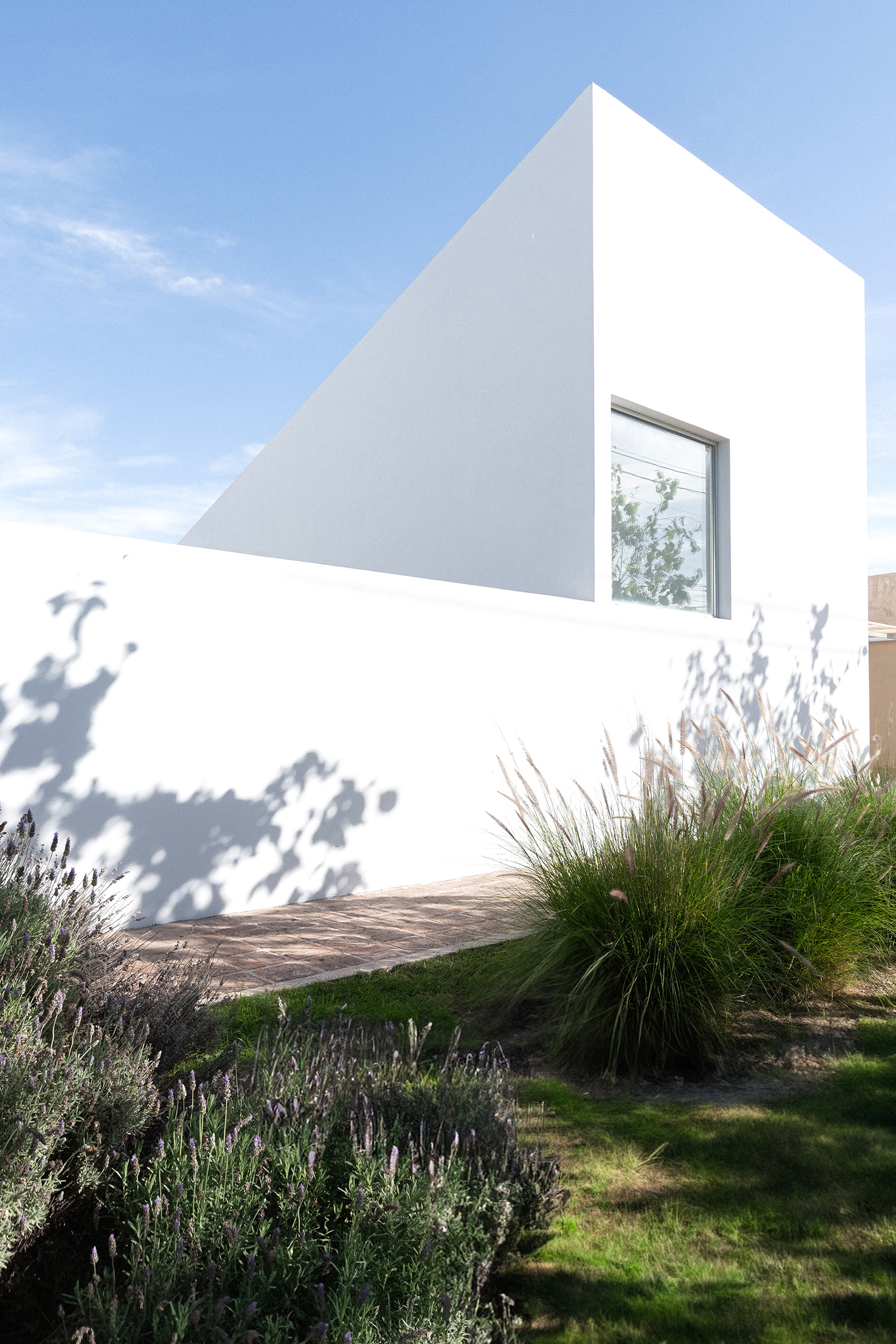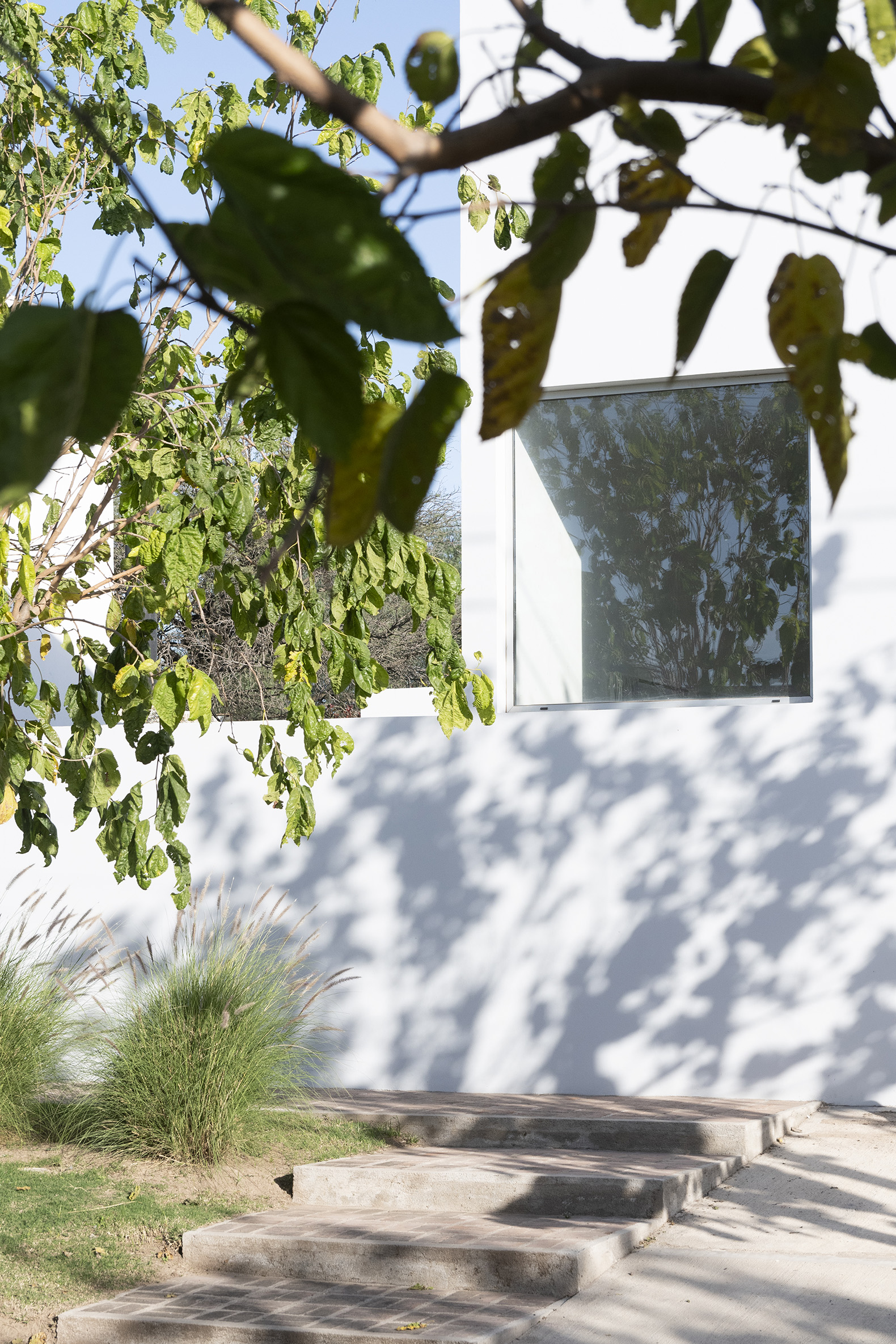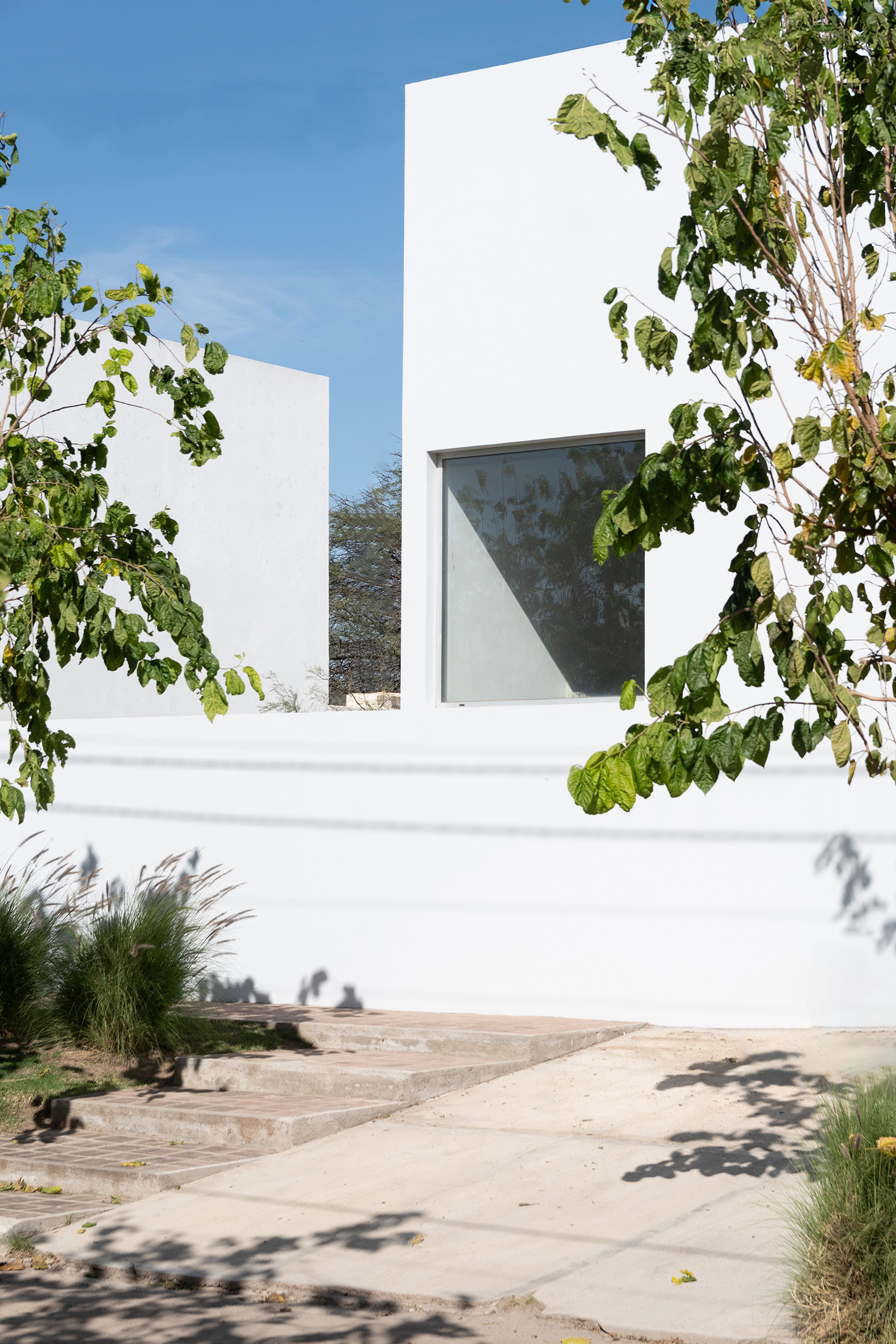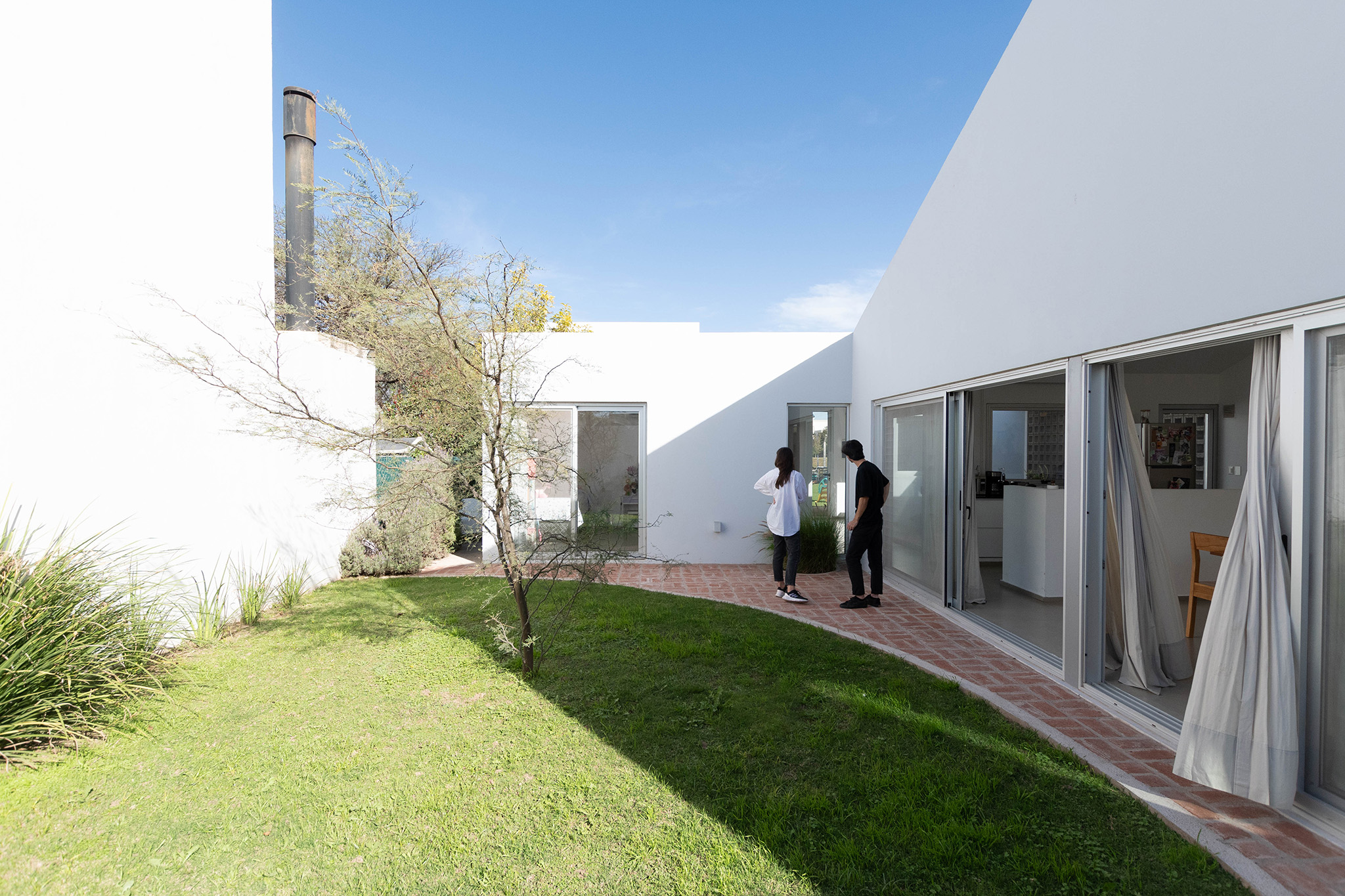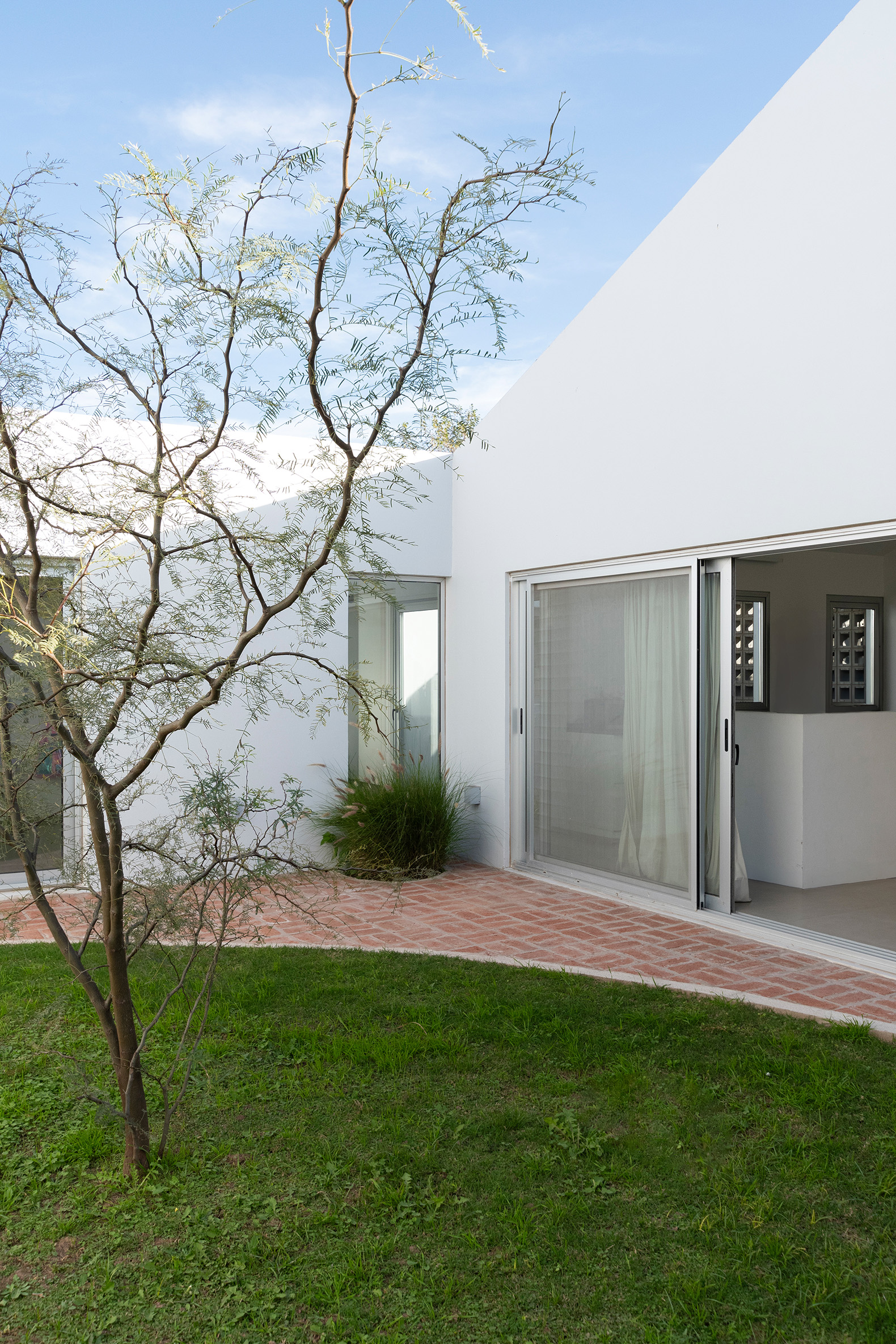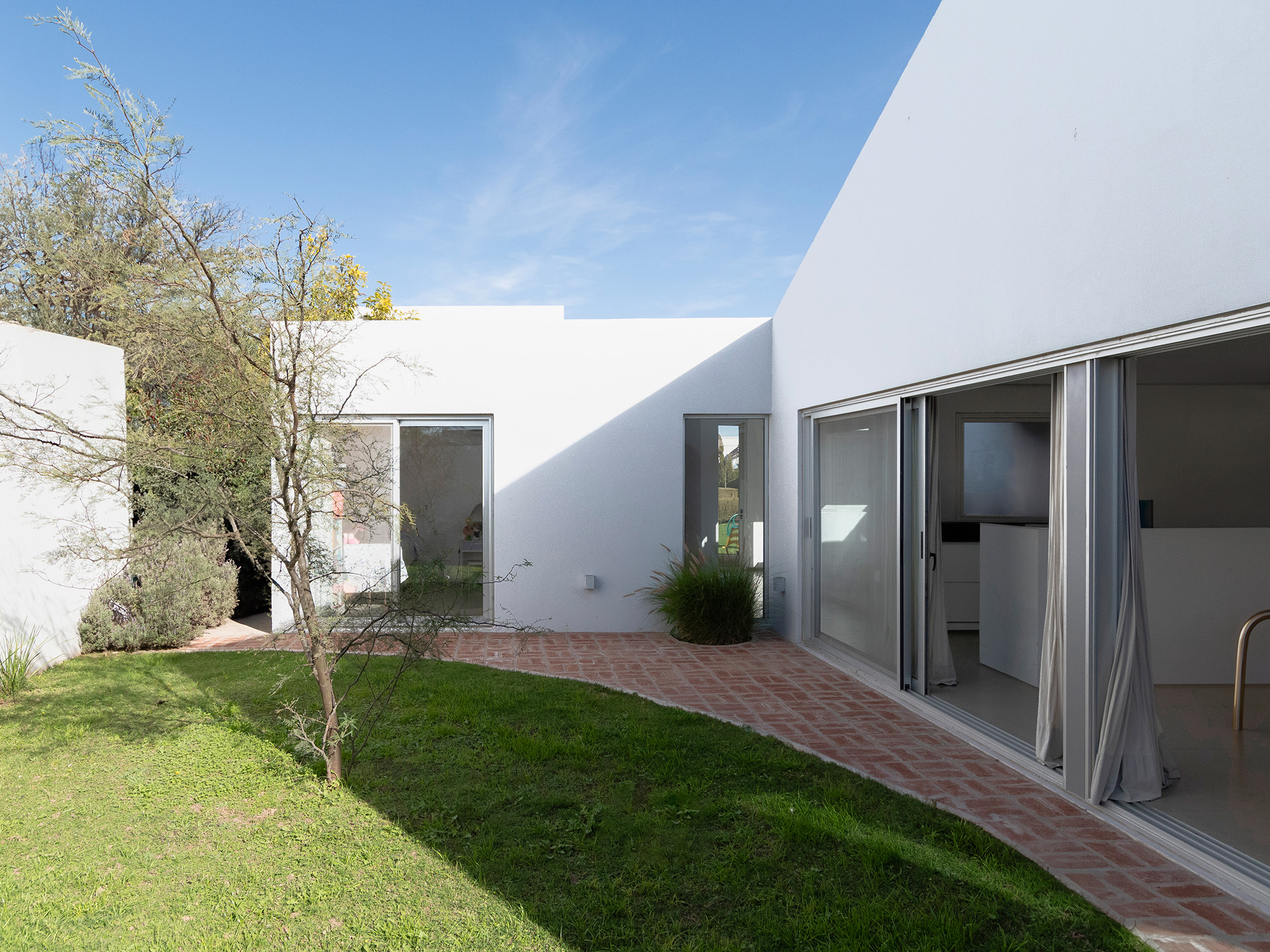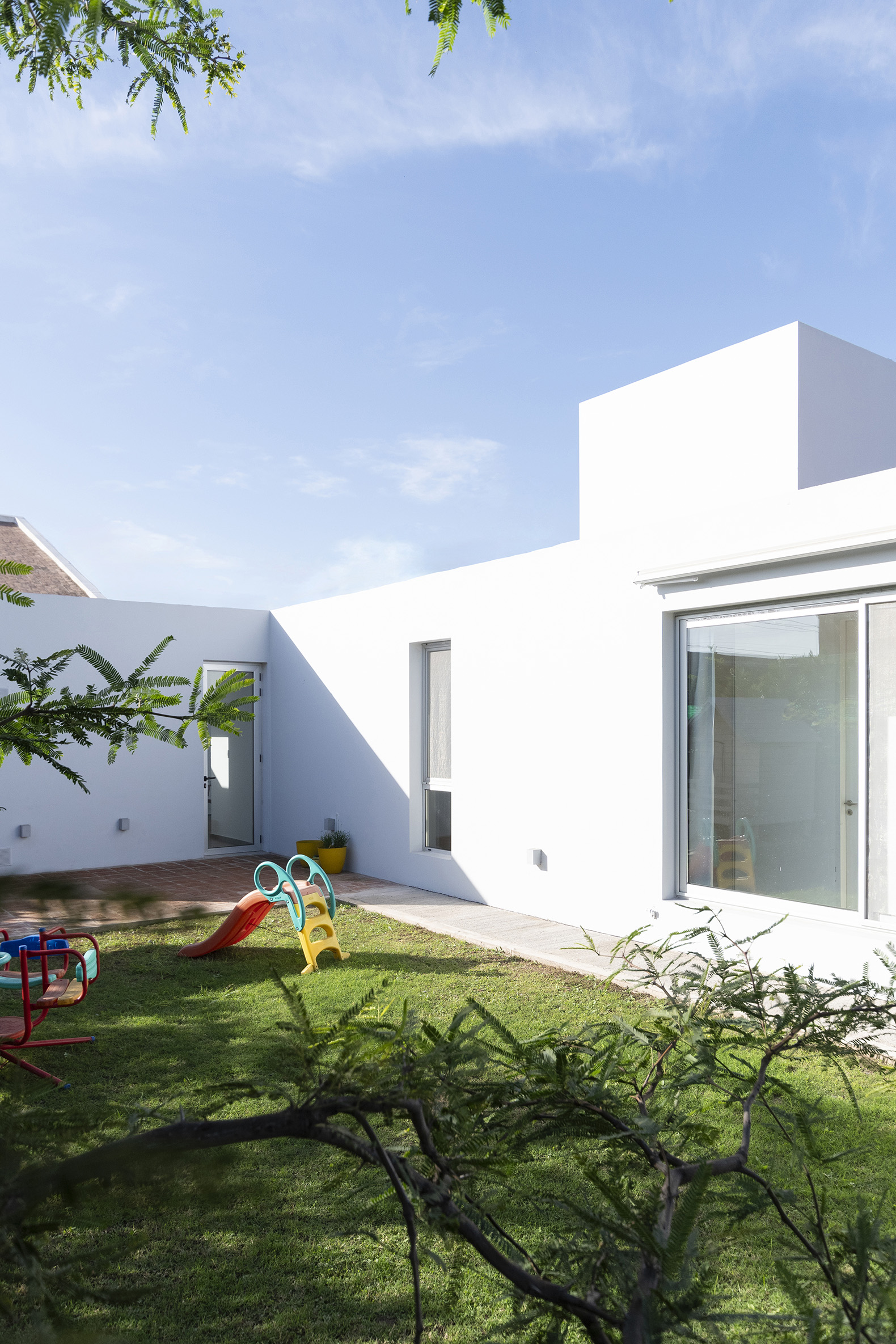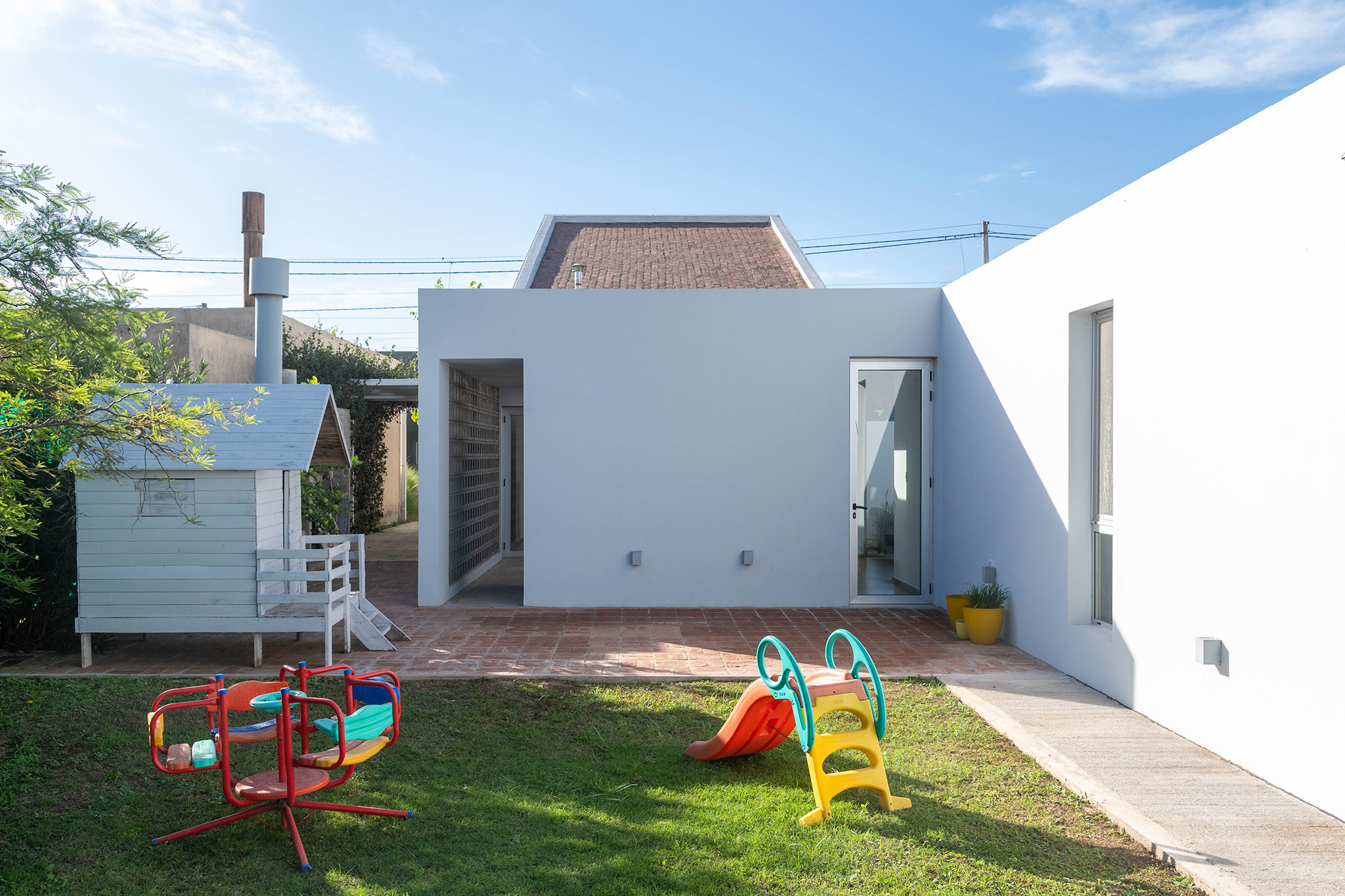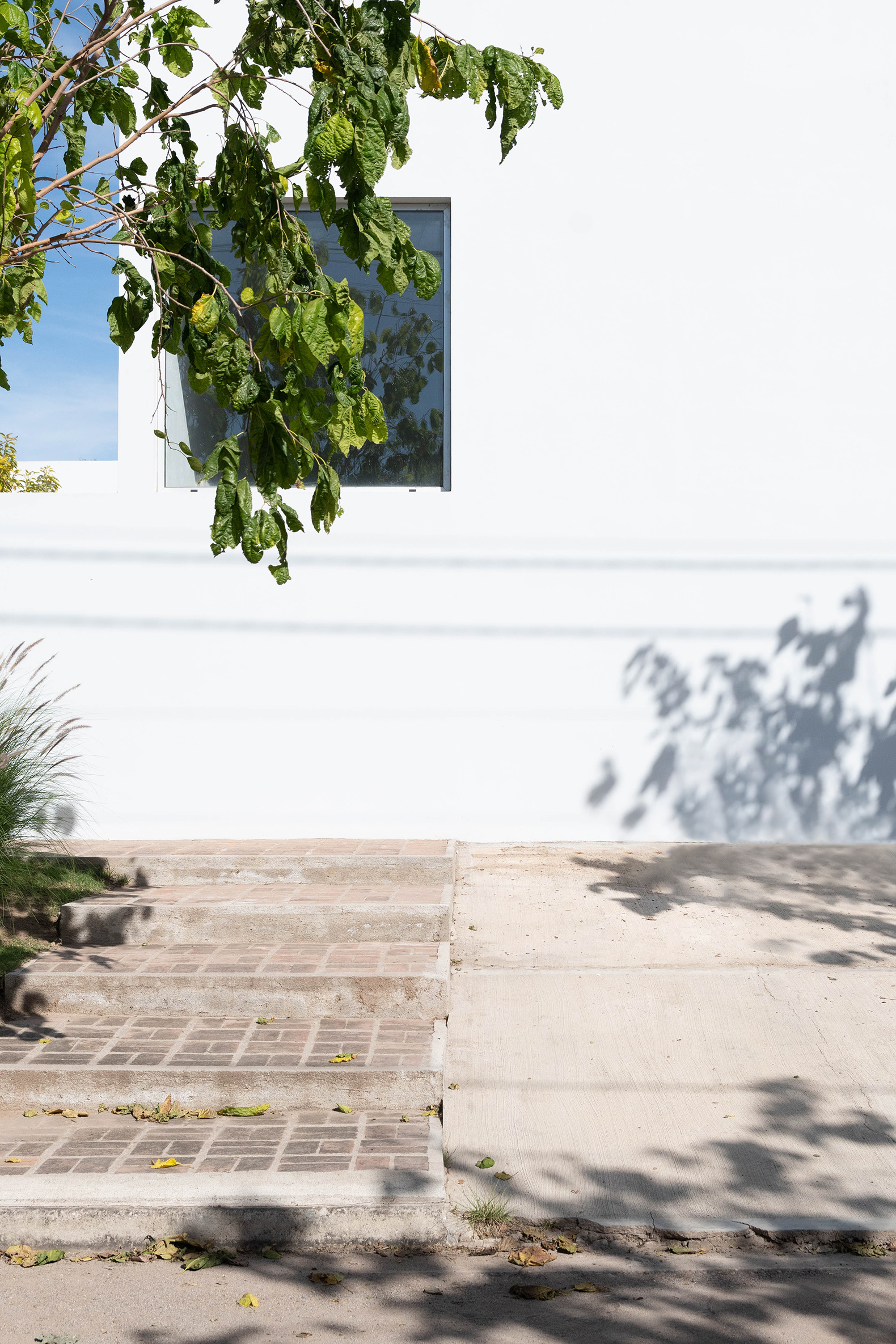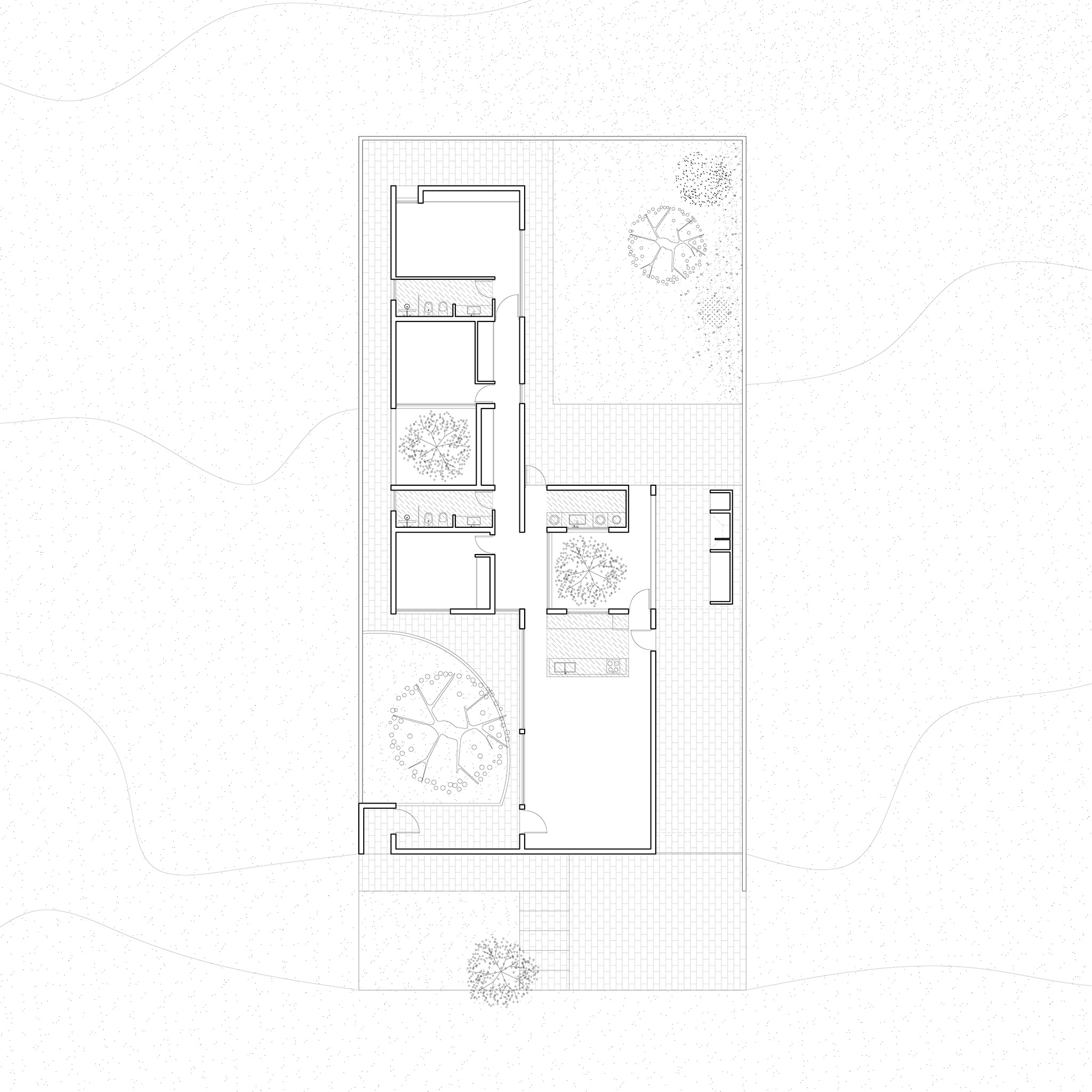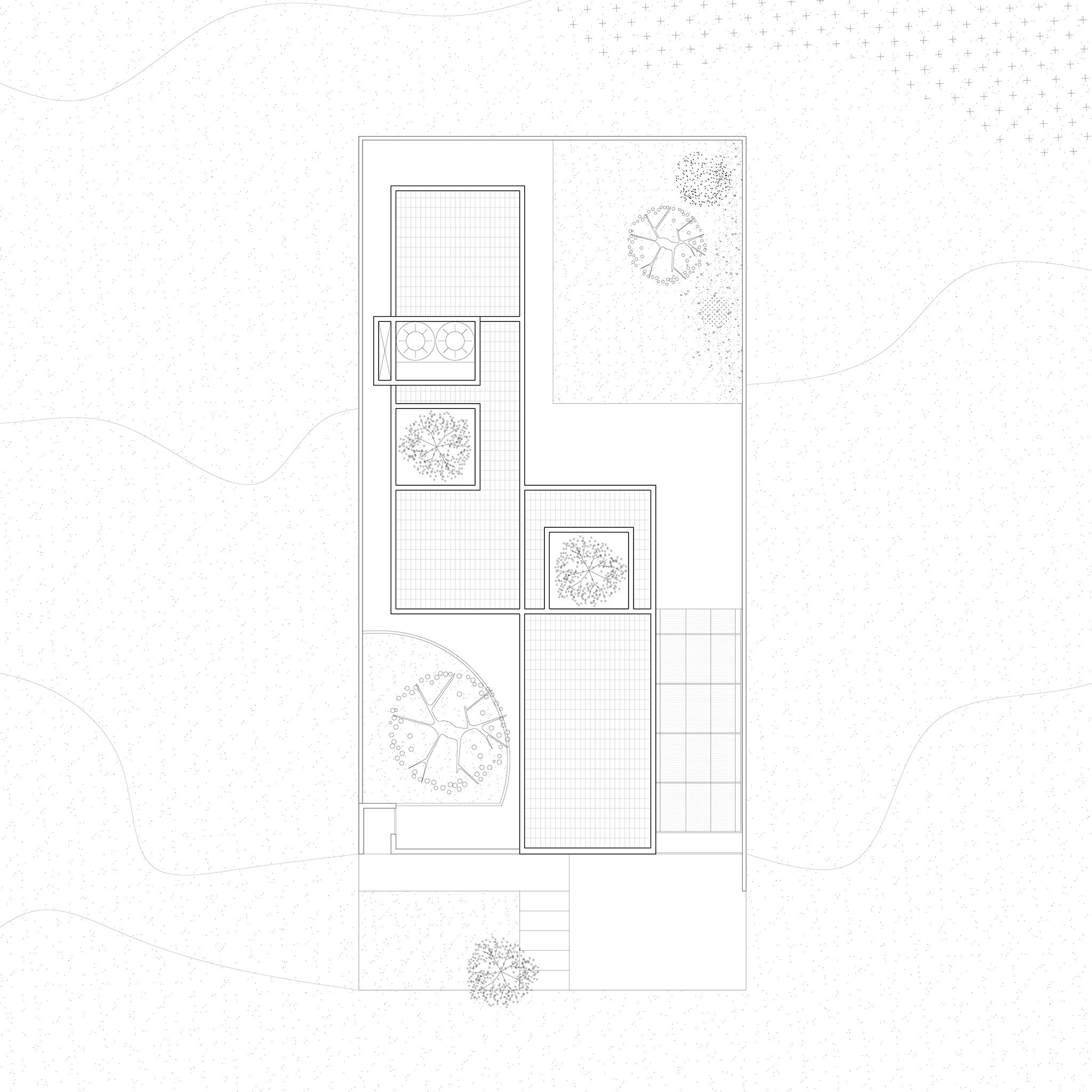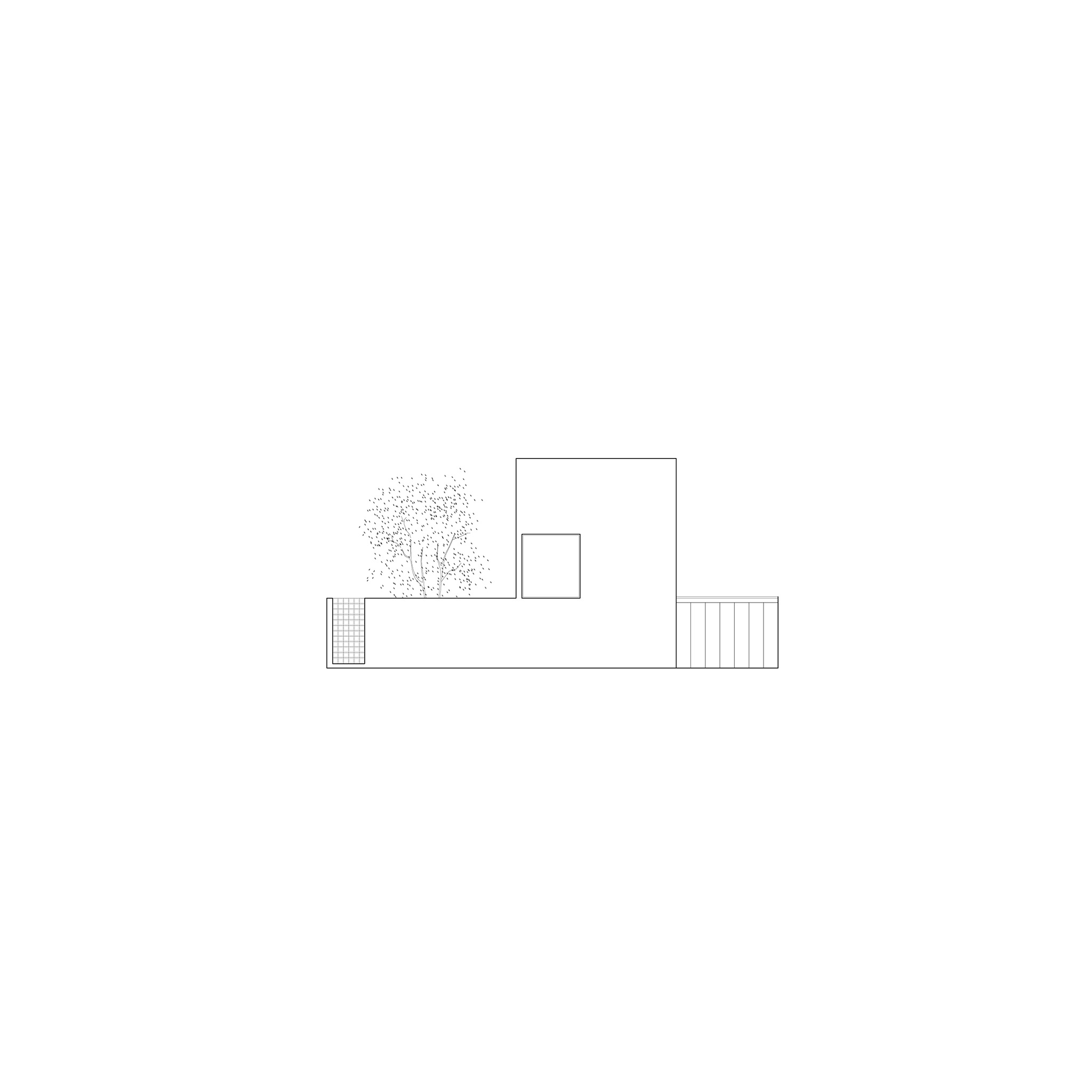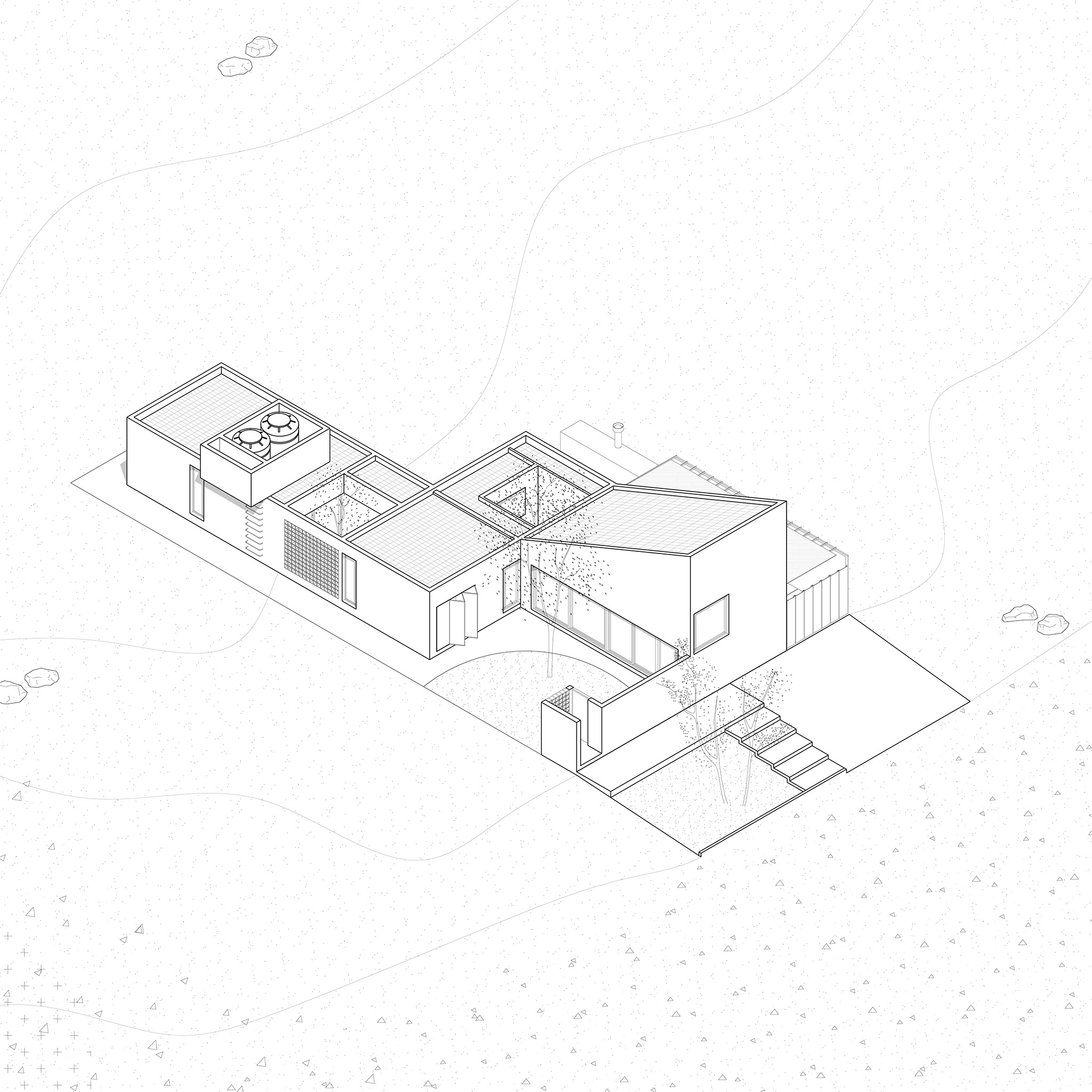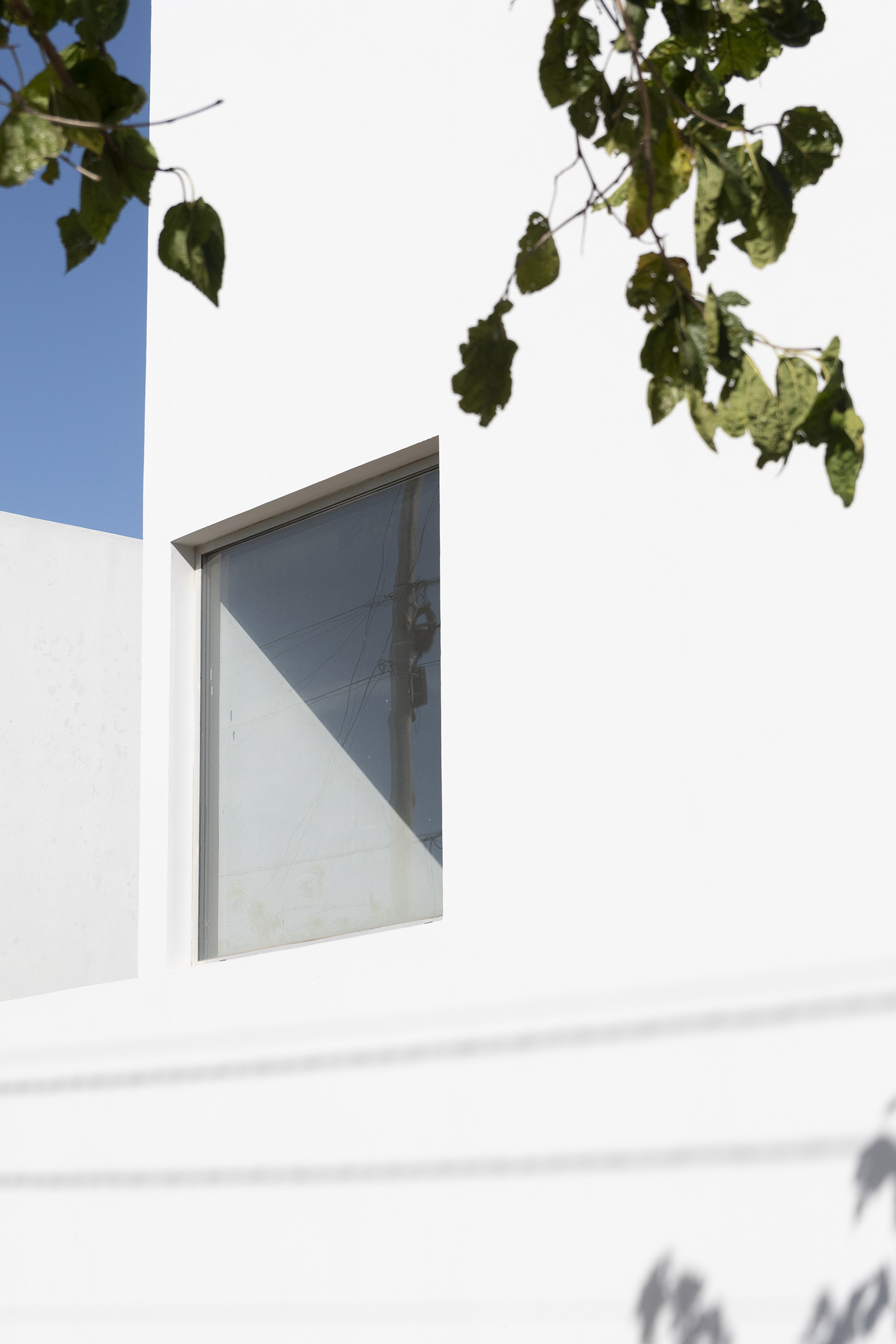
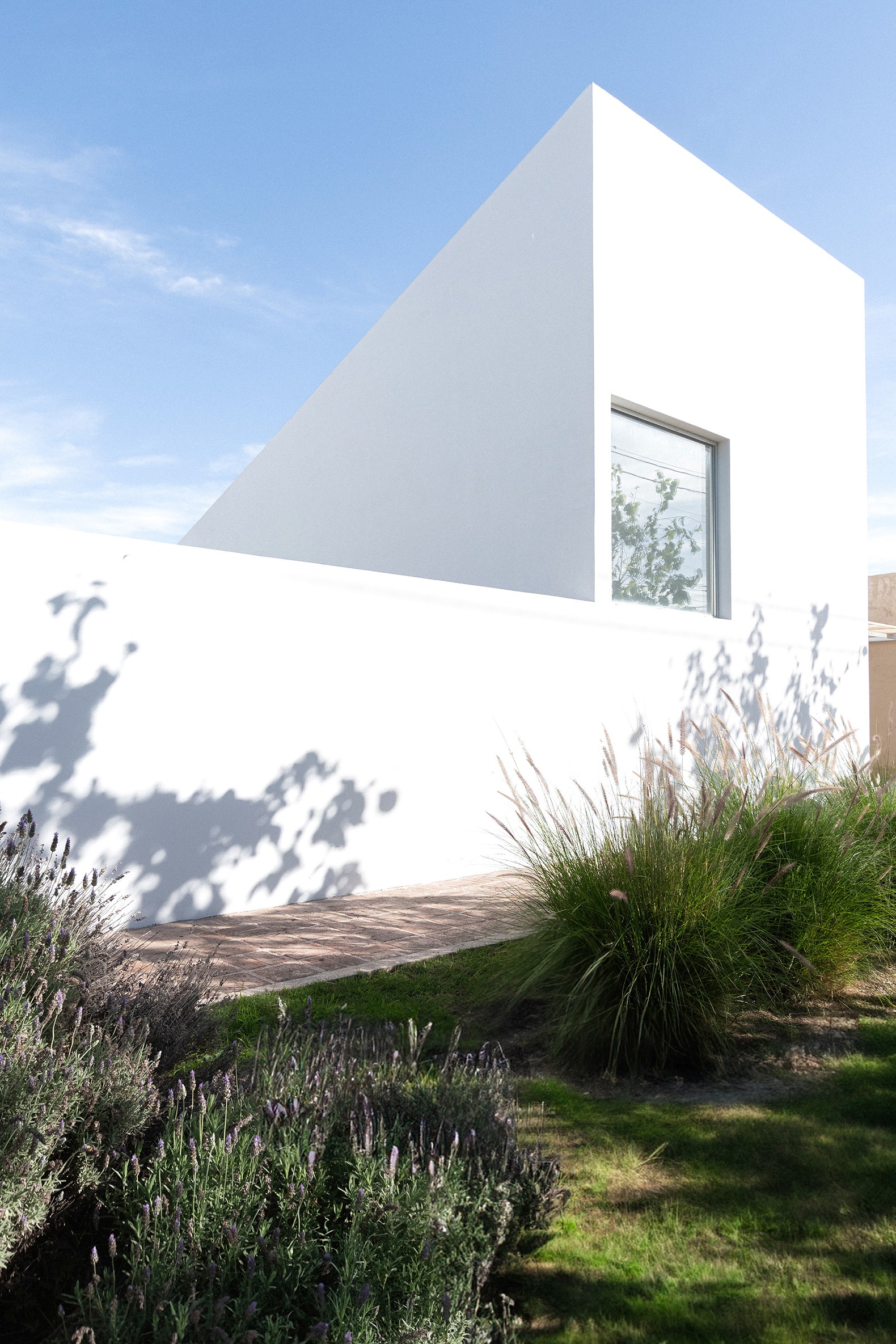
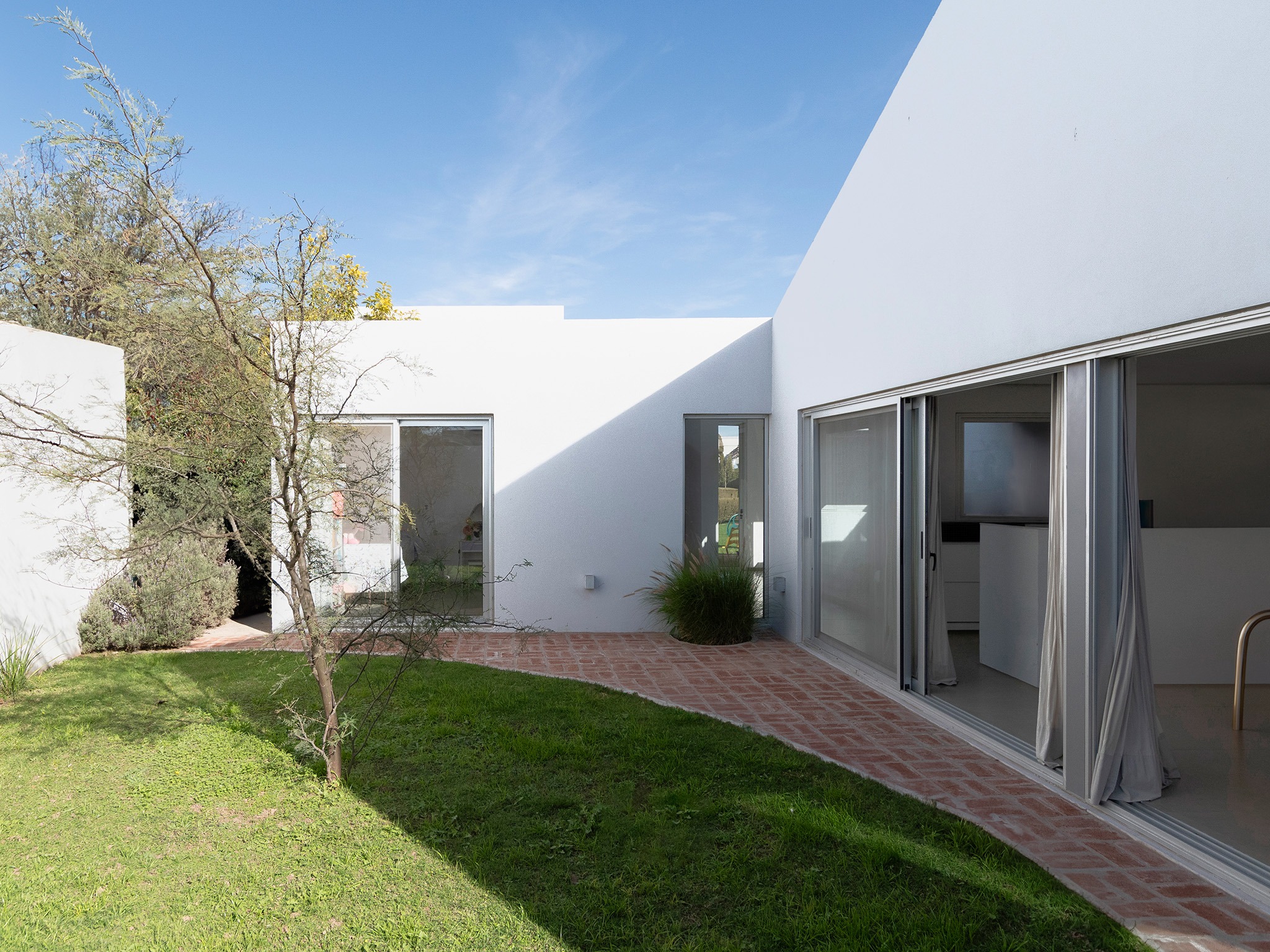
The design by Esteras Perrote fosters a close dialogue with a tree located in front of the facade, which becomes the starting point for housing the program within two linear volumes measuring 5 x 10 meters. The mutual displacement between these two elements facilitates the creation of two large courtyards: one close to the façade, which serves as a welcoming space, and the more private one, inside the plot, to which other smaller ones are joined.
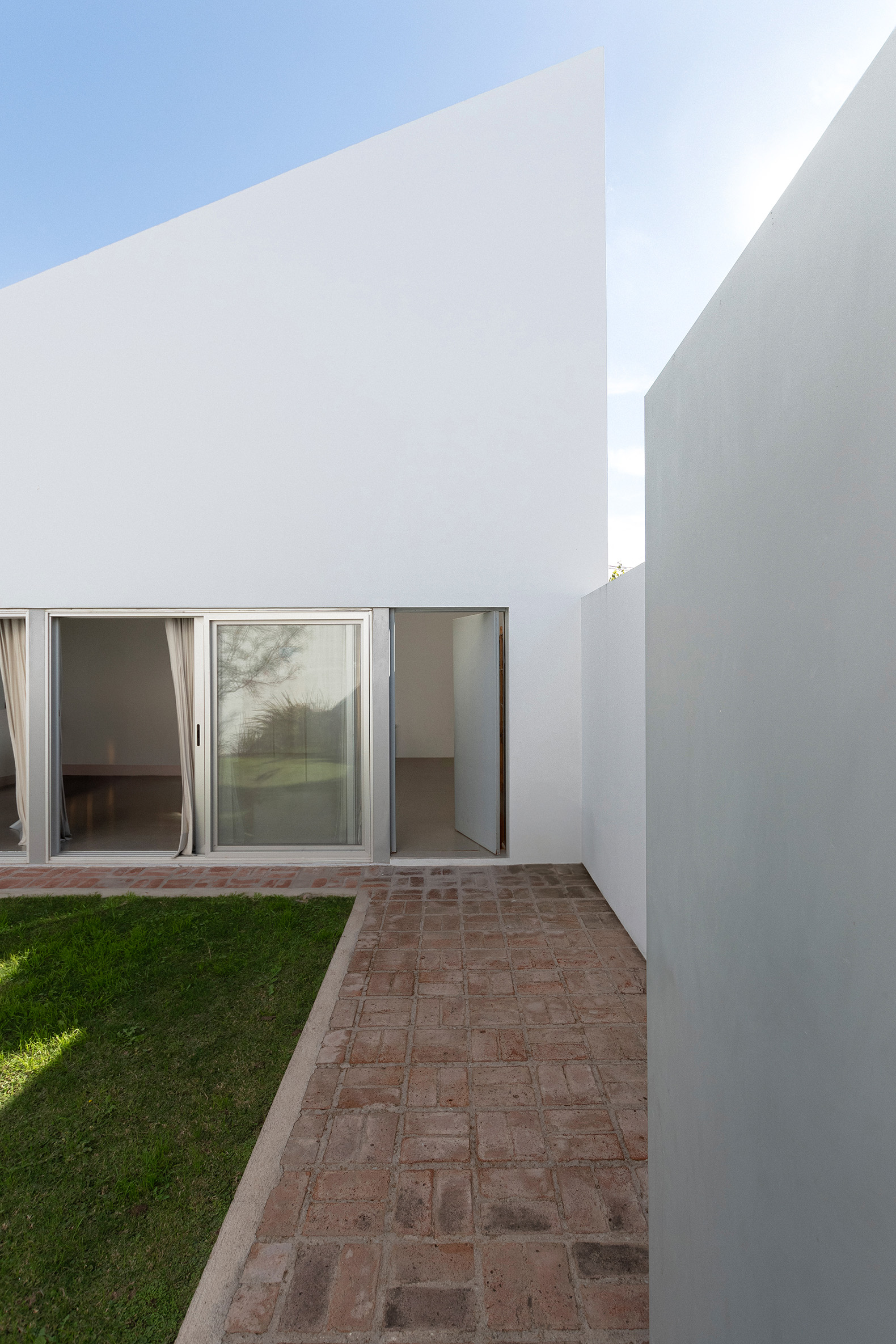
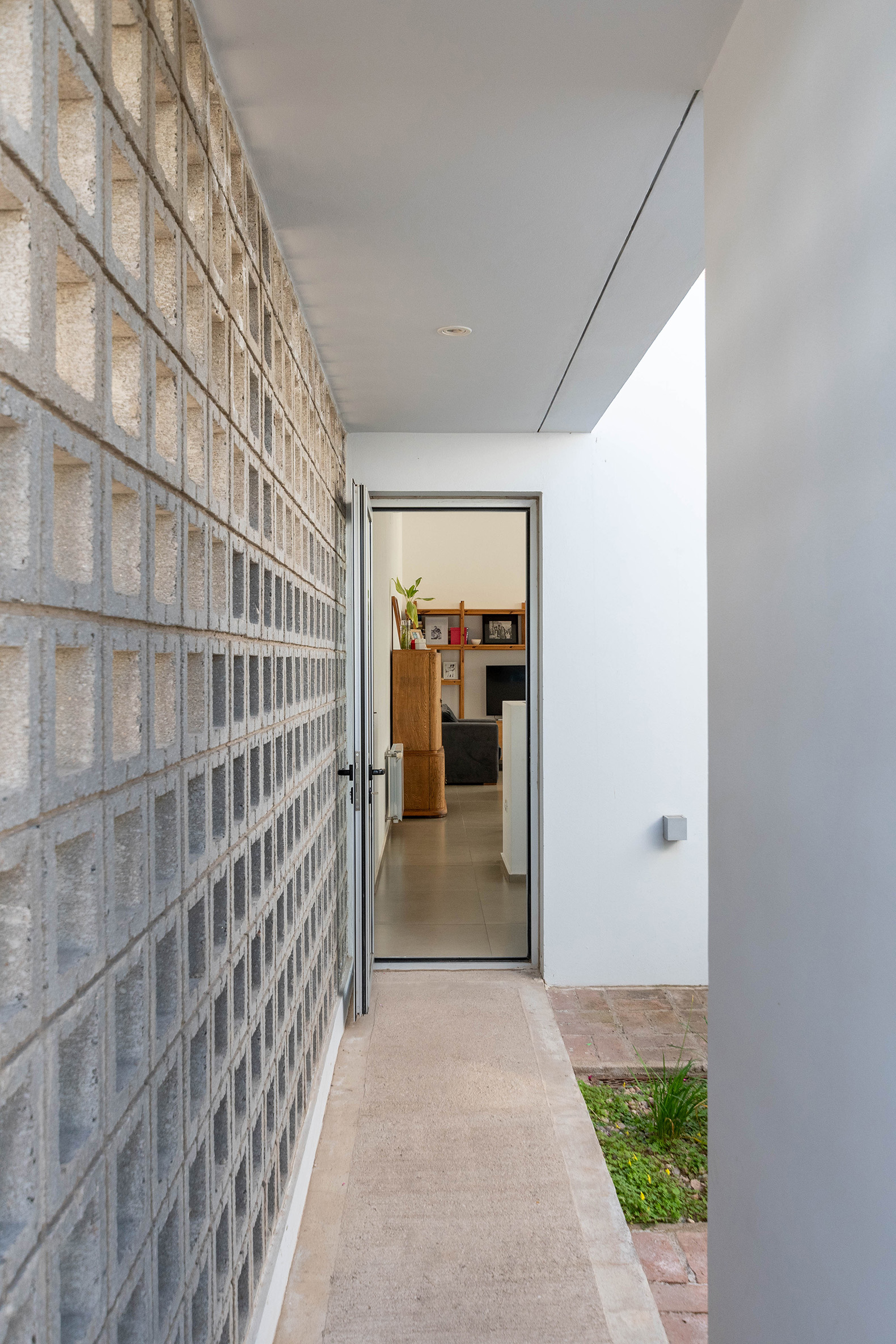
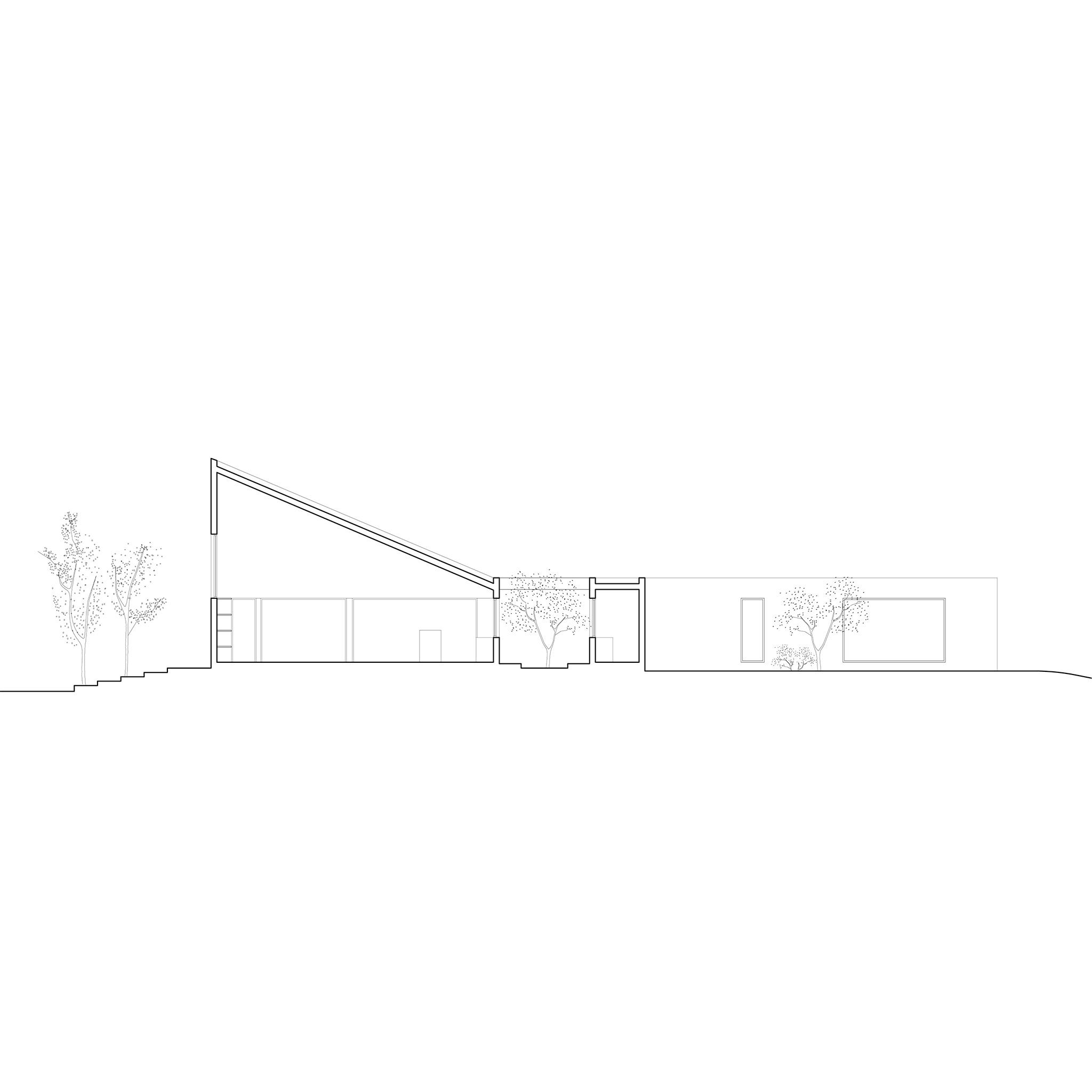
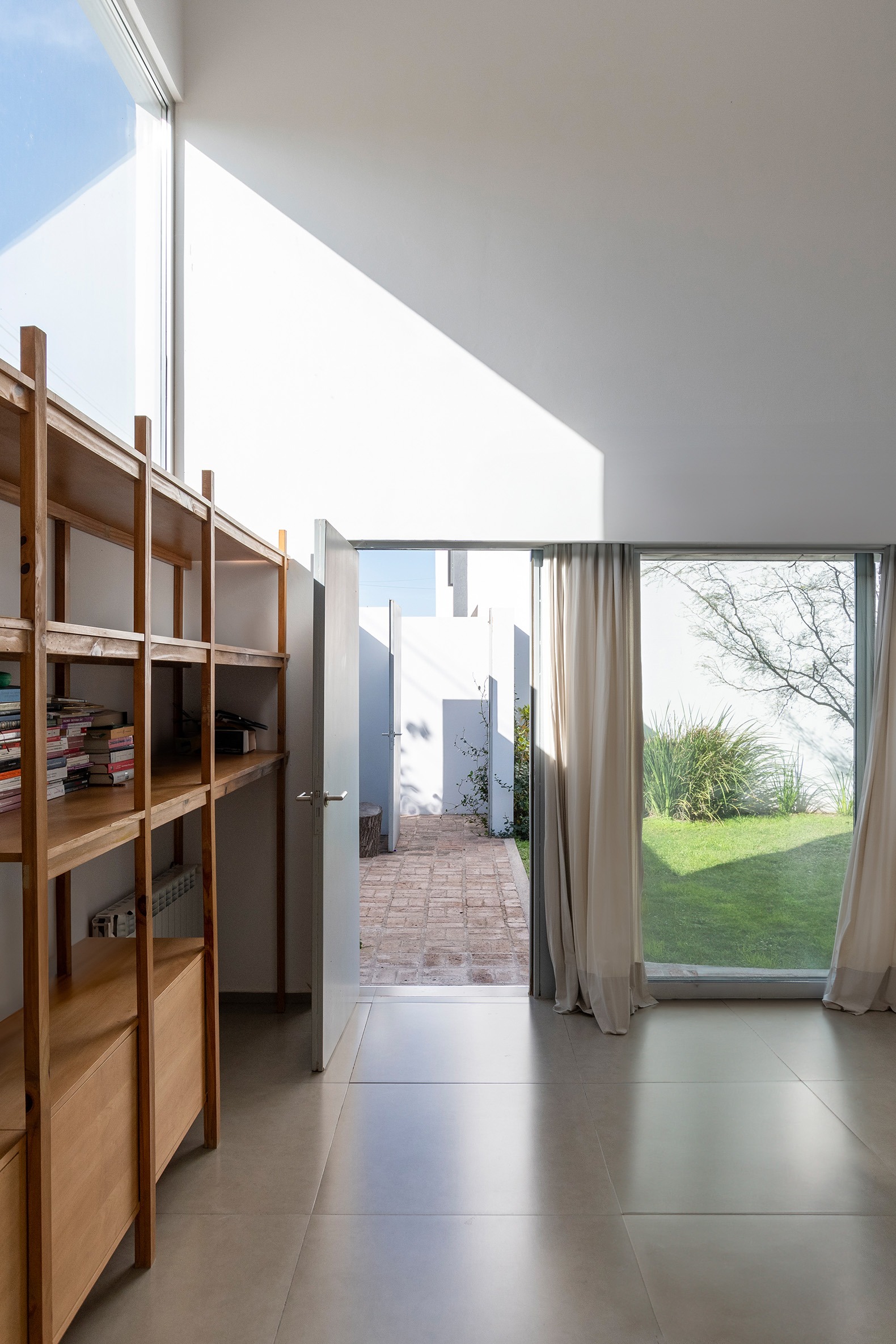
The ensemble is defined by an intriguing interplay of perforated white volumes, which connect with the exterior and enhance the entry of natural light. The interior spatiality is shaped by a dialogue with the tree: the roof rises toward the facade via a sloping plane, bringing the tree's presence into the interior. This gesture, translated into a careful selection of heights, distinguishes the different activities within the house.
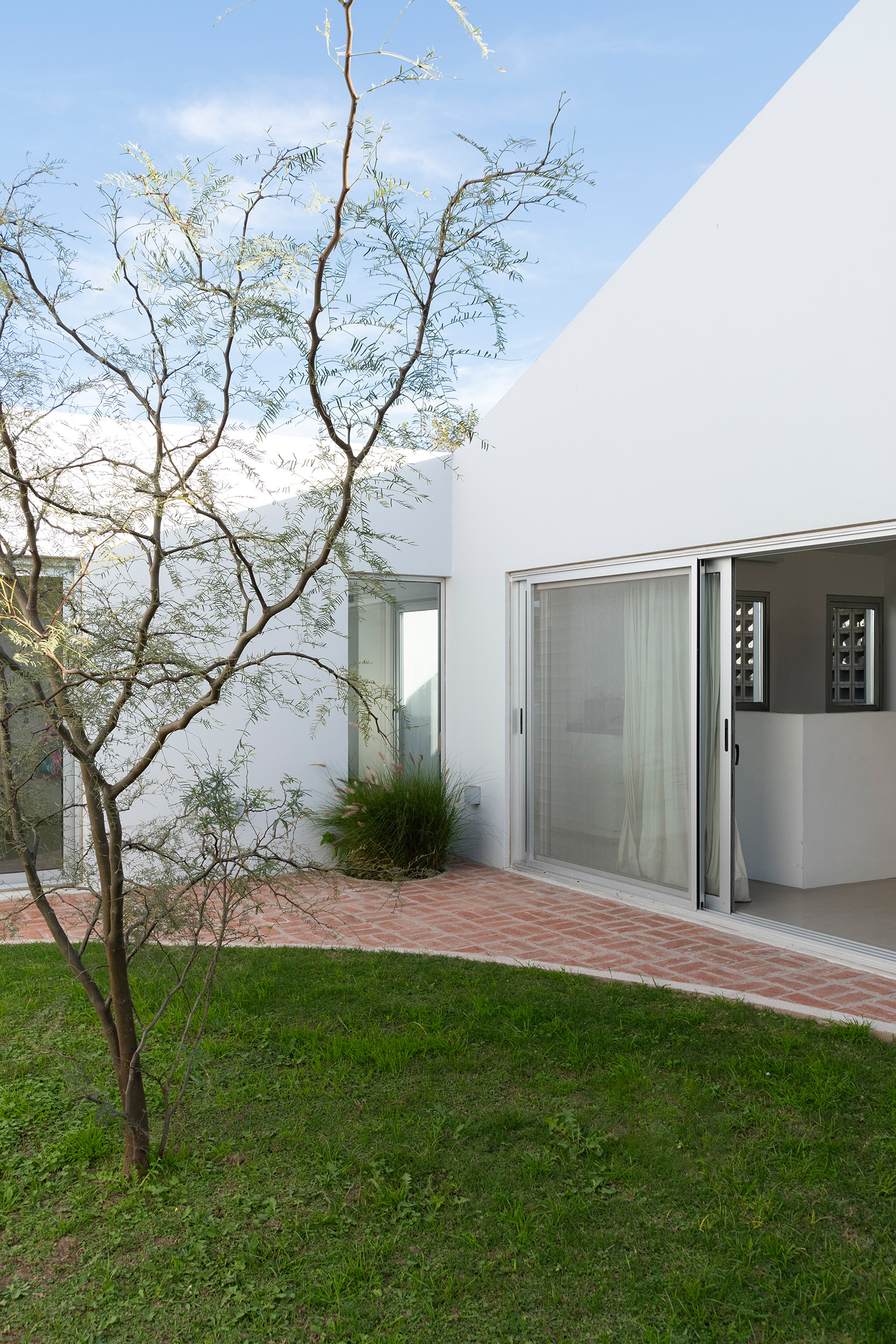
House for a tree by Esteras Perrote. Photograph by Juan Cruz Paredes.
Project description by Esteras Perrote
We envisioned a house in relation to a tree, the central element to which we decided to pay homage. We designed the program in relation to this tree and to other courtyards that follow one another. We decided to move away from pre-established limits. We created distance.
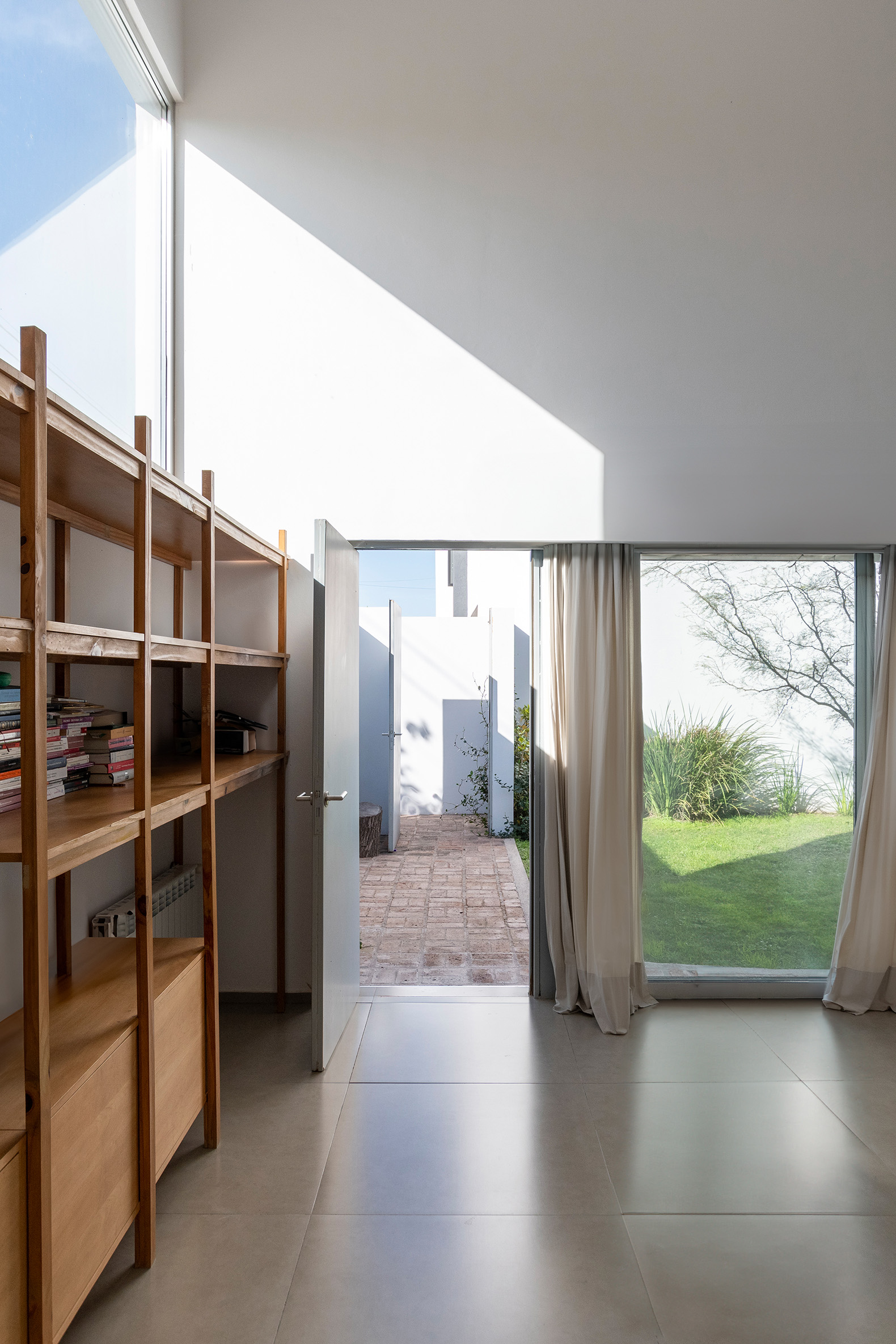
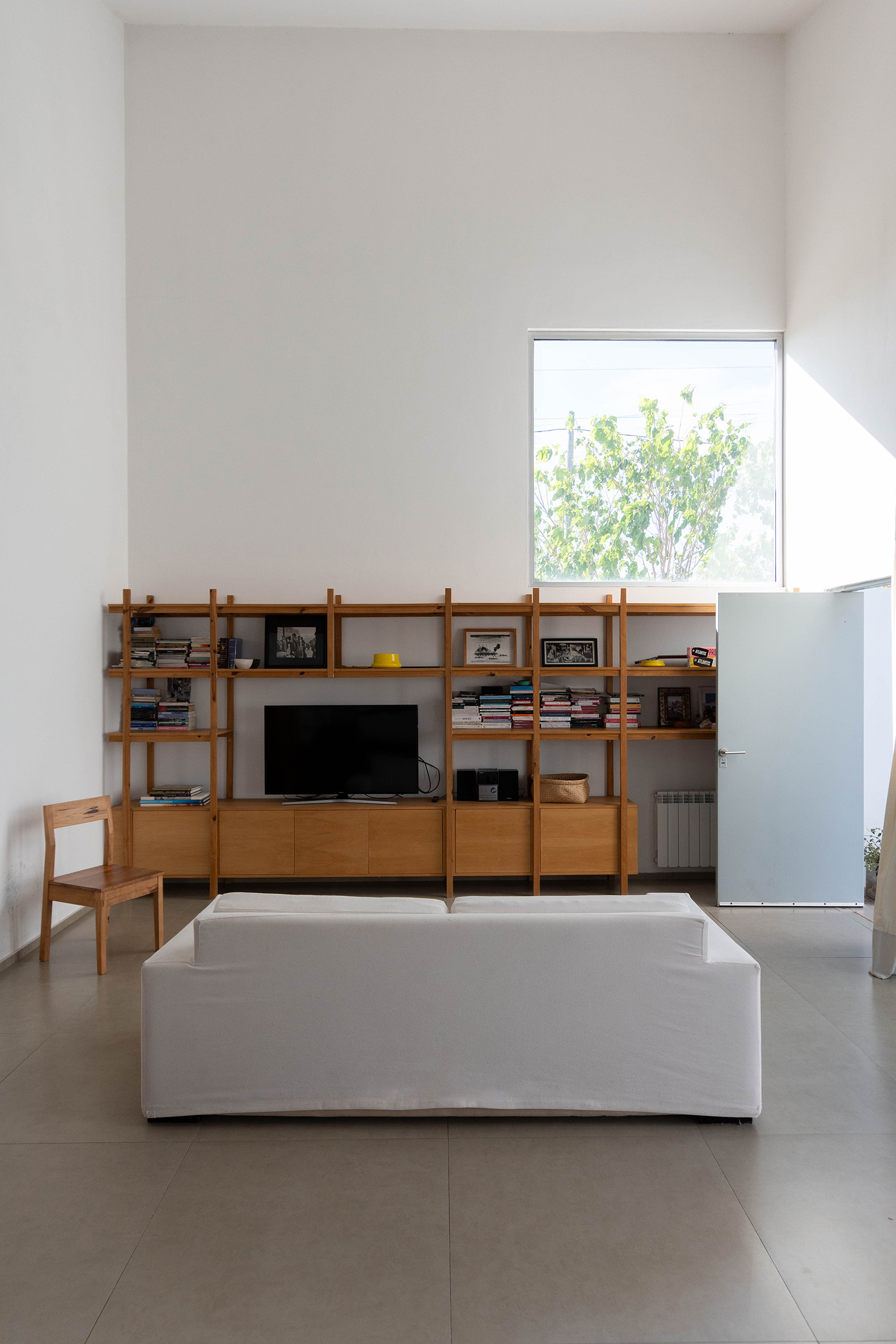
We envisioned white walls that would bring silence to the living space and a pause to the surrounding context. We proposed a large, double-height space under a sloping roof, connected to the single window that faces the street, but which truly looks out at the sky.
Location
Located in a neighborhood on the outskirts of the city of Córdoba, Argentina, the commission came from a young family to develop their residence in the city. Inserted into an urban-rural fabric that extends across the territory with a low scale and exclusively residential character, the commission sought to break the pre-established limits of urban regulations that promote the separation of dwellings. On the contrary, it promotes the accumulation of disparate facades, generating a saturation of morphologies, textures, and colors.
Over the years, Córdoba's urban development has focused on expanding into rural areas, primarily westward in relation to the Sierras Chicas mountain range. As a result, professional development is increasingly concentrated on flat terrain, sparsely vegetated, with irregular or regular layouts, but above all, with low, extensive, and homogeneous density. In this context, the collective condition is reduced to a mere accumulation of individual dwellings scattered across the territory.
In this complex context, individuality constantly seeks to stand out over the collective, and there is an excess of resources, archetypes, textures, and colors used to highlight facades.
Insertion
In contrast to this interpretation, where the current conditions and regulations do not yield an optimal outcome for those who choose to live in this type of isolated, single-family urban development, the house is situated free of its party walls, with its perimeter open on all four sides to allow for complete exploration and enjoyment.
Developed on a single level to ensure direct connectivity between all spaces and the exterior and greenery, the design incorporates different types of patios that correspond to the activities taking place in each area of the house.
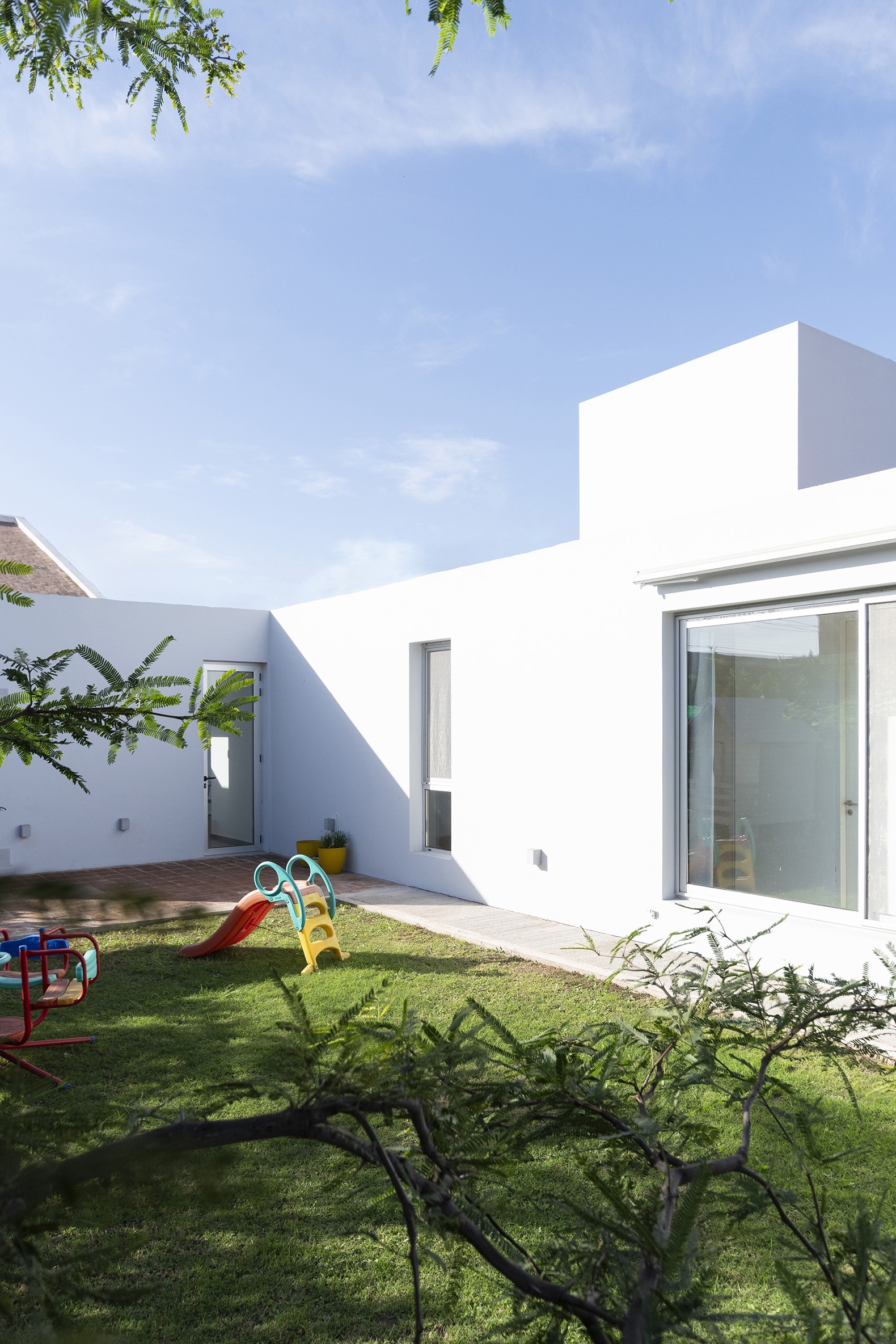
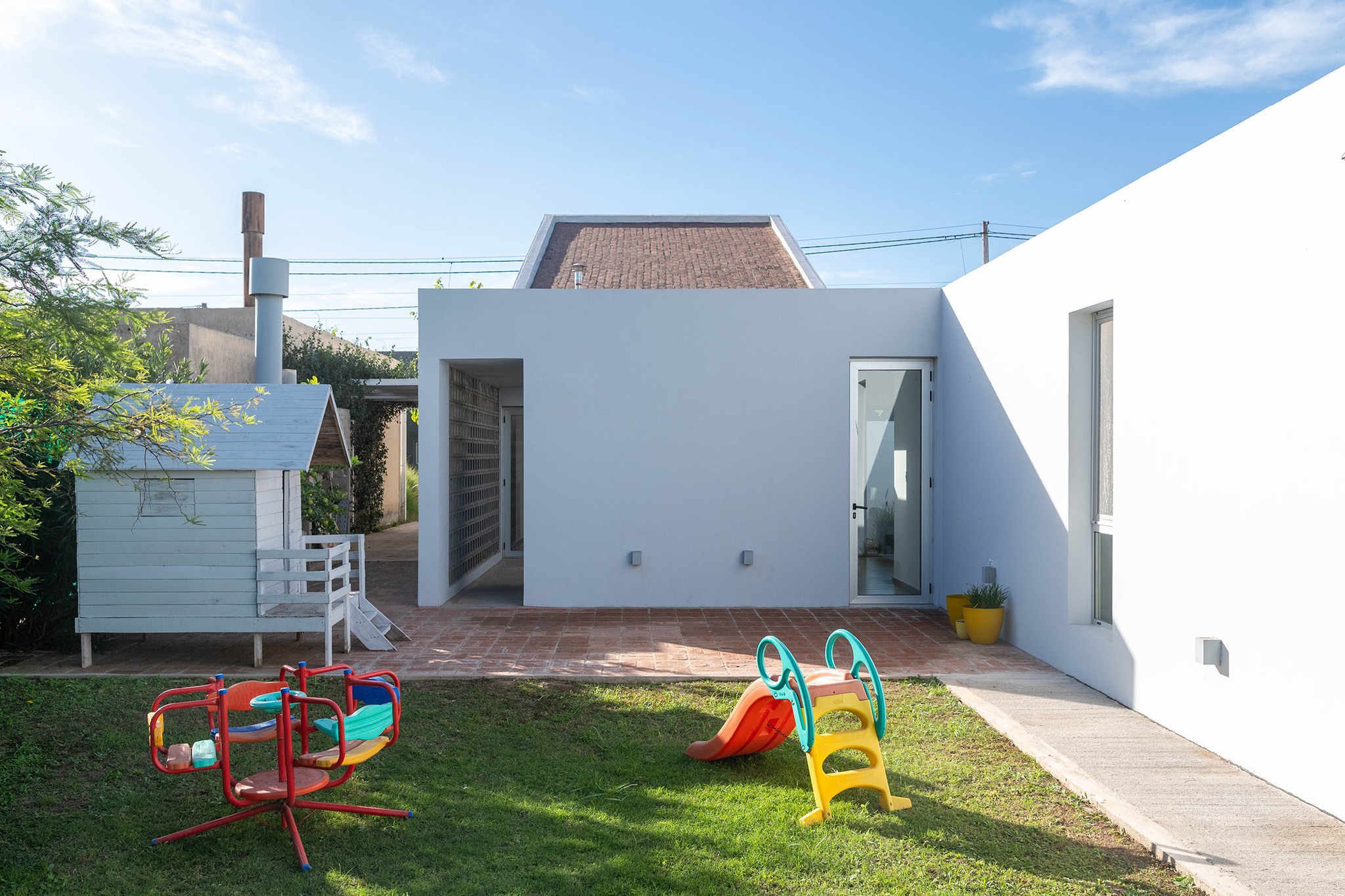
In this way, a compact layout is proposed, consisting of two 5 x 10 meter blocks offset from each other, creating two distinct patios: an entrance and social patio that embraces the native vegetation of the site with its walls, and an open patio with expansive views towards a vacant lot.
Program
Exclusively residential, this single-family home was commissioned by a young couple with two children. Their daily life revolves around family, contemplation, reading, and above all, their children's development in a natural and welcoming environment, where the architecture complements their spatial experience.
To achieve this, two independent volumes were designed. One volume accommodates social and collective activities, while the other provides space for individual and private activities.
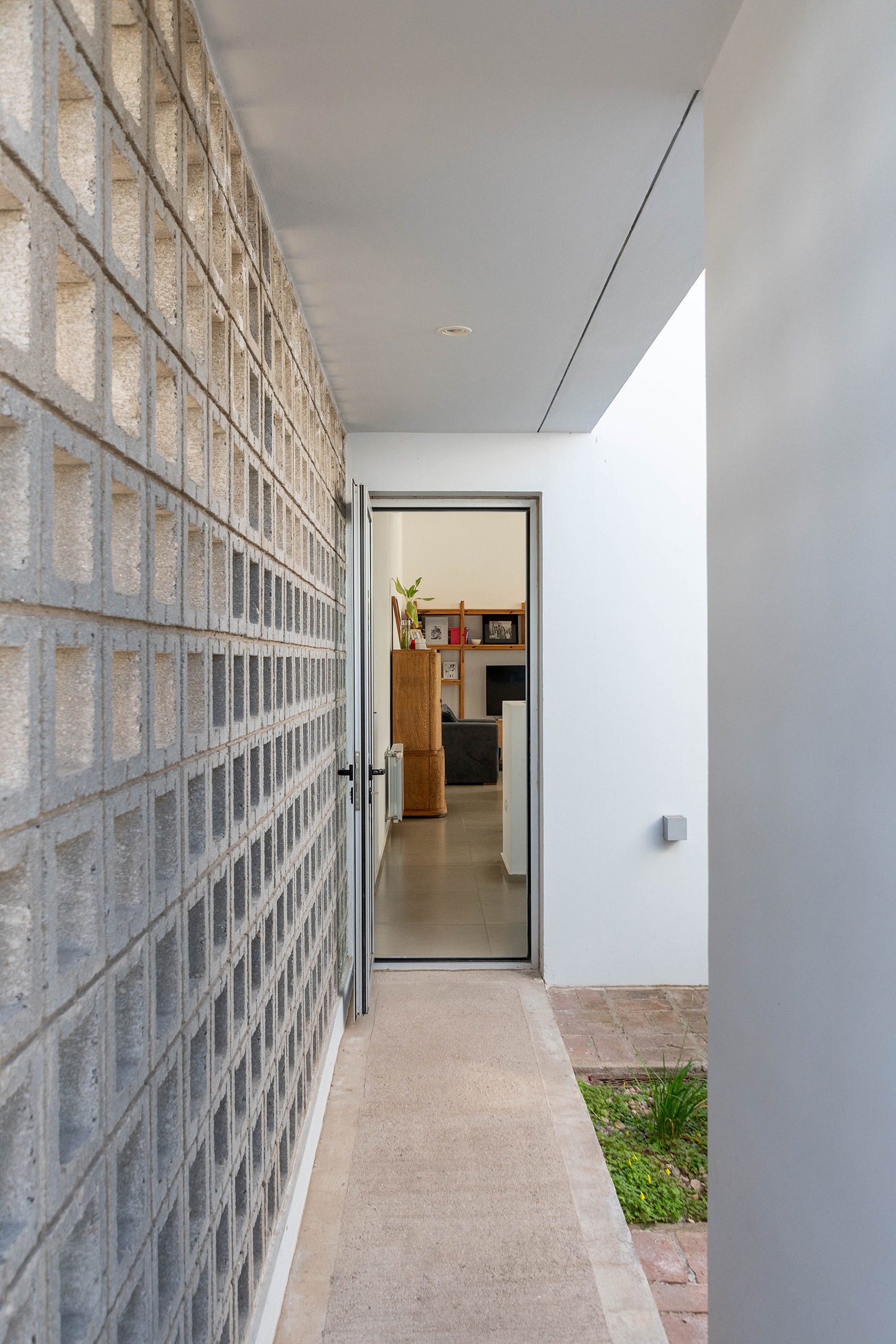
The social volume, with its prismatic form and double-height sloping roof, expands the space and opens onto a contemplative patio. This patio connects the walls and party walls to the existing native vegetation on the site. The threshold between the street and the interior is marked by white walls that guide the movement from the outside in, passing through different spatial situations, until it culminates in a single, double-height space that brings together the daily and collective activities of the building.
With a single element, the island, the hearth and cooking area is what brings people together. The rest is this large, empty space with expansive linear openings that constantly connect the inside with the outside, and a single window facing the street, set back from the street, that allows a view of the sky.
The link between the two prisms, the public and the private, is established through a central courtyard, a contemplative, visual space that allows light and air to enter. This small courtyard plays a fundamental role in both separating and connecting these spaces. This transition between public and private occurs through the mediation with the exterior, which visually recreates the interior movement.
Finally, the bedrooms and bathrooms are located in the other rectangular prism, with flat roofs, where each private space connects to a completely different exterior area, achieving a private connection with the use of the exterior space—a kind of direct connection that extends the inside and outside.
Materiality
With its white walls, the house was morphologically conceived as a volume that was gradually excavated to bring in light and connect with the outdoors. The perforations that pierce these volumes were meticulously studied in relation to the interior-exterior space, as well as to the spatial requirements of each area.
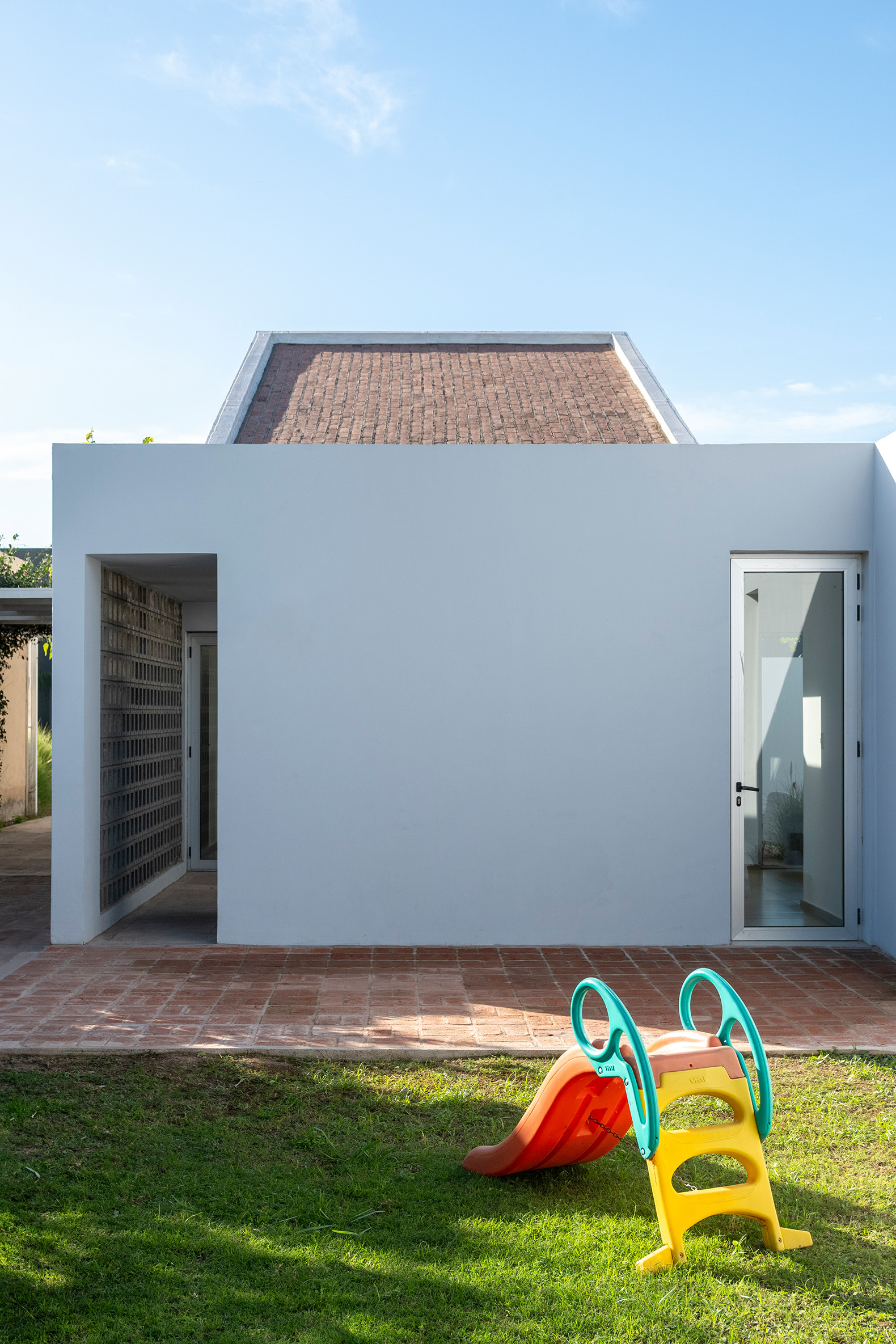
Reminiscent of those old villa typologies, where white walls coexisted with the green of the garden, and where the roof was the element that synthesized the architecture, the design proposes that the social volume, which rises towards the street and creates the double-height space inside, be covered with red vaulted ceilings that echo the same aesthetic as the ground floor flooring.
In this way, this morphological interplay of pure and simple forms that follow the path of the sun responds to its interaction with the exterior and proclaims the quiet and austere interior space, as well as its exterior image.
Space
Spatial considerations were paramount in this project, where the built surface required a dominant spatial experience. Thus, in addition to exploring spatial morphologies, heights, and cutouts, extensive work was done on a continuous, 2.20-meter-high window system that shifts the viewer's perspective throughout the entire dwelling. In this way, in relation to the exterior, these openings not only provide an expansion to the outside world but also a visual expansion to the sky.