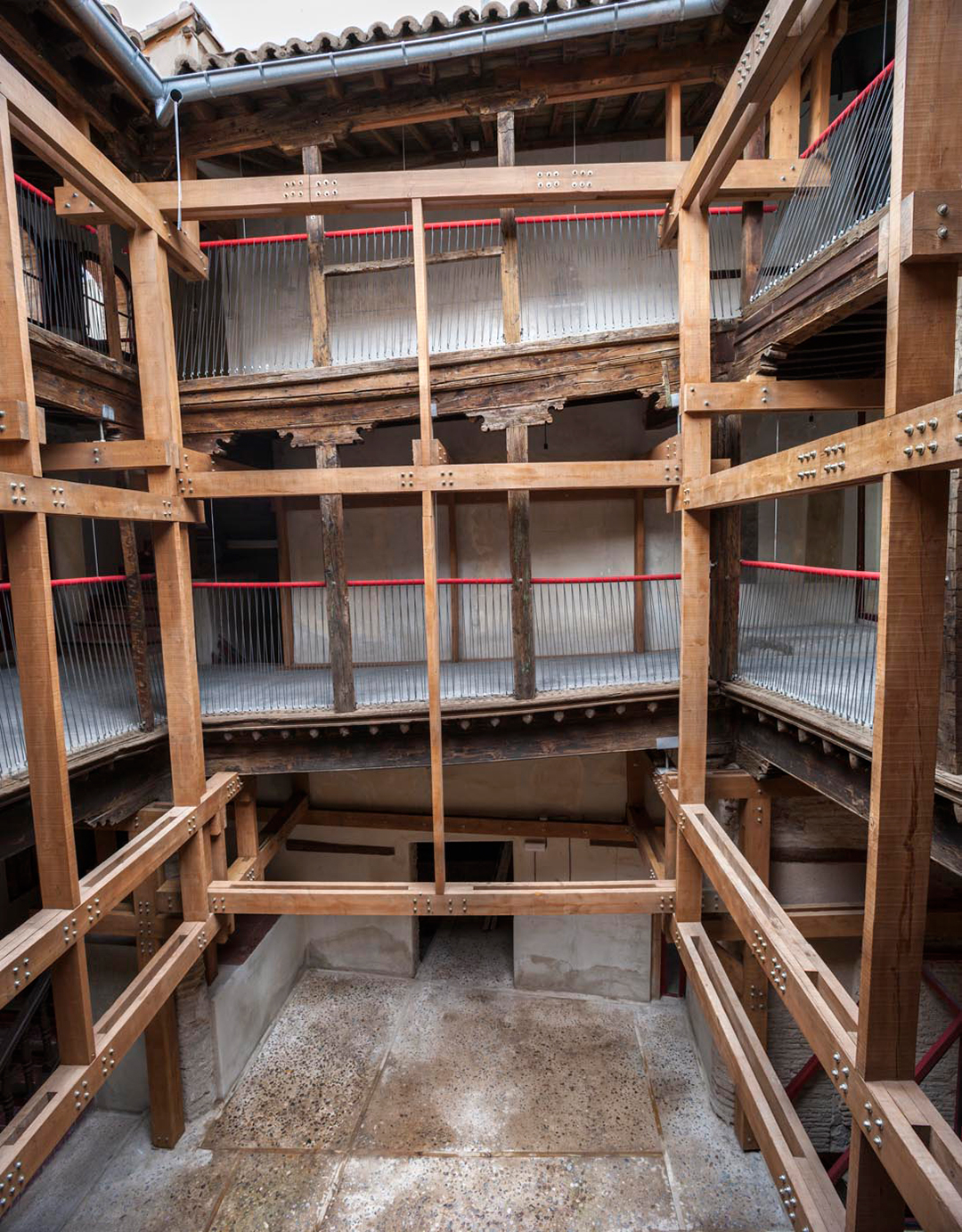
The School of Architecture at the University of Toledo thought for the first year of life would be very enriching for the students to be part of the rehabilitation and provision of new uses for a building that goes from I to nineteenth centuries. The most characteristic feature is a wooden exoskeleton subject without altering the building materials and morphology, respecting built up over the centuries. The project has been chosen to be exhibited at the Venice Biennale 2016.
Description of the proyect by School of Architecture at the University of Toledo
The house at callejón de Menores 12 is a courtyard house with many elements of interest, dating from the first- through the twentieth-centuries. This project set out to establish innovative criteria for historic building renovation. The fundamental goal was to reactivate the residential fabric of the historic centre with new uses: generate new design methods for historic buildings, transmit knowledge to the participating students and define other approaches to renovation ranging from project management to actual construction, which could be exported as models for other situations in the city. Regarding the interventions, the first was to insure the stability of the structure by adding an exoskeleton that supports the existing structure, without removing anything. The intervention is accomplished while conserving the form and textures of the existing construction elements, maintaining the possibility to read each moment of the house’s history. Only reversible, dry-mounted construction systems are used.