El edificio se Saarinen se ha convertido en uno de los elementos a conservar más importantes de Estados Unidos tras su declaración de conservación en 2003. Para los que tuvimos la suerte de usarlo como terminal todo un lujo poder volver a verlo.

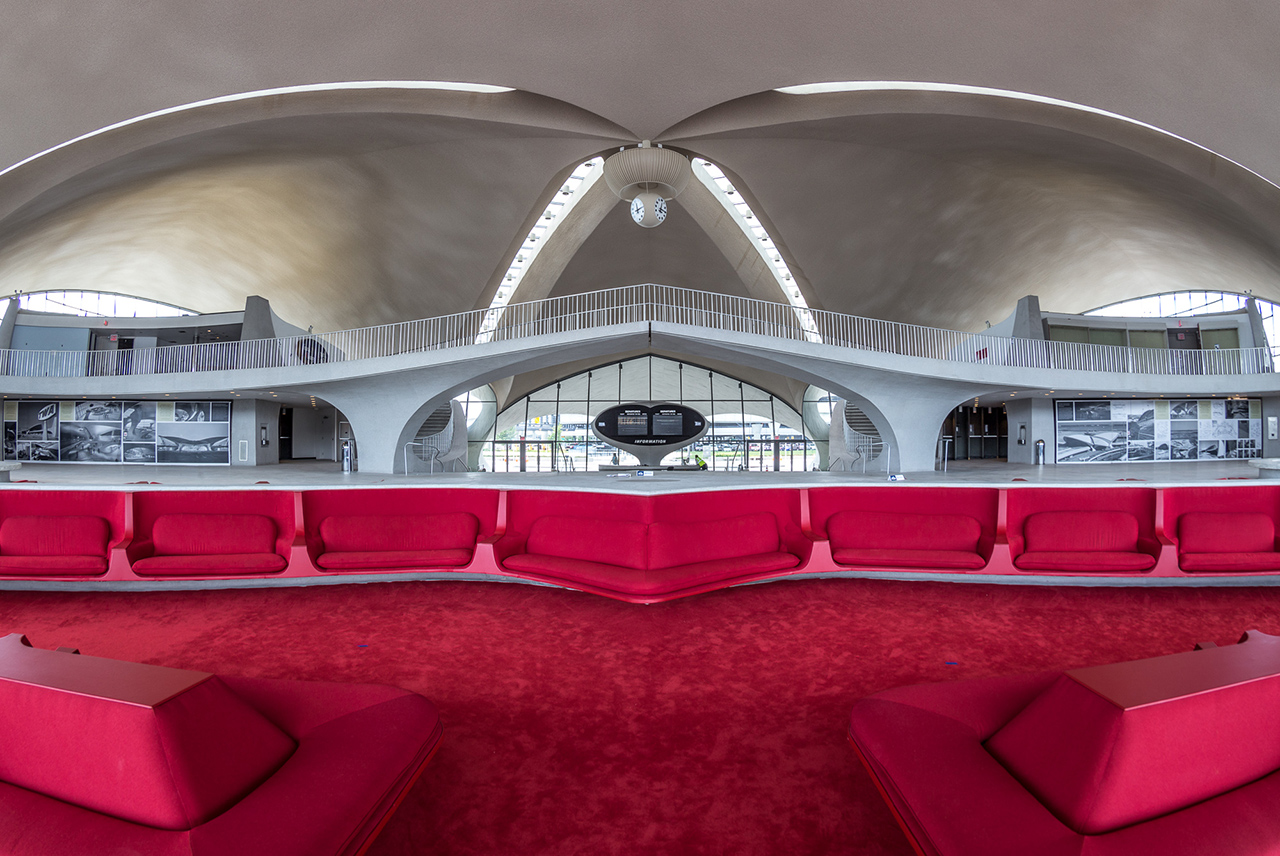
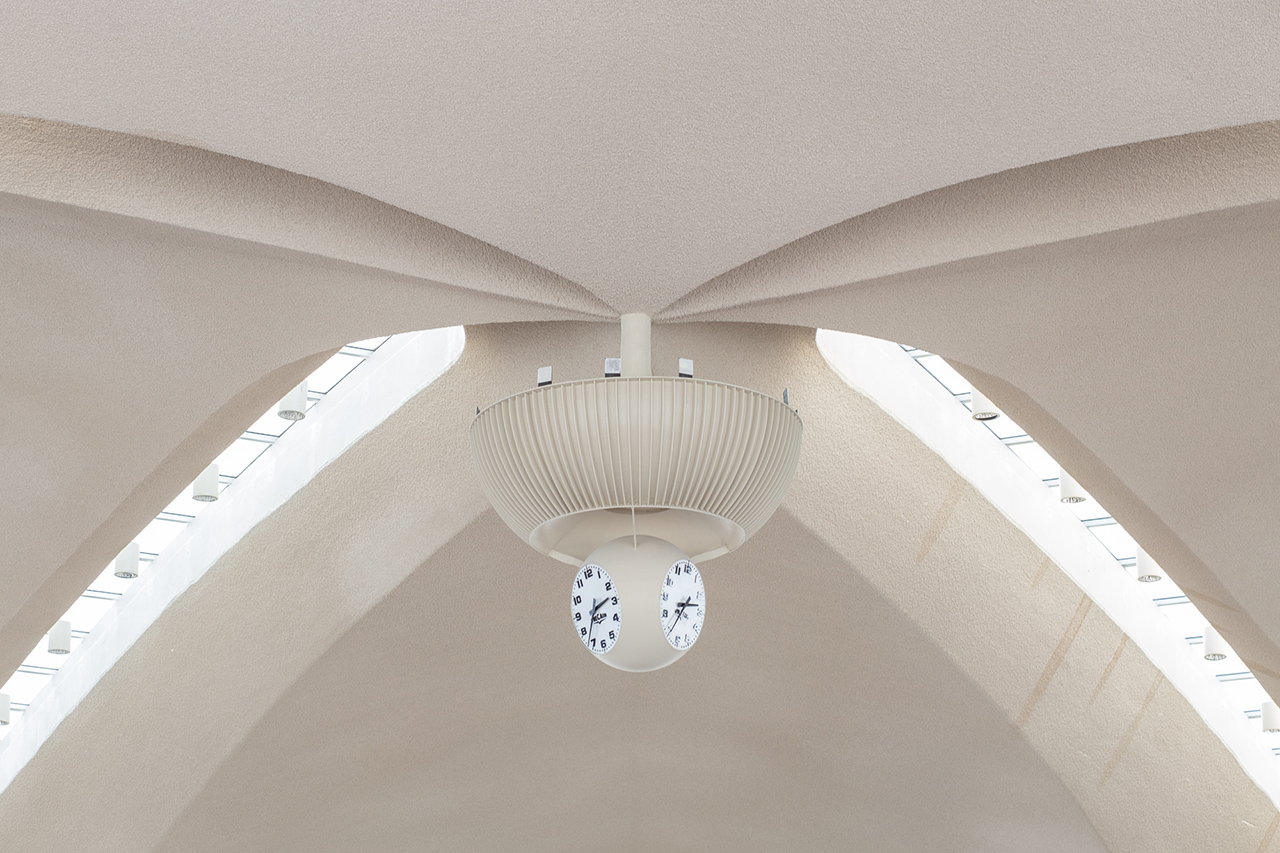
Eero Saarinen’s 1962 terminal at John F. Kennedy, which was published on METALOCUS article with photographies by Connie Zho in November last year, now, on June 2015, while the staff of a team of digital scanning - the historical preservationist Lori Walters and her team at ChronoPoints- was at work recording every detail of Eero Saarinen terminal to make a digital 3D model,  Curbed NY sent the photographer Max Touhey to document the process and to capture the closed-to-the-public building just ahead of its transformation into a boutique hotel.

It's a special place for architecture and midcentury design lovers—and photographers. Touhey said of his experience shooting:

Even when I'm really excited to shoot a space if it stands the hype the excitement still drops off at a certain point. But TWA is different. You can stand in 100 different places and still be in awe. The interplay of curves is really fascinating and changes dramatically depending on where you're looking. One of my favourite features is of two sharply angled forms on both sides of the "passion pit," two aerodynamic shapes in a sea of curves. I could almost hear a plane taking off! Now I'll have to see what my parents remember from their TWA days when I share the images.

In 2014, I wrote about my experience using the terminal during a trip to LA.-

One of the most famous icons of mid-century modernism, the TWA Flight Center, beautifully restored over the last six years, is on the National Register of Historic Places, in the USA.

One of the last times I had the opportunity to go through the TWA terminal was way to LA in 1998, had missed the flight after waiting in a long queue, and after arriving at the airport from Manhattan on a slow Subway, travelling across the city from my hotel in 109 St. and very early. The stewardess who waited on me was extremely friendly (now, Low-cost lines between his cuts have also reduced friendliness) and I could catch the next flight to Los Angeles. At other times, I returned to cross the terminal again, always looking sideways, thinking that this was a special place, but thinking it was timeless.

José Juan Barba

Read more
Read less

More information

Eero Saarinen (Rantasalmi, Finland, 1910 - Bloomfield Hills, United States of America, 1961), is an architect of Finnish origin who developed all his professional activity in the United States, a country he moved to in 1923, when he was thirteen years old. He studied sculpture at the Academy of the Grand Chaumiére of Paris in 1929 and architecture at Yale University between 1930 and 1934.

In his first years of professional activity, Eero Saarinen worked in the practice of his father, the also well-known architect Eliel Saarinen, of which he became a partner in 1941 along with J. Robert Swanson. At this time, he was also a professor of architecture at the Cranbrook Art Academy.

After the death of his father in 1950, Saarinen opened his own practice in Birmingham (Alabama) under the name of Eero Saarinen & Associates. Some of his best-known works are the General Motors Technical Center in Michigan, the Gateway Arch in St. Louis, the TWA at John F. Kennedy Airport in New York and the hockey pavilion at Yale University.

The professional career of Eero Saarinen also included his activity as a furniture designer, creating well-known pieces.
Read more

Max Touhey is a New York City architectural and interior photographer who work with architects, designers and builders in NYC and beyond. His true passion is New York City and Curbed NY has enabled him to photograph the most New York of places. Eero Saarinen’s TWA Terminal being the latest and greatest.

Read more

José Juan Barba (1964). Architect from the Madrid School of Architecture (ETSAM) in 1991. He received his PhD in Architecture from ETSAM in 2004, graduating summa Cum laude with the doctoral thesis "Inventions: New York vs. Rem Koolhaas, Bernard Tschumi, Piranesi." In 1991, he received a Special Mention in the Spanish National Graduation Awards. Until 1997, he worked as an advisor to several NGOs. In 1992, he founded his architectural practice in Madrid (www.josejuanbarba.com). 

He is an architectural critic and, since 1998, Editor-in-Chief of the internationally acclaimed bilingual architecture journal METALOCUS (Spanish/English), recipient of several national and international awards.

Barba is an Associate Professor at the University of Alcalá and a member of several research groups. He has been invited to participate in numerous international forums on architecture and urbanism, including the II Forum of Mexican World Heritage Cities, Urban Development, History and Modernity, organized by the Pan-American Committee for Urban Development and Historical Heritage; the World Urban Development Forum (FMDU), held in Culiacán, Sinaloa, Mexico; and the International Conference on Architecture and Urbanism from the Perspective of Women Architects. He has also been invited as lecturer and guest critic at numerous national and international institutions, including the National Building Museum, Roma Tre University, Politecnico di Milano, University of Genoa, Université Pierre Mendès France Grenoble, the Madrid and Barcelona Schools of Architecture, National Autonomous University of Mexico, the Faculty of Architecture in Montevideo, the Schools of Architecture of Medellín and Ecuador, Universidad Iberoamericana, IE University, as well as the Schools of Architecture of Zaragoza, Valladolid, Málaga, Granada, Seville, and A Coruña, among others.

He has extensive professional experience in architecture, urbanism, landscape intervention, and territorial regeneration. His work has received numerous awards, including First Prize in the “Gran Vía Posible” competition for Delirious Gran Vía, Madrid; recognition for the Rivers Interpretation Centre in Zamora, awarded and exhibited at the World Architecture Festival 2008; and recognition for the Santa Bárbara Park project in Toledo. He was also awarded the Erich Degner Prize for Architecture (1995), promoted by the BBVA Foundation. His project for a Day Centre for the Elderly was included in Volume 3 of the Madrid Architecture Guide published by the Official College of Architects of Madrid (COAM) in 2007. His work has been widely published in national and international books and journals.

He served as Maître de Conférences at the Institut d’Urbanisme de Grenoble, Université Pierre Mendès France Grenoble, during the 2013–14 academic year, following his appointment through a European open competition. His work has been published internationally. He regularly serves on academic and professional juries, including the editorial competition jury for the journal Quaderns (2011), the selection committee for the European Union Prize for Contemporary Architecture – Mies van der Rohe Awards (2007–present), and the jury panels for EUROPAN 13 (2015–16) and TRANSFER, Zurich (2019). He was also invited to participate in the Biennale di Venezia 2016 as part of the exhibition Spaces of Exception / Spazi d’Eccezione.

He has authored several books, including "The Dark Line. michele&miquel, dA Vision Design" (2024), "CONGRESO ANYWAY. La ciudad de las ciudades" (2020), "#Positions" (2016), and "Inventions: New York vs. Rem Koolhaas, Bernard Tschumi, Piranesi" (2015). He has also contributed to publications such as "Espacio público Gran Vía. La Ciudad del Turismo" (2020), "Spaces of Exception / Spazi d’Eccezione" (2016), "La manzana de la discordia" (2015), and "Contemporary Japanese Architecture: New Territories" (2015), as well as chapters in numerous books, including "Women Architects: A Professional Challenge" (2009), "21st Century Architectures" (2007), "Ruta de la Plata, New Conquerors of Space" (2019), and "The City of Tourism" (2020).

Selected awards include:

•    “SANTIAGO AMÓN” AWARD, award for the promotion of architecture, COAM Madrid, 2000.
•    “PANAYIOTI MIXELI AWARD,” SADAS-PEA, award for the promotion of architecture, Athens, 2005.
•    “PIERRE VAGO” ICAC. International Committee of Art Critics Award, London, 2005.
•    FAD Award 07, Ephemeral Interventions, First Prize, M.C. Escher Exhibition, Arquin-FAD, Barcelona, 2007.
•    World Architecture Festival, Center for Research and Interpretation of the Rivers, Tera, Esla, and Órbigo, Finalist, Barcelona, 2008.
•    Gran Vía Posible, First Prize, Delirious Gran Vía, Madrid, 2010.
•    Reform of the Río Segura Surroundings, Award, Murcia, 2010.

Read more
Published on: August 20, 2015
Cite:
metalocus, JOSÉ JUAN BARBA
"Saarinen’s TWA Terminal by Max Touhey " METALOCUS. Accessed
<https://www.metalocus.es/en/news/saarinens-twa-terminal-max-touhey> ISSN 1139-6415
Loading content ...
Loading content ...
Loading content ...
Loading content ...
Loading content ...
Loading content ...
Loading content ...
Loading content ...
Loading content ...
Loading content ...
Loading content ...
Loading content ...
Loading content ...
Loading content ...
Loading content ...
Loading content ...
Loading content ...
Loading content ...
Loading content ...
Loading content ...
Loading content ...
Loading content ...
Loading content ...
Loading content ...
Loading content ...
Loading content ...
Loading content ...
Loading content ...
Loading content ...
Loading content ...
Loading content ...
Loading content ...
Loading content ...
Loading content ...
Loading content ...
Loading content ...
Loading content ...
Loading content ...
Loading content ...
Loading content ...
Loading content ...
Loading content ...
Loading content ...
Loading content ...
Loading content ...
Loading content ...
Loading content ...
Loading content ...
Loading content ...
Loading content ...
Loading content ...
Loading content ...
Loading content ...
Loading content ...