


AJC Architectes proposes an organization in which the building rotates the traditional axis of stage and auditorium 90 degrees to open the foyer directly toward the city, incorporating part of the public space as a natural extension of the theater. The program includes a large hall with fixed seating, a smaller hall with mobile seating for dance or experimental theater, a glass-enclosed foyer, and an articulated network of dressing rooms, artist foyers, and terraces. This system allows for flexible uses, hosting performances, residencies, and rehearsals, with a permeable and communal feel.
Materially, the theater is constructed of white concrete pigmented with tones similar to those of local stone, establishing a chromatic continuity with the surroundings. The facades are decorated with a structured pattern that reinterprets the Flamboyant Gothic style of the Church of Saint-Étienne, generating an undulating texture. The building combines passive strategies, such as a high-performance thermal and acoustic envelope, with low-energy active technologies, featuring 100% geothermal heating and air conditioning.
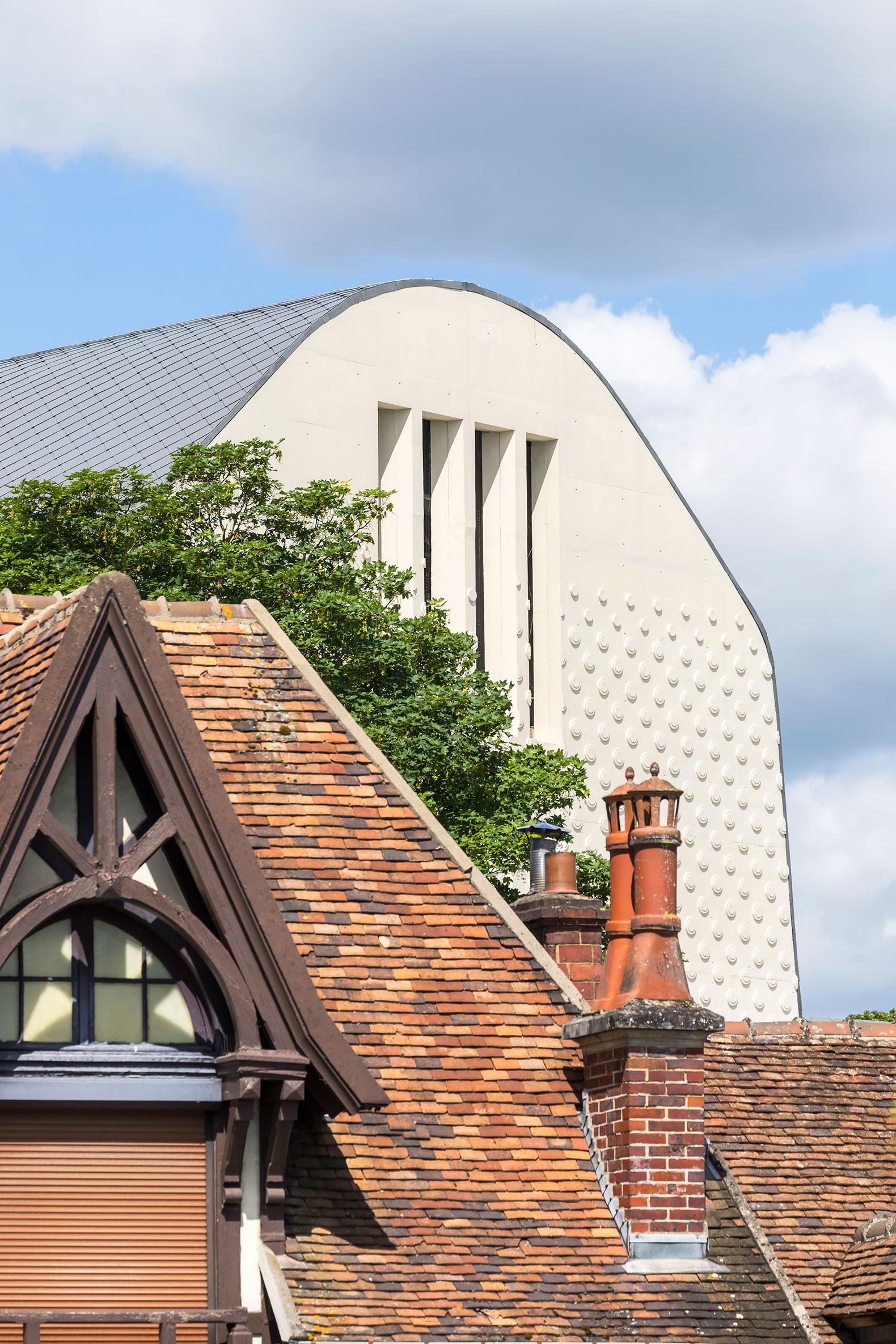
Beauvaisis Regional Theatre by AJC Architectes. Photography by Sergio Grazia.
Description of project by AJC Architectes
The Beauvaisis Theatre stands apart from the new cultural facilities built with the sobriety imposed by managerial constraints. In Beauvais, the site of the project inherits a deep historical sedimentation. The site is located near the remains of ancient Gallo‑Roman thermal baths, not far from the banks of the Thérain River, and has witnessed history up to the end of World War II. Among the rubble of reconstruction, a popular cultural life was reborn. First, warehouses were repurposed as a community hall, and in the 1970s the architecture of those buildings began to be appreciated.
Gradually, the community hall transformed into a performance space, attempting to host cultural events as best it could with its 450 seats and low fly‑tower height. But the limitations of this facility ultimately excluded the city of Beauvais season after season from the circuit of French cultural life, since it could only accommodate shows very rarely.
Therefore, authorities finally decided to provide the city with a true theatre, and to build it precisely on the same site, in continuity with the history. Designing a project on a site three times larger than the existing one requires great sensitivity in fairly assessing the relationship with the buildings already there.
The main challenge is the perception of a new volumetric “intruder”. By increasing from 10 to 27 metres in height, the Theatre acquires de facto the status of a new urban interlocutor. The objective is to sustain the dialogue as best as possible with Beauvais’s two emblematic monuments: the Church of Saint‑Étienne, very close, and the Cathedral of Saint‑Pierre, somewhat further away.
To meet this challenge, the Theatre was conceived as a “deconstruction” of the theatrical typological object, choosing to accentuate the volumetric imbalance traditionally associated with the “theatre object”. To achieve this, the height of the envelope was reduced as much as possible, thus softening its relationship to the surroundings, while the main volume was raised.
Thus, the new Théâtre du Beauvaisis rises toward the sky like a profane nave whose singularity proposes a contemporary resonance with the two prestigious buildings of past centuries. The expression “profane nave” deliberately refers to Roman basilicas, whose architecture evokes the gathering of citizens united in a common moment.

Postwar urban planners succeeded in perfectly enhancing the Church of Saint‑Étienne. They proposed a spatial arrangement that favours alternation between near and far, generating a very distinctive architectural and urban play.
This architectural organization could place this site within the continuity of urban “clos” such as those that can be found in, for example, Pisa (Italy) or Orléans (France).
Located along Rue du 51ᵉ Régiment d’Infanterie, the plot of the new Théâtre de Beauvais, which extends east to west beneath the trees, was difficult to grasp. The construction of the new theatre became an opportunity to gracefully and smoothly conclude the development of an original and successful urban idea initiated during reconstruction. The project was conceived with two essential parameters in mind: insertion and orientation.
The siting of the new Theatre allows the public space to be reorganized so that Rue du 51ᵉ Régiment is protected from a detrimental “back‑stage effect.” The space wraps around the theatre much like the void of the Saint‑Étienne clos encloses the church. Thus, the potentially monumental reality of the theatre is accepted as it is, without seeking foreground camouflage beyond the trees. Thanks to attention to these factors, a new Beauvaisian clos is born.

Rotated 90 degrees from the traditional “stage‑audience” axis, the theatre’s lobby decisively turns toward the city. It naturally annexes part of the urban forecourt running under the tree canopy of the parking, and invites connection to the city’s main street.
Architecturally, it is nothing more than the act of enclosing a void “under a glazed bell jar.” The ticket booths, bar, foyer and staircase combine to provide the theatre—with its limited budget—the minimum monumental attributes warranted by its status.
The harmonious sway of the chandelier and staircase carries everything in a whirlwind that leads the spectator to the upper part of the foyer. There, the unusually low ceiling guides the gaze toward the Beauvais sky before entering the dimness of the auditorium. The glazed walls further soften the architectural presence of the building in relation to neighboring houses.

Whether entering from the lower level of the lobby at the foot of the seating, or from above via a promenade overlooking the city skyline, the large auditorium presents itself as an intimate space, as if held in the hollow of two hands.
The strong unity perceived there is surely due to the power of a continuous “seating block.” The seats, arranged in uninterrupted rows, are served only by side aisles. The angular and concave form of the side walls ensures, by virtue of its geometry, the good diffusion of early sound reflections essential to the acoustic character of the hall.
Like wooden bas‑reliefs inspired by the cheerfully vegetal motifs of the Beauvais tapestries, the sculpted diffusing panels of the auditorium give the dark walls the appearance of bushy undergrowth—or perhaps the foliage surrounding a distinctive clearing, under a “Magritte‑blue” sky that signals a beautiful summer night.

A “bourgeois” hall? No, rather a clearing at dusk
It is a rectangular stage box of “Greek” proportions, with radical efficiency. A mobile 200‑seat stand can be deployed longitudinally over a timber stage floor suited to dance. The composition of the wall finishes gives the whole a dry acoustic signature, well suited to rehearsals, artistic residencies and contemporary performances.
The stage machinery is very simple to operate, manually controlled from walkways completely encircling the upper part of the auditorium. This flexibility of use thus facilitates programmatic opportunities and permeability for cultural action throughout the Beauvaisis territory.
The project was designed with strong programmatic restraint. Seeking frugality in devices, the lobby spaces may feel “small,” somewhat lacking the monumentality usually expected of a theatre. But a positive effect quickly emerged from this arrangement. From the very first performances, this space assumed the role of a home, the home of theatre lovers, imbued with intimacy.
At the same time, a small external network of nooks and diverse terraces was developed to expand spaces judged too narrow. The terraces or embankments invite strolling and meeting before performances or during intermissions. The success of a theatre is also, and greatly, a matter of hospitality.

A theatre of which people speak is also a theatre of which people speak “on the circuit,” a beloved place, both for the kindness of its teams and because artists feel at home during their stay. The dressing rooms here are not residual, dark or underground spaces with depressing views, as is often the case.
Here every dressing room has something special:
- View of the adjoining garden or, in depth, toward the lobby or neighboring houses.
- View of the Saint Jean wooded hillside, with a terrace overlooking the city.
- Direct access to the patio (relaxation, post‑show contact with the public).
- Direct proximity to the stages of the large and small auditorium.
The dressing rooms can also be arranged around an artists’ foyer, on the first floor above the patio, offering a magnificent view over the city and the Church of Saint‑Étienne. From there, it is possible to access “as good neighbours” the large terrace on the forecourt, a natural extension of events, unexpected or special encounters.
The white concrete used in the Theatre, tinted with nuances of the surrounding stone, seeks to reinforce coherence with the urban materiality of Beauvais. The patterned motif of the concrete façades draws inspiration from the Flamboyant Gothic style of the adjacent church. It revisits, in contemporary form, the undulating and sinuous movement of the ribbed vaults that characterize its architecture. Combining passive engineering and cutting‑edge active technologies, the Théâtre de Beauvais stands out for its environmental exemplariness.

A building sober by conception
Design to combine artistic ambition and energy responsibility, the theatre consumes 25 % less energy than the usual standards for this type of facility, despite the high technical demands associated with hosting performances.
100 % geothermal heating and cooling
All thermal needs are met by high‑performance heat pumps powered by the groundwater aquifer. This geothermal system alone accounts for approximately 17 % of the total energy consumption.
A highly efficient envelope
Walls and roofs offer thermal and acoustic insulation twice as efficient as current standards. The remarkable acoustic quality contributes both to listening comfort and to the limitation of energy losses.


