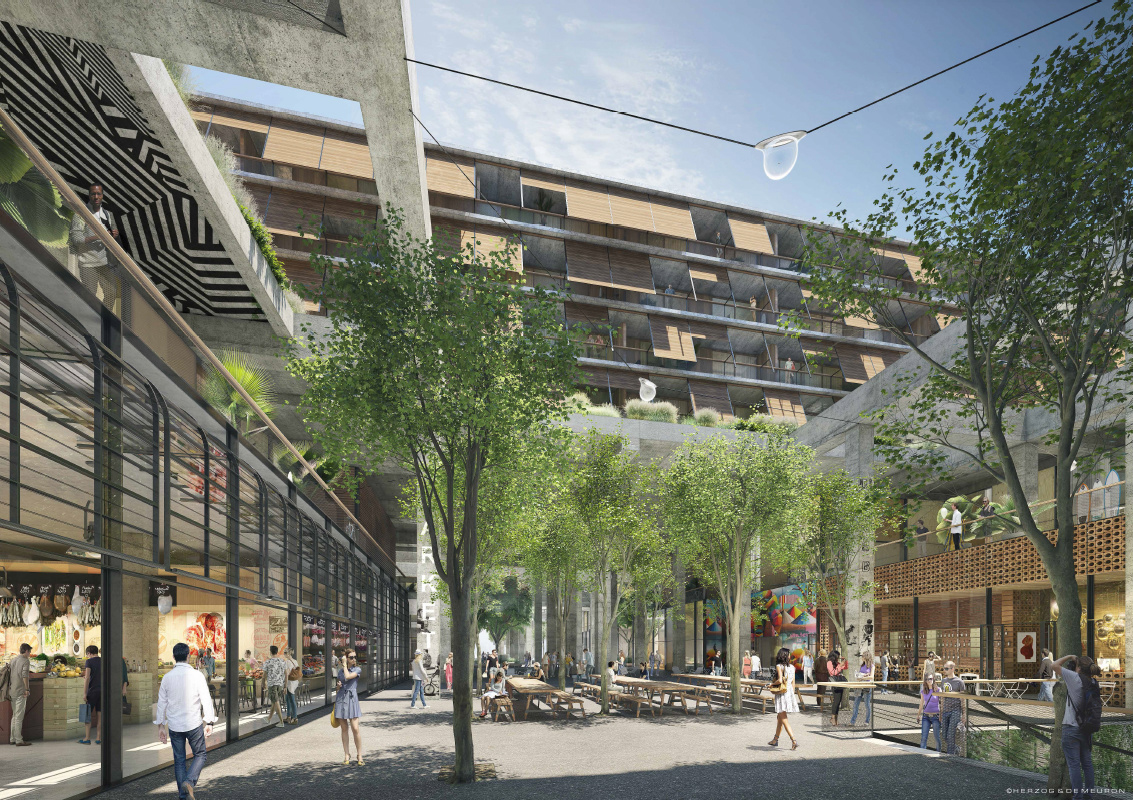
6AM project is the name of a massive mixed-use development proposed for downtown L.A.’s booming Arts District by the Swiss architects Jacques Herzog and Pierre de Meuron.

Herzog & de Meuron’s 6AM project—developed by Irvine, California–based developer SunCal and located in Los Angeles’s booming Arts District neighborhood—anytime soon are in for a long wait. Why? Because according to a preliminary report filed with the Los Angeles City Planning Department (LACPD), the $2 billion development is not expected to be completed until 2035. 

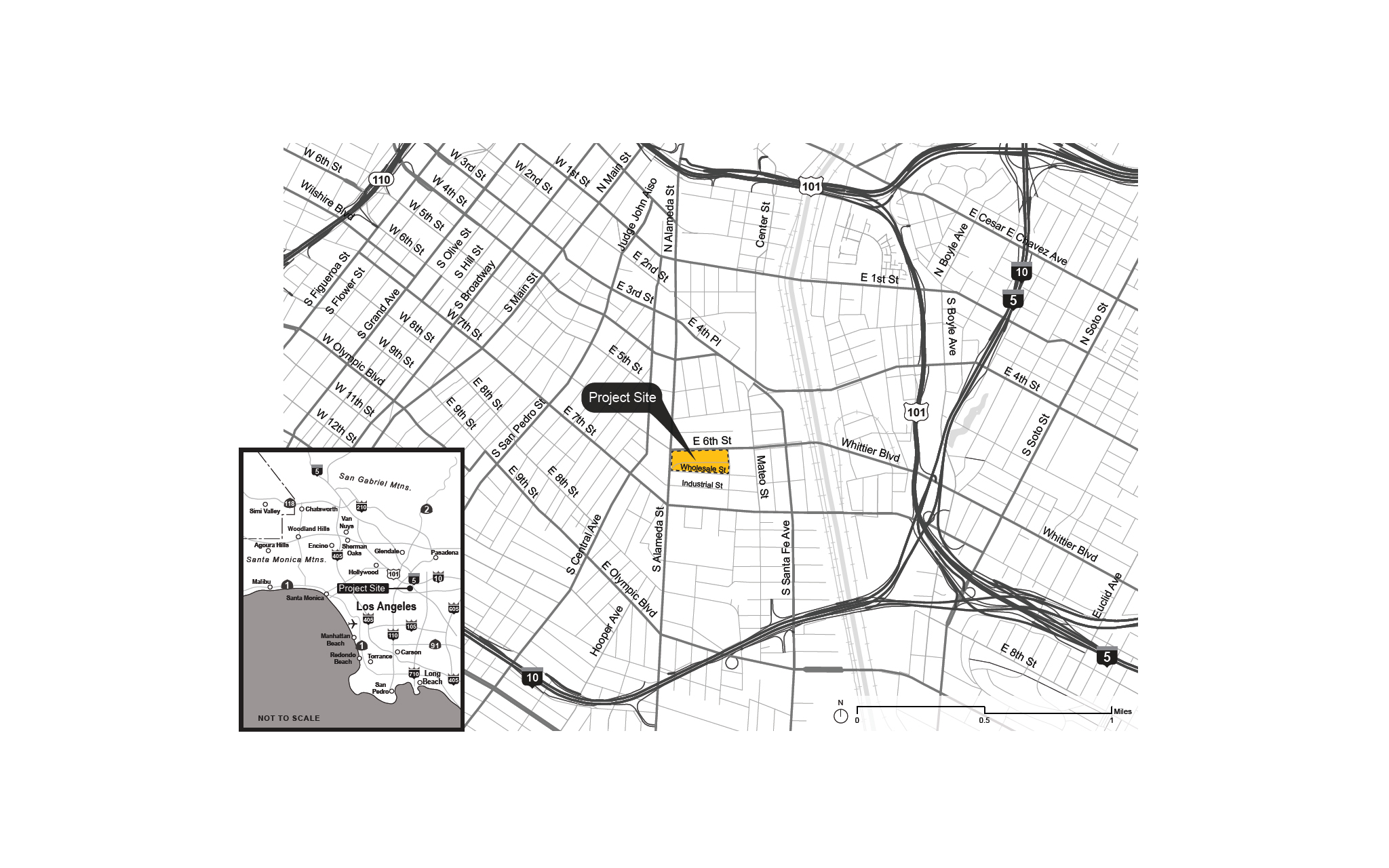
Called 6AM — for its location along 6th Street between Alameda and Mill streets — the project includes, two 58-story towers, 1.96 million square feet of residential space as well as shops, offices, a pair of hotels, room for a charter school and parking, most of it underground, for more than 3,400 cars. These elements, plus eighteen years and two billion dollars make up the fundamental elements of Herzog & de Meuron's city-like mixed-used development "6 AM." It will begin its first phase of construction in 2018 in downtown L.A.'s Arts District andwon't be finished until its principal architects are both 85 years old.
 
However, this is clear, no one can stop the dawn of high-concept gentrification from breaking all over the district of former abandoned warehouses, especially when that concept promises to embody the so-called "DNA"of Los Angelestemas.


Descripción del proyecto por Herzog & de Meuron

The Project includes an integrated mix of residential, community-serving commercial, hospitality, educational, office, and cultural uses within seven new buildings dispersed across the Project Site. specifically, the Project would provide 412 hotel guest rooms with related conference and hotel amenities, 1,305 residential apartments, 431 residential for-sale condominium units, approximately 253,524 square feet of office space, an approximately 29, 316-square-foot school, approximately 127,609 square feet of community-serving commercial space, and approximately 22,429 square feet of art space. In total, the Project includes approximately 2,824,245 square feet of floor area with an associated floor area ratio (FAR) of 4.44 to 1 based on the lot area of 635,566 after street dedications. The Project would also provide 3,441 parking spaces to accommodate the proposed uses. To provide for the new uses, the existing produce warehouse and distribution facility would be removed.

The Project would involve the development of a range of building types and heights that are based on the existing building typologies that are present withim the Project vicinity. Specifically, the Project would include seven buildings that would range in height from 110 feet to up to 732 feet. The design of the Project is intended to incorporate rough, "authentic," and typical industrial construction materials, consistent with existing buildings in the Arts District.

The Project would also include a number of open space areas and recreational amenities spread withim all seven of the proposed buildings and their surroundings. Open space and recreational amenities would include promenades, walkways that would provide connectivity throughout the Project Site, outdoor pool and amenity decks and terraces for the residential and hotel uses, a school park, numerous outdoor plazas and courtyards for use by the public, and private residential balconies.


Read more
Read less

More information

Label
Architects
Text
Herzog and De Meuron
+ + copy Created with Sketch.
- + copy Created with Sketch.
Label
Location
Text
1206-1338 East 6th Street / 1205-1321 Wholesale Street, Los Angeles, CA. USA
+ + copy Created with Sketch.
- + copy Created with Sketch.

Herzog & de Meuron is an international architecture practice founded in 1978 in Basel, Switzerland, by Jacques Herzog and Pierre de Meuron, both born in Basel in 1950. The practice's work encompasses projects of different scales and programmes, from housing and cultural buildings to hospitals, stadiums, infrastructure, and urban developments. Its architecture is characterised by an ongoing investigation into materials, construction processes, and the relationship between buildings and their context.

Jacques Herzog (Basel, Switzerland, 1950) and Pierre de Meuron (Basel, Switzerland, 1950) studied architecture between 1970 and 1975 at the Swiss Federal Institute of Technology Zurich (ETH Zürich), where they were students of Aldo Rossi and Dolf Schnebli. Friends since childhood, they began a professional partnership that has maintained a close relationship between architectural practice, research, and teaching.

Jacques Herzog was a visiting professor at Cornell University in 1983. Both architects taught as visiting professors at Harvard University Graduate School of Design in 1989 and between 1994 and 2014, and were professors at ETH Zürich from 1999 to 2018. They also co-founded ETH Studio Basel – Contemporary City Institute, a research programme focused on processes of urban and territorial transformation.

During its early years, the practice gained international recognition with projects such as the Blue House in Oberwil (1980), the Ricola Storage Building in Laufen (1987), the Stone House in Tavole (1988), and Dominus Winery in Yountville, California (1998). These projects helped establish an architectural approach based on material experimentation, the reinterpretation of construction systems, and the exploration of new relationships between structure, building envelope, and space.

The practice's international reputation grew significantly with the transformation of the former Bankside Power Station into Tate Modern in London (2000), one of the most influential cultural adaptive reuse projects of recent decades. This was followed by buildings such as Schaulager in Münchenstein (2003), Prada Aoyama in Tokyo (2003), the de Young Museum in San Francisco (2005), Allianz Arena in Munich (2005), CaixaForum Madrid (2008), the Beijing National Stadium (2008), VitraHaus in Weil am Rhein (2010), and the Elbphilharmonie in Hamburg (2017).

The practice has also expanded its work into museums, collective housing, educational and healthcare buildings, and urban transformation. Notable projects include Pérez Art Museum Miami (2013), the extension of Tate Modern in London (2016), the residential tower at 56 Leonard Street in New York (2017), the Tai Kwun cultural centre in Hong Kong (2018), the M+ museum in Hong Kong (2021), and the extension of Museum Küppersmühle in Duisburg (2021).

In recent years, Herzog & de Meuron has completed projects including the University Children's Hospital Zurich (2024), the Roche pRED research centre in Basel (2024), the Hortus office building in Allschwil (2025), the new Lombard Odier headquarters in Bellevue, Geneva (2025), Calder Gardens in Philadelphia (2025), and the transformation of Marcel Breuer's building on Madison Avenue in New York for Sotheby's (2025). Further projects followed in 2026, including Titlis Tower in Engelberg and the Ford Student Center at Amherst College in Massachusetts.

A distinctive aspect of the practice's work has been its collaboration with artists from different generations, including Rémy Zaugg, Thomas Ruff, and Michael Craig-Martin, alongside projects exploring the relationships between architecture, contemporary art, and public space.

Herzog & de Meuron currently employs more than 500 professionals from approximately 50 countries. The practice maintains its headquarters in Basel, with offices in cities including Berlin, Barcelona, Hong Kong, London, Munich, New York, Paris, and San Francisco. Its leadership structure comprises the founding partners, Jacques Herzog and Pierre de Meuron, together with a team of senior partners, partners, and associate partners. Senior partners include Christine Binswanger, Ascan Mergenthaler, Stefan Marbach, Jason Frantzen, Andreas Fries, and Wim Walschap, who became Chief Executive Officer of the practice in May 2026.

In 2001, Jacques Herzog and Pierre de Meuron were awarded the Pritzker Architecture Prize. In 2007, they received the Royal Gold Medal from the Royal Institute of British Architects (RIBA) and the Praemium Imperiale from the Japan Art Association, followed by the RIBA Jencks Award in 2015. That same year, they established the non-profit institution Jacques Herzog und Pierre de Meuron Kabinett, dedicated to preserving, researching, and sharing their collections of architecture, art, and photography.

Read more
Published on: February 28, 2017
Cite:
metalocus, DANIEL MADERA
"6 AM in DTLA Arts District. New details revealed by Herzog & de Meuron " METALOCUS. Accessed
<https://www.metalocus.es/en/news/6-am-dtla-arts-district-new-details-revealed-herzog-de-meuron> ISSN 1139-6415
Loading content ...
Loading content ...
Loading content ...
Loading content ...
Loading content ...
Loading content ...
Loading content ...
Loading content ...
Loading content ...
Loading content ...
Loading content ...
Loading content ...
Loading content ...
Loading content ...
Loading content ...
Loading content ...
Loading content ...
Loading content ...
Loading content ...
Loading content ...
Loading content ...
Loading content ...
Loading content ...
Loading content ...
Loading content ...
Loading content ...
Loading content ...
Loading content ...
Loading content ...
Loading content ...
Loading content ...
Loading content ...
Loading content ...
Loading content ...
Loading content ...
Loading content ...
Loading content ...
Loading content ...
Loading content ...
Loading content ...
Loading content ...
Loading content ...
Loading content ...
Loading content ...
Loading content ...
Loading content ...
Loading content ...
Loading content ...
Loading content ...
Loading content ...
Loading content ...
Loading content ...
Loading content ...
Loading content ...