


"Illa Glòries", by Cierto Estudio, aims to foster community life through courtyards and rooftops connected to the apartments by exterior walkways, creating flexible, interconnected, adaptable, and permeable spaces.
Replicable models of affordable housing are generated, responding to the city's pressing needs. Each apartment is organized around a rotated central space that multiplies connections and allows the home to adapt to changing family needs. The kitchen, contrary to the norm, is located on the south facade, recognizing domestic work as a fundamental pillar of family life and giving this space a new, gender-sensitive approach.
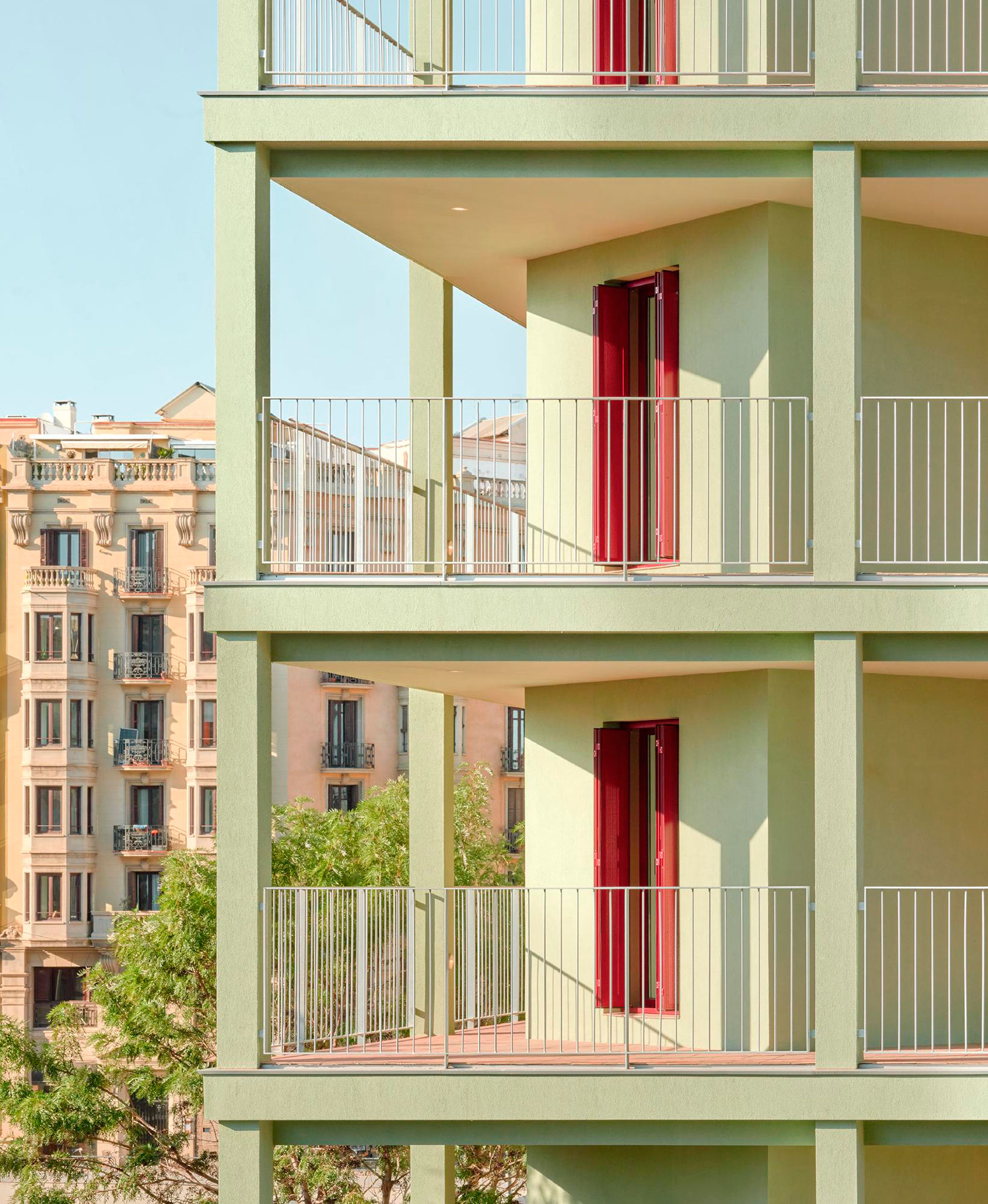
"Illa Glòries" by Cierto Estudio. Photograph by José Hevia.
Sustainable construction is prioritized with a mixed structure of cross-laminated timber (CLT) for floors, walls, and facades, metal for walkways, and reinforced concrete for vertical circulation loops.
Project description by Cierto Estudio
Winning the 2017 international competition organized by the Institut Municipal de l'Habitatge i Rehabilitació de Barcelona (IMHAB), Cierto Estudio proposed a groundbreaking design for the Illa Glòries block, situated at the nexus of Barcelona's 22@ technological district and the historic Eixample neighborhood.
This ambitious project involves the construction of 238 apartments. Building A, designed by Cierto Estudio, includes 51 dwellings and reflects a holistic approach to urban living. The design integrates gender perspective strategies, ensuring inclusivity and adapting to diverse family structures.
Designed with a gender perspective, the project promotes equity, safety, and shared responsibility in domestic and caregiving tasks. By incorporating spatial strategies that encourage interaction, mutual support, and visibility of caregiving activities, the design fosters an inclusive environment that adapts to diverse family structures.
Extensive Communal Spaces
Two large courtyards and continuous communal balconies encourage interaction among neighbors while providing secure and vibrant environments for socializing and relaxation. The arrangement of homes around these shared spaces follows a "corrala" layout, a strategy that cultivates a network of mutual vigilance and enhances collective security, particularly relevant from a gender perspective, as it helps reduce risks associated with gender-based violence. The spatial configuration ensures crossed sightlines, reinforcing a naturally protected environment. The courtyards are shielded from public activity yet visually connected to the street, blending privacy with openness. The balconies act as outdoor meeting points, linking residences to shared spaces like patios and rooftops, thus transforming them into integral parts of everyday life.

Dynamic Living Spaces
Flexible apartment layouts prioritize adaptability, ensuring that homes can evolve with the changing needs of their occupants. Each residence is designed to de-hierarchize living spaces, eliminating a main central area or a predefined space for a dominant figure. Instead, rooms of similar size and character allow residents to distribute space freely according to their needs, promoting equity in everyday life. The design also integrates a thoughtfully positioned kitchen that enhances connectivity within the home and fosters an inclusive environment. Additionally, hinged spaces and centrally located rooms create opportunities for both physical and visual connections, promoting individual autonomy as well as communal living.

Environmental Responsibility
The project adheres to NZEB (Nearly Zero Energy Building) standards, employing cross-laminated timber (CLT) for its structure, maximizing thermal insulation, and integrating passive design strategies such as cross-ventilation, solar protection, and green roofs. Over 60% of the site is dedicated to green spaces, mitigating the urban heat island effect.


