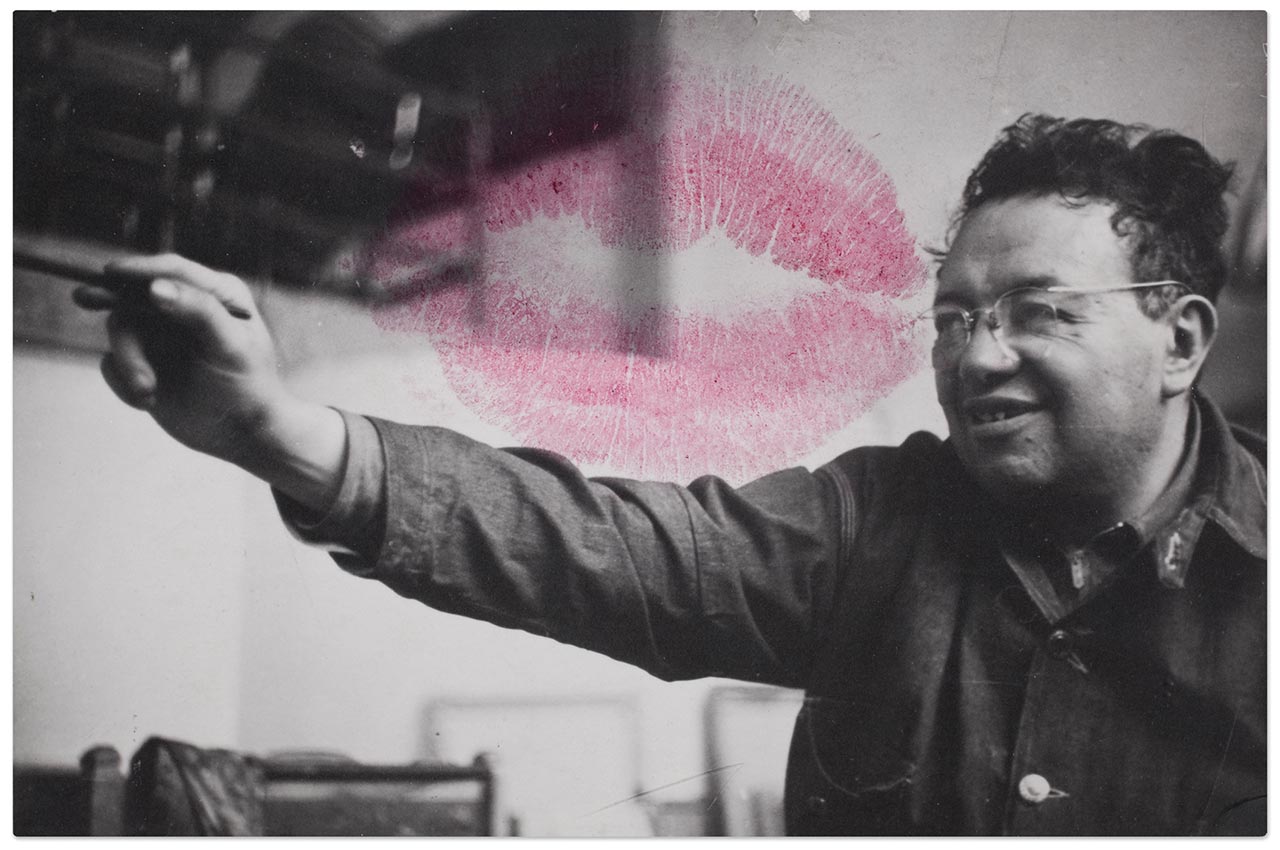
Yesterday, the Museum Marta Herford kicks off its anniversary year with intimate insights into the life of Frida Kahlo. The Mexican artist is world famous for her colour-intensive pictures, but it was only 50 years after her death that a huge private photo archive was discovered which documents her life and collecting in black and white.

For the first time in Germany, Marta Herford presents an exquisite selection: 241 photographs which served the artist as mementores, a source of inspiration and working material. Pictures by important photographers such as Man Ray, Martin Munkácsi, Brassaï and others are combined with photos by unknown photographers and by Frida Kahlo herself to form compelling document of her time.

I recommend her to you, not as a husband but as an enthusiastic admirer of her work, acid and tender, hard as steel and delicate and fine as a butterfly's wing, loveable as a beautiful smile, and profound and cruel as the bitterness of life.

Diego Rivera

Marta Herford begins the exhibition season 2015 with the extraordinary exhibition project "Frida Kahlo – the photos". In cabinets reminiscent of the colours in Kahlo's paintings, more than 60 years after the death of the Mexican artist (1907–1954) the museum is showing a selection from her extensive photo archive which was presented to the public for the first time in 2007. In her treasure trove of pictures Frida collected photos of friends, of her family, of Diego Rivera, but also of herself taken by unknown photographers. The first presentation of her collection in Germany comprises 241 photographs put together by Pablo Ortiz Monasterio for the Museo Frida Kahlo in Mexico. In six central theme areas ranging from the origins to the blue house, her damaged body, her loved ones, right up to politics, revolution and Diego, the exhibition illuminates the important role that the photographic image played in the life of the painter Frida Kahlo.

The medium of photography took on a special significance from an early age for the daughter of a German—Hungarian professional photographer who emigrated from Germany to Mexico at the age of 18. The numerous portraits that Guillermo Kahlo made of his daughter display not only her self-confident manner in front of the camera but also left Frida with a deep consciousness of the graphic power of self-staging. Works by famous photographers such as Man Ray, Martin Munkácsi, Brassaï, Tina Modotti, Lola and Manual Álvarez Bravo as well as Edward Weston are mixed with pictures of writers or artists who were her friends or who she admired.

The life and work of Frida Kahlo are inextricably interwoven with each other, which is also reflected in her photo collection. Her damaged body, her pain and suffering, but also her loves, are recurrent themes in the photographs. Nickolas Muray, with whom she also had a relationship, shows her in very intimate and vulnerable poses. Other photos are evidence of how her body was increasingly scarred by illness. This image is interrupted by pictures showing her in the company of her friends, relaxing or partying – happy scenes that express her joie de vivre. It is also remarkable how she treated the photographs: for the artist they were treasured and familiar objects which she coloured and cut, marking them with thoughts and notes, and sometimes even with kisses.

Another room is dedicated to the subject of politics, revolution and Diego. The pictures make the political atmosphere of the times palpable. The documentations of industrial buildings such as the Ford works in Detroit are juxtaposed with the leaders of Russian socialism, Lenin, Trotsky and Stalin. Many of the photos also show the Mexican artist Diego Rivera to whom Frida was married from 1929 and who remained a focal point of her romantic and emotional life.

Venuew.- Marta Herford Museum. Goebenstr. 2–10, 32052 Herford. Germany.
Dates.- 1 February to 10 May 2015.

Title Frida Kahlo – Her photos.
Curator.-. Pablo Ortiz Monasterio.
Exhibition organizers at Marta Herford.- Roland Nachtigäller (artistic director). Ann Kristin Kreisel (assistant curator). Friederike Fast (curator).
Exhibits 241 photographs.
Artists Frida Kahlo; Man Ray, Martin Munkácsi, Edward Weston, Brassaï, Tina Modotti and others.
Exhibition area ca. 400 m²

Read more
Read less

More information

José Juan Barba (1964). Architect from the Madrid School of Architecture (ETSAM) in 1991. He received his PhD in Architecture from ETSAM in 2004, graduating summa Cum laude with the doctoral thesis "Inventions: New York vs. Rem Koolhaas, Bernard Tschumi, Piranesi." In 1991, he received a Special Mention in the Spanish National Graduation Awards. Until 1997, he worked as an advisor to several NGOs. In 1992, he founded his architectural practice in Madrid (www.josejuanbarba.com). 

He is an architectural critic and, since 1998, Editor-in-Chief of the internationally acclaimed bilingual architecture journal METALOCUS (Spanish/English), recipient of several national and international awards.

Barba is an Associate Professor at the University of Alcalá and a member of several research groups. He has been invited to participate in numerous international forums on architecture and urbanism, including the II Forum of Mexican World Heritage Cities, Urban Development, History and Modernity, organized by the Pan-American Committee for Urban Development and Historical Heritage; the World Urban Development Forum (FMDU), held in Culiacán, Sinaloa, Mexico; and the International Conference on Architecture and Urbanism from the Perspective of Women Architects. He has also been invited as lecturer and guest critic at numerous national and international institutions, including the National Building Museum, Roma Tre University, Politecnico di Milano, University of Genoa, Université Pierre Mendès France Grenoble, the Madrid and Barcelona Schools of Architecture, National Autonomous University of Mexico, the Faculty of Architecture in Montevideo, the Schools of Architecture of Medellín and Ecuador, Universidad Iberoamericana, IE University, as well as the Schools of Architecture of Zaragoza, Valladolid, Málaga, Granada, Seville, and A Coruña, among others.

He has extensive professional experience in architecture, urbanism, landscape intervention, and territorial regeneration. His work has received numerous awards, including First Prize in the “Gran Vía Posible” competition for Delirious Gran Vía, Madrid; recognition for the Rivers Interpretation Centre in Zamora, awarded and exhibited at the World Architecture Festival 2008; and recognition for the Santa Bárbara Park project in Toledo. He was also awarded the Erich Degner Prize for Architecture (1995), promoted by the BBVA Foundation. His project for a Day Centre for the Elderly was included in Volume 3 of the Madrid Architecture Guide published by the Official College of Architects of Madrid (COAM) in 2007. His work has been widely published in national and international books and journals.

He served as Maître de Conférences at the Institut d’Urbanisme de Grenoble, Université Pierre Mendès France Grenoble, during the 2013–14 academic year, following his appointment through a European open competition. His work has been published internationally. He regularly serves on academic and professional juries, including the editorial competition jury for the journal Quaderns (2011), the selection committee for the European Union Prize for Contemporary Architecture – Mies van der Rohe Awards (2007–present), and the jury panels for EUROPAN 13 (2015–16) and TRANSFER, Zurich (2019). He was also invited to participate in the Biennale di Venezia 2016 as part of the exhibition Spaces of Exception / Spazi d’Eccezione.

He has authored several books, including "The Dark Line. michele&miquel, dA Vision Design" (2024), "CONGRESO ANYWAY. La ciudad de las ciudades" (2020), "#Positions" (2016), and "Inventions: New York vs. Rem Koolhaas, Bernard Tschumi, Piranesi" (2015). He has also contributed to publications such as "Espacio público Gran Vía. La Ciudad del Turismo" (2020), "Spaces of Exception / Spazi d’Eccezione" (2016), "La manzana de la discordia" (2015), and "Contemporary Japanese Architecture: New Territories" (2015), as well as chapters in numerous books, including "Women Architects: A Professional Challenge" (2009), "21st Century Architectures" (2007), "Ruta de la Plata, New Conquerors of Space" (2019), and "The City of Tourism" (2020).

Selected awards include:

•    “SANTIAGO AMÓN” AWARD, award for the promotion of architecture, COAM Madrid, 2000.
•    “PANAYIOTI MIXELI AWARD,” SADAS-PEA, award for the promotion of architecture, Athens, 2005.
•    “PIERRE VAGO” ICAC. International Committee of Art Critics Award, London, 2005.
•    FAD Award 07, Ephemeral Interventions, First Prize, M.C. Escher Exhibition, Arquin-FAD, Barcelona, 2007.
•    World Architecture Festival, Center for Research and Interpretation of the Rivers, Tera, Esla, and Órbigo, Finalist, Barcelona, 2008.
•    Gran Vía Posible, First Prize, Delirious Gran Vía, Madrid, 2010.
•    Reform of the Río Segura Surroundings, Award, Murcia, 2010.

Read more

Frida Kahlo (Coyoacán, Mexico City, July 6, 1907–Coyoacán, Mexico City, July 13, 1954). Magdalena Carmen Frida Kahlo Calderón, born Magdalena Carmen Frida Kahlo Calderón, was a Mexican painter whose work developed one of the most distinctive explorations of identity, the body, and Mexican culture in twentieth-century art. Although her career was closely connected to Diego Rivera and to the artistic environment that emerged after the Mexican Revolution, her painting maintained an independent position, far removed from the monumental scale and predominantly public character of muralism.

The daughter of photographer Guillermo Kahlo and Matilde Calderón, she grew up in the Casa Azul in Coyoacán, later converted into the Frida Kahlo Museum. Photography was deeply present in her family environment and played a constant role in the construction of her own image. The photographic archive she preserved throughout her life, also addressed by METALOCUS on the occasion of the exhibition Frida Kahlo – Her Photos, includes works by figures such as Tina Modotti, Edward Weston, Man Ray, Brassaï, Lola and Manuel Álvarez Bravo, and Nickolas Muray.

At the age of six, she contracted polio, which affected her right leg. She later studied at the National Preparatory School in Mexico City. On September 17, 1925, at the age of eighteen, she suffered a serious accident when the bus in which she was travelling collided with a streetcar. The numerous injuries and the prolonged period of immobility that followed had a profound impact on her life, and during her convalescence she began to paint systematically.

From then on, the body became one of the main territories of investigation in her work. Kahlo repeatedly turned to self-portraiture to address identity, illness, physical pain, sexuality, frustrated motherhood, and her relationship with the social and political environment. However, her painting cannot be reduced to autobiographical transcription. Her images incorporate elements from Mexican ex-votos, colonial portraiture, popular traditions, pre-Hispanic art, and modern visual culture, articulated through a deeply personal iconography.

By the end of the 1920s, she had entered the artistic and political circles that included, among others, Tina Modotti and Diego Rivera. Kahlo and Rivera married on August 21, 1929. During the following years, they lived in different places in Mexico and the United States, coinciding with Rivera’s major mural commissions in San Francisco, Detroit, and New York. They divorced in 1939 and remarried in San Francisco on December 8, 1940.

Her stays in the United States were also decisive for Kahlo’s independent career. While Rivera was producing his large mural cycles, she continued working on small- and medium-scale paintings that differed radically from muralism’s monumentality. Works such as Henry Ford Hospital (1932), My Birth (1932), and My Dress Hangs There (1933) combined personal experience with a critical view of American society and industrialisation.

Her international recognition consolidated during the second half of the 1930s. In 1938 André Breton visited Mexico, encountered her work, and attempted to place it within Surrealism. That same year, Julien Levy organised Kahlo’s first solo exhibition in New York. In 1939 she travelled to Paris at Breton’s invitation and participated in the exhibition Mexique, organised with Marcel Duchamp’s collaboration at Galerie Renou et Colle. In that context, the French state acquired The Frame (1938), now held by the Centre Pompidou. Kahlo, however, repeatedly rejected the idea that her painting should be understood as a representation of dreams, insisting instead that she painted her own reality.

Mexican identity occupies a central position within that pictorial reality. Kahlo incorporated plants, animals, domestic objects, traditional clothing, and references to Indigenous cultures and popular art into her work. This visual construction also extended to her public presence: traditional dress, pre-Hispanic jewellery, and the deliberate construction of her photographic portraits formed part of a visual identity inseparable from her painting.

Among her best-known works are The Two Fridas (1939), Self-Portrait with Cropped Hair (1940), The Broken Column (1944), and The Wounded Deer (1946). In these works, self-portraiture ceased to function simply as physical representation and became an instrument through which she explored questions of gender, cultural identity, politics, and bodily experience.

Her political commitment was equally constant. Kahlo was closely linked to Mexican communism and actively participated in the left-wing political circles of her time. Together with Rivera, she was involved in the efforts that enabled Leon Trotsky to settle in Mexico in 1937; Trotsky and Natalia Sedova initially lived at the Casa Azul. Her political militancy remained present until the final years of her life.

During the 1940s, Kahlo gained an increasing presence in international institutions and exhibitions and also developed a teaching activity. Her deteriorating physical condition required numerous operations and long periods of hospitalisation, although she continued painting and participating in Mexican artistic life.

In 1953, Lola Álvarez Bravo organised at her Galería de Arte Contemporáneo in Mexico City the only solo exhibition of Kahlo’s work held in Mexico during the artist’s lifetime. Her health was already extremely poor, but Kahlo attended the opening lying in a bed.

Frida Kahlo died on July 13, 1954, at the Casa Azul in Coyoacán, a few days after her forty-seventh birthday. The house opened as a museum in 1958, preserving a fundamental part of her works, objects, documents, and domestic spaces.

In the decades following her death, appreciation of her work grew until she became one of the central figures of twentieth-century art. Beyond the extraordinary popular circulation of her image, her historical significance lies in the development of a highly individual pictorial language in which body, identity, Mexican culture, biographical experience, and politics are integrated without being subordinated to any of the artistic movements with which she was associated.

Read more
Published on: February 2, 2015
Cite:
metalocus, JOSÉ JUAN BARBA
"Frida Kahlo – Her photos" METALOCUS. Accessed
<https://www.metalocus.es/en/news/frida-kahlo-her-photos> ISSN 1139-6415
Loading content ...
Loading content ...
Loading content ...
Loading content ...
Loading content ...
Loading content ...
Loading content ...
Loading content ...
Loading content ...
Loading content ...
Loading content ...
Loading content ...
Loading content ...
Loading content ...
Loading content ...
Loading content ...
Loading content ...
Loading content ...
Loading content ...
Loading content ...
Loading content ...
Loading content ...
Loading content ...
Loading content ...
Loading content ...
Loading content ...
Loading content ...
Loading content ...
Loading content ...
Loading content ...
Loading content ...
Loading content ...
Loading content ...
Loading content ...
Loading content ...
Loading content ...
Loading content ...
Loading content ...
Loading content ...
Loading content ...
Loading content ...
Loading content ...
Loading content ...
Loading content ...
Loading content ...
Loading content ...
Loading content ...
Loading content ...
Loading content ...
Loading content ...
Loading content ...
Loading content ...
Loading content ...
Loading content ...