The Madrid-based studio, Sancho-Madridejos Architecture Office, has developed the project in the Cantalares urbanization in Murcia to design a residential complex with great diversity between housing types, as well as the insertion of a singular element visible in the environment as a point of reference.

These premises, together with the conditions of the plot, have generated the solution of the elaborated proposal. The project results in a complex made up of two longitudinal bars adapted to the geometry of the site, which alternates with the outdoor spaces of a private nature and for community use.
The project of Sancho-Madridejos Architecture Office results in a hybrid typology of single-family houses in a row, which are also grouped in blocks of four heights. In this way, two bands of dwellings (A-B and C-D) are superimposed on each of the bars, each with two levels connected internally.

All the typologies of housing are planned as patio houses, open to the south and to the views of the valley, where each of these patio houses enjoys a succession of interior and exterior spaces in continuity. They have a design that allows cross ventilation, shaded spaces that protect the interior, and the use of natural light and views.

The common spaces of each of the three strata are treated differently and singularly, with special prominence of the central space, at the eastern end of which is the space of shadow, water, and air, covered by a singular cover-fold and in whose interior a microclimate created by the water is generated, the channelled air that refreshes the environment and the shade that the roof generates.
 

39 homes and common areas in Cantalares by Sancho-Madridejos Architecture Office. Photograph by Imagen Subliminal.- Miguel de Guzmán + Rocío Romero
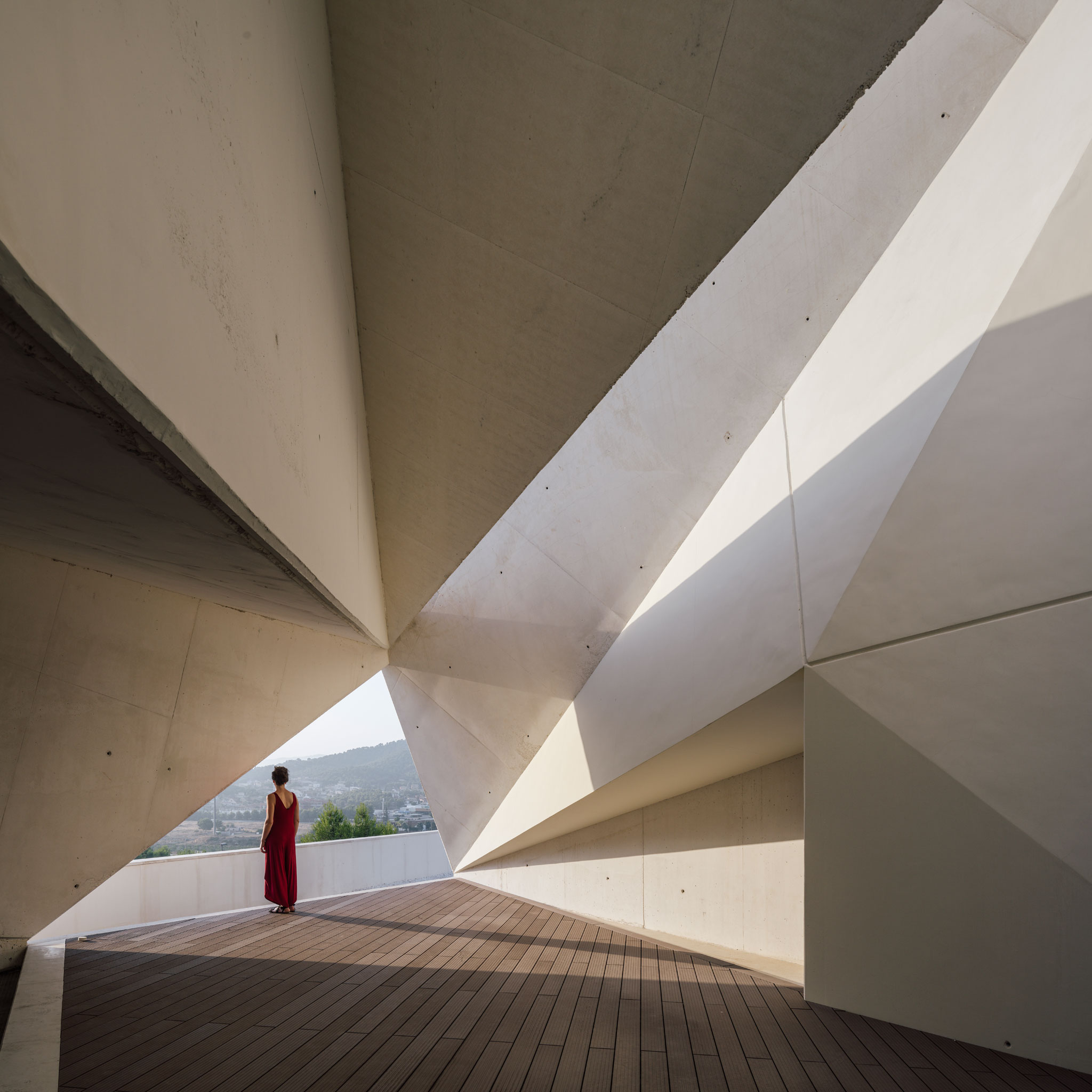

39 homes and common areas in Cantalares by Sancho-Madridejos Architecture Office. Photograph by Imagen Subliminal.- Miguel de Guzmán + Rocío Romero
 

Description of project by Sancho-Madridejos Architecture Office

The project arises initially as a response to the particular requests of a private client: on the one hand, to design a residential complex with the greatest diversity among dwellings and, on the other hand, to include a singular element visible from the environment as a point of reference and that forms part of our research work around folds.

This starting point, together with the specific conditions of the site, such as the considerable south-facing slope and its irregular shape, has led to the proposed solution.

Based on these premises, the project is conceived as a set composed of two longitudinal bars adapted to the geometry of the site, which alternates with the outdoor spaces of a private nature and for community use.

The natural slope of the land allows the plot to be laid in the three strata with a fall in the North-South direction, on which the two residential bars are supported. Each of the levels corresponds to one of the communal outdoor spaces, from which there is direct access from the outside to each of the homes in continuity with the exterior layer.

In this way, a hybrid typology of single-family row houses is generated grouped in 4-story blocks.

Thus, in each of the bars, two bands of dwellings (A-B and C-D) are superimposed, each with two levels connected internally. All of them are planned as courtyard houses, open to the south and the views of the valley. Each of these patio homes enjoys a succession of interior and exterior spaces in continuity, which allows cross ventilation, shaded spaces that protect the interior, and the use of natural light and views.

The four bands generate four base situations that unfold in different typologies depending on the situation and geometry and endow the project with great diversity within the common logic.

The common spaces of each of the three strata are treated differently and singularly, with special prominence of the central space, at the eastern end of which is the space of shadow, water, and air, covered by a singular cover-fold and in whose interior a microclimate created by the water is generated, the channelled air that refreshes the environment and the shade that the roof generates.

More information

Label
Architects
Text
Sancho-Madridejos Architecture Office. J.C. Sancho Osinaga, Sol Madridejos, Ana Vinagre. Responsible for construction management.- Gerardo Martín.
+ + copy Created with Sketch.
- + copy Created with Sketch.
Label
Design team
Text
Anja Lunge, Mafalda Ambrosio, Elena Castro, Enrique Tazon, Carlos Seco, Esther Jimenez, Loic Brunsard, Herve Lot, Lourdes Cardenas, Manuel Lagarto, Felix Bellido, Gabriel Bonis, Peio Erroteta, Victor Alonso.
+ + copy Created with Sketch.
- + copy Created with Sketch.
Label
Collaborators
Text
Construction management.- Luis García Anero - Laboratorio de Arquitectura Moderna. Structures.- PONDIO S.L. / BERNABEU INGENIEROS, S.L. Installations.- R.URCULO INGENIEROS CONSULTORES, S.A.
+ + copy Created with Sketch.
- + copy Created with Sketch.
Label
Client / Developer
Text
Altamira Santander Real Estate, S.A. + D.G. Asfaltos S.A.
+ + copy Created with Sketch.
- + copy Created with Sketch.
Label
Builder
Text
Sorkia Mediterraneo S.L.
+ + copy Created with Sketch.
- + copy Created with Sketch.
Label
Location
Text
Cantalares Urbanization, Murcia, Spain.
+ + copy Created with Sketch.
- + copy Created with Sketch.
Label
Photography
Text
Sancho-Madridejos.- Juan Carlos Sancho. Imagen Subliminal.- Miguel de Guzmán + Rocío Romero.
+ + copy Created with Sketch.
- + copy Created with Sketch.

Sancho-Madridejos Architecture Office (S-MAO) is an architecture studio founded in Madrid in 1982 by Juan Carlos Sancho and Sol Madridejos. Since then, they have developed their professional practice in the fields of architecture and urbanism, with projects encompassing public, cultural, educational and residential buildings, as well as urban interventions, both in Spain and internationally. Their work has evolved through an ongoing investigation into space and perception, closely linked to questions arising from the visual arts, theory and architectural thought.

Juan Carlos Sancho Osinaga (San Sebastián, 1957) is an architect from the Madrid School of Architecture (ETSAM), where he graduated in 1982. He received his PhD in Architecture from the same school in 1992 and was appointed Professor of Architectural Design at the Universidad Politécnica de Madrid in 2010, where he continues to teach at ETSAM. Throughout his career, he has been a visiting professor and has taught courses and given lectures at numerous international universities and schools of architecture.

Sol Madridejos (Madrid, 1958) is an architect from the Madrid School of Architecture (ETSAM), where she graduated in 1983. She has developed an extensive academic career, teaching Architectural Design at Universidad Europea de Madrid and Universidad CEU San Pablo, and serving as a visiting professor at institutions including the École Polytechnique Fédérale de Lausanne (EPFL). Her professional and academic practice has been complemented by courses, workshops and lectures at different schools of architecture.

Sancho and Madridejos have jointly taught courses, masterclasses and lectures at institutions including the Massachusetts Institute of Technology (MIT), the Pontificia Universidad Católica del Perú, the Universidad de los Andes in Bogotá, OTIS College of Art and Design in Los Angeles, the Architectural Association in London, the College of Architecture and Urban Planning at Tongji University in Shanghai, and the École Polytechnique Fédérale de Lausanne.

The studio’s work has received numerous awards and distinctions, including the Urbanism Award from the Colegio Oficial de Arquitectos de Madrid, the Urbanism Award from Madrid City Council, and the Best New Building Award in the Anthological Awards for Contemporary Architecture of Castilla-La Mancha for the Chapel in Valleacerón. In 2022, the IESE Business School Campus in Madrid received a COAM Mention, while the Chapel in Valleacerón received a COAM +10 Mention.

Their work has been widely published and exhibited internationally at institutions and events including the Museum of Modern Art (MoMA) in New York, the Venice Architecture Biennale, the National Building Museum in Washington, the Shanghai Urban Planning Exhibition Center, the RIBA in London, the Petit Palais and the Palais de Chaillot in Paris. Their work has also been featured in numerous international publications and monographs.

Read more
Published on: November 25, 2020
Cite:
metalocus, VALERIA OZUNA
"Hybrid typology and light. 39 homes and common areas in Cantalares by Sancho-Madridejos" METALOCUS. Accessed
<https://www.metalocus.es/en/news/hybrid-typology-and-light-39-homes-and-common-areas-cantalares-sancho-madridejos> ISSN 1139-6415
Loading content ...
Loading content ...
Loading content ...
Loading content ...
Loading content ...
Loading content ...
Loading content ...
Loading content ...
Loading content ...
Loading content ...
Loading content ...
Loading content ...
Loading content ...
Loading content ...
Loading content ...
Loading content ...
Loading content ...
Loading content ...
Loading content ...
Loading content ...
Loading content ...
Loading content ...
Loading content ...
Loading content ...
Loading content ...
Loading content ...
Loading content ...
Loading content ...
Loading content ...
Loading content ...
Loading content ...
Loading content ...
Loading content ...
Loading content ...
Loading content ...
Loading content ...
Loading content ...
Loading content ...
Loading content ...
Loading content ...
Loading content ...
Loading content ...
Loading content ...
Loading content ...
Loading content ...
Loading content ...
Loading content ...
Loading content ...
Loading content ...
Loading content ...
Loading content ...
Loading content ...
Loading content ...
Loading content ...