


Inspired by the logic of the ancient Chinese puzzle, Bioma's proposal for the "Tangram House" is defined by a simple outline, permeable to different, changing use scenarios. Like pieces in a game, activities such as sleeping, cooking, resting, or working activate a series of actions that enable multiple combinations. It is in this interaction that the open interior space truly comes to life.
Formally, the main square that shapes the house is punctuated by a rotated central courtyard, which interrupts the orthogonal order with a diagonal. For its construction, the prototype adopts a perimeter structure of galvanized columns and two sets of metal trusses: one follows the diagonals of the square, while the other connects intermediate points of the perimeter. In this way, the floor plan is completely free of interior supports, resulting in a compact and open volume, ready to accommodate diverse ways of living.
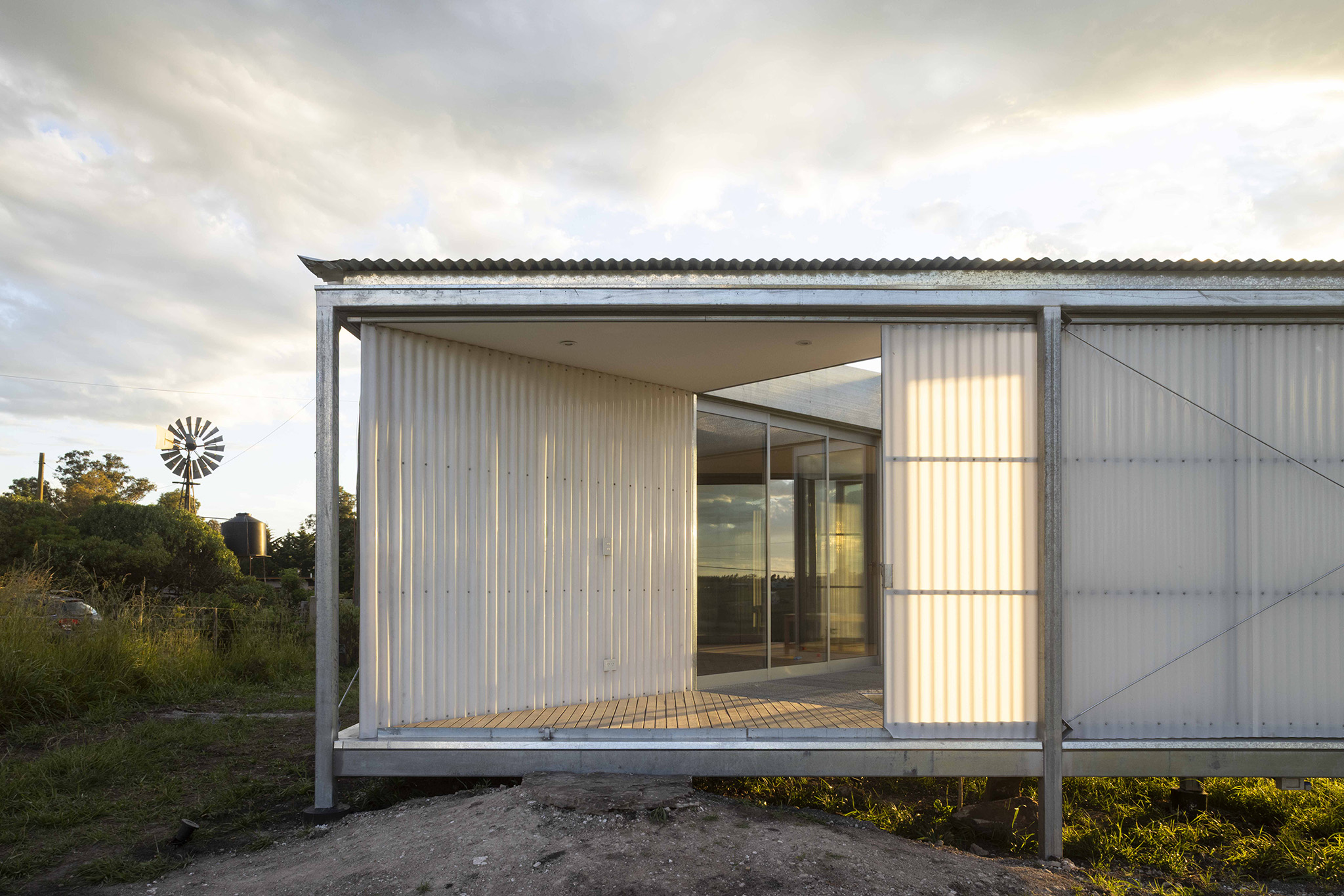
"Tangram House" by Bioma. Photograph by Luis Barandiarán.
Project description by Bioma
The Tangram House is conceived as a housing prototype: a lightweight structure that rests on stilts and barely touches the ground, a technical piece designed to be assimilated by the landscape rather than imposed upon it. A freestanding structure supports a continuous envelope that incorporates patios along its perimeter and thickens its edges to house services, storage, and intermediate spaces. This technologically advanced perimeter functions simultaneously as a support and a movable device: sliding and folding planes allow for integrating or softening the exterior, regulating air and light, opening up to the wetland and the horizon, or turning inward. The house thus explores an alternative construction logic, capable of coexisting with the natural environment while maintaining the necessary comfort and shelter.
The context is a unique neighborhood in Chapadmalal, composed of detached houses, without party walls, arranged like isolated pieces on the edges of a small wetland and a few blocks from the cliffs. A low-rise, dispersed community lives between the lagoon, the nearby sea, and a landscape still in transition between rural and coastal. In this scenario, the dwelling appears as an 8 x 8 m square, serving as the first prototype built for intermittent habitation.
In this design, a structure with a double geometry organizes the whole. The square, pierced by a courtyard rotated at its center, superimposes a diagonal line onto the orthogonal order of the perimeter. This diagonal lines orient the entrance, guide the circulation, and frame views of the small lagoon. The structure is resolved using perimeter galvanized columns and two sets of metal trusses: some follow the diagonals of the square, while others connect intermediate points along the edge. This framework completely frees the floor plan from interior supports and, at the same time, establishes the criteria for the openings and thicknesses of the project: the position of the courtyard, the openings in the roof, and the way in which the perimeter thickens to become a support for the living space.
Upon this structural support, the design matrix is mounted, inspired by the logic of the tangram: a simple outline, a limited number of operations, and many ways to combine them. Here, the pieces are no longer triangles or polygons, but verbs. Sleeping, cooking, resting, working, looking, opening, closing become the game pieces and colonize the structure: they occupy the thick edge, densify certain sections, empty others, organizing the interior space. In this first prototype, there are no bedrooms or rooms as defined enclosures; it is an open space where the configuration of the void, tensioned between patio and perimeter, delineates scenes of changing use. The same principle allows us to imagine future expansions—new attached squares with different internal configurations—and, on another scale, a system of houses or tangram modules that share a logic rather than a repeated form.

The materiality complements both the maritime climate and the condition of the structure. In an environment of salty air and high corrosion, the structure is built of galvanized steel and the envelope of translucent opalescent sheeting, which better withstands the coastal atmosphere and filters the light.
From the outside, the house is perceived as a compact and precise volume; From the inside, like a luminous and permeable chamber. A first inhabited square that, true to the logic of the tangram, keeps its subsequent combinations open.


