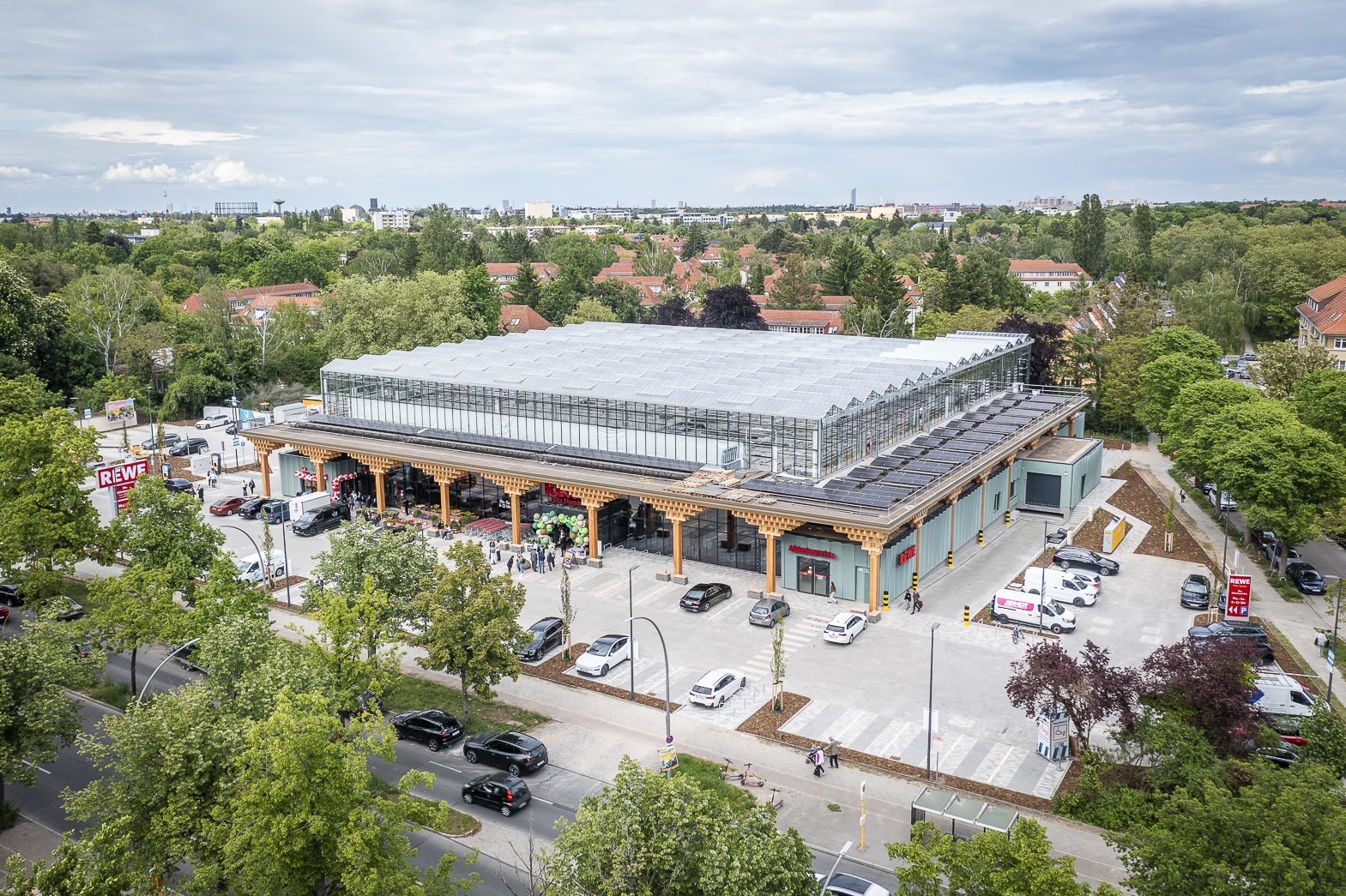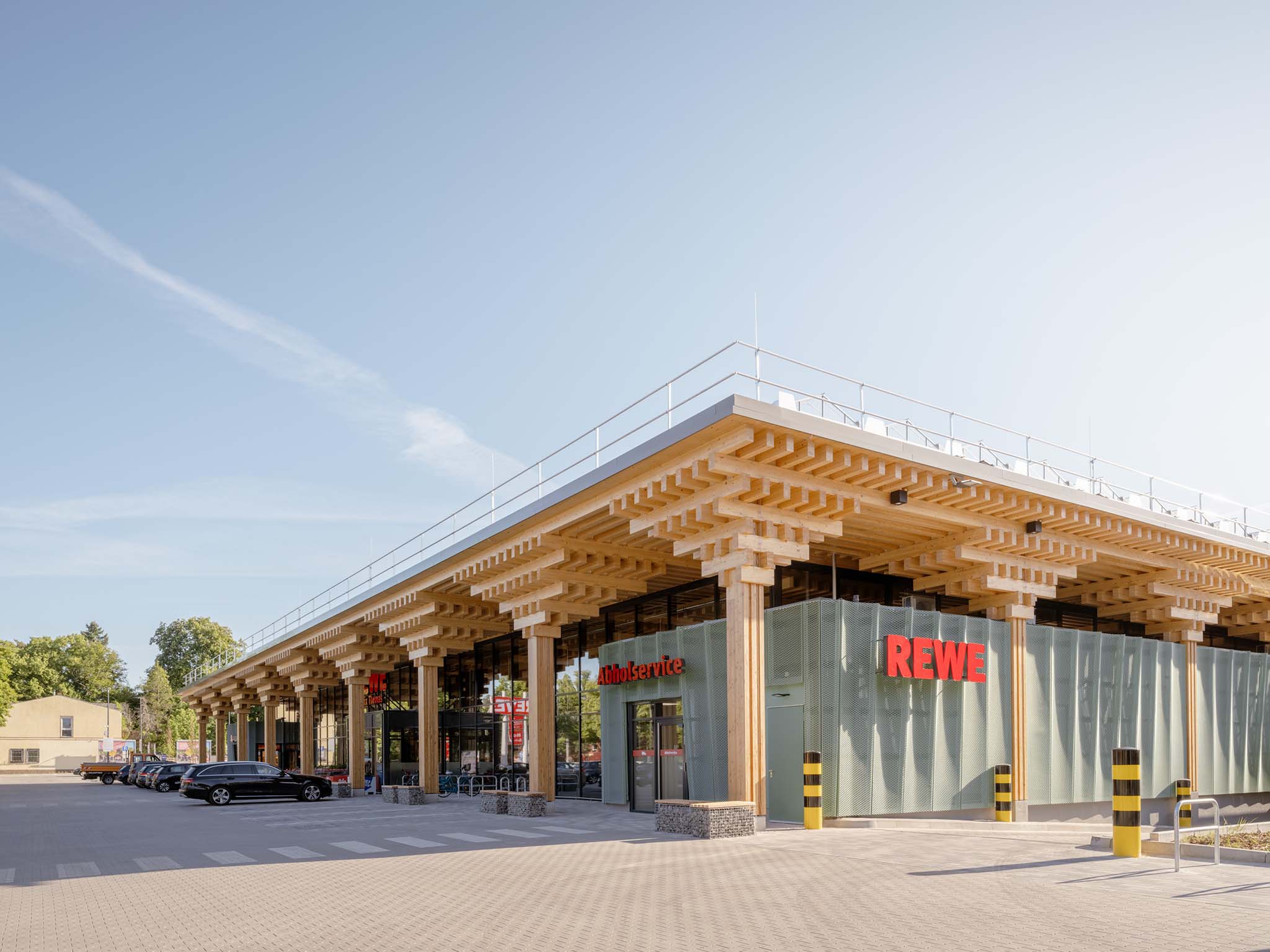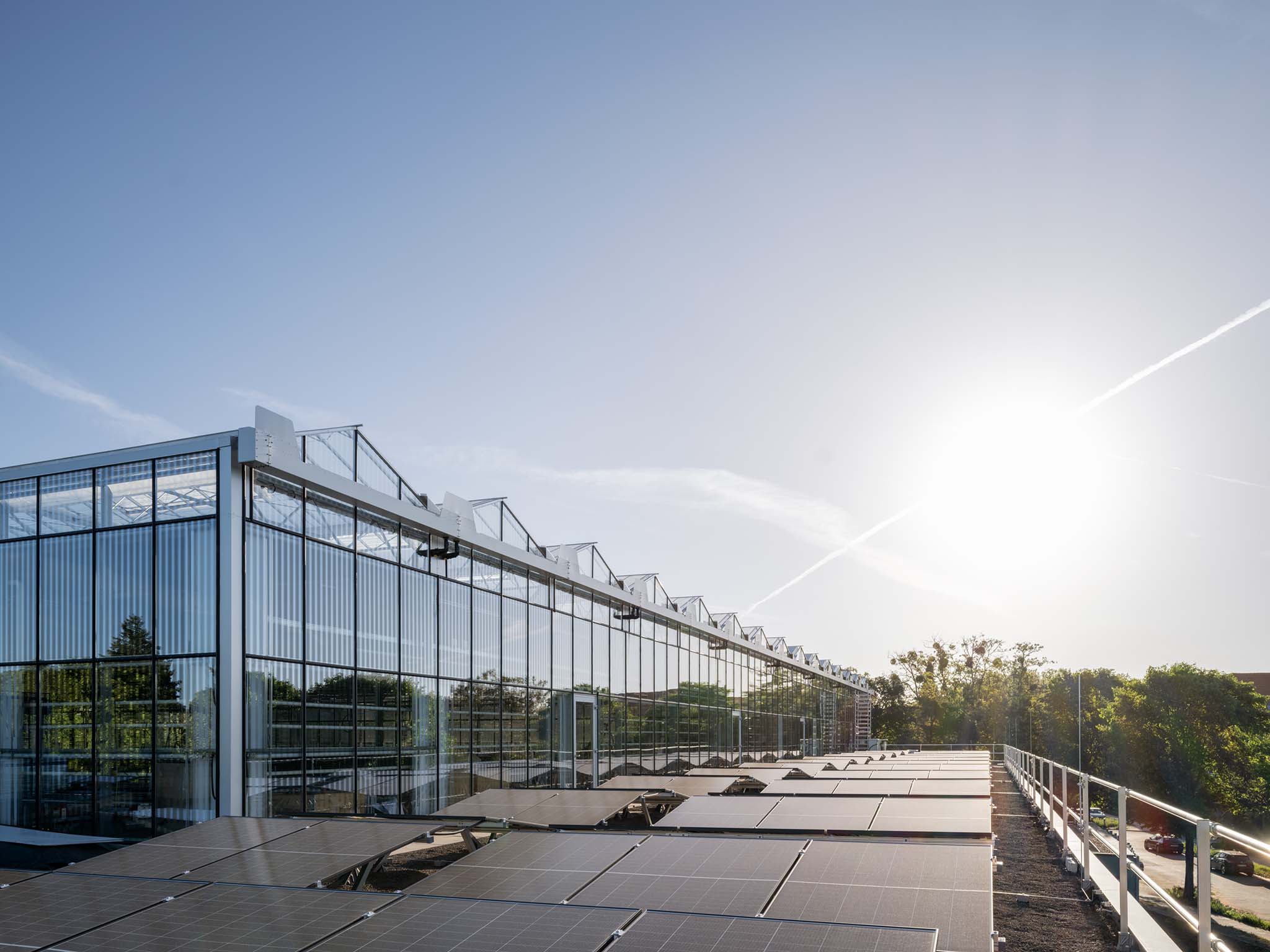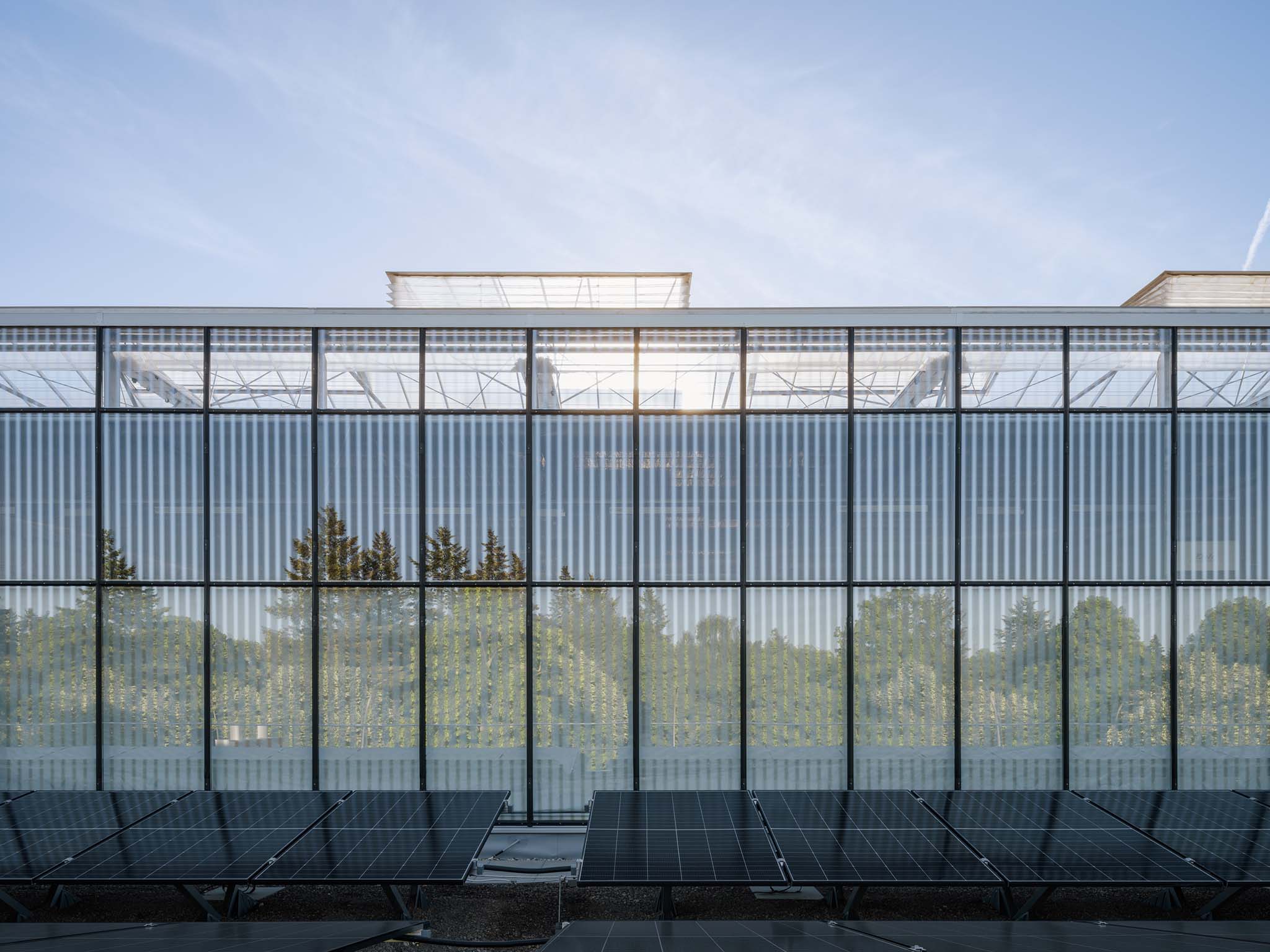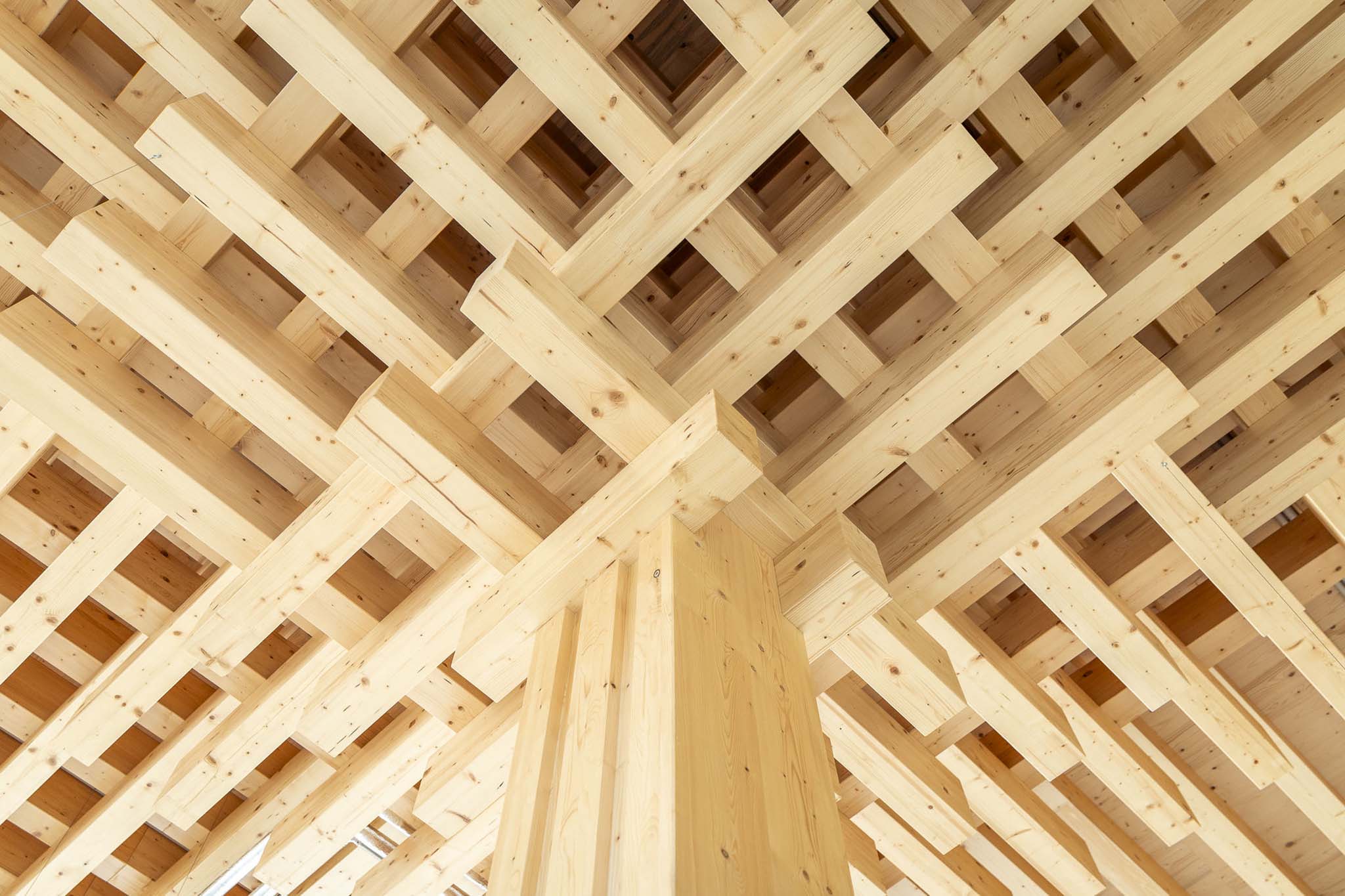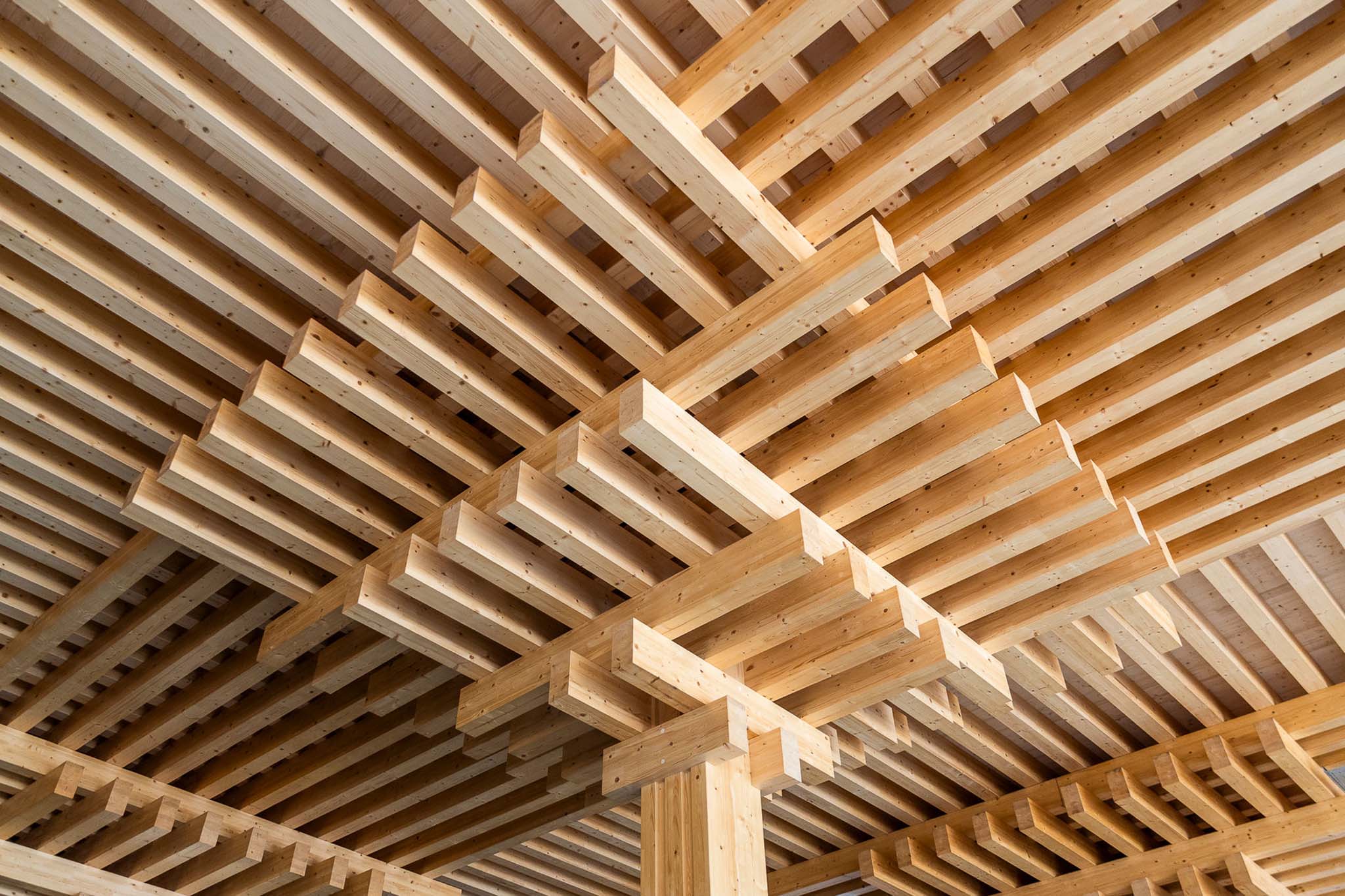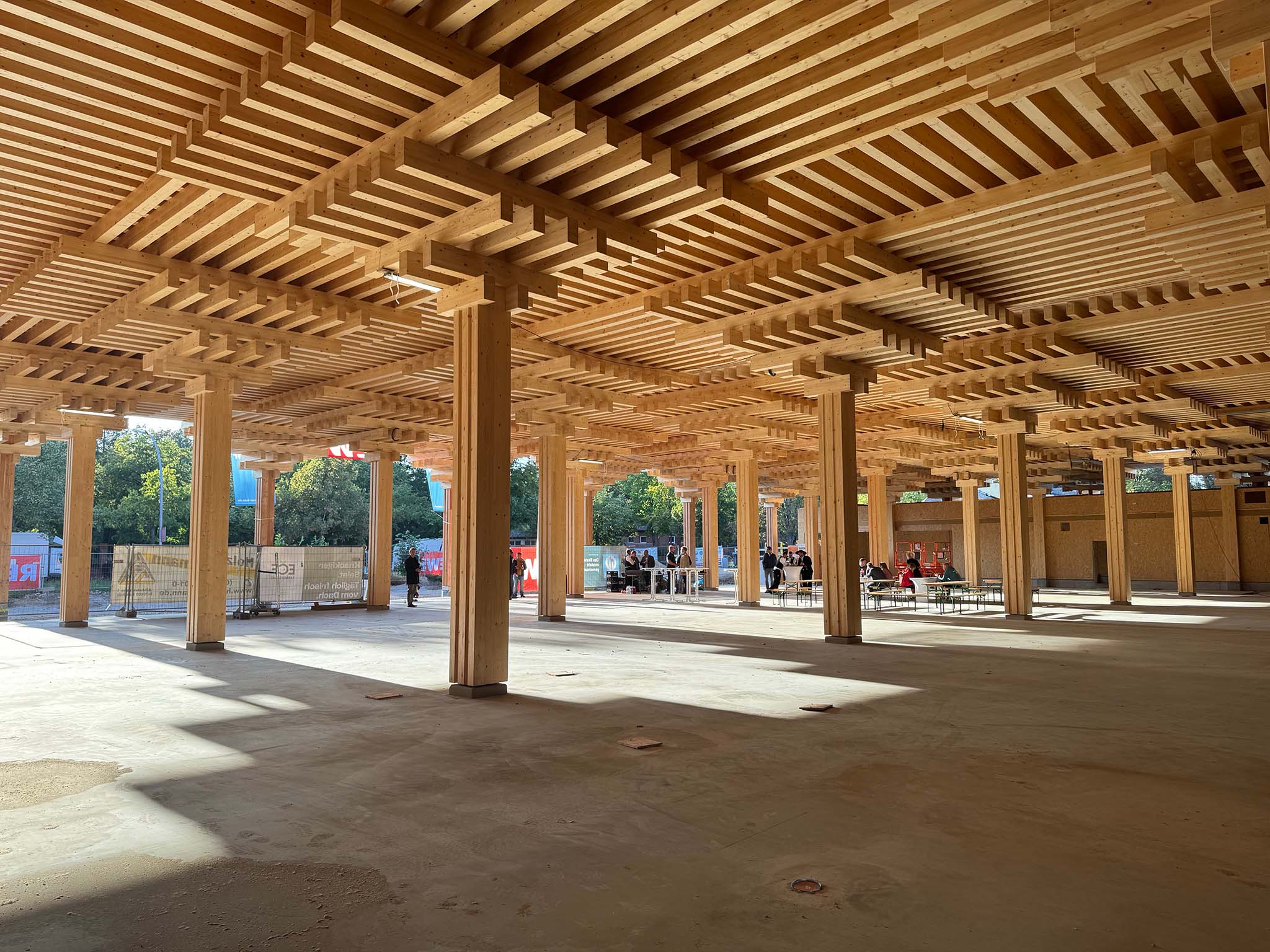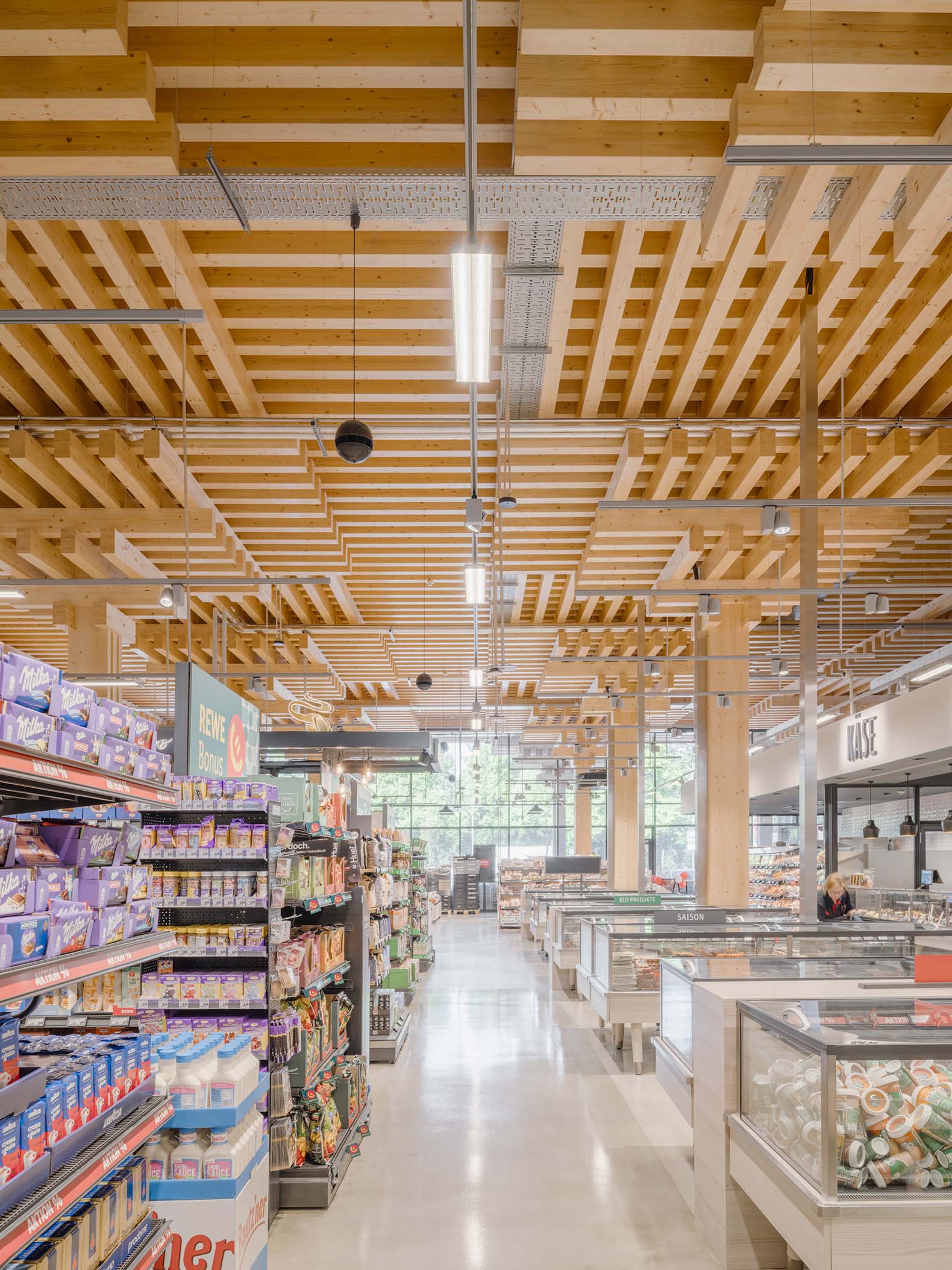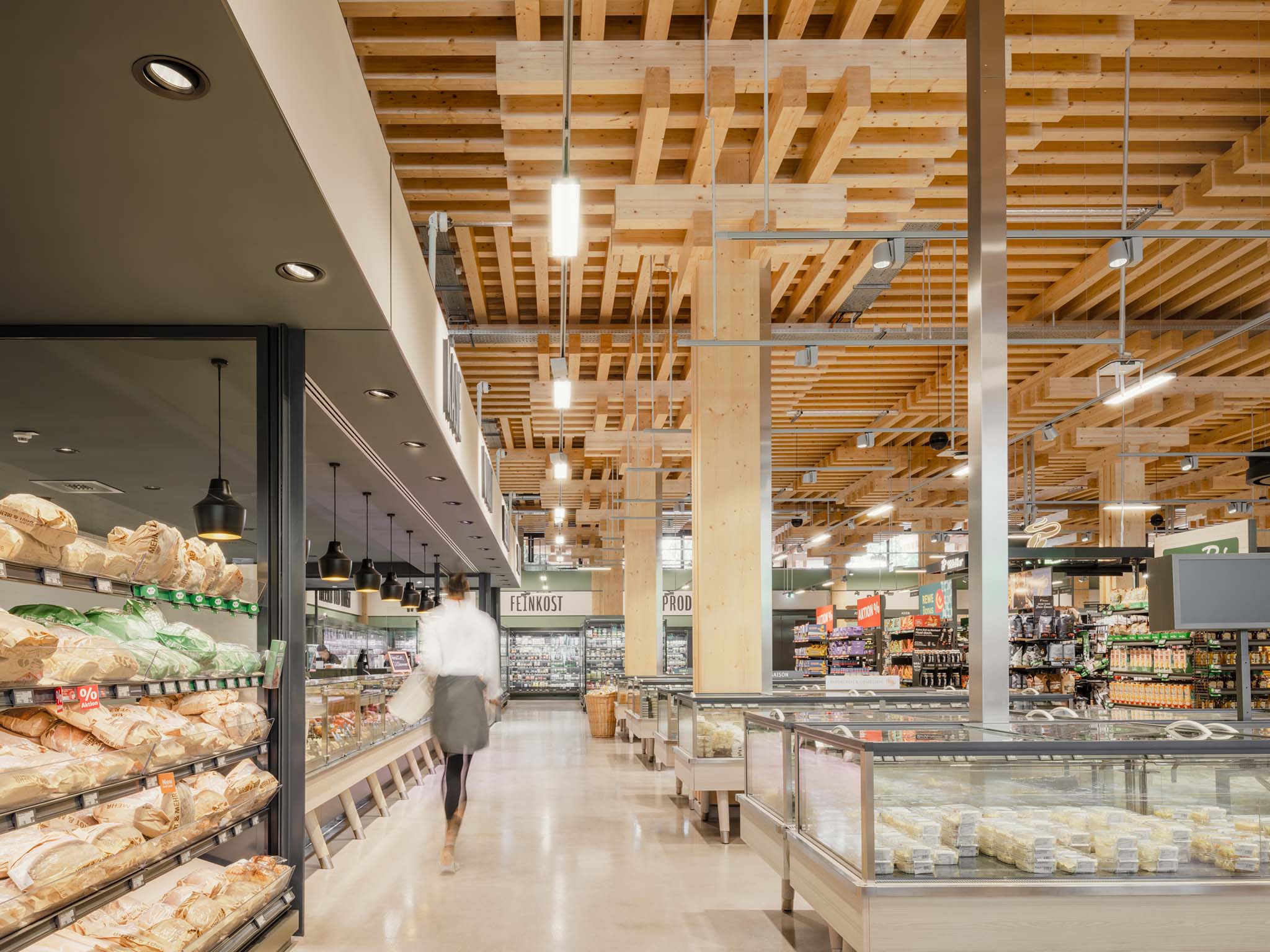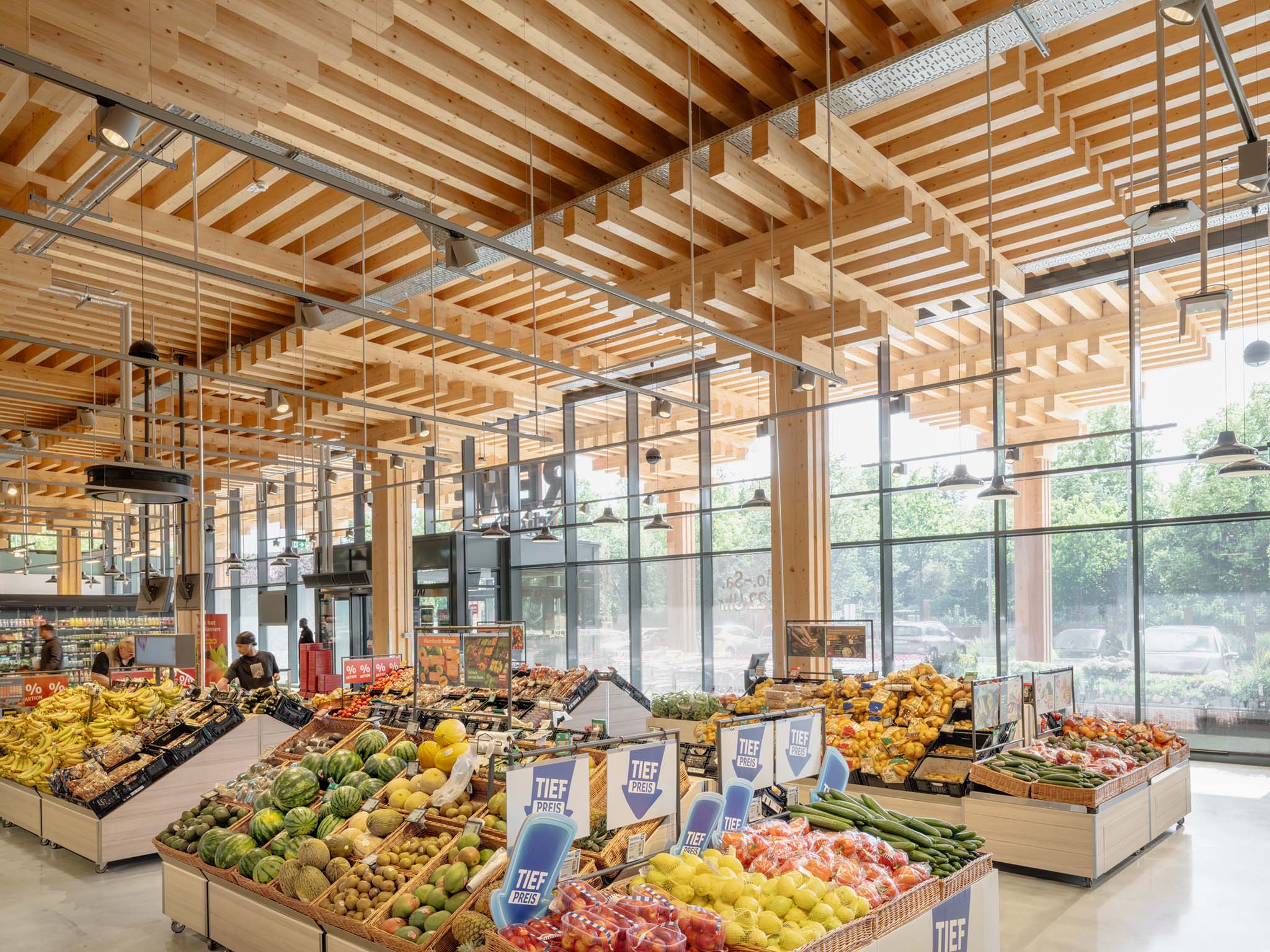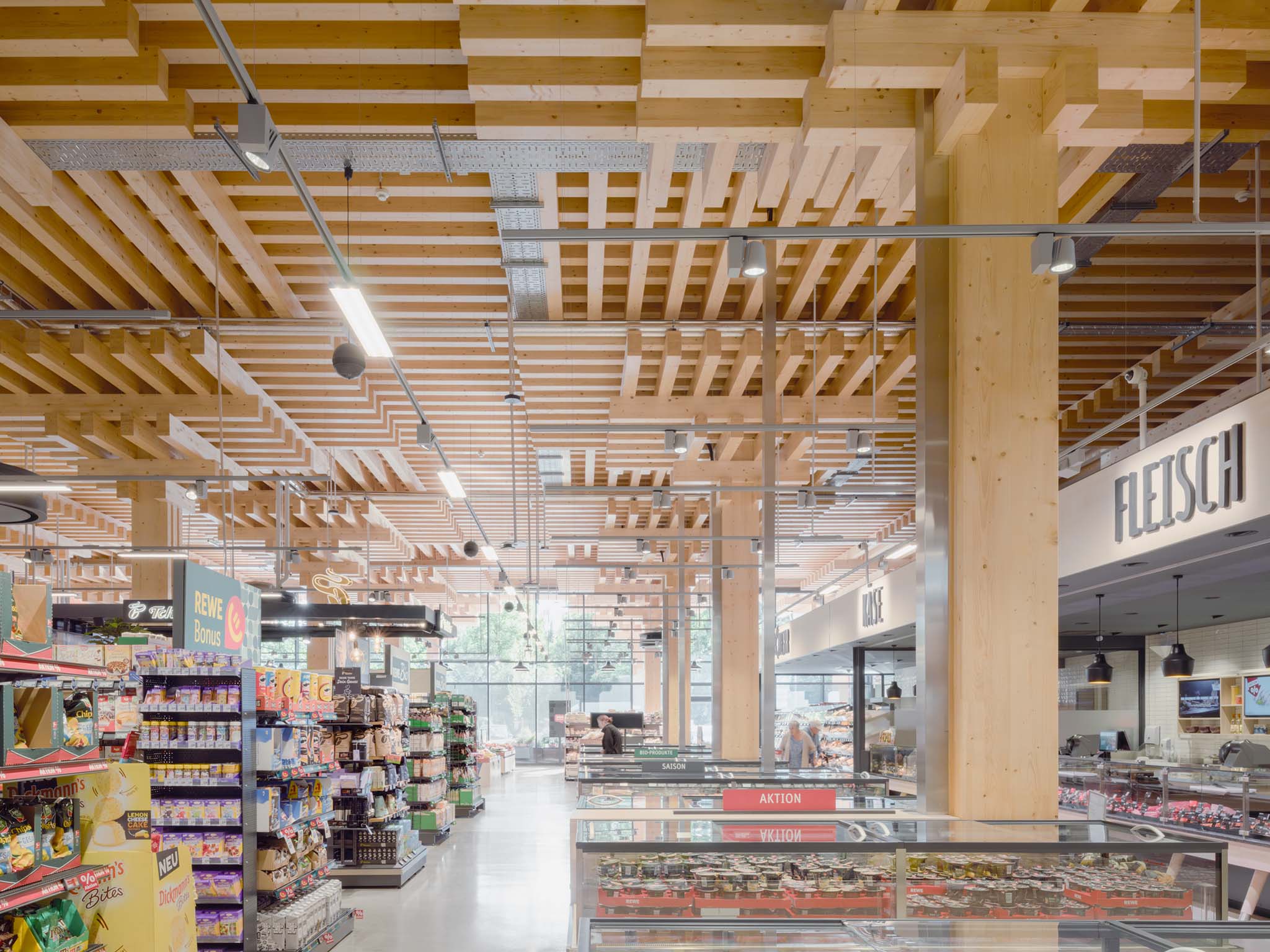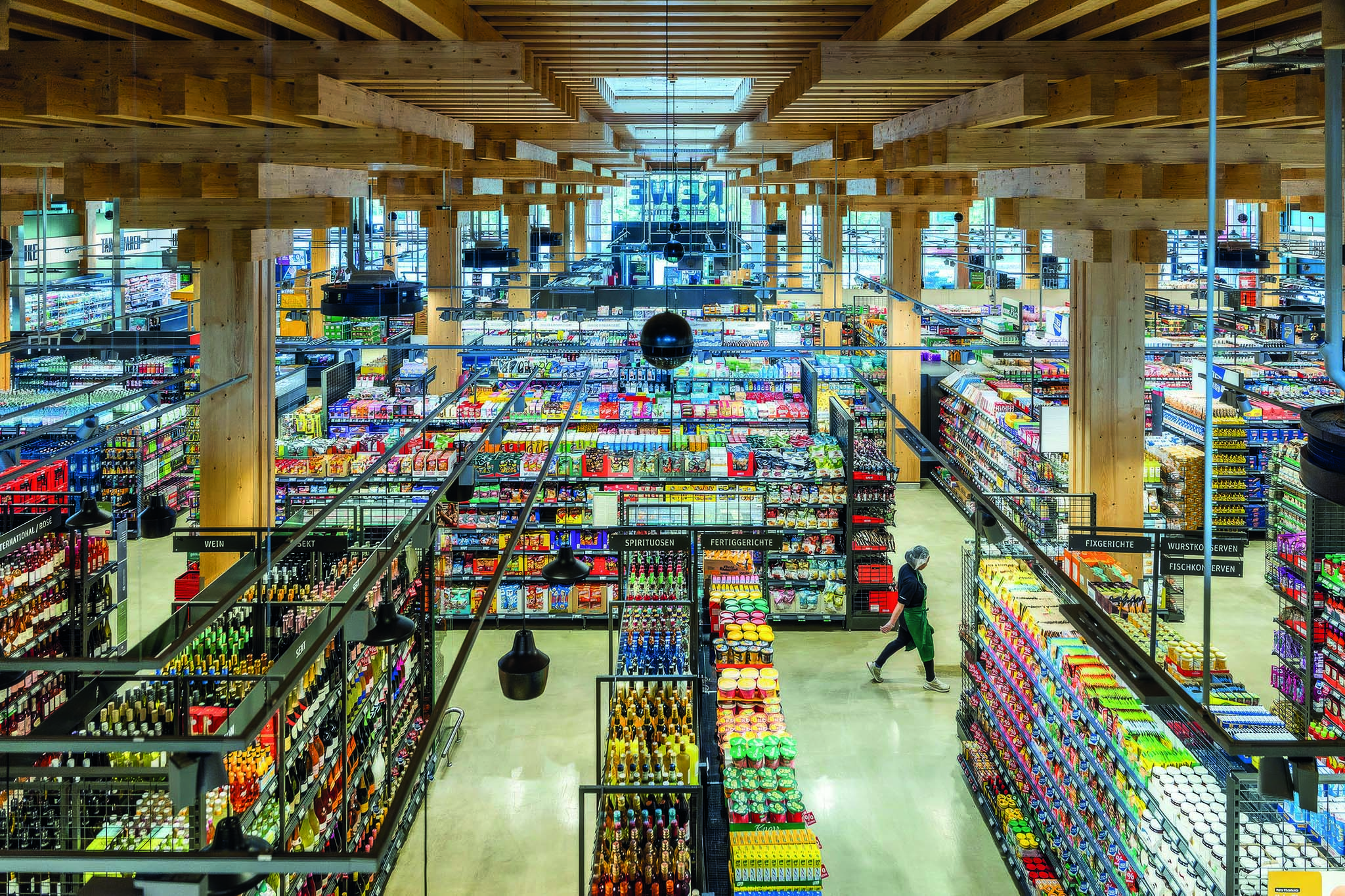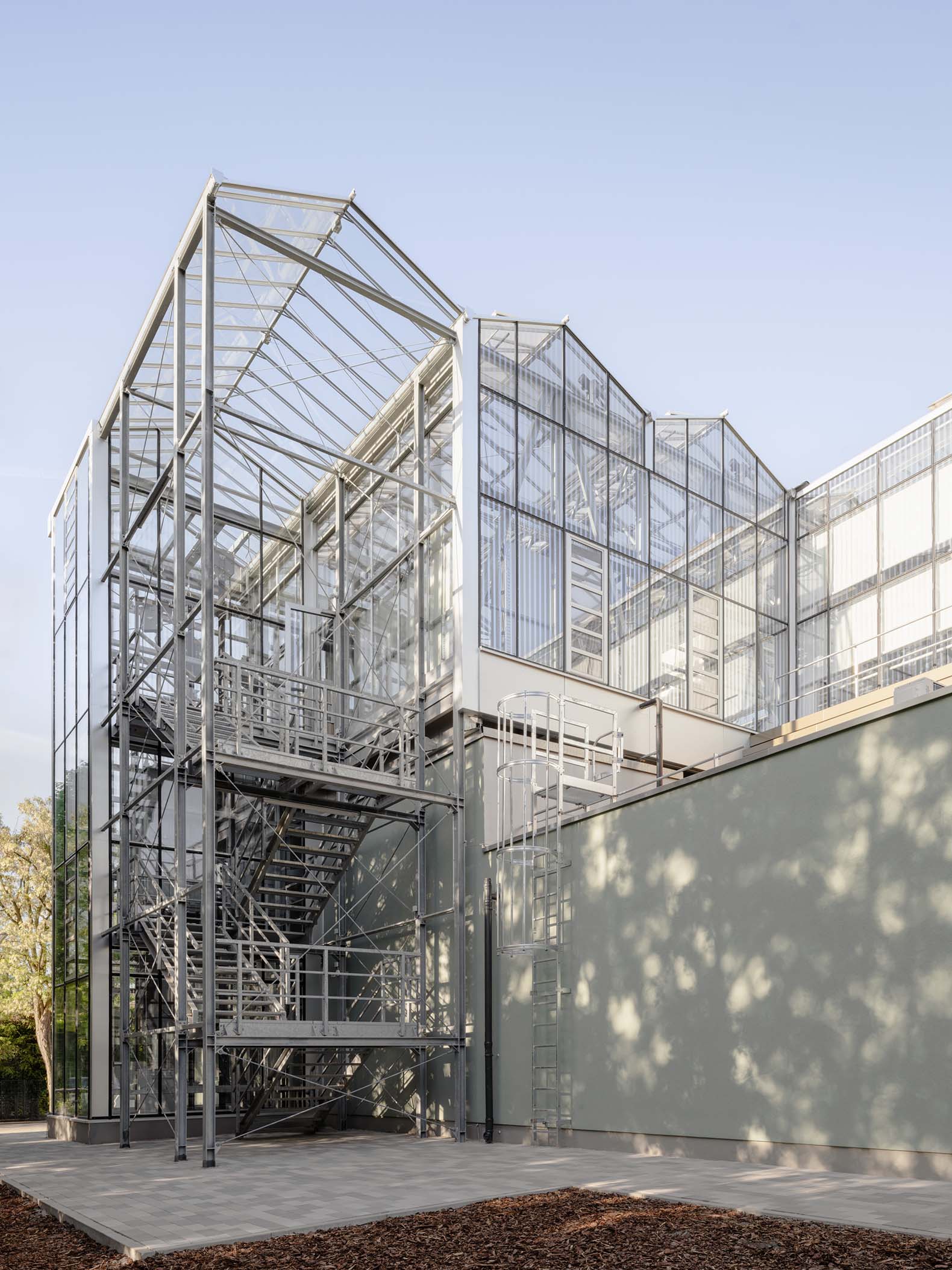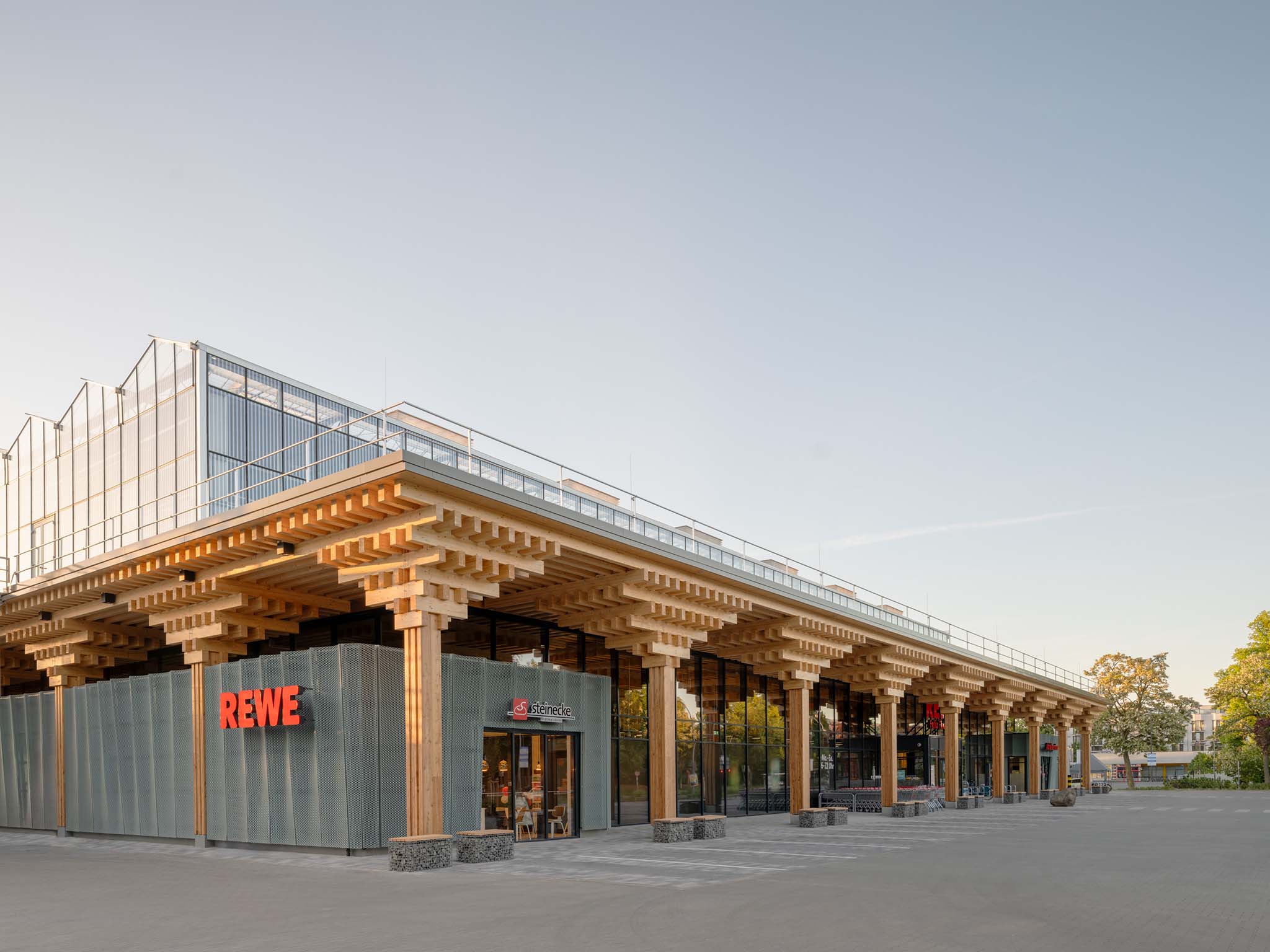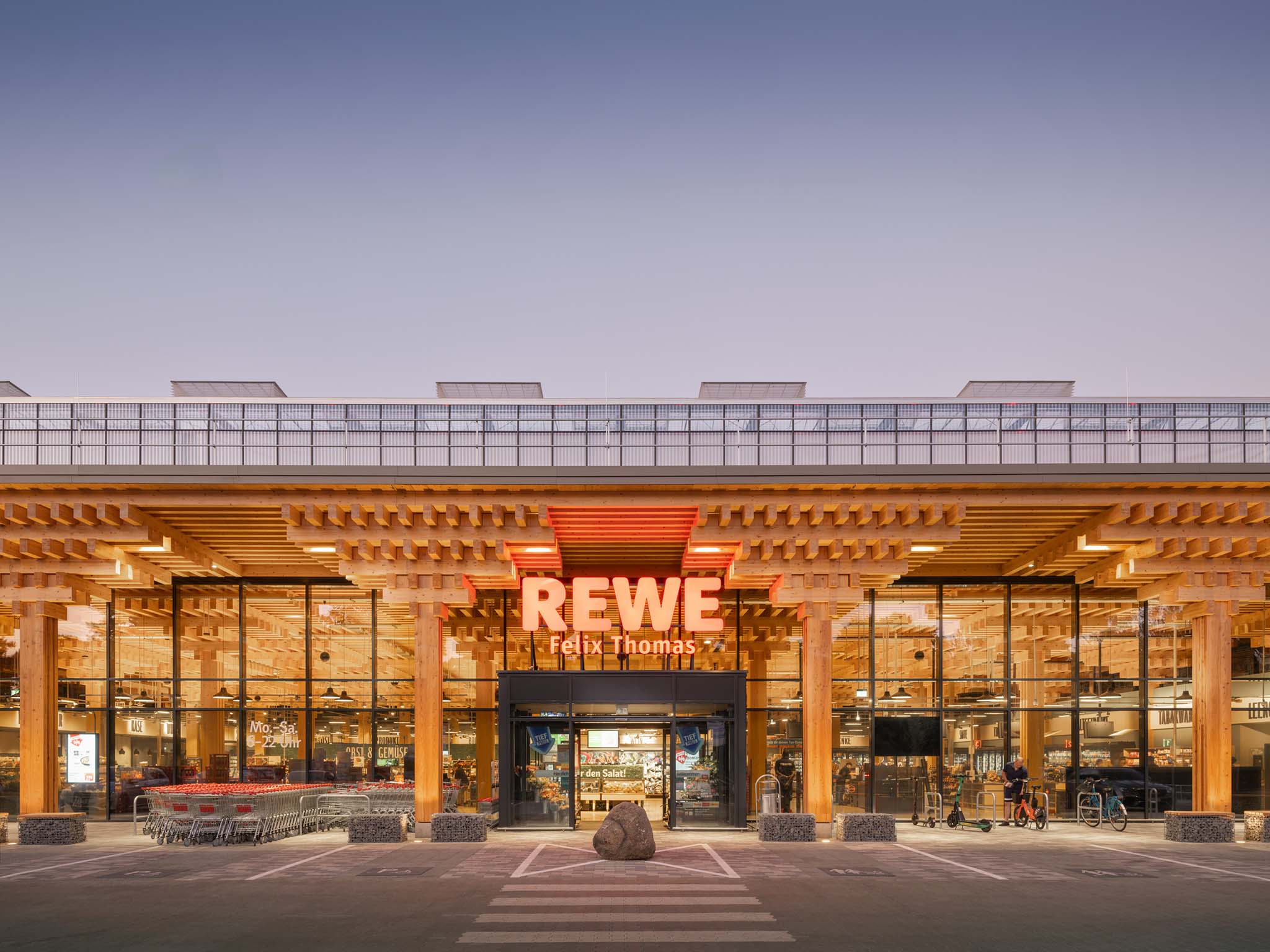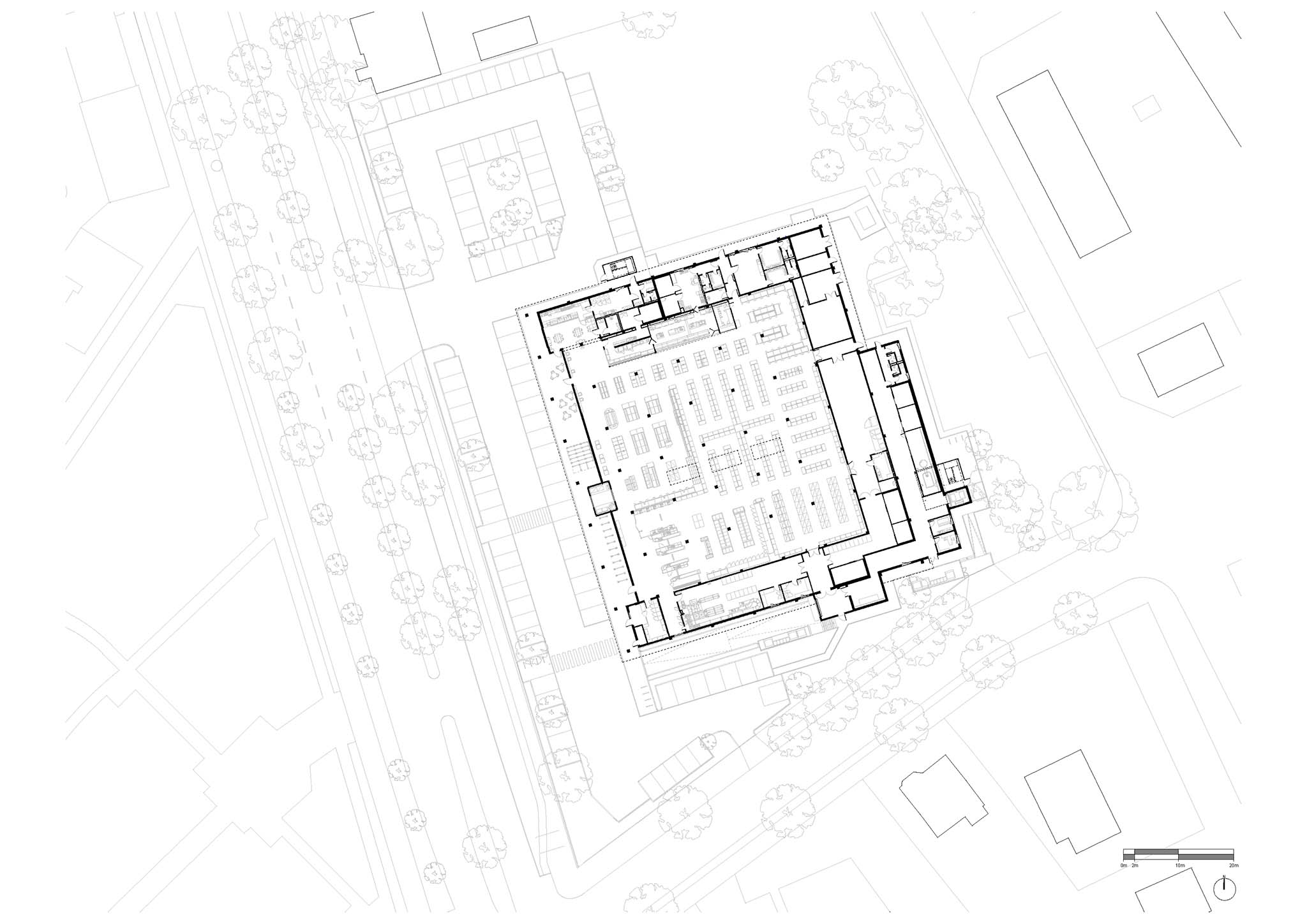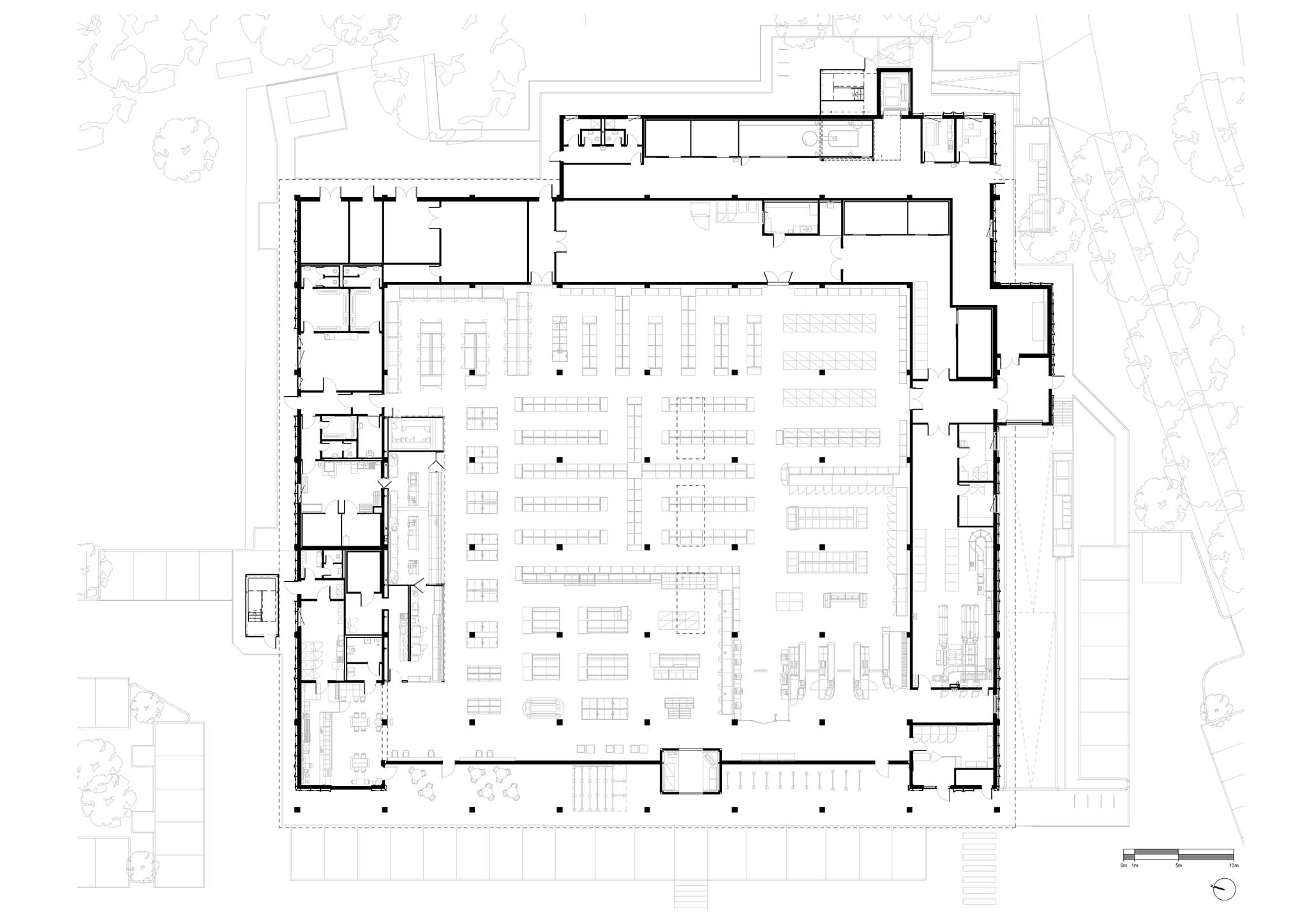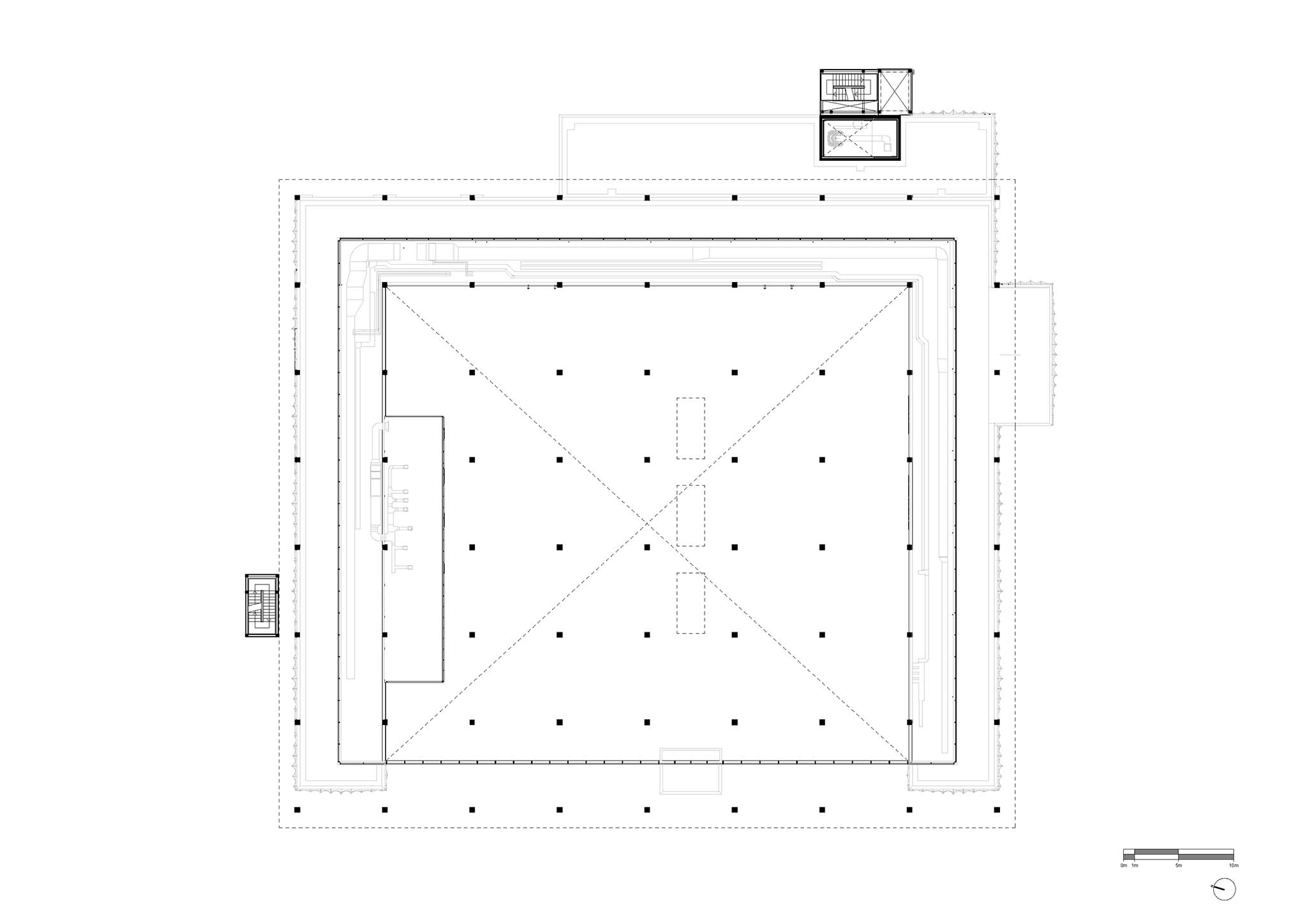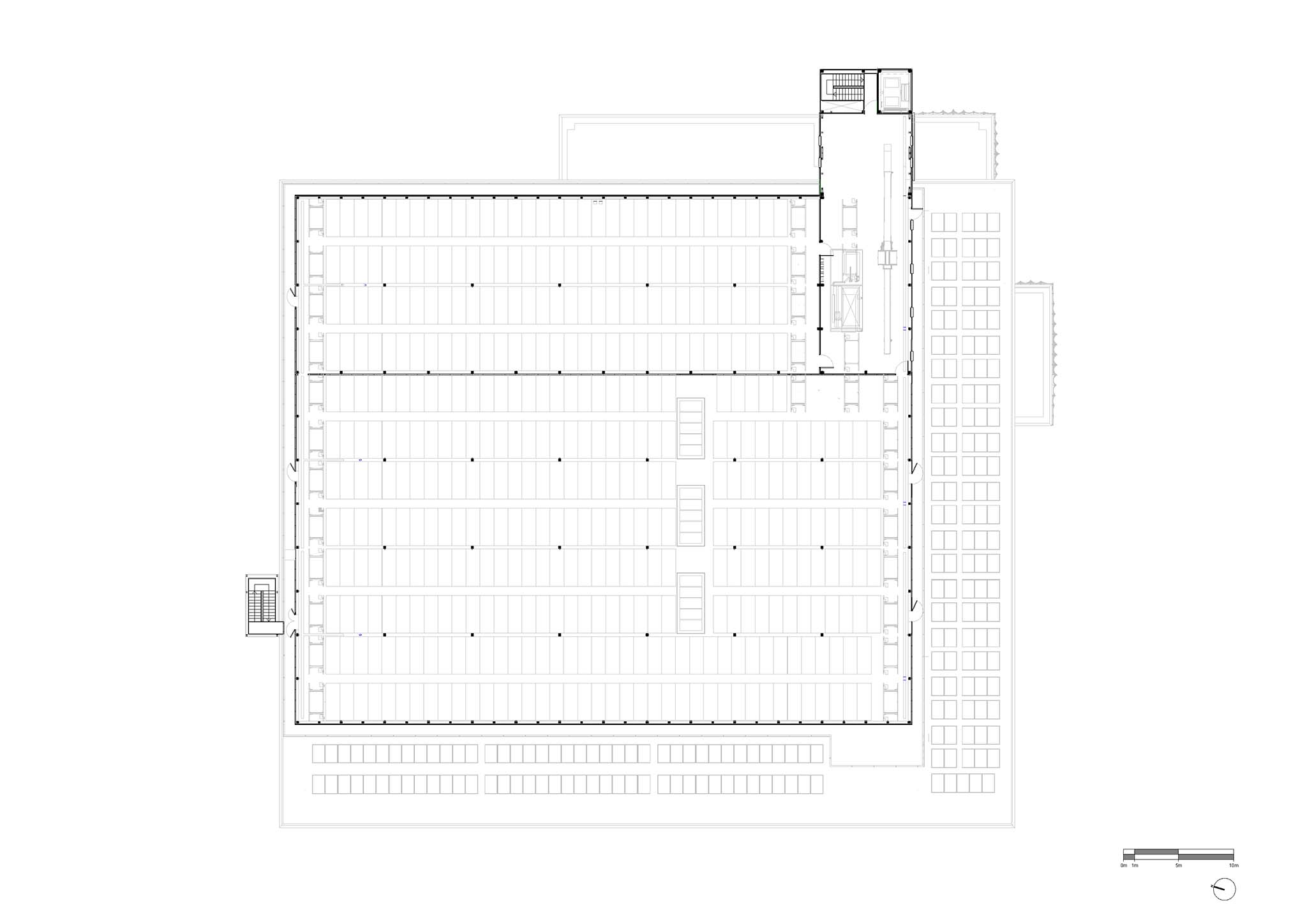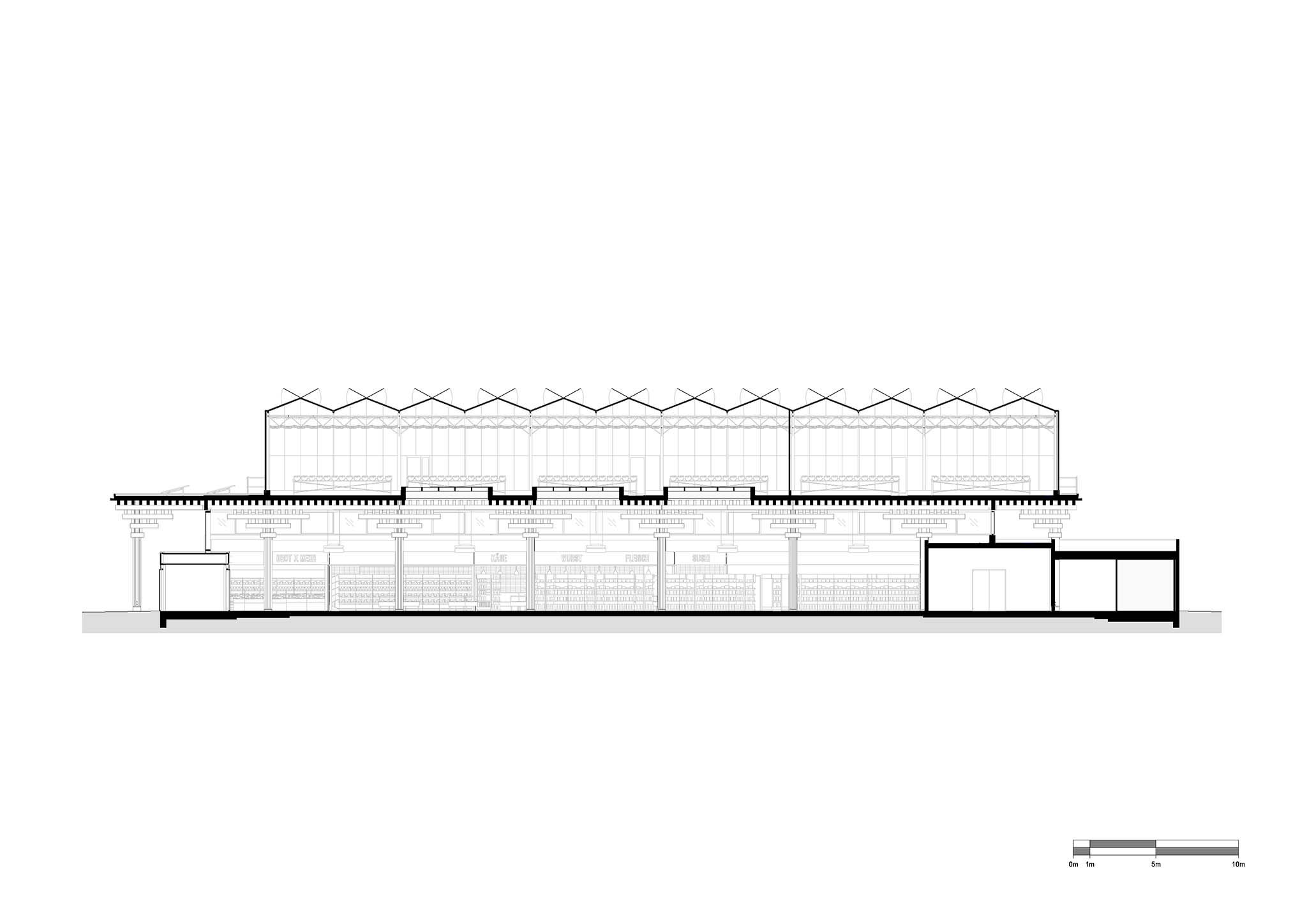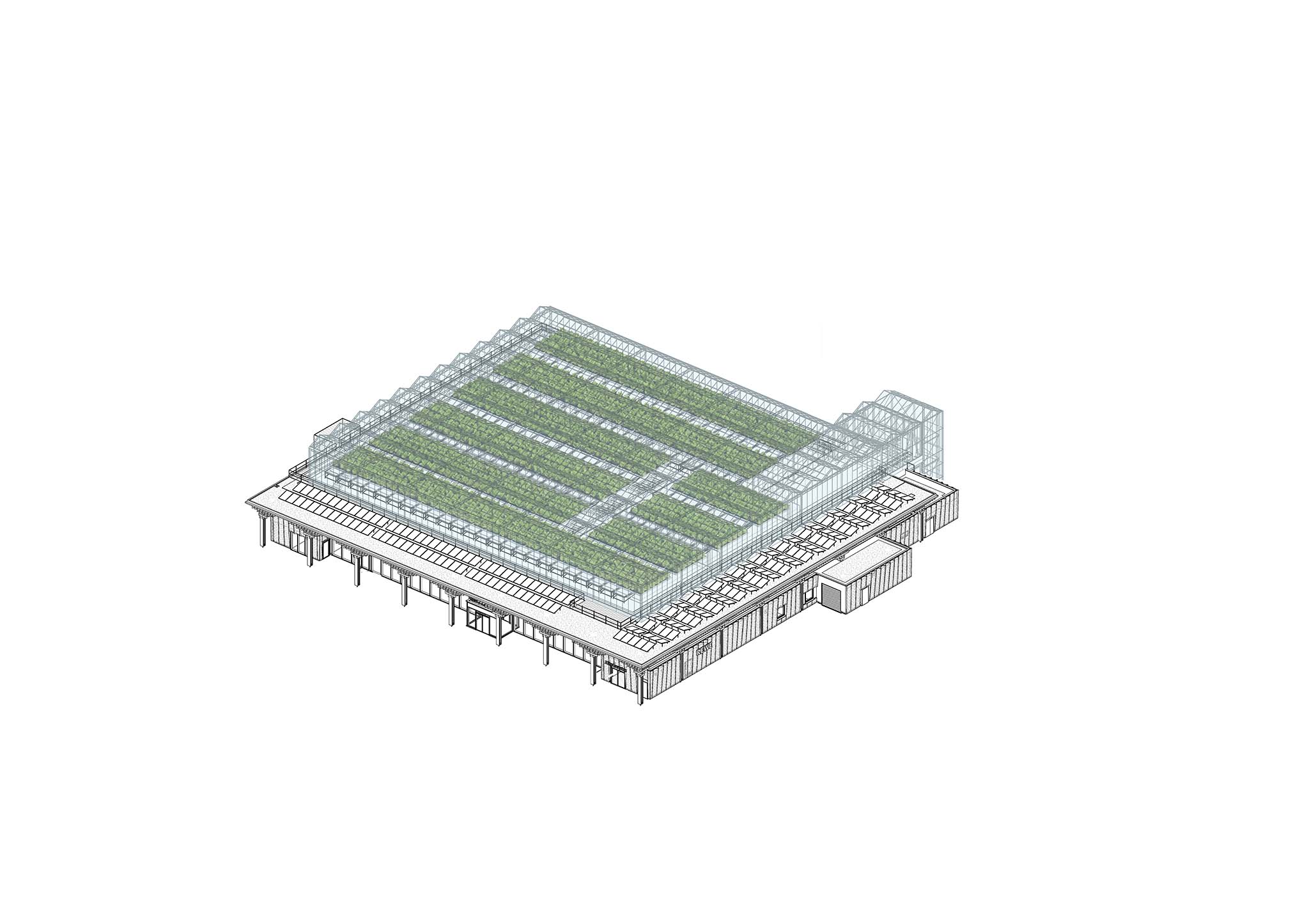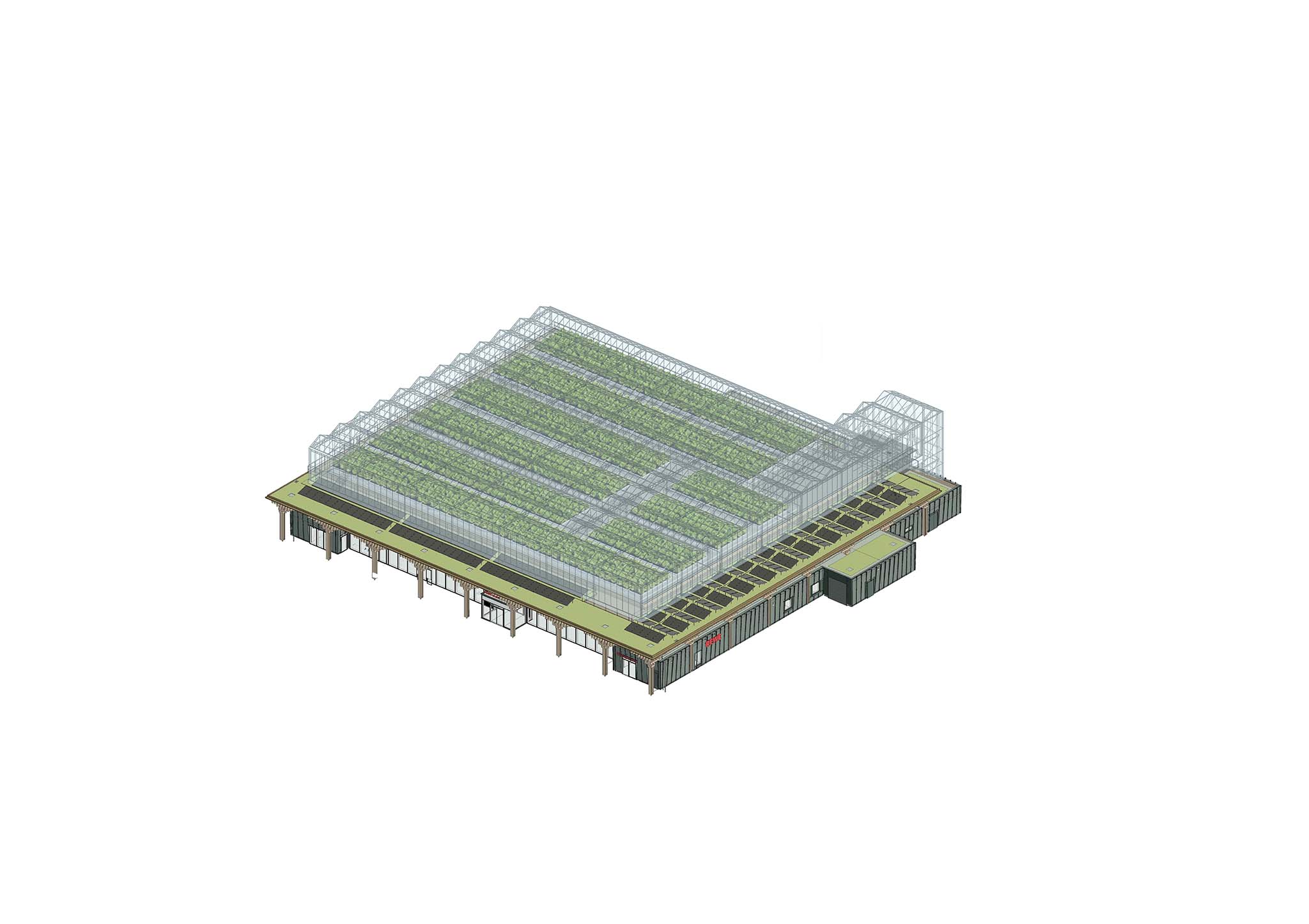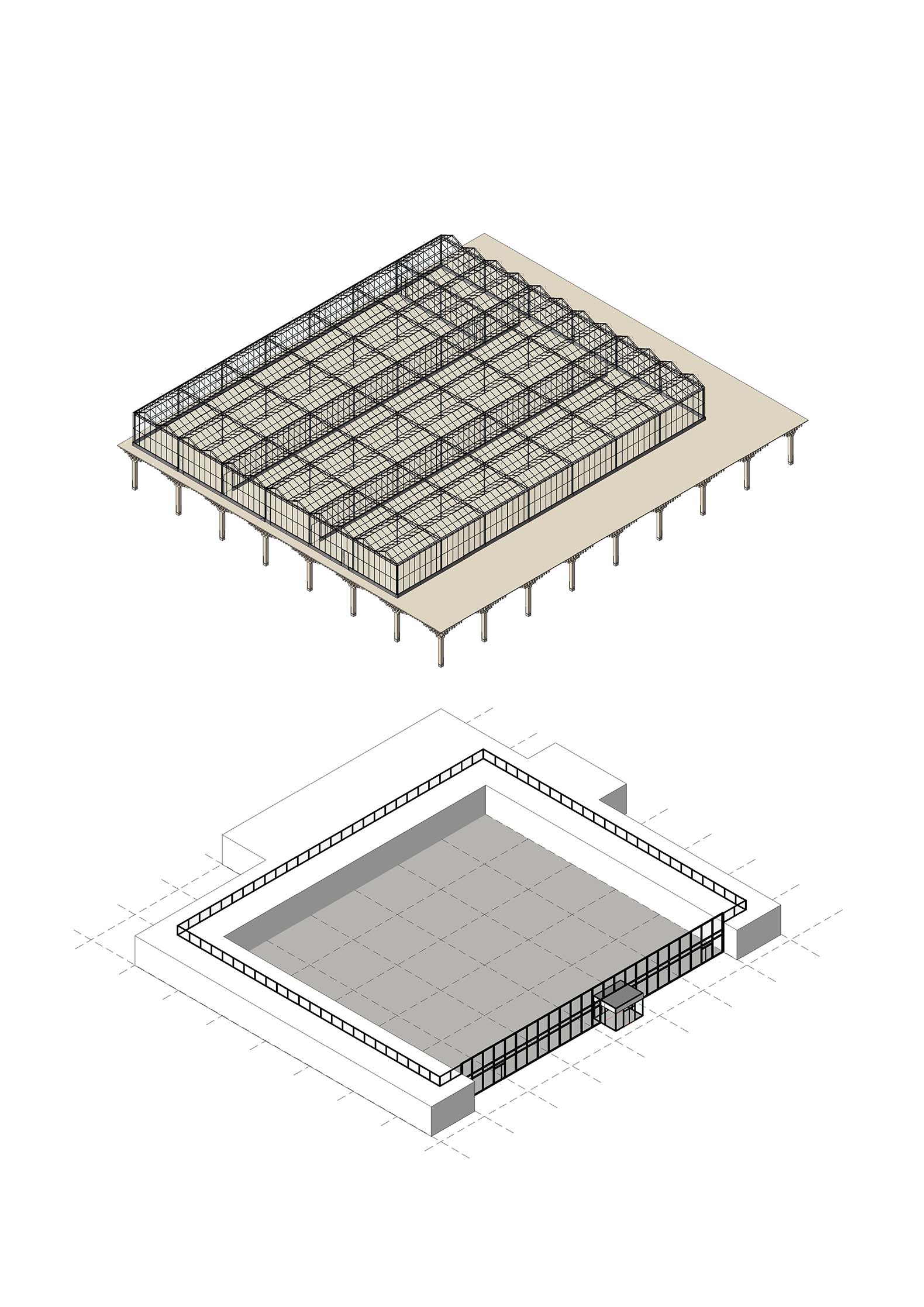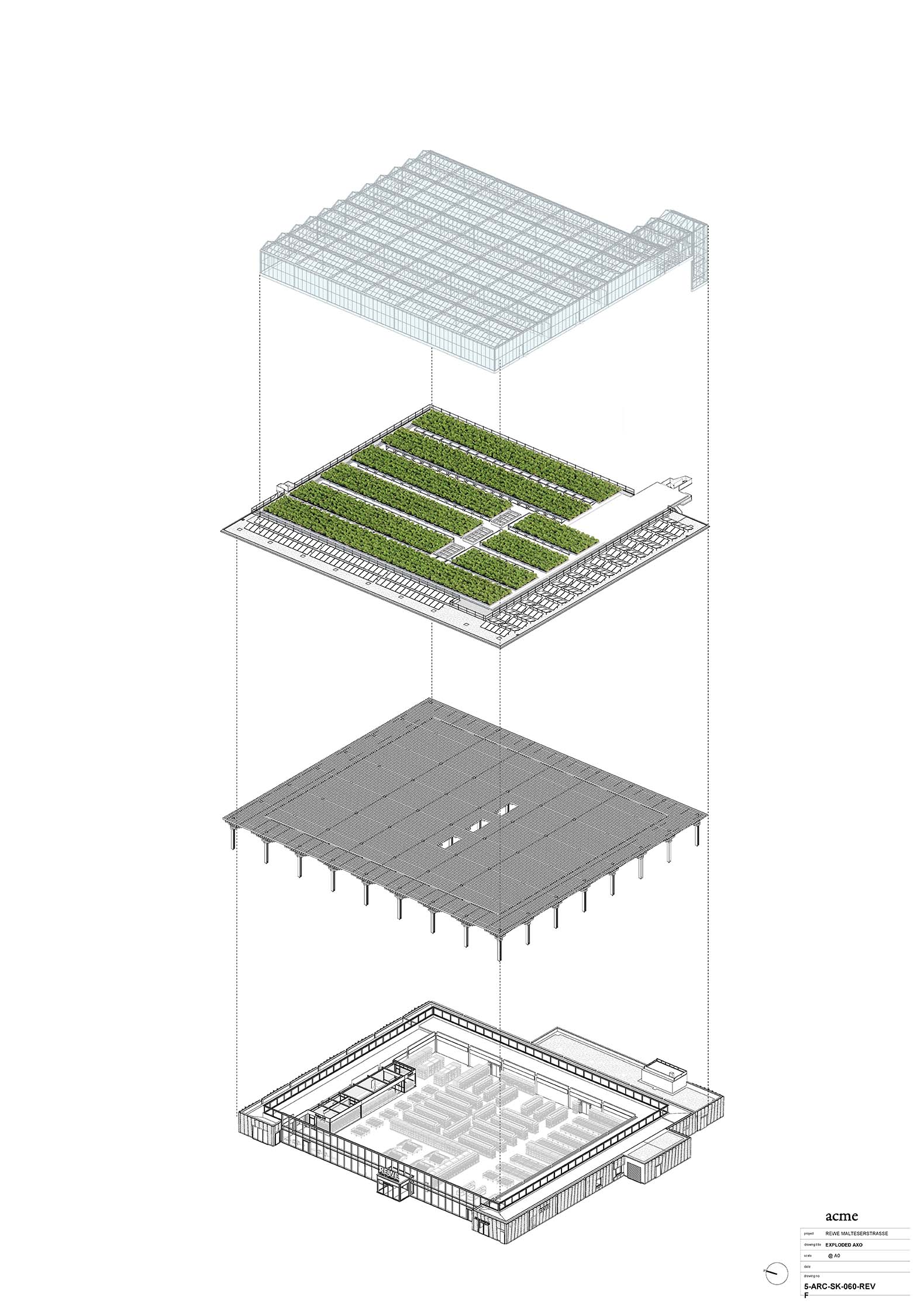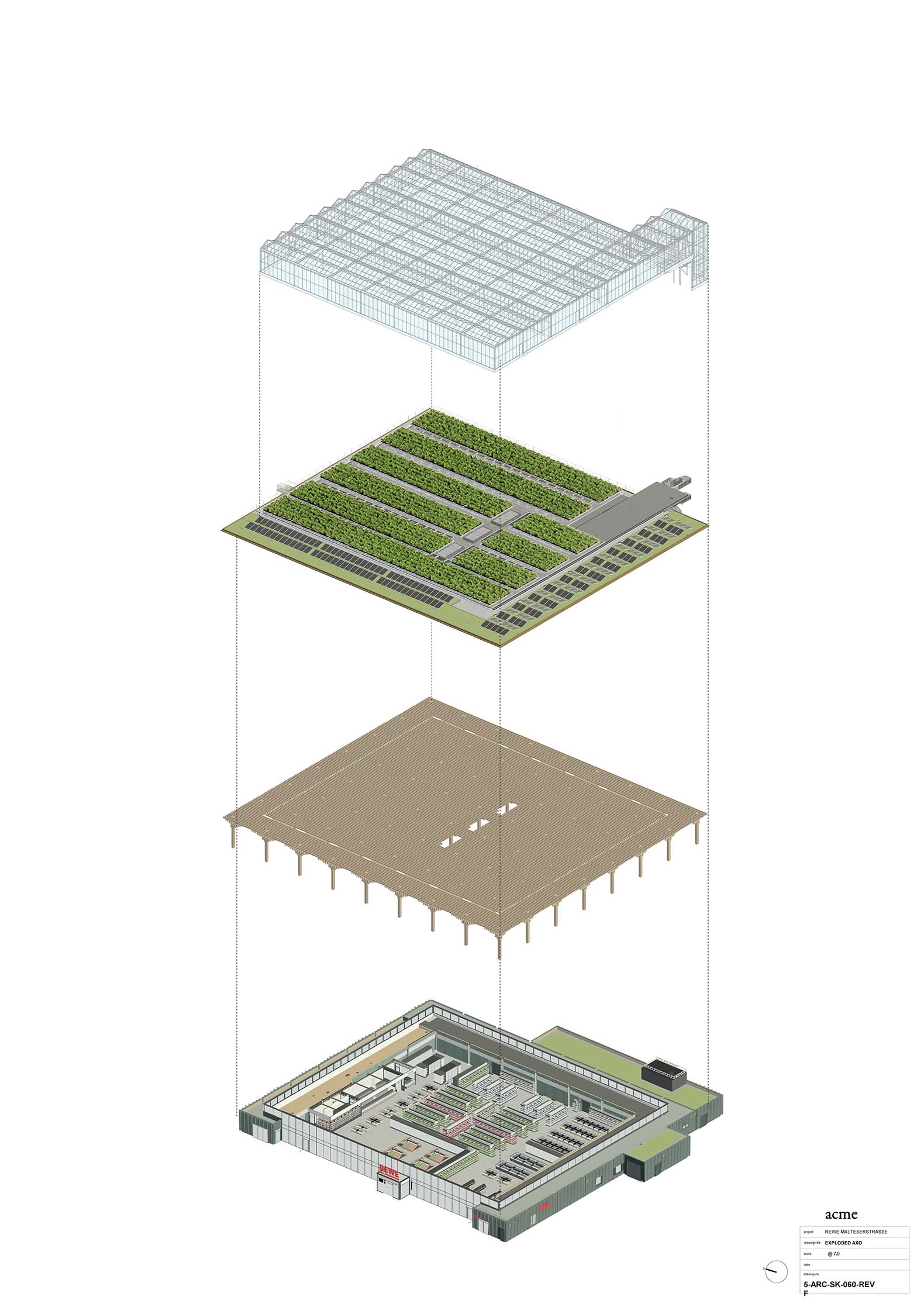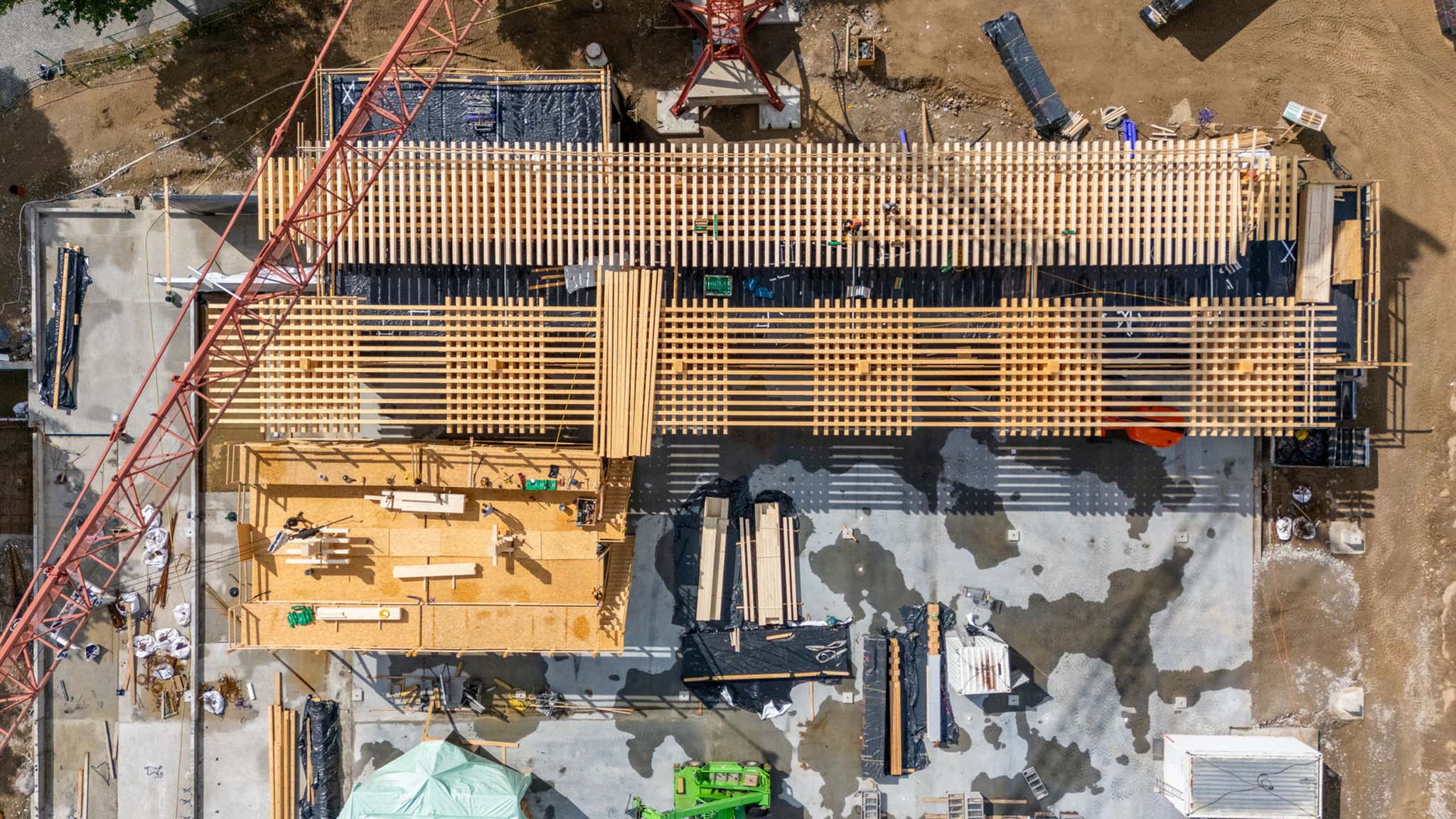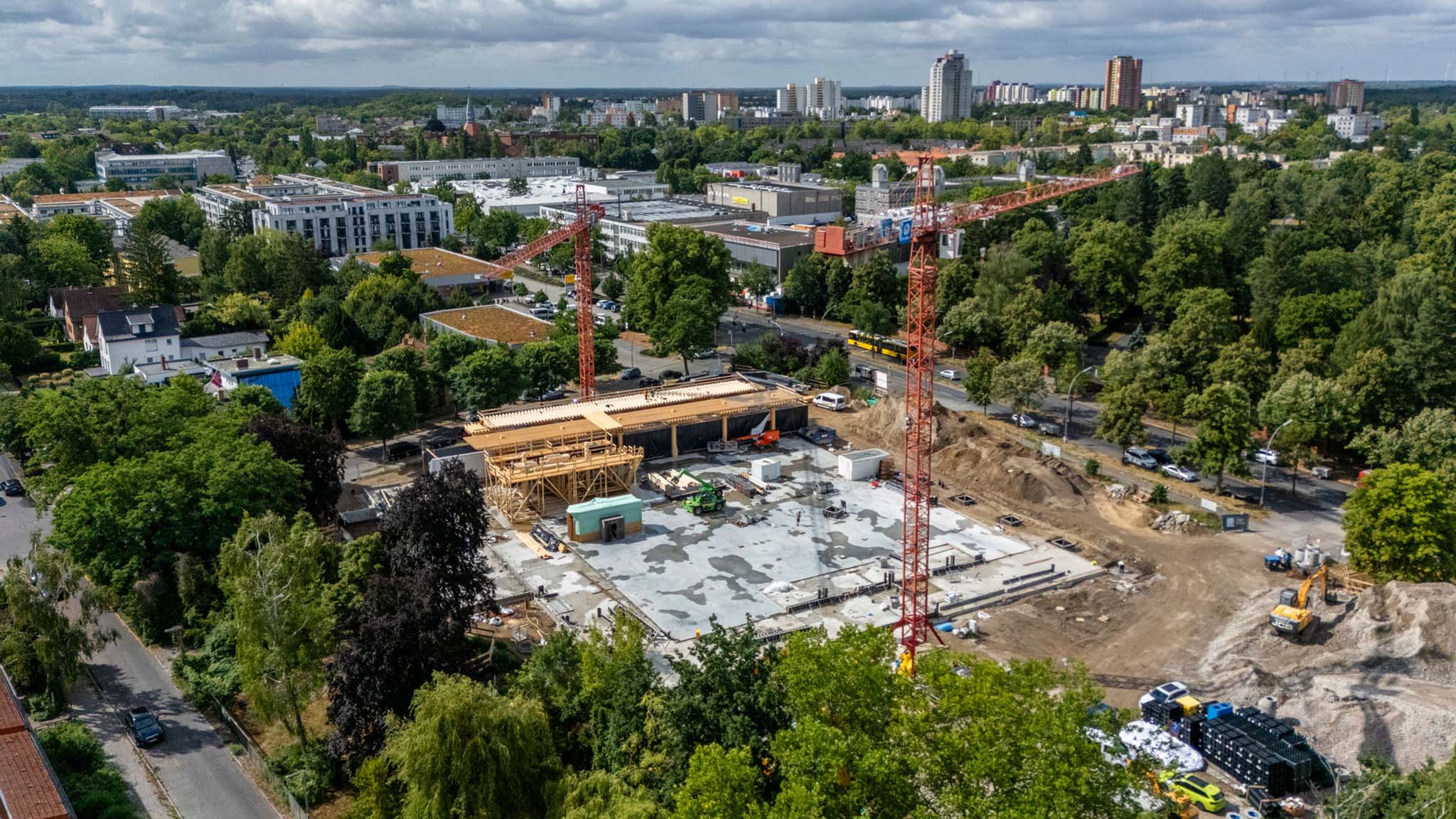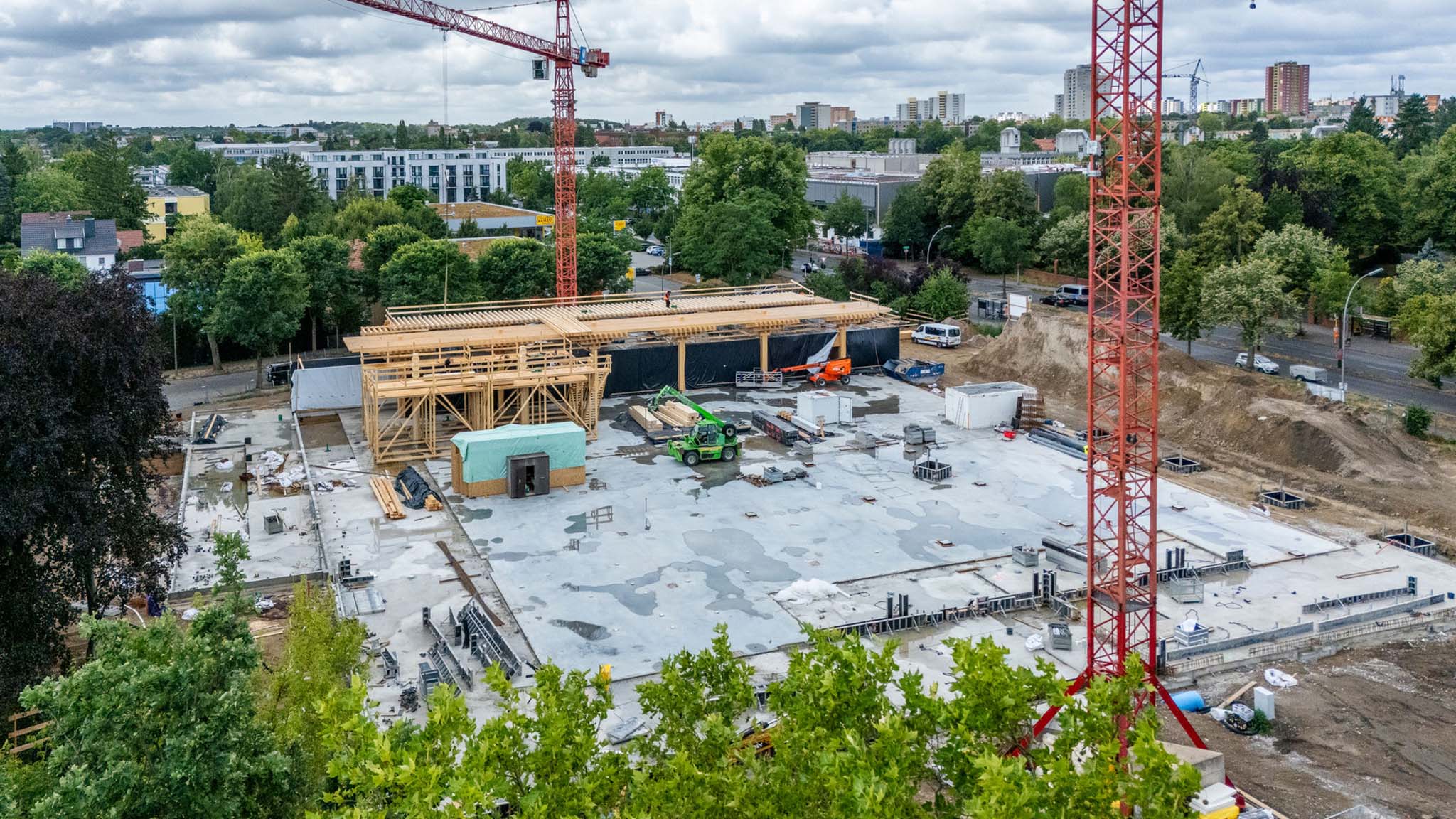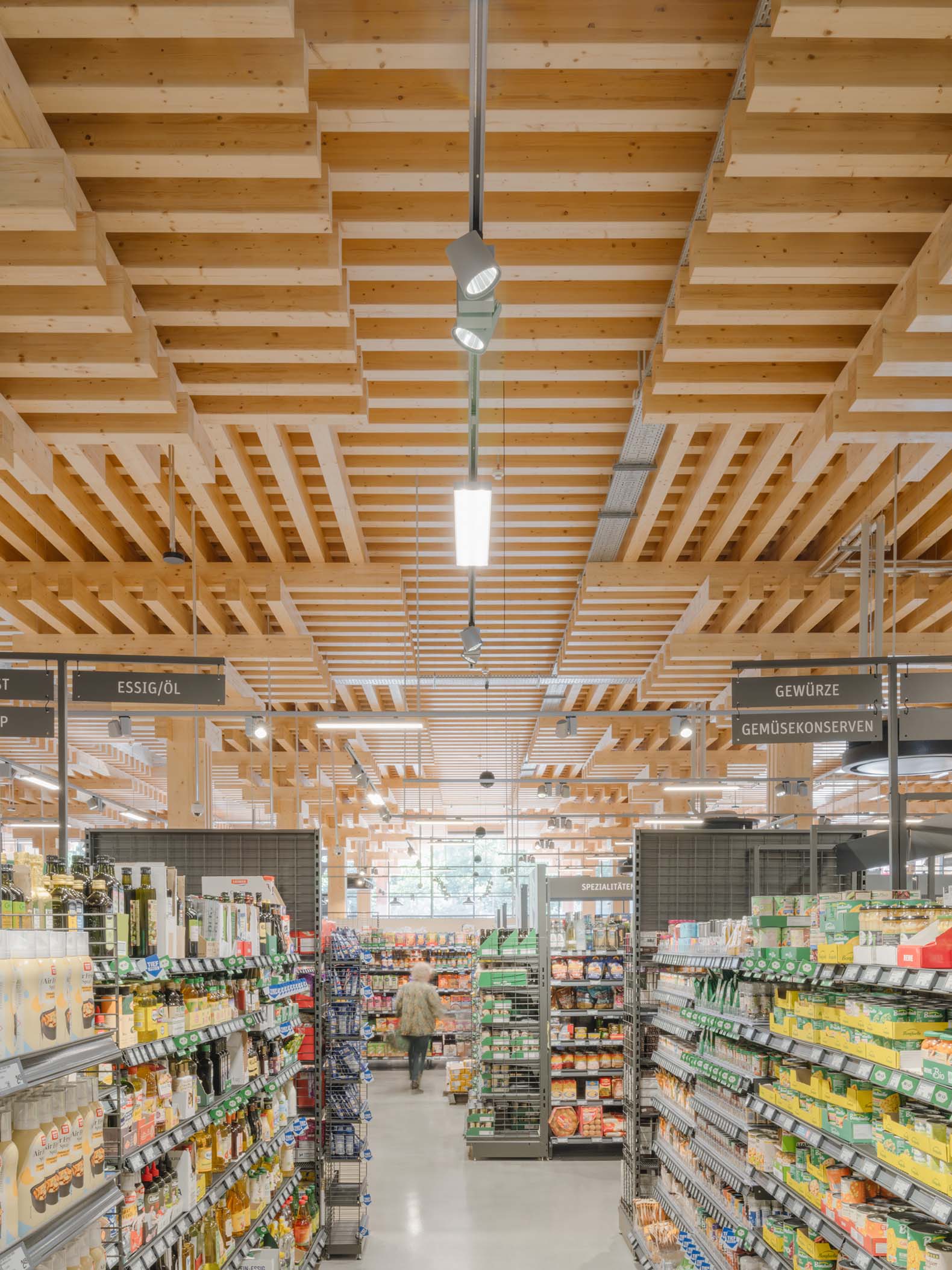
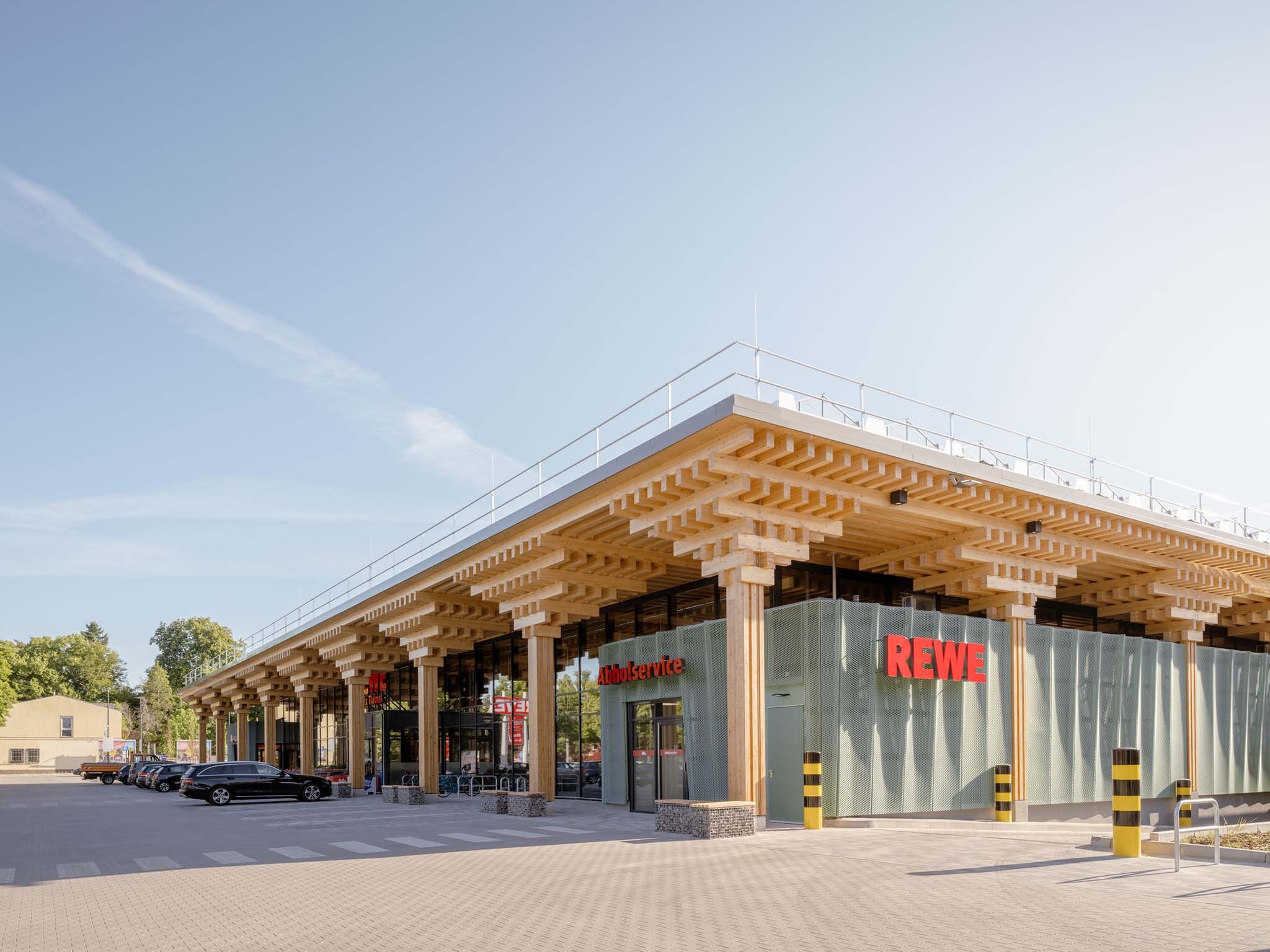
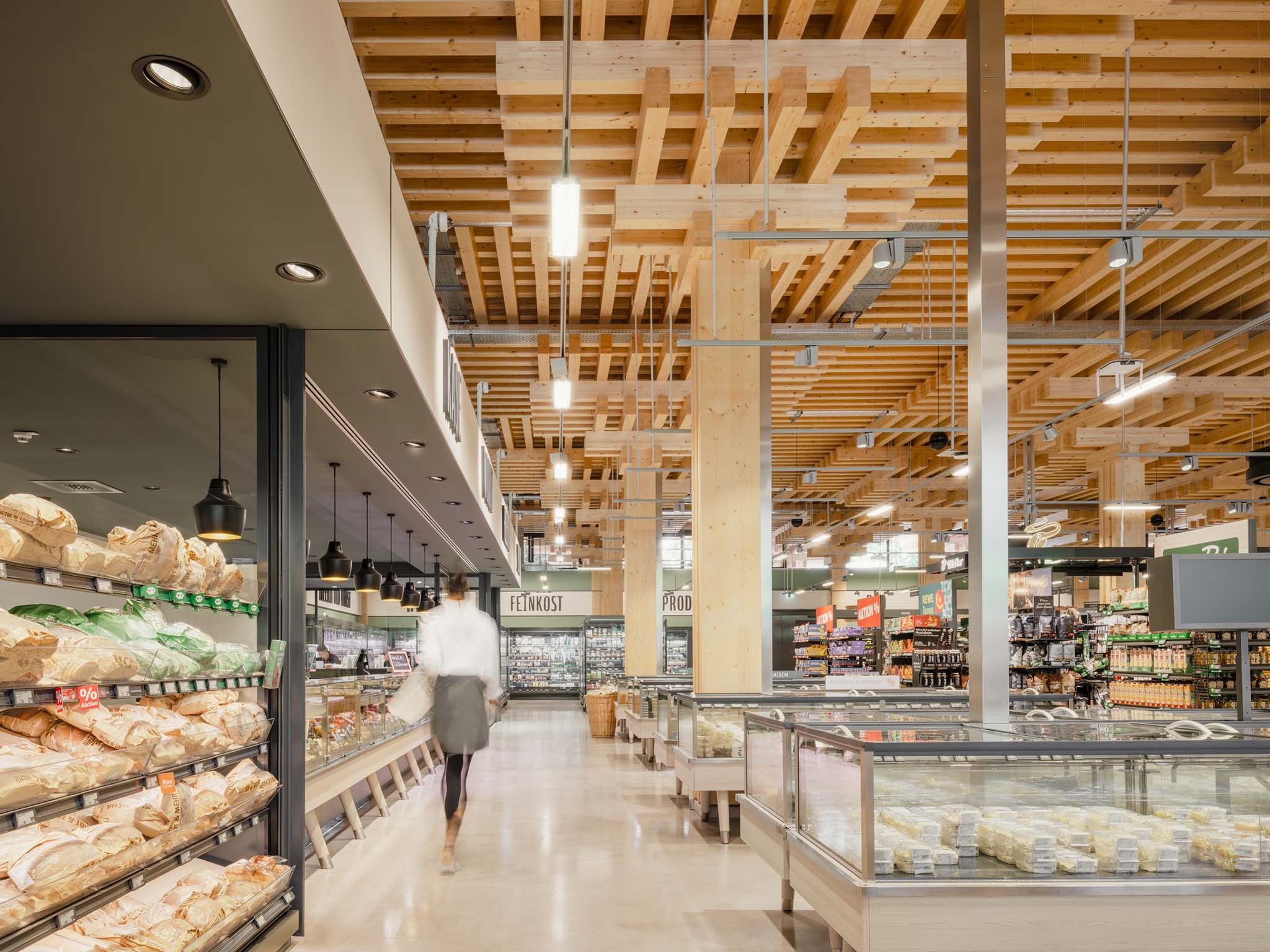
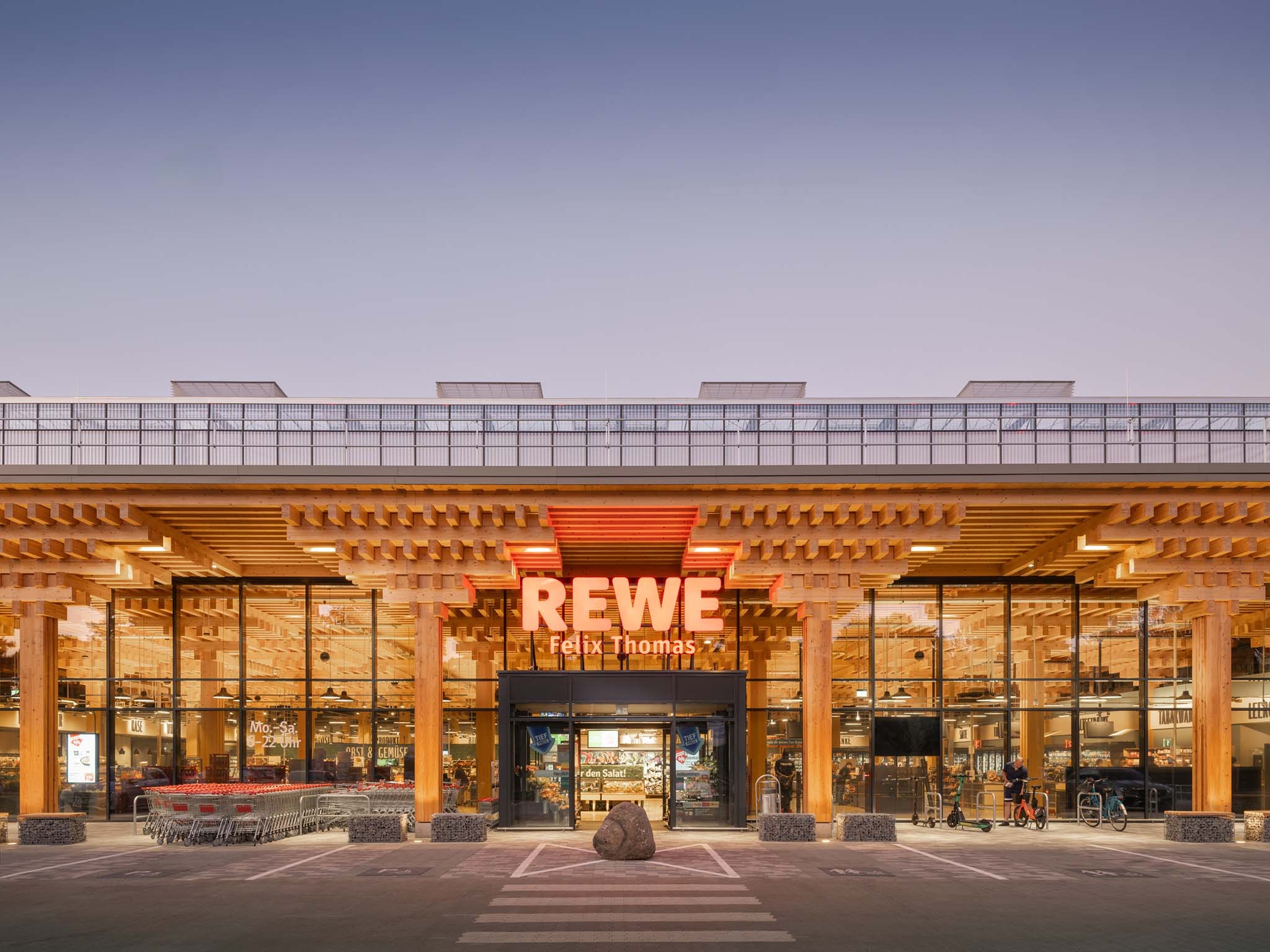
The supermarket designed by ACME is conceived as a seven-metre-high, open-plan space supported by 72 stacked laminated-timber columns. A large glazed frontage and a perimeter skylight bring natural light into the retail area, which houses more than 20,000 products. An automated hydroponic farm is located above the structure, while the ancillary functions are arranged alongside the main volume.
The building was designed entirely using BIM and incorporates 200 solar panels, LED lighting, glazed refrigerated display cases, intelligent temperature controls, a heat pump, and systems that recover waste heat and collect rainwater. These measures reduce energy consumption by approximately 50% and facilitate the disassembly, recycling and reuse of its components.
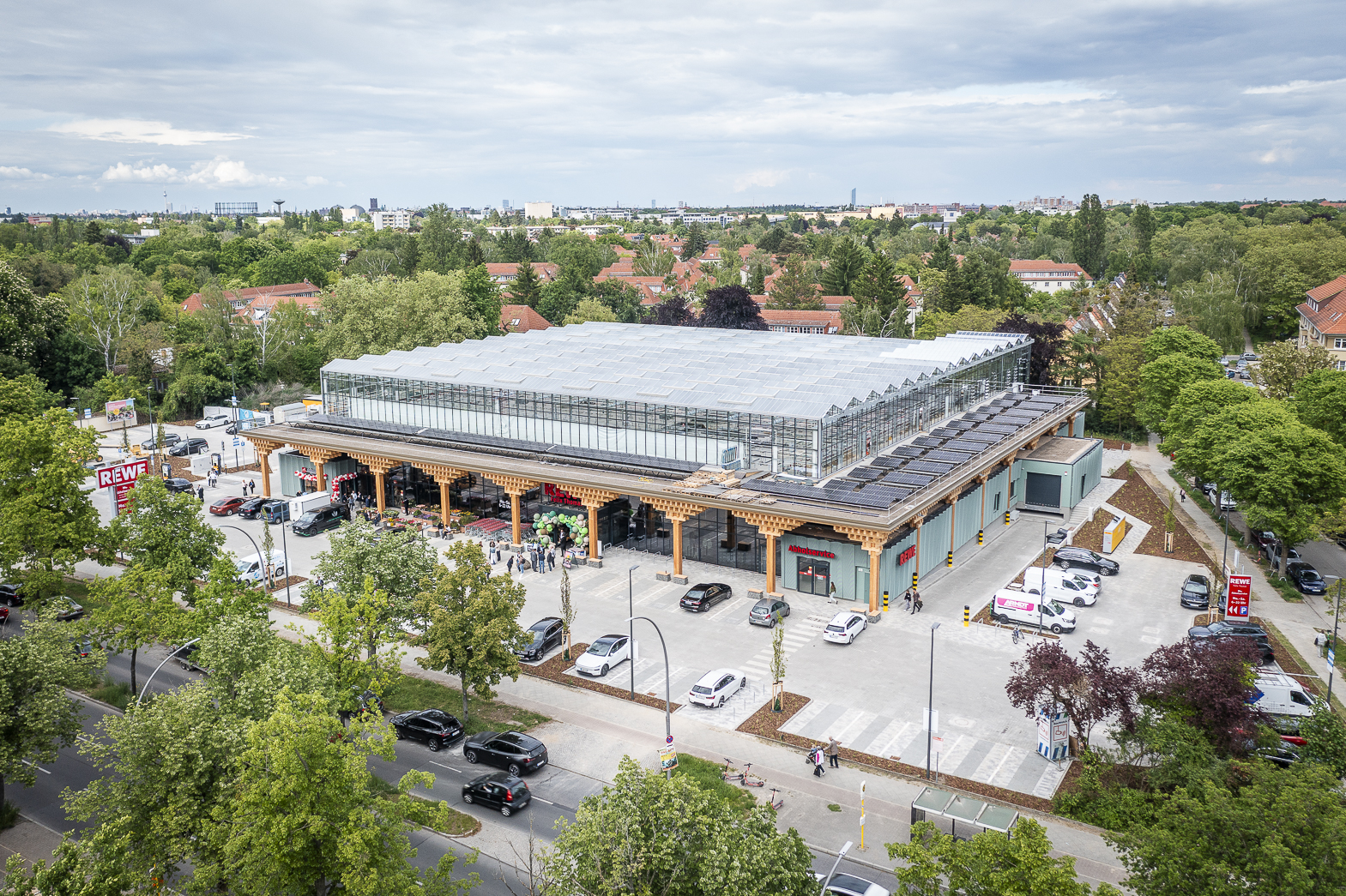
REWE Green Farming Berlin by ACME. Photograph by Christoph Große.
Project description by ACME
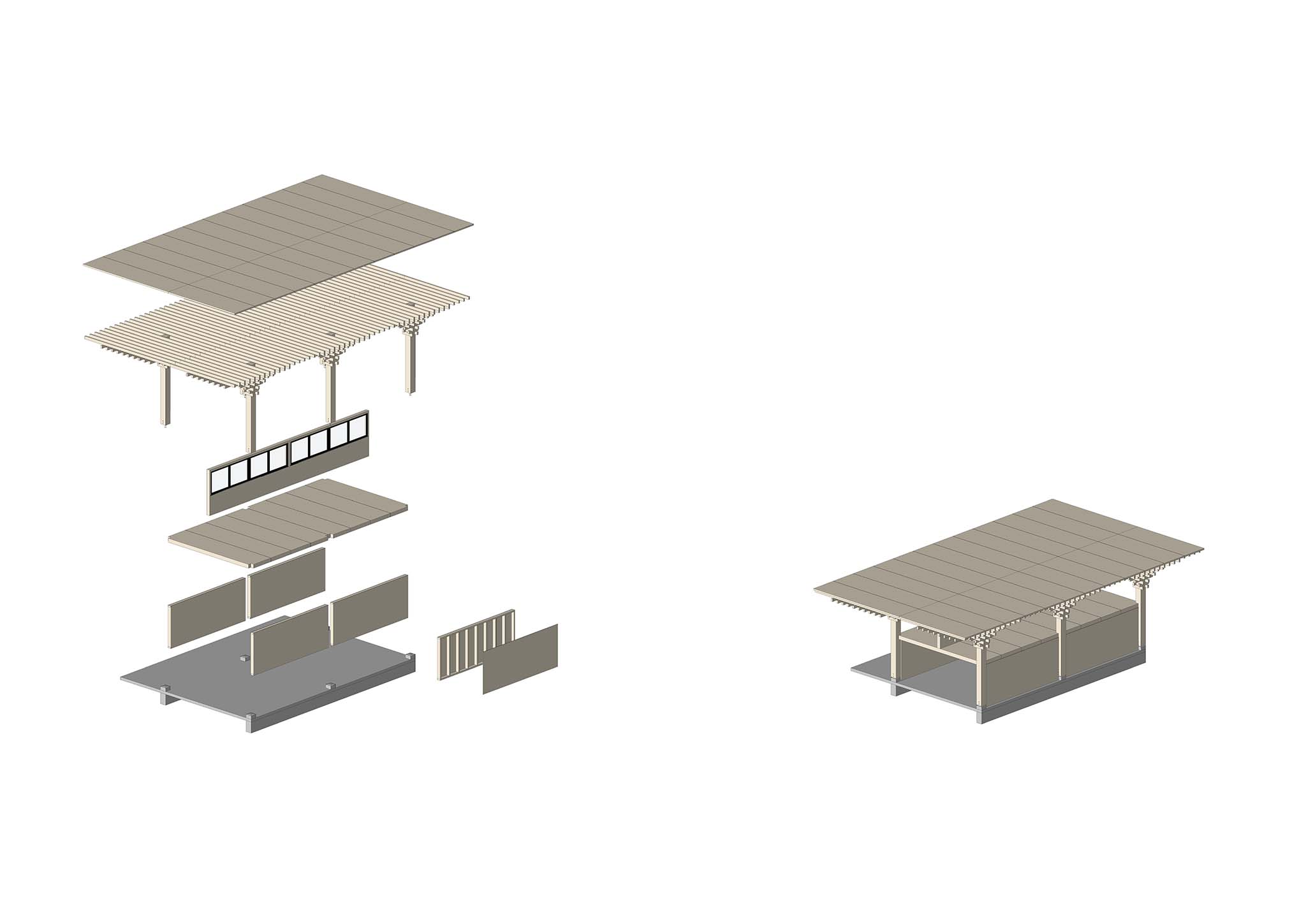
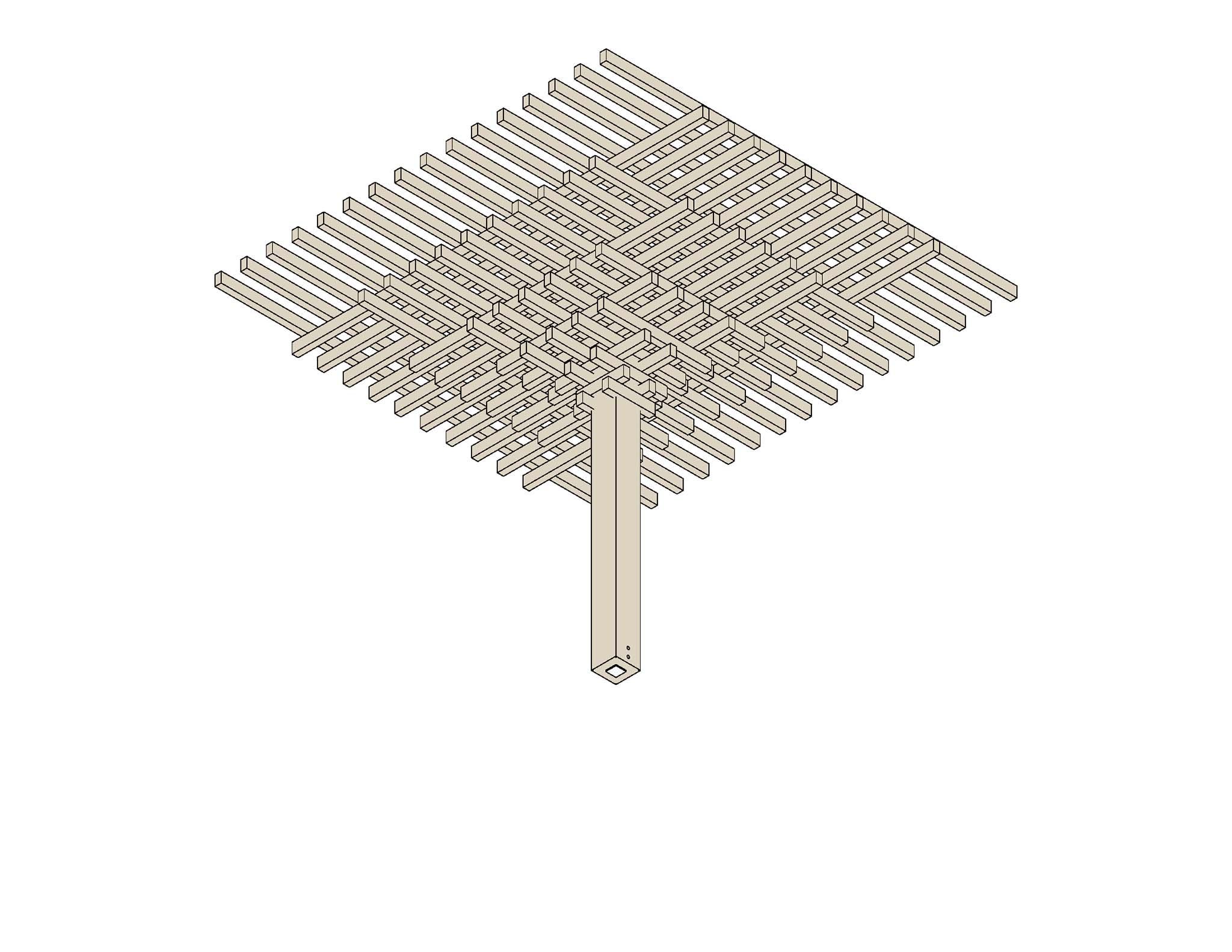
Following the success of the REWE Green Farming Wiesbaden prototype, the Berlin supermarket represents the second realization of this concept — proof of its modularity and adaptability. It differs in many ways from the prototype. The timber columns have become slimmer, they need less timber, and a lot less screws. The substructure is now entirely in timber, removing the concrete used in the first building entirely. And the central atrium has evolved, learning many lessons on cold-bridging and complexity from the past.
REWE Green Farming Berlin is an important milestone to show how REWE are evolving the first prototype to make it fit for mass production. It is the food retailer’s first market to be planned entirely using BIM (Building Information Modelling). The next stage is series production.
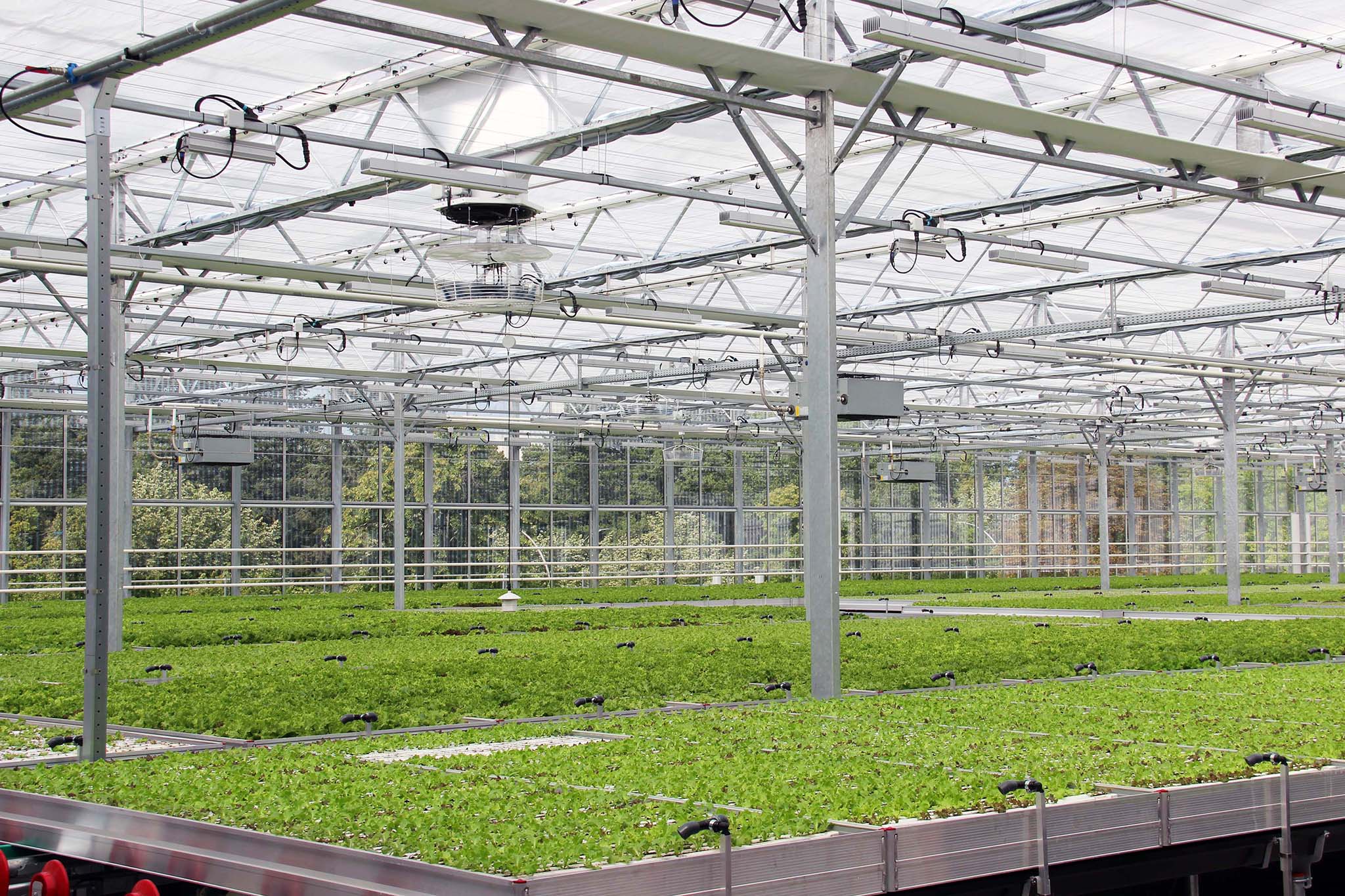
The core element of the new generation of supermarkets is wood. The wooden structure with 72 columns of stacked beams form the airy market hall. The structure is exposed and the materiality is celebrated. Wood offers clear advantages over conventional building materials: It stores carbon, and thanks to the modular construction, the timber can be dismantled and recycled for a second life. The cycle is also closed during operation: waste heat from the store, a heat pump and rainwater from a cistern provide optimal growing conditions for the urban salad on the roof.
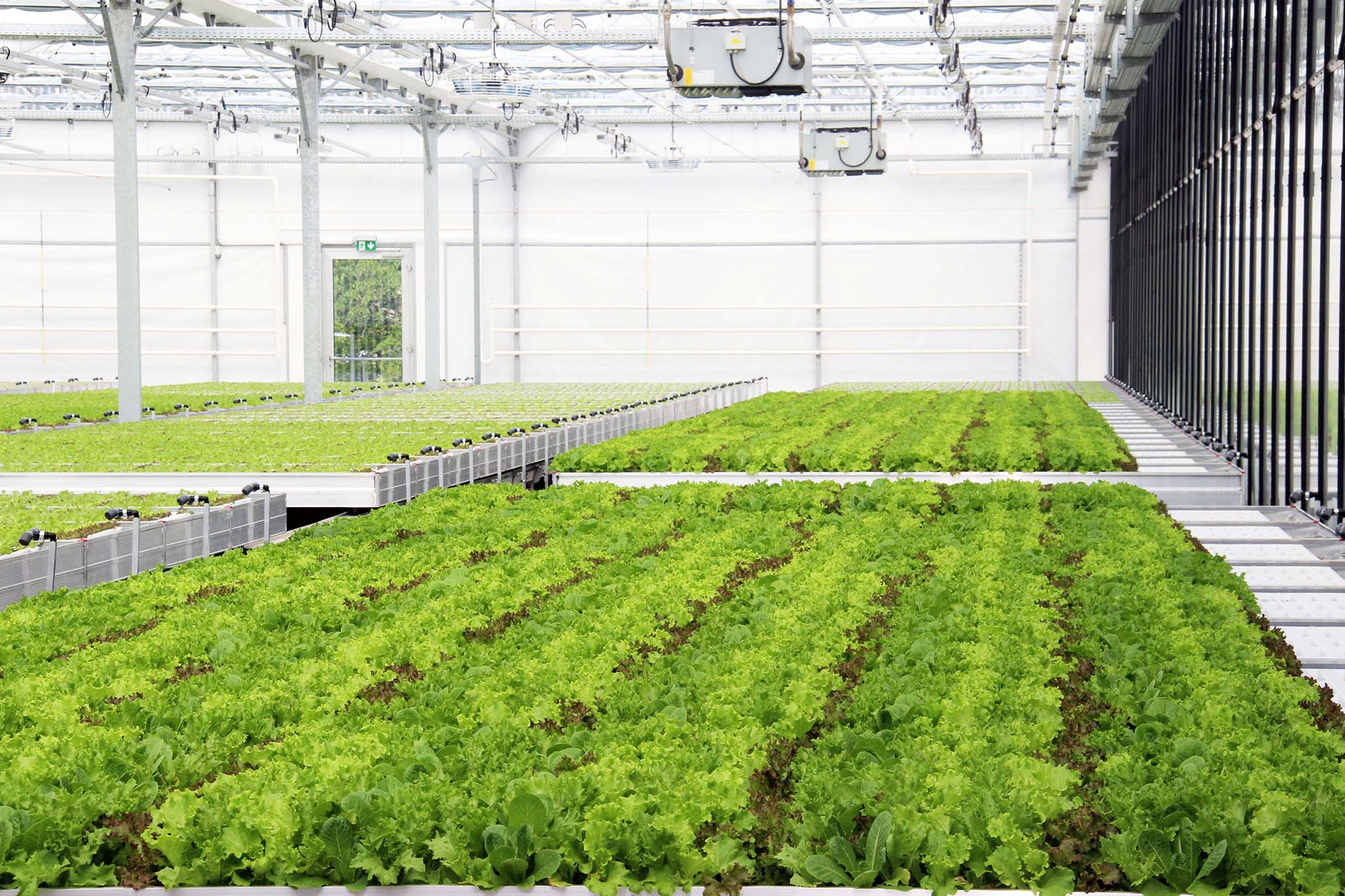
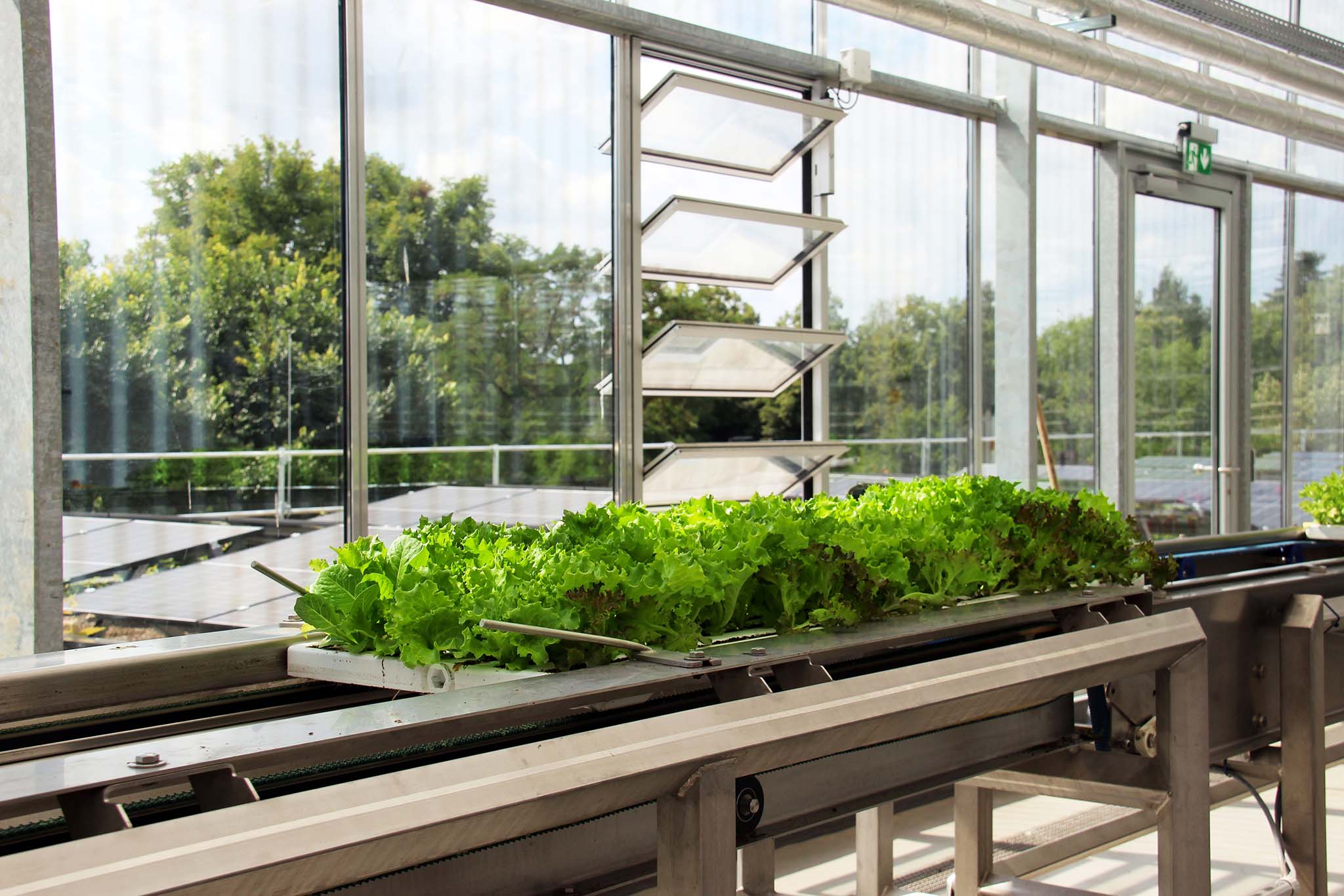
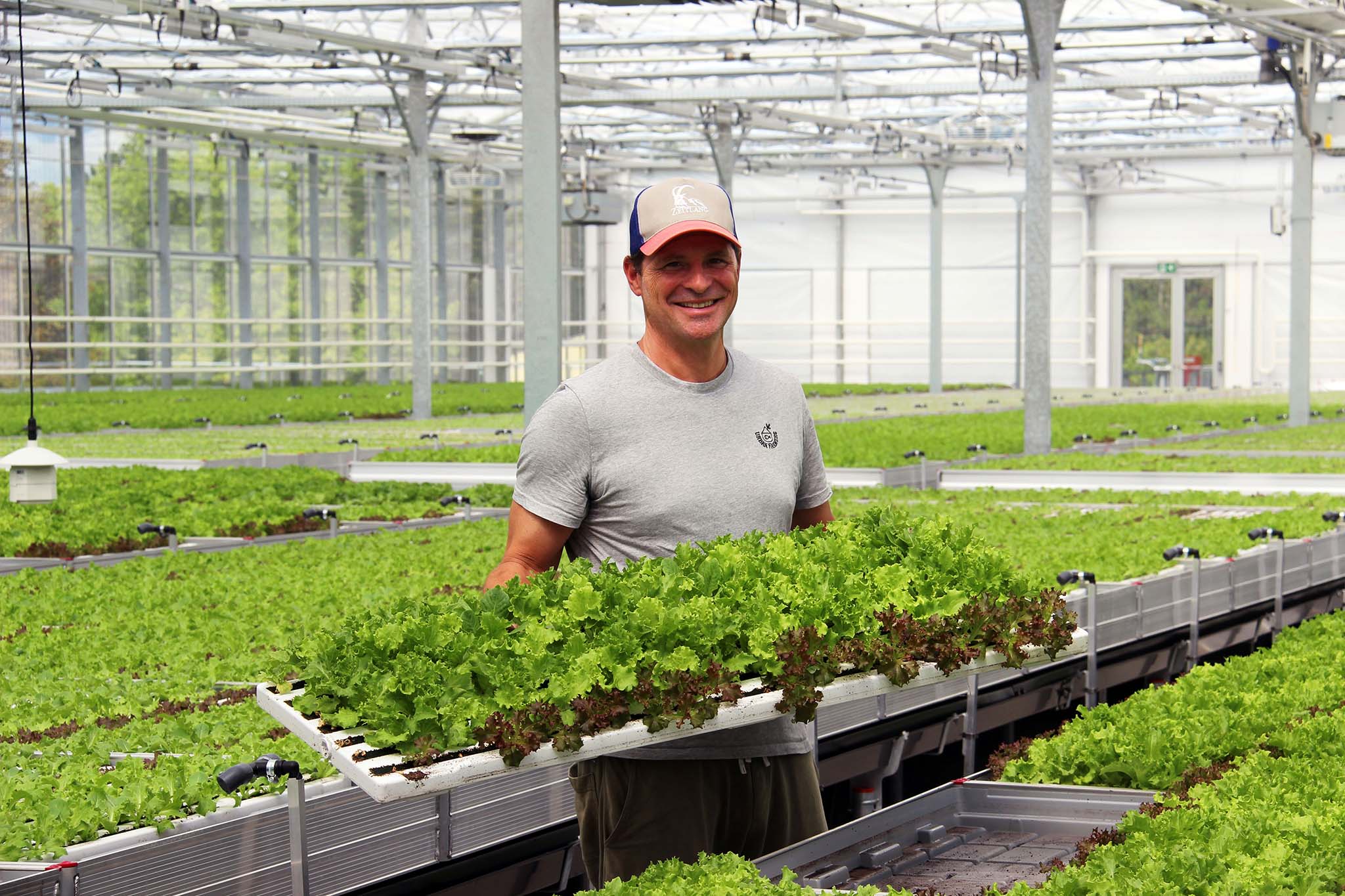
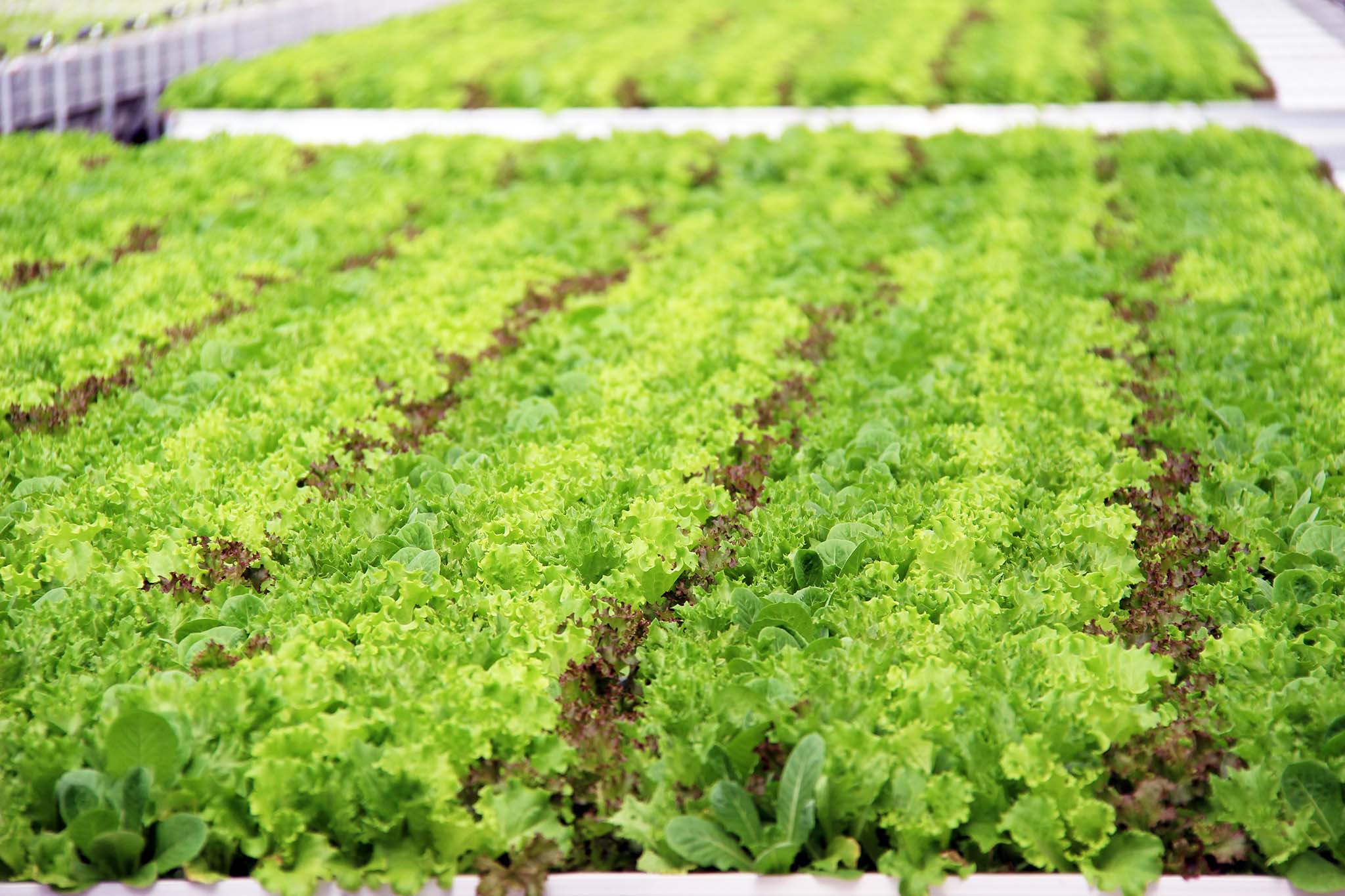
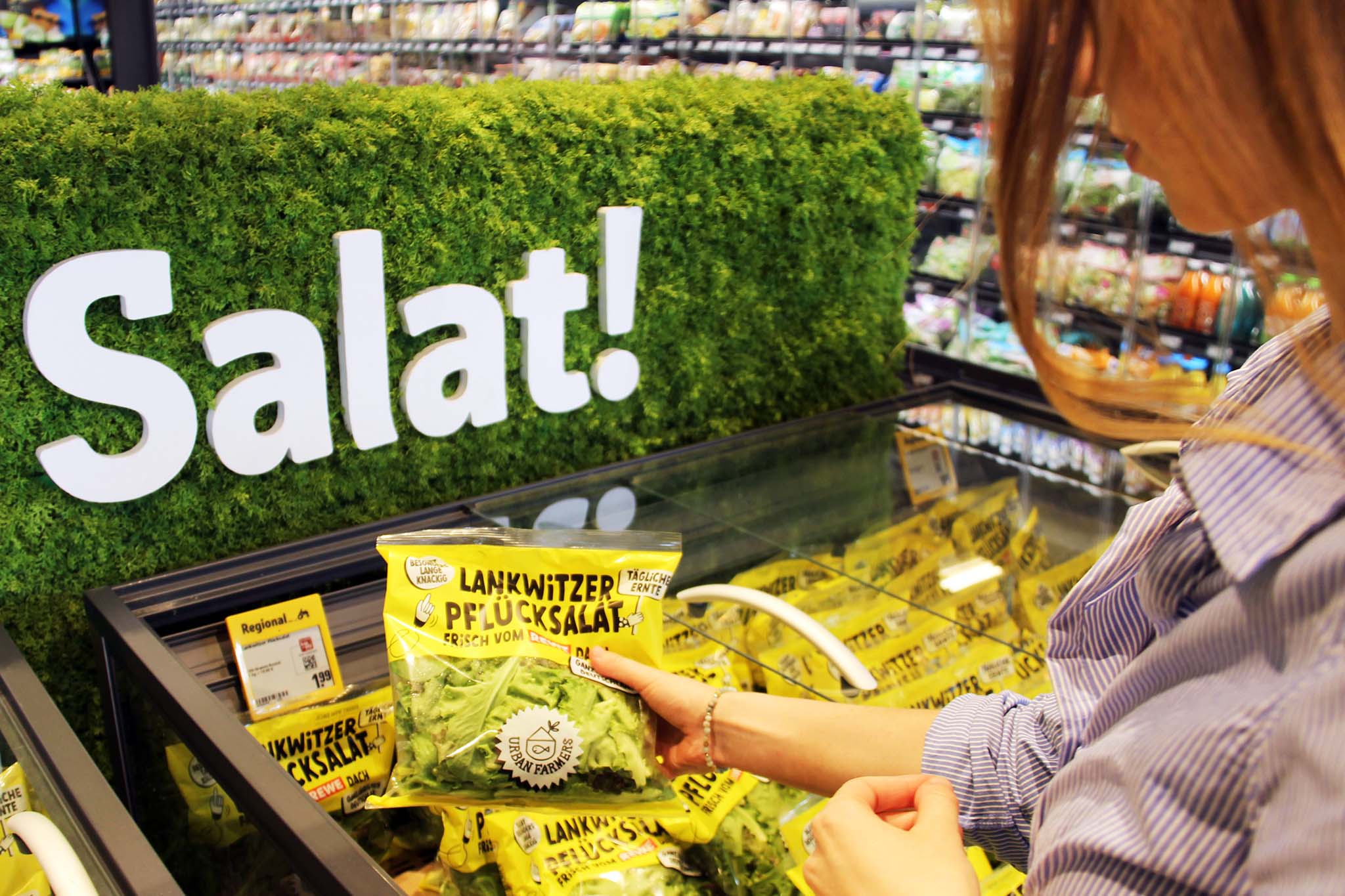
On the rooftop, site grown leaf lettuce goes from the roof to the shelf in 25 days. Behind this visionary cultivation concept is ECF Farmsystems. The team led by founder Nicolas Leschke champions innovative food production in urban areas. The Lankwitz pick-your-own lettuce from REWE Green Farming Berlin includes the varieties of lettuce, including romaine lettuce and lollo rosso. The plants undergo an automated, hydroponic cultivation process on the rooftop farm with virtually no soil. The lettuce grows on special trays that are flooded with a nutrient solution several times a day. After the daily harvest, the salad is processed, packed and prepared for sale on-site or for transport at the market. Up to 900,000 salad mixes are grown annually on the rooftop farm. From summer 2026 onwards, the first lettuce will be harvested from the supermarket roof.
REWE will use this to supply around 500 supermarkets in the capital region. Compared to imported produce from Southern Europe, this will save around 500,000km of transport per year.
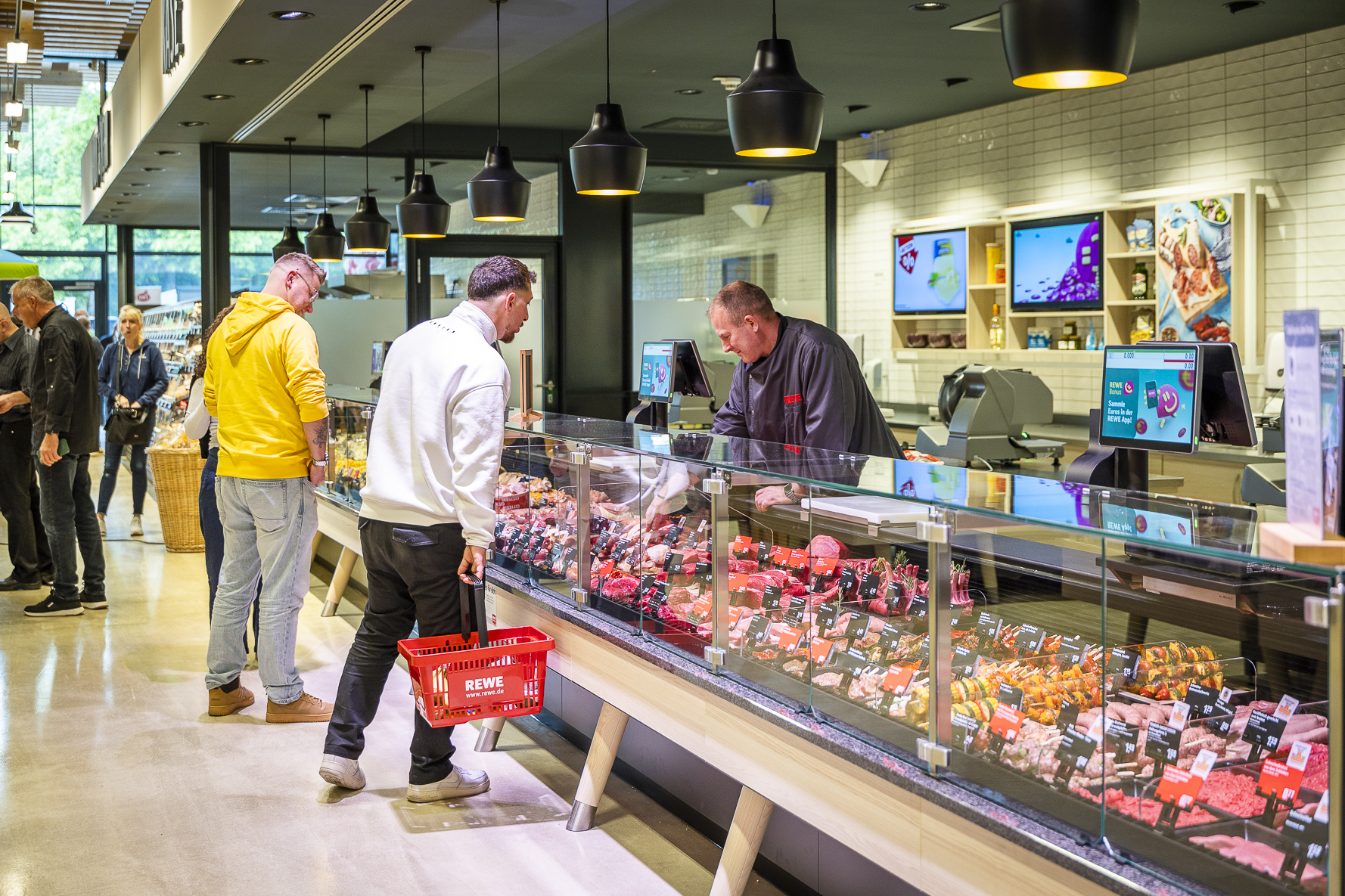
A large window front at the entrance to the store and the surrounding skylight flood the interior with natural light. With the seven-metre-high ceilings, this creates a spacious market-style environment. The product range reflects a market atmosphere with over 20,000 items. Products sold are from from the REWE Regional own brand, as well as produce from 20 regional suppliers including Candé Natura, Hemme Milch and Mampe Berlin.
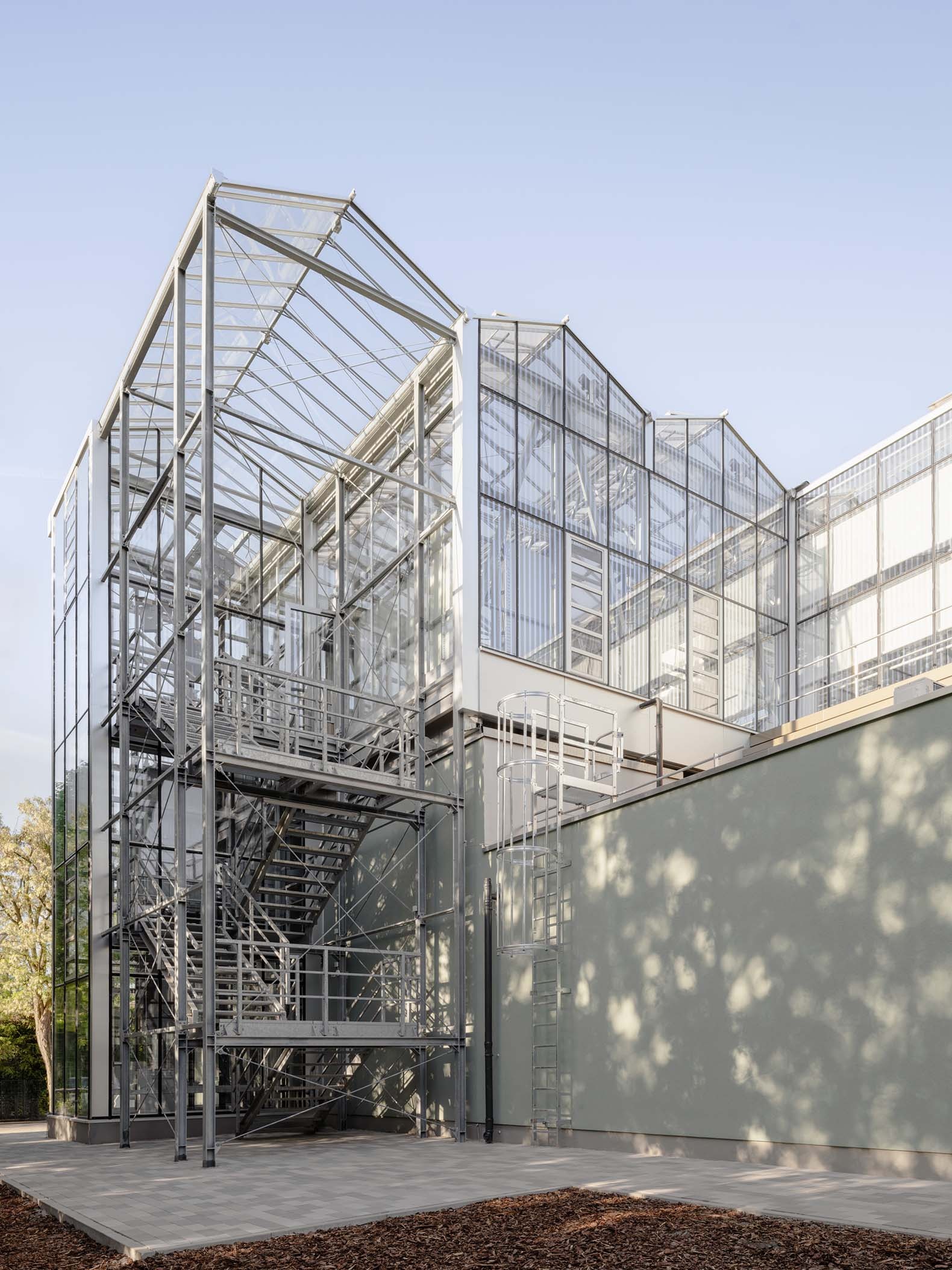
For many years, REWE have been using 100 per cent green electricity in their stores. Thanks to LED lighting, glazed refrigerated display cabinets and intelligent temperature control, the store consumes around 50% less energy. In addition, we can generate part of the electricity requirement with the 200 solar panels on the roof. Overhanging eaves provide summer heat protection as a structural sunshade, reducing the store’s cooling requirements. A ten-tonne heat pump ensures optimal temperatures in the rooftop farm.
The landscape has also been thoughtfully designed: parking spaces for bicycles and cargo bikes are available in front of the store; the car parks have permeable paving; Electric cars can be charged at one of the four EV charging points.
Feasibility studies for additional REWE concepts have been undertaken across Germany, based on a defined set of parameters that establish ideal conditions for modular deployment and a consistent architectural identity.
In each case, a column typology is selected to structurally support a specific roof type, while supplementary functions can be arranged alongside it, allowing for flexible and scalable store configurations.
“With REWE Green Farming, we are further developing our green building strategy and combining circular construction with urban food cultivation. Our new generation of supermarkets is now going into production; thanks to the modular design, we can optimally adapt the roof usage to the location. We are already planning further timber-framed supermarkets in Germany.”
Peter Maly, CEO - REWE Group.
“REWE Green Farming Berlin is the result of ten years of collaboration. Since 2016, ACME and REWE have been developing the modular concept, which can be flexibly configured for any location. It is a market hall for the 21st century that celebrates fresh and local producem, with sustainability at its core. The first market hall in Wiesbaden was a groundbreaking pilot project, widely acclaimed and immediately popular. The experience gained in Hesse formed the basis for how we have further developed the concept in all areas. The second generation of the supporting structure consists entirely of timber above the floor slab, and the architecture of the rooftop farm has been reimagined.”
Friedrich Ludewig, Director - ACME.
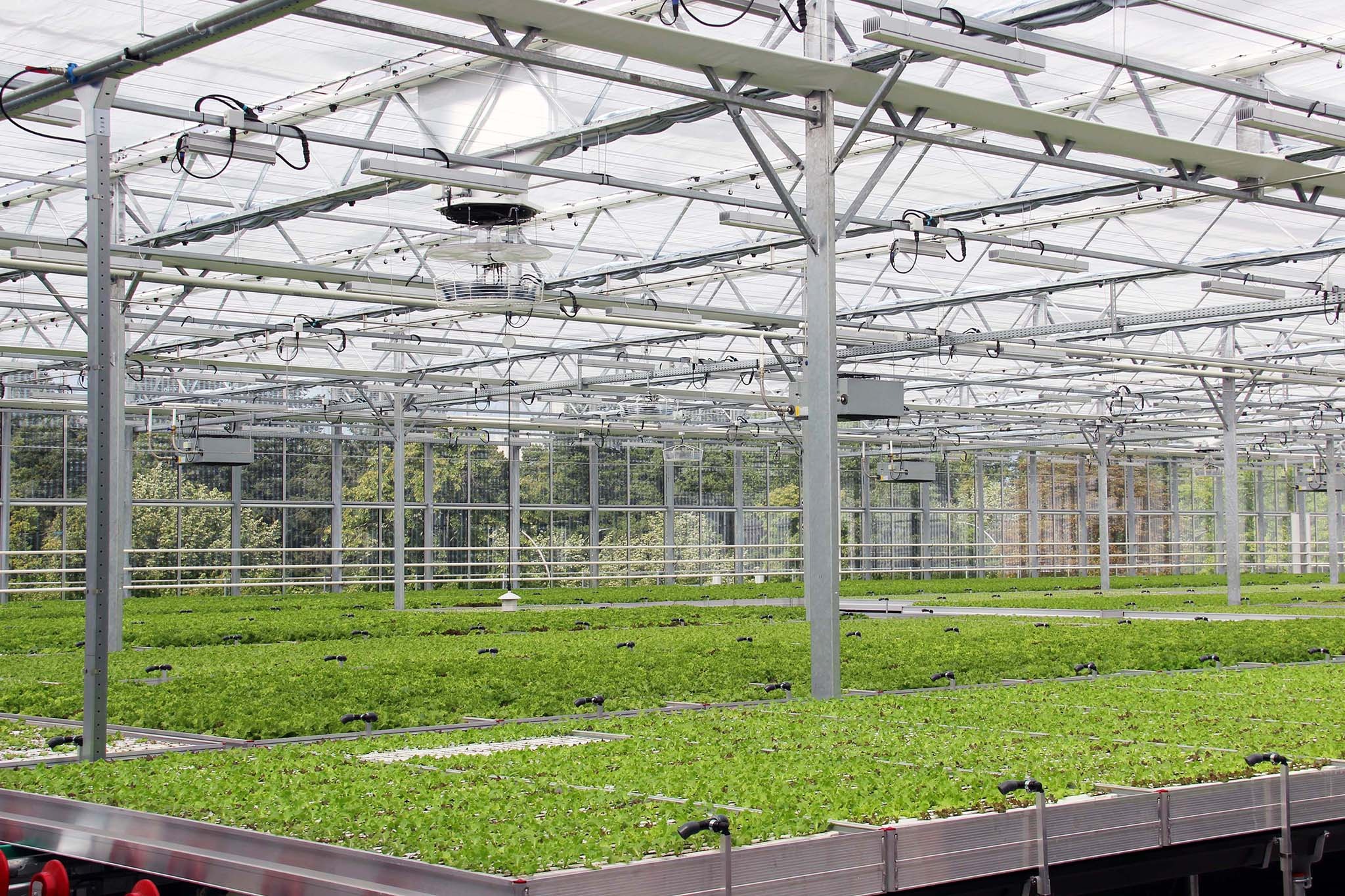
“There is an incredible amount of unused roof space in our cities. If we think of these areas as production sites, there is enormous potential there. REWE was the first food retailer to recognise this.”
Nicolas Leschke, Managing Director - ECF Farmsystems.
“Our new Green Buildings are an outstanding example of what the future of construction must look like: circular, with the right choice of materials and always with an eye on the environmental impact of building.”
Klaus Wiens, Head of Store Construction - REWE.
“Beams, ceiling elements, interior and exterior walls – thanks to digital planning, all timber elements could be delivered ready for assembly in advance. This significantly sped up the construction process.”
Hendrik Pfeffinger, Project Manager - Holzbau Amann.
“Instead of planning in 2D as we did before, we are now working in 3D for the first time, in a data-driven and, above all, collaborative way...Potential problems can be identified and resolved in the digital model – even before they arise on the construction site.”
Thomas van der Broeck, Head of Digital Construction & Processes - REWE.
“With the REWE Green Farming project, we are rethinking the construction process. As a natural material, timber has many advantages but also specific requirements compared to traditional materials – here, effective coordination between all trades is crucial.”
Karl Erik Lederer - Site Manager, Dreßler Bau.
“The shift in emphasis from traditional structural work towards elegant timber construction not only brings technical innovations, but also reshapes the structures of the companies involved. This project is a real learning experience for everyone involved and thrives on collaborative development.”
Carsten Schmidt, Managing Director - CS Architekten.