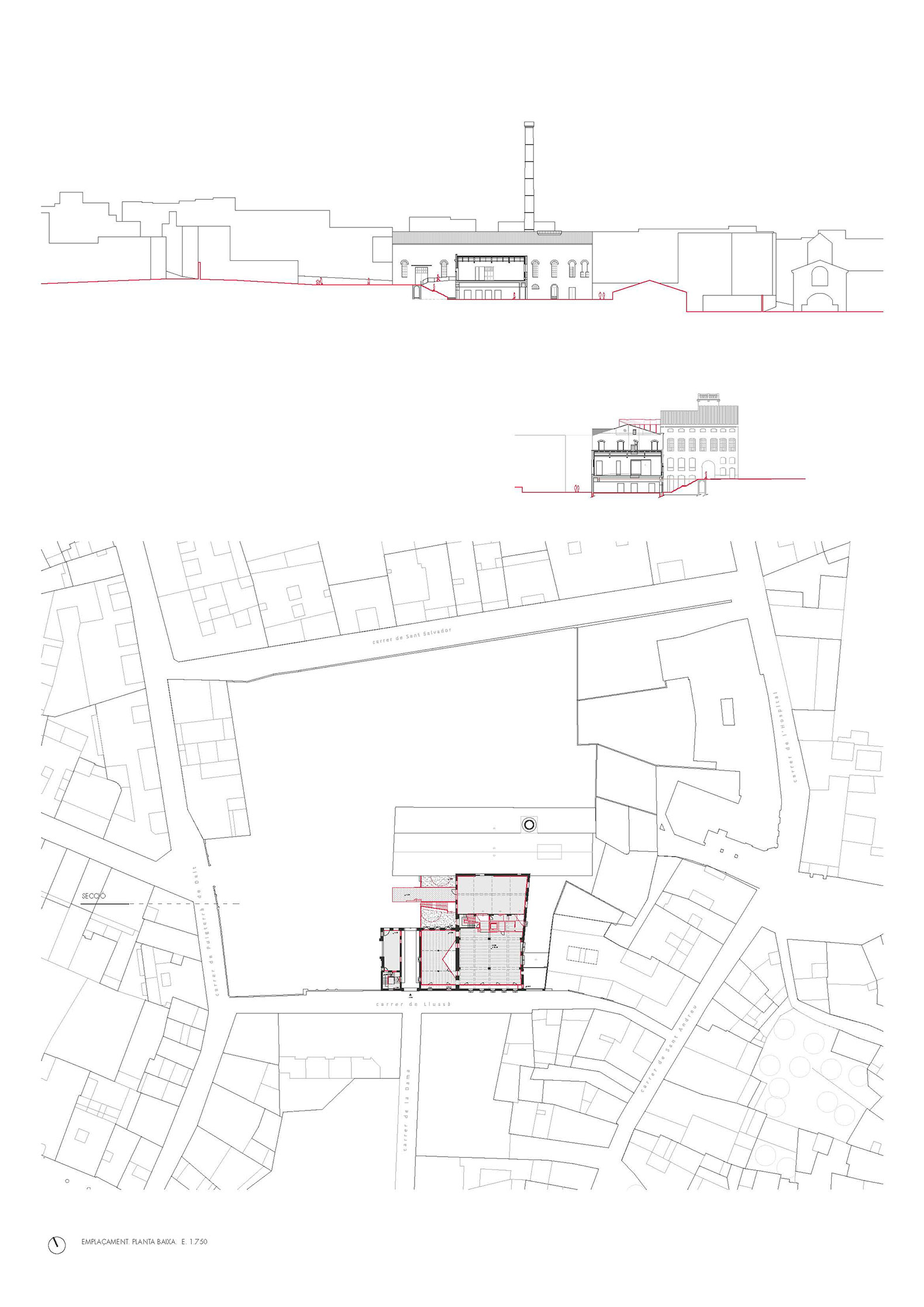
The architectural complex, renovated by Meritxell Inaraja, comprises three buildings. Originally, the first and closest to the street housed the textile factory, while the other two parallel buildings, accessible from the passageway and central courtyard, contained the boilers and machinery. The basements held the coal storage and the flues that carried smoke to the large chimney.
In the new layout, the three floors of the former textile factory are now used for municipal offices, the largest building for performances and multipurpose activities, and the central building serves as a public lobby. The design incorporates a glazed gallery that acts as a climate regulator, enhances natural light and cross-ventilation, and highlights the interior façade.

L’Anònima Manresana by Meritxell Inaraja. Photograph by Adrià Goula.
Project description by Meritxell Inaraja
Since its construction in 1894, based on a design by Ignasi Oms i Ponsa, the Anònima Manresana power plant occupied a central position in Manresa's old town, facilitating the production and distribution of electricity and establishing itself as a key element in the city's urban and industrial development. The current project, spearheaded by the City Council, recovers this historical legacy by transforming it into a public facility, restoring urban centrality to an area in need of revitalization and contributing to the social and functional revitalization of the old quarter.
The rehabilitation reinforces the building's inclusive character through an urban inclusion strategy that improves access to public services, strengthens its connection with the community, and transforms the Anònima into an open and dynamic civic hub within the urban fabric. The building, originally embedded in a dense urban fabric with adjacent structures, is freed up through selective demolition, creating new open urban spaces and improving its relationship with the immediate surroundings.
The architectural complex comprises three buildings: the one closest to the street, originally a textile factory that utilized surplus electricity, and two parallel buildings accessible from a passageway and central courtyard, which housed the boilers and machinery. The basements contained the coal storage and the flues that carried smoke to the large chimney. In the new functional layout, the largest building remains open-plan for performances and multipurpose activities, while the central building is transformed into a public lobby, and the three floors of the former textile factory are designated for municipal offices.
The proposal acknowledges the building's historical, architectural, and social significance and conceives of it as a living structure capable of accommodating new uses without losing its identity. The intervention is conceived as a graft between the historical and the contemporary, ensuring its continuity and establishing a respectful dialogue between eras, activating its transformative potential on an architectural, urban, and social scale.

Initially focused on interior rehabilitation, the intervention found an opportunity in the deterioration of the basement beneath the plaza to create new urban connections. The excavation of these spaces has allowed them to be opened to natural light and the public space, transforming a limitation into an added value that improves the urban, social, and environmental conditions of the surroundings.
The preservation of the façades and the memory of the original interior spaces forms the basis of the proposal, reinforced by a passive energy strategy that defines and organizes the space. The addition of a glazed gallery acts as an intermediate element for climate regulation, providing shade and natural ventilation in summer and solar gain in winter. A central, full-height space functions as a vertical ventilation chimney, promoting cross-ventilation, natural lighting, and visual connections between floors, while also highlighting a historic interior façade.

This rehabilitation transforms the energy strategy into a tool for interpreting, preserving, and updating heritage, and transcends the building itself to impact the public space and architectural, urban, and social regeneration, promoting sustainability, health, and quality of life.