


The hospital complex developed by Burgos & Garrido Arquitectos, MAPA AC, and Neila Arquitectura significantly expands existing capacity and incorporates new areas dedicated to clinical research, medical innovation, and advanced healthcare technologies. The layout is based on a simple, repetitive geometric structure, combined with a limited number of façade solutions that respond to both the specific characteristics of the interior spaces and the requirements for thermal comfort.
The proposal is governed by a set of simple and effective rules that respond, on the one hand, to the needs of use and, on the other, to the logistics of a phased construction process. As a fundamental premise, the hospital had to remain operational throughout the entire construction process. In this sense, the design system incorporates margins of variation and flexibility that allow for adaptations over time, resulting in a diverse array of spaces: some highly specialized and precise, others more ambiguous and sensory.
The chosen volume is conditioned by several clearly differentiated urban contexts: a local scale, seeking not to overwhelm the immediate surroundings; the presence of large nearby infrastructure; and the distant landscape of the Sierra de Guadarrama mountains to the north of Madrid. The project finds its balance between these tensions, proposing a contemporary hospital model that combines high functional complexity with a clear and flexible spatial organization, capable of adapting to future transformations in medicine and healthcare technology.
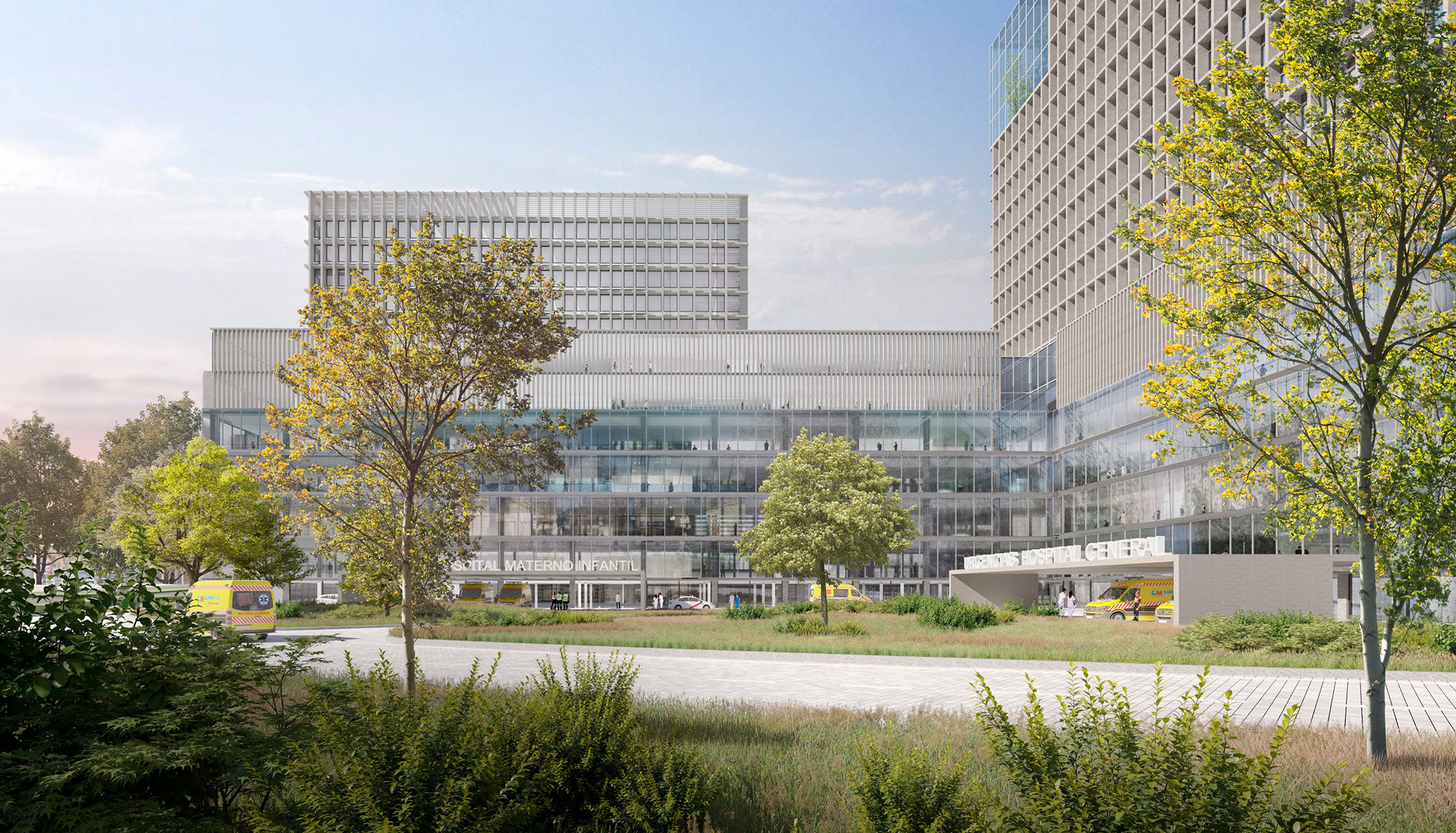
La Paz University Hospital by Burgos & Garrido Arquitectos + MAPA AC + Neila Arquitectura. Rendering by Show Me The Project / Supernova.
Project description by Burgos & Garrido Arquitectos + MAPA AC + Neila Arquitectura
La Paz University Hospital is one of the most important public institutions in the city and the country. Located on the Paseo de la Castellana, home to many other institutions such as the Prado Museum, the Bank of Spain, and the National Library, its design is critical to the development of the urban and civic space—in the broadest sense of the word—of northern Madrid, an area still under construction. Furthermore, the project requires formidable geometric rigor and organizational clarity to resolve the extraordinary complexity of its functional program and its phased construction, while ensuring the uninterrupted provision of essential services.
Construction has begun with the first phase, corresponding to the new industrial building, work on which commenced on February 9th. This initial construction houses the technical facilities necessary for the hospital's operation.
This project is the result of a commitment to the city, to cutting-edge hospital science, and to architecture that is sensitive and welcoming to the people who will use the hospital. A constructive and structural system is proposed, containing simple and effective rules that precisely address the program's needs and the logistics of phased execution. At the same time, this system allows for generous margins of variation and freedom, which the Hospital project explores to transform La Paz into a rich and varied collection of distinct spaces—some highly specialized and precise, others ambiguous and sensory.
The large volume that must be built is fragmented by creating smaller-scale spaces that do not overwhelm the public. However, La Paz is also inextricably linked to the city's major infrastructure, the large scale of its neighbors, and the distant landscape of the Sierra de Guadarrama mountains to the north of Madrid. In relation to these, it asserts the importance of public institutions and the construction of its identity. This project strikes a balance between these two demands. It employs a contemporary and advanced hospital model, one that has been tested in other large, complex hospitals, both in Spain and elsewhere in the world, and which we have adapted to the exceptional compactness of the Hospital.

The project is organized around a simple, repetitive geometric structure in plan and a concise catalog of facade solutions that address the unique characteristics of the interior spaces, on the one hand, and, on the other, ensure efficient solar gain from a thermodynamic perspective.
The project significantly expands the existing hospital capacity and will incorporate new areas dedicated to clinical research, medical innovation, and advanced healthcare technologies.
The architectural strategy seeks to combine the extraordinary functional complexity of the contemporary hospital with a clear and flexible spatial organization capable of adapting to future transformations in medicine and healthcare technology.


