


In response to the growth driven by high-density residential developments in the South Korean city of Paju—a suburb lacking quality public space, Sol89 and Jongjin Lee have projected the Care and Wellness Center for the Elderly and People with Disabilities, creating an environmental oasis within the dense urban fabric.
The layout of the project is horizontal, promoting accessibility and giving the complex a human scale. The central void articulates transparency and access points through a continuous ramp connecting two large porches: one on the ground floor, linked to communal spaces, and another on the upper floor, housing activity areas. The roof houses the administrative areas of each center in two pavilions with views of the city.
The structure follows an isotropic grid that ensures flexibility and organizational clarity, with cantilevered concrete beams defining the larger-scale spaces. The façade is resolved using a single module with concavities, glass glazing, and curved perforated aluminum sheet.
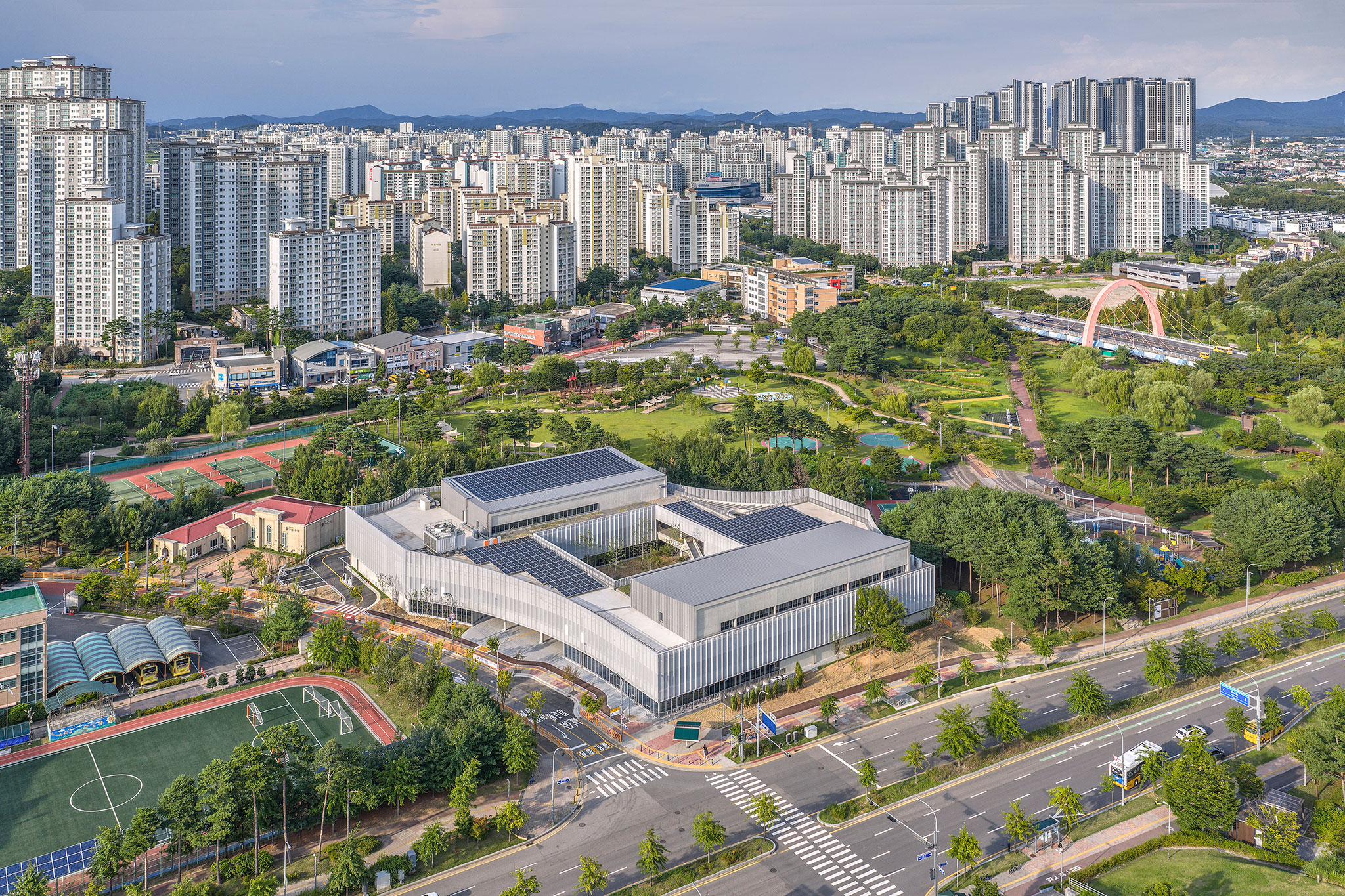
Care and Wellness Center by Sol89 + Jongjin Lee. Photograph by Bojune Kwon.
Project description by Sol89 and Jongjin Lee
The South Korean city of Paju has grown through high-density residential developments, resulting in a generic periphery often lacking quality public spaces. It is within this context that the new Care and Wellness Center for the elderly and people with disabilities is situated. Instead of the two separate buildings requested in the competition, we opted for a unified, compact, and porous design that allows the adjacent metropolitan park to flow through the building. This creates an internal public void that reinterprets the Korean madang, a kind of courtyard with a communal purpose, as a place for meeting and relaxation. It naturally separates the various programs, reinforces the connection with the park, and creates an environmental oasis within the dense urban fabric.
The horizontal configuration reduces vertical circulation, promotes universal accessibility, and gives the complex a more welcoming scale. The central void, sunny year-round, articulates transparencies and access points to the various uses, where a continuous ramp connects the two large porches opening onto the courtyard: one on the ground floor, linked to collective uses such as auditoriums, classrooms, and a dining hall, and another on the first floor, where gyms, rehabilitation rooms, and activity spaces are located. On the roof, two pavilions with views of the city house the administrative areas of each center.
The project is resolved through an 8x8 m isotropic structural grid that guarantees flexibility and organizational clarity, integrating the concrete volumes of auditoriums and the cores of ramps and services within it. Suspended concrete beams define the larger-scale spaces, where structure and installations are exposed against the backdrop of the courtyard and park vegetation. On the exterior, the building adapts to its surroundings through multiple concave forms, where the façade is resolved using a single 125 cm module that houses the glass window frames and a curved, perforated aluminum sheet that homogenizes the exterior appearance and softens the privacy of the interior spaces facing the street.
The result is a porous building that blurs the boundaries of the city and allows the park to pass through it, creating a green and quiet public space that fosters interaction among citizens.


