Christ & Gantenbein in collaboration with WMM Ingenieure AG, Henauer Gugler AG, and August + Margrith Künzel Landschaftsarchitekten AG, has designed a new bridge located in the natural environment of the Aare River as it passes through the city of Aarau, in the canton of Aargau, north of Switzerland.

The historic city center has been connected to the canton of Jura since Roman times, especially thanks to this bridge, which has been replaced on different occasions by new structures, including the famous "Kettenbrücke" bridge from 1848.

Currently, this new bridge replaces an old concrete bridge from 1949, already very old. The competition for the project aimed to replace the old bridge and also to make it a welcoming public space that would fit harmoniously with the urban context.

Christ & Gantenbein's team designed a new bridge, also made of concrete, which maintains the traditional structure of this type of infrastructure, creating an elegant layout that technically optimizes concrete construction. Its formalization and colors dialogue naturally with the stone structures of Aarau and its medieval houses.

The arch-shaped construction optimizes the use of reinforced concrete thanks to its careful geometry. The five arches with spans of different widths partially rest on the two caissons of the old bridge located in the riverbed, favoring reuse.

An important aspect of the bridge's construction is its monolithic support structure, in which all components build a seamless, uniform construction. With a length of 119 meters and a width of 17.5 meters, the bridge has two lanes, sidewalks on both sides and bike lanes.
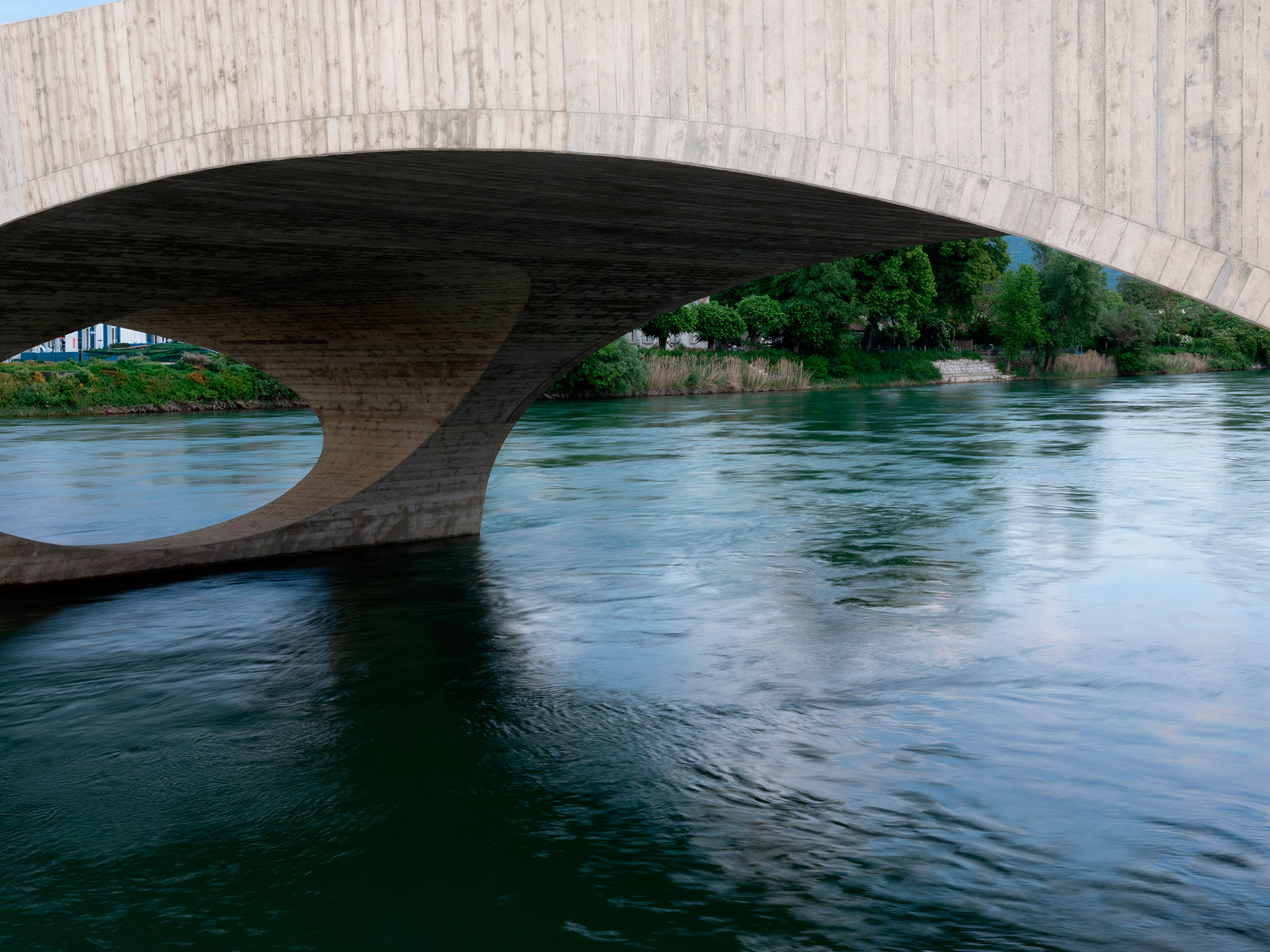

New Aare Bridge by Christ & Gantenbein. Photograph by Stefano Graziani.


New Aare Bridge by Christ & Gantenbein. Photograph by Stefano Graziani.

Description of project by Christ & Gantenbein

The new Aare Bridge in Aarau, Switzerland, designed by the planning team Christ & Gantenbein, WMM Ingenieure AG, Henauer Gugler AG, and August + Margrith Künzel Landschaftsarchitekten AG, is both a modern infrastructure construction and a part of the city. Replacing a 1949 concrete bridge, the new structure blends organically into Aarau’s distinctive cityscape and the natural environment of the Aare river while strengthening the region’s transportation network. As a comprehensive bridge and riverbank design, the project creates an appealing urban space, and with its distinctive, elegantly curved arches, becomes a new landmark.

Since Roman times, there has been a bridge over the Aare at this location – from the historical city center over the Zollrain towards the north, to the Jura. This bridge has been replaced several times by new structures, including the 1848 “Kettenbrücke” and a concrete bridge from 1949. As such, the competition which sought a replacement for the aging predecessor emphasized that the new bridge should fit into its urban context. The winning design distinguished itself through this very connection to the urban structure and the creation of an inviting public space at the entrance to the historical old town. Today, the bridge seamlessly transitions into the riverbank walls, harmoniously connecting it with the river.
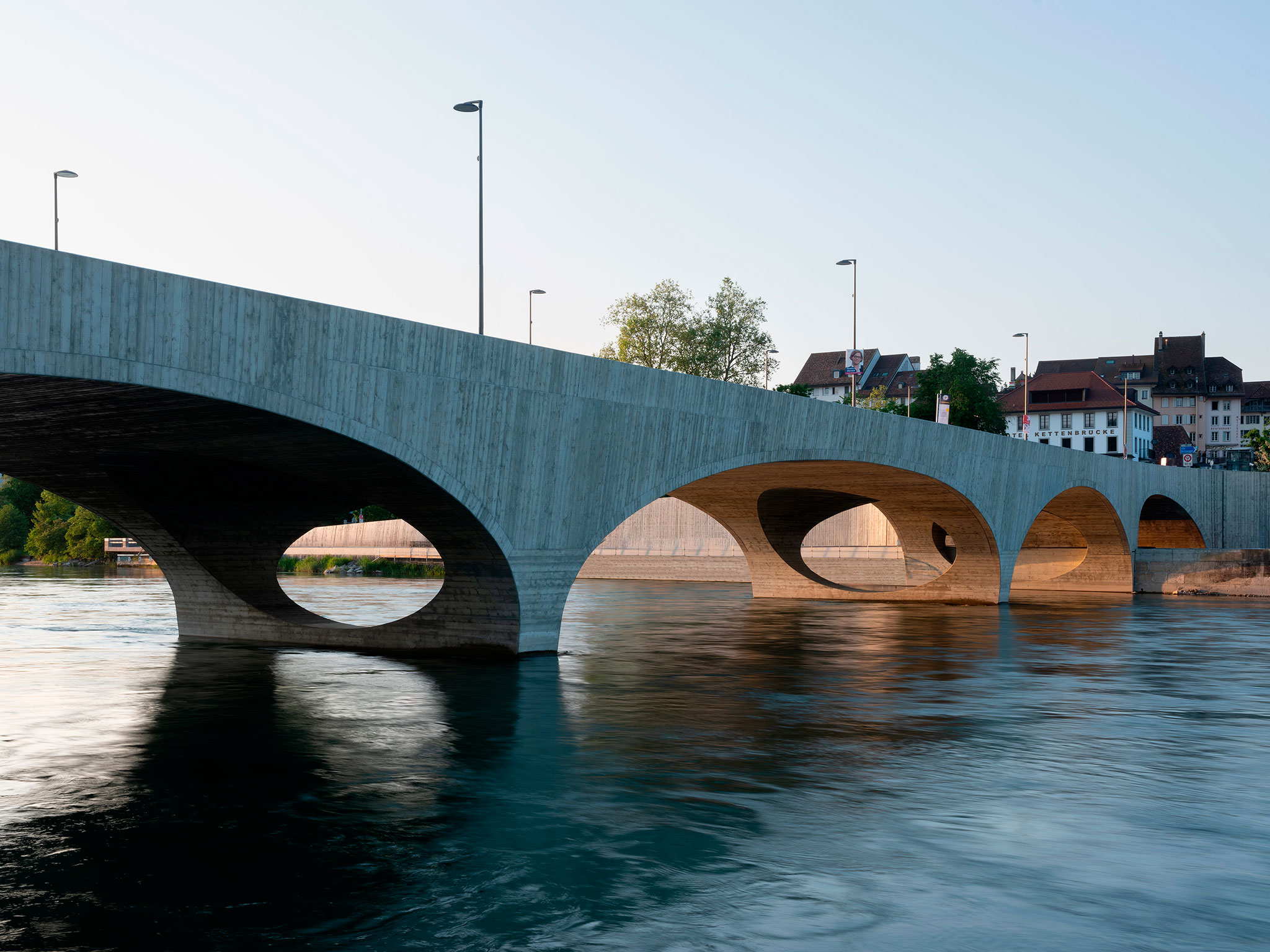

New Aare Bridge by Christ & Gantenbein. Photograph by Stefano Graziani.

The new bridge is both a traditional structure and a technically optimized, concrete construction. Inspired by the solidity of the stone buildings in Aarau, the medieval houses along the city wall, the nearby piers, retaining walls, ramps, and riverbank reinforcements, its light coloring maintains the dialogue of the structure with its surroundings. Equally, the bridge is a rational, modern archlike reinforced concrete construction, which employs concrete sparingly thanks to its specific geometry. The five spanning arches of different widths partially rest on the two caissons of the old bridge located in the riverbed, thus enabling their reuse. Another important aspect of the bridge construction is its monolithic supporting structure, in which all of the components – pillar foundations, pillars, arches, flanks, roadway, parapets – build a uniform, seamless construction. All elements participate in load-bearing, leading to an optimized and thus sustainable structure.

With a length of 119 meters and a width of 17.5 meters, the bridge features two lanes, sidewalks on both sides, and bicycle tracks. Where the riverbank path spans the bridge, large openings offer transverse views of the environs, thus creating attractive public spaces for everyone walking, jogging, or cycling along the Aare river. The new riverside links the bridge to the city where existing promenades are enhanced and newly interpreted: on the old town side, a spacious urban promenade with a square for lounging beneath shady trees is being created. On the northern riverbank area, the bridge is embellished with green meadows and local vegetation.

At first glance, the new Aare Bridge is a traditional bridge, but upon closer inspection, it is a technically optimized engineering structure. Its architectural design discerningly contributes another layer to the evolution of our urban environment, making the city more attractive to its inhabitants.

More information

Label
Architects
+ + copy Created with Sketch.
- + copy Created with Sketch.
Label
Project team
Text
Emanuel Christ, Christoph Gantenbein, Mona Farag; Tabea Lachenmann; Jean Wagner.
+ + copy Created with Sketch.
- + copy Created with Sketch.
Label
Collaborators
Text
General Management.- Ingenieurgemeinschaft Pont Neuf (WMM Ingenieure AG, Henauer Gugler AG).
Landscape Architecture.- August + Margrith Künzel Landschaftsarchitekten AG.
+ + copy Created with Sketch.
- + copy Created with Sketch.
Label
Client
Text
Kanton Aargau, Stadt Aarau.
+ + copy Created with Sketch.
- + copy Created with Sketch.
Label
Dimensions
Text
Length.- 119 meters.
Width.- 17.5 meters.
+ + copy Created with Sketch.
- + copy Created with Sketch.
Label
Dates
Text
2010-2023.
+ + copy Created with Sketch.
- + copy Created with Sketch.
Label
Location
Text
Stadt Aarau, Kanton Aargau, Switzerland.
+ + copy Created with Sketch.
- + copy Created with Sketch.
Label
Photography
+ + copy Created with Sketch.
- + copy Created with Sketch.

Christ & Gantenbein is an architecture practice founded in 1998 by Emanuel Christ and Christoph Gantenbein, it has offices in Basel and Barcelona. The firm employs a team of over 100 architects from 20 countries.

The practice develops projects of varying scales and typologies, from cultural institutions and infrastructure to housing, workspaces, and urban master plans.

Among the practice's most representative projects are the extension of the Swiss National Museum in Zurich and the expansion of the Kunstmuseum in Basel, two landmark interventions that integrate contemporary architecture into historically significant contexts. Other notable works include the Lindt Home of Chocolate in Zurich (2020) and the multifunctional building for Roche in Germany.

Currently, the studio is developing, among other projects, the extension of the MACBA in Barcelona, ​​the expansion of the Wallraf-Richartz Museum in Cologne, the new Kistefos Museum in Norway, the renovation of the main building of the Kunstmuseum in Basel, the rehabilitation of the Swiss National Library in Bern, and the transformation of the University Hospital of Zurich campus.

In their work, practice and research are deeply intertwined. Since 2018, Emanuel Christ and Christoph Gantenbein have been full professors at ETH Zurich and have held international academic positions at institutions such as Harvard GSD, the Accademia di Architettura di Mendrisio, and the Oslo School of Architecture and Design. Their work has been widely published and exhibited internationally.

Emanuel Christ (b. Basel, Switzerland, 1970) and Christoph Gantenbein (b. St. Gallen, Switzerland, 1971) graduated from ETH Zurich (Swiss Federal Institute of Technology) in 1998 and have since maintained a balance between their professional practice and academic involvement. After several lectures at ETH Zurich (2000-2005), HGK Basel (2002-2003), the Mendrisio Academy of Architecture (2004, 2006, 2009), and the Oslo School of Architecture and Design (2008), they returned to ETH Zurich (2010-2015). They currently teach at Harvard GSD.

Following internationally acclaimed projects in London, Jalisco (Mexico), and Jinhua (China), their studio, Christ & Gantenbein, continues to solidify its reputation both nationally and internationally with numerous conceptual museums, as well as a wide range of private and public commissions. Among their most recent designs are the extension of the Kunstmuseum Basel and the renovation and expansion of the Swiss National Museum in Zurich.

In the spring of 2019, Christ & Gantenbein presented the first solo exhibition of their most emblematic buildings in Japan with "The Last Act of Design." That same year, the studio contributed pieces to "The Poetics of Reason" at the 5th Lisbon Architecture Triennale. In 2017, the studio was invited to contribute to the Chicago Architecture Biennial, and the previous year, they participated in the 15th Venice Biennale, "Reporting from the Front."

Read more
Published on: June 28, 2023
Cite:
metalocus, OSCAR A. SÁNCHEZ
"Tradition and technology in a single element. New Aare Bridge by Christ & Gantenbein" METALOCUS. Accessed
<https://www.metalocus.es/en/news/tradition-and-technology-a-single-element-new-aare-bridge-christ-gantenbein> ISSN 1139-6415
Loading content ...
Loading content ...
Loading content ...
Loading content ...
Loading content ...
Loading content ...
Loading content ...
Loading content ...
Loading content ...
Loading content ...
Loading content ...
Loading content ...
Loading content ...
Loading content ...
Loading content ...
Loading content ...
Loading content ...
Loading content ...
Loading content ...
Loading content ...
Loading content ...
Loading content ...
Loading content ...
Loading content ...
Loading content ...
Loading content ...
Loading content ...
Loading content ...
Loading content ...
Loading content ...
Loading content ...
Loading content ...
Loading content ...
Loading content ...
Loading content ...
Loading content ...
Loading content ...
Loading content ...
Loading content ...
Loading content ...
Loading content ...
Loading content ...
Loading content ...
Loading content ...
Loading content ...
Loading content ...
Loading content ...
Loading content ...
Loading content ...
Loading content ...
Loading content ...
Loading content ...
Loading content ...
Loading content ...