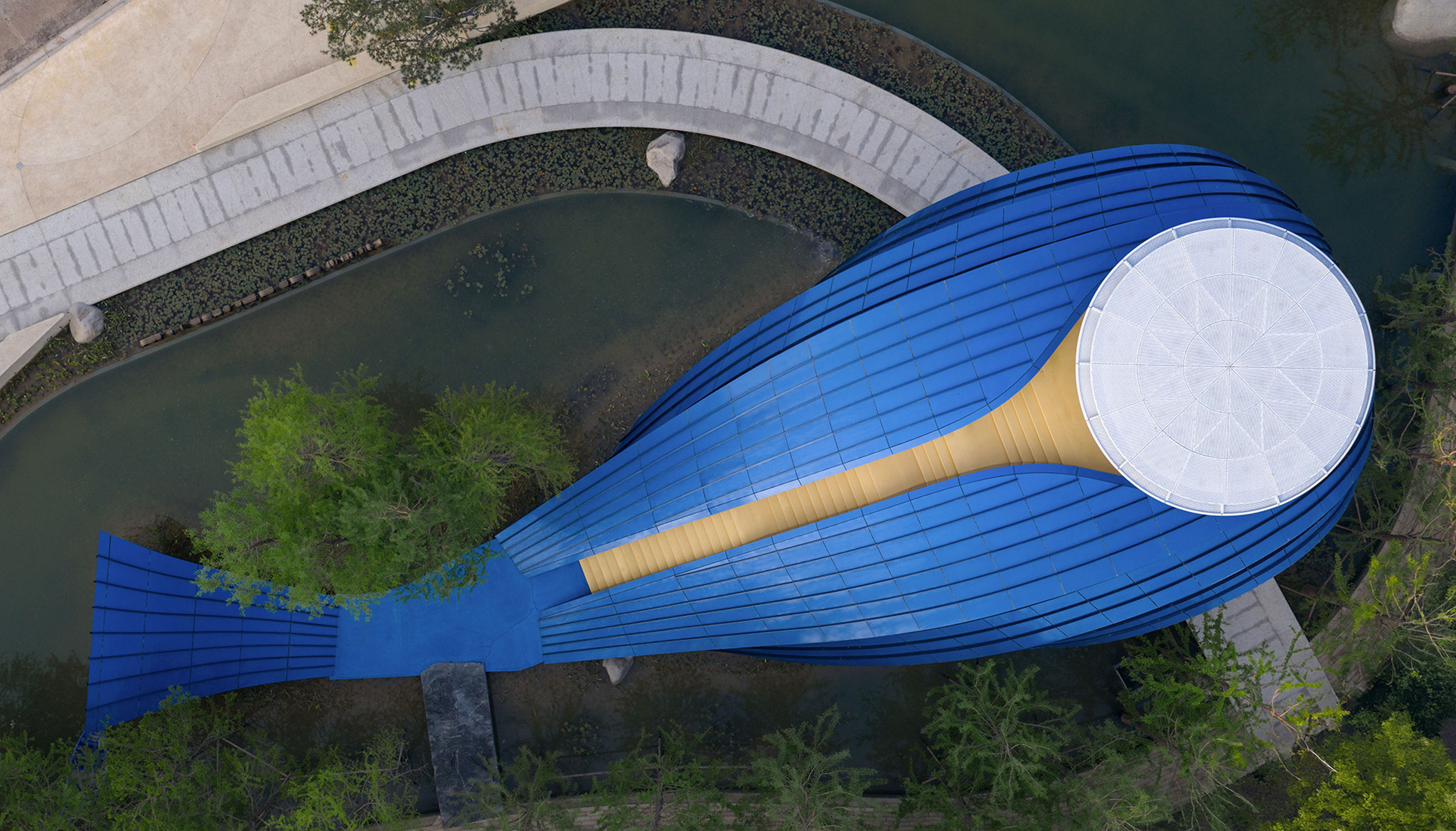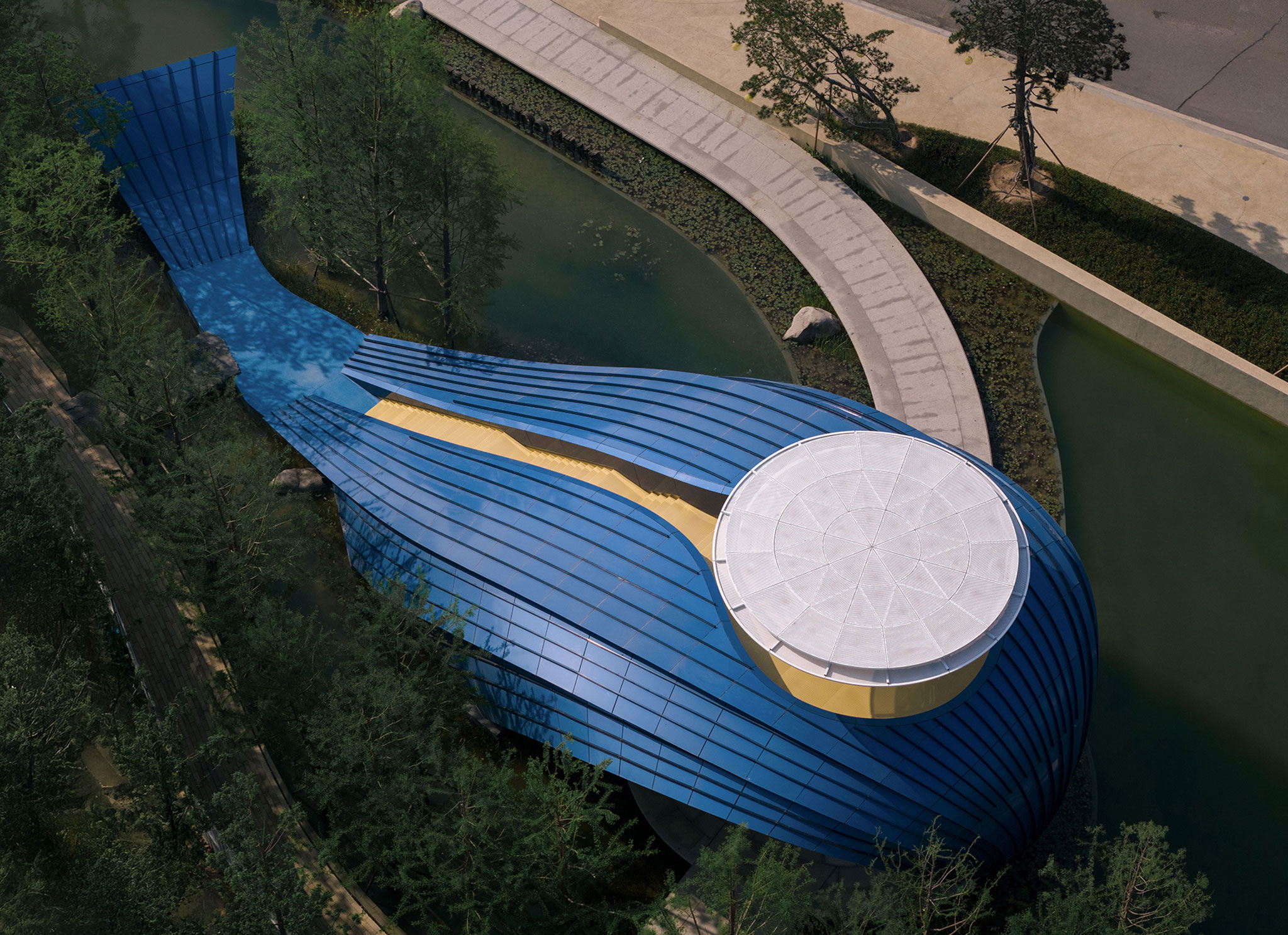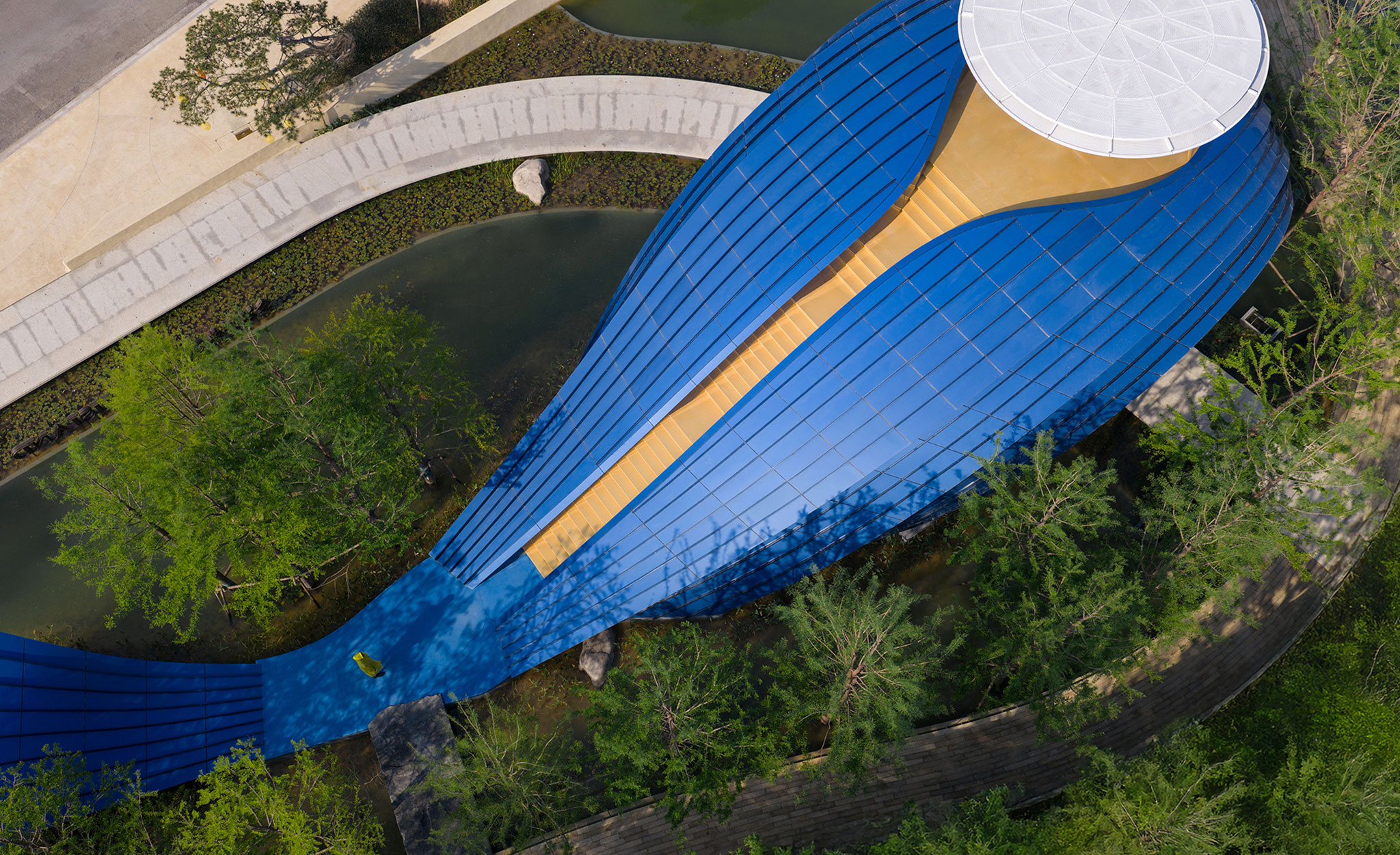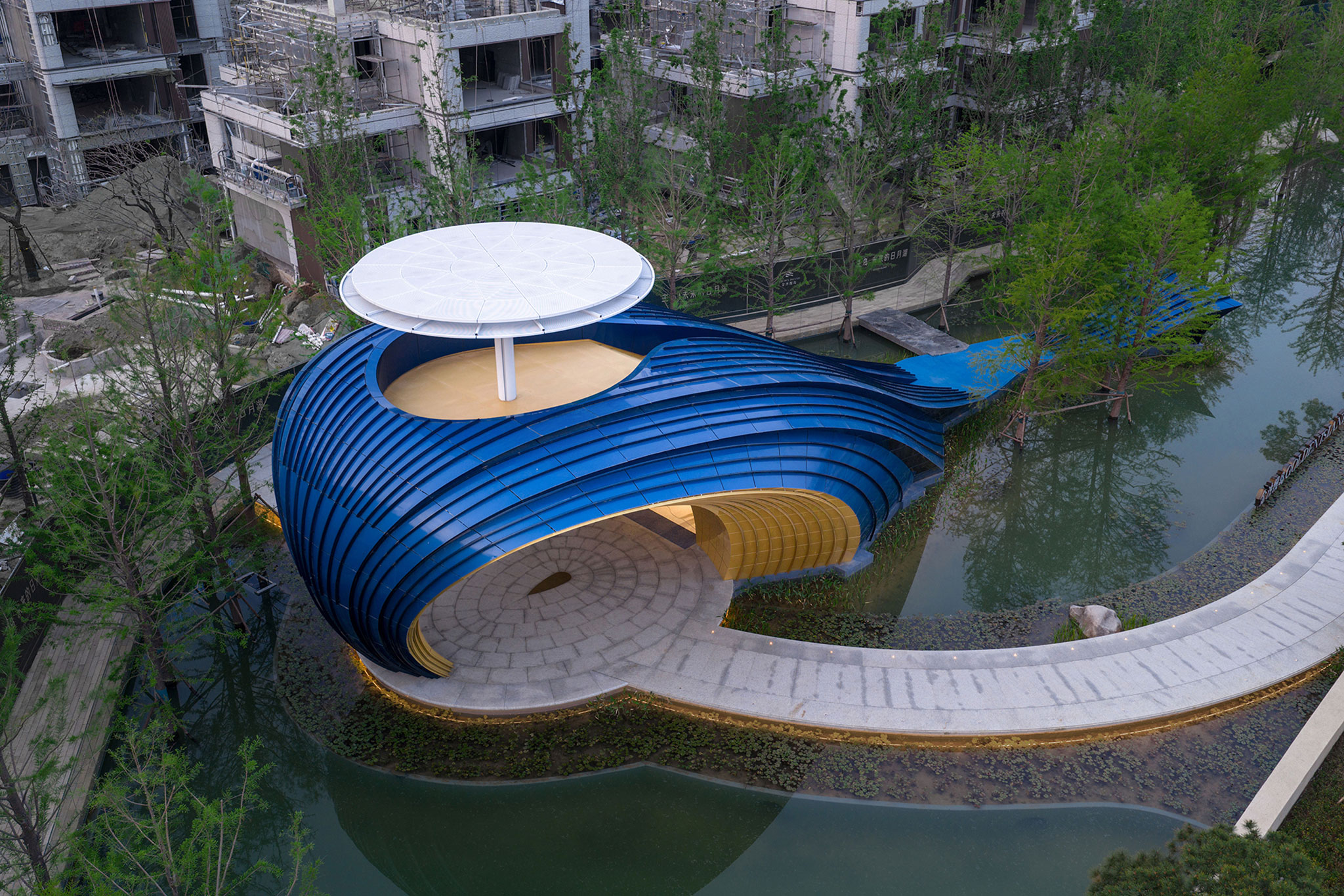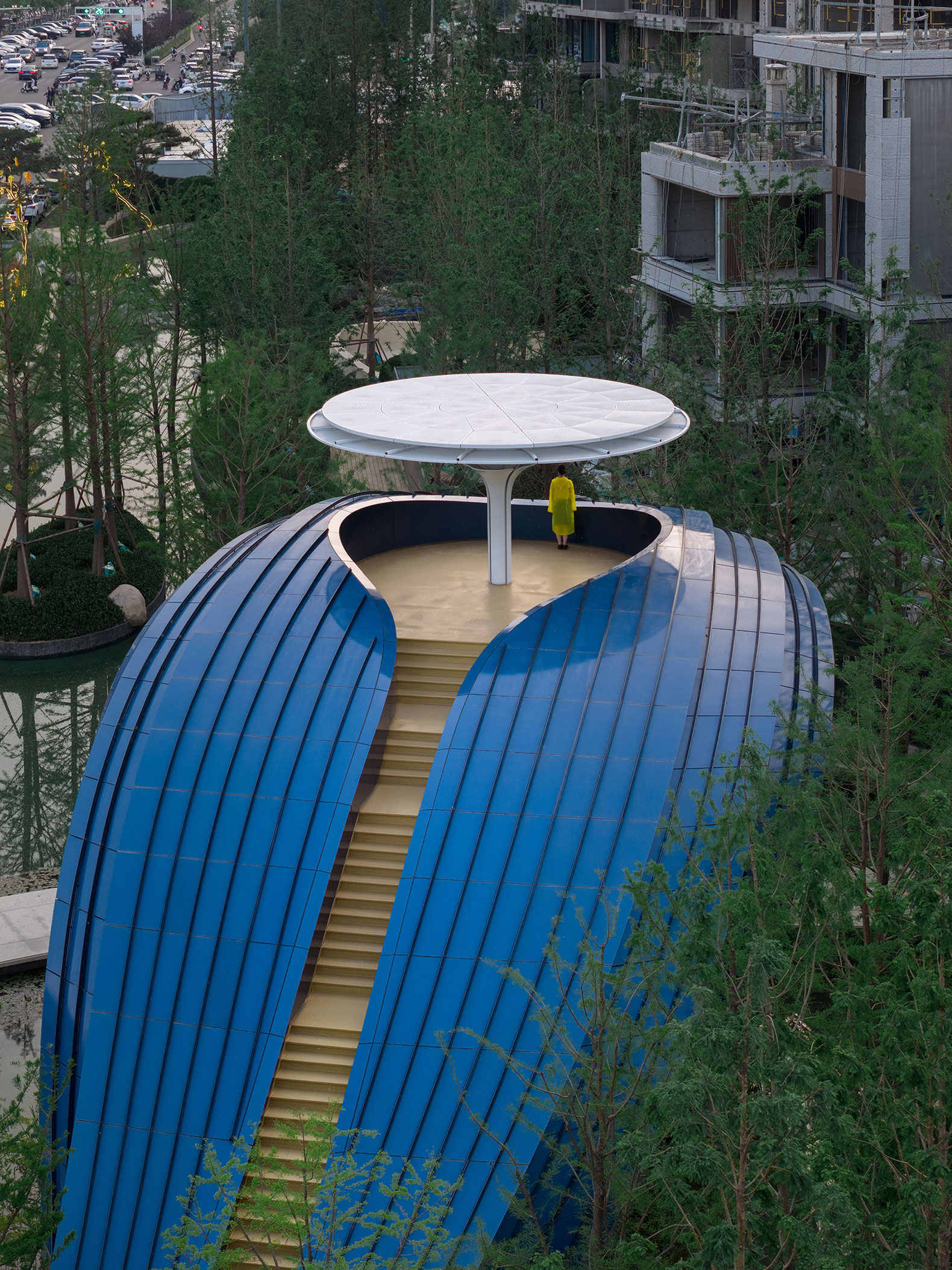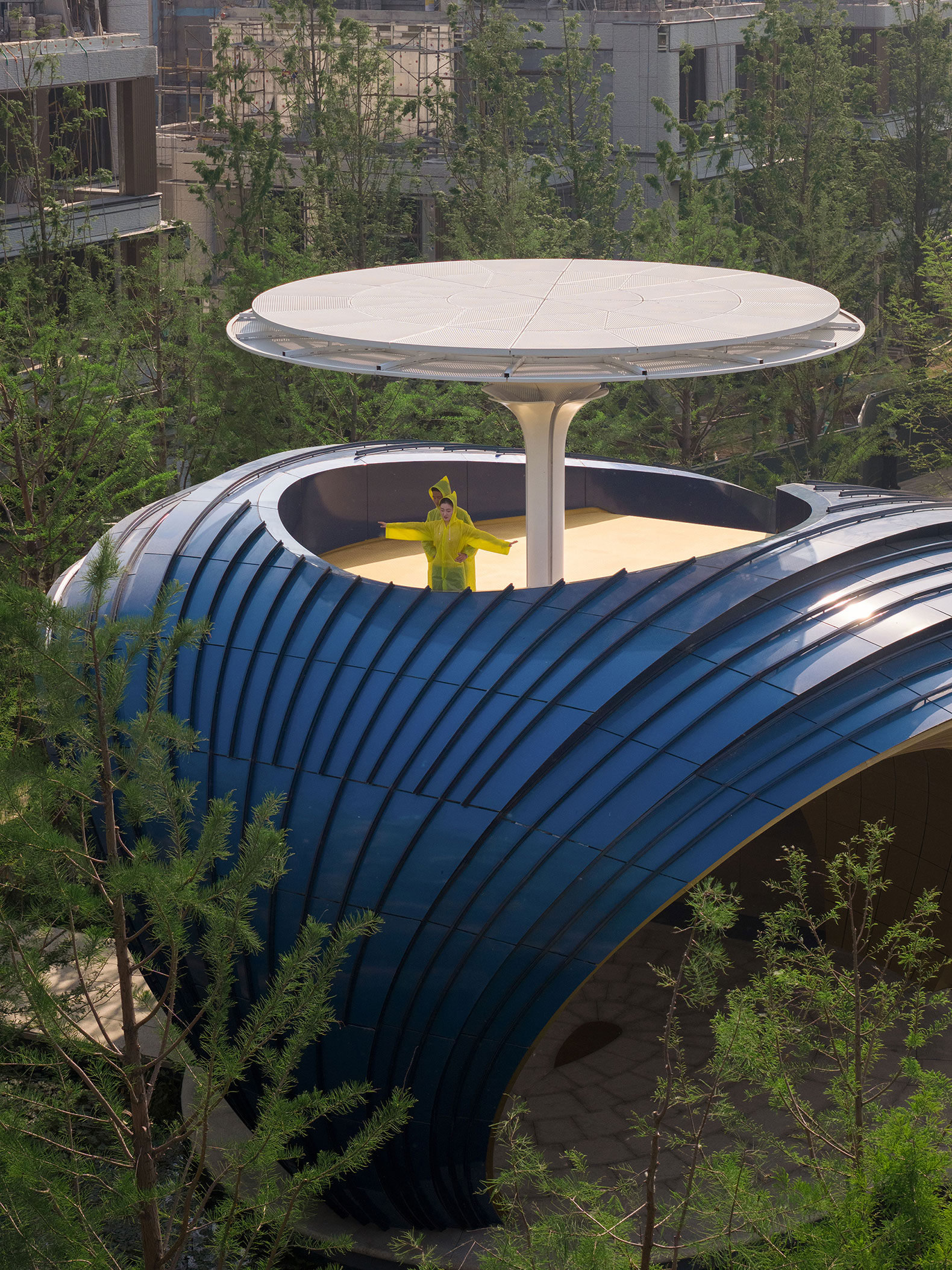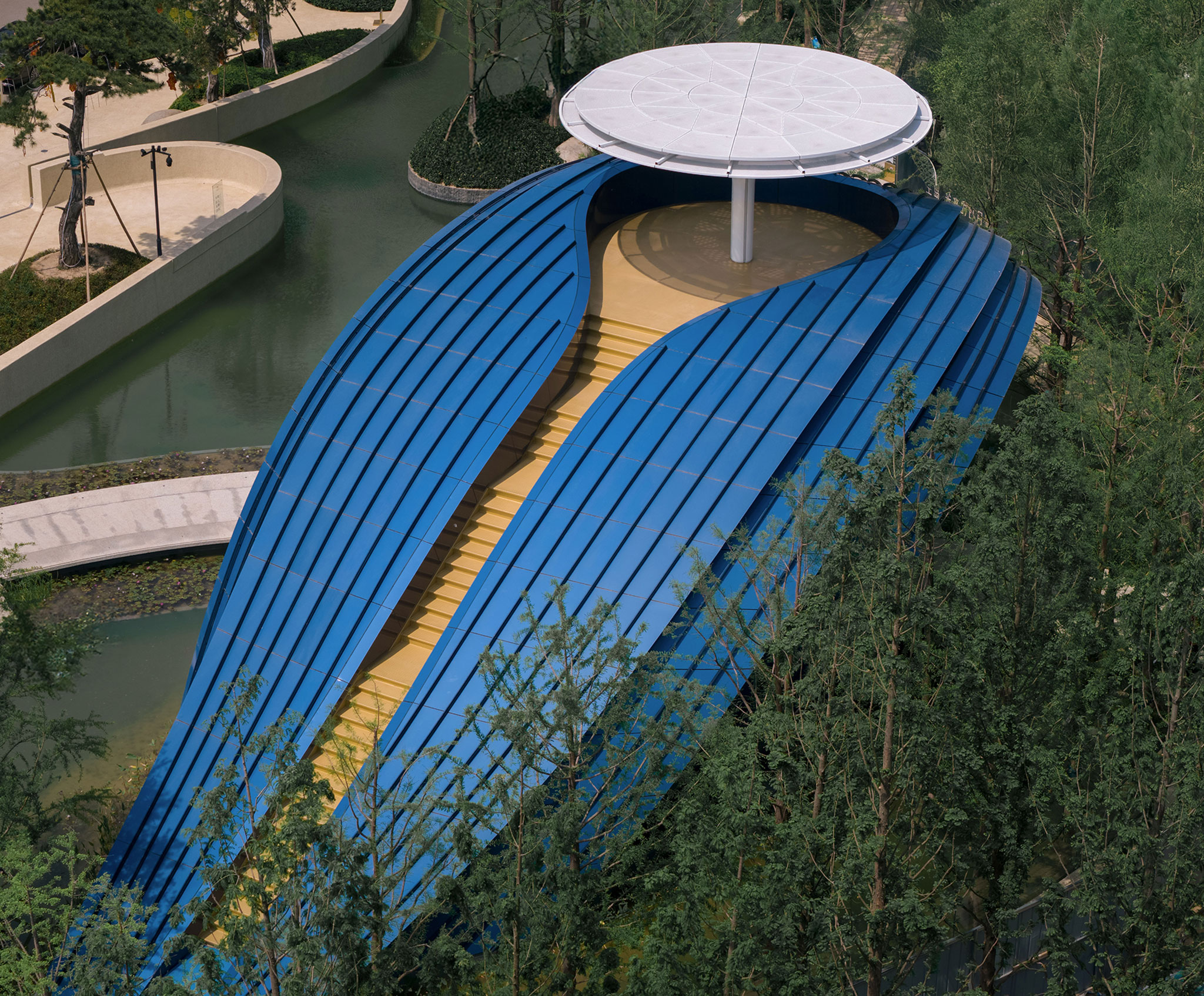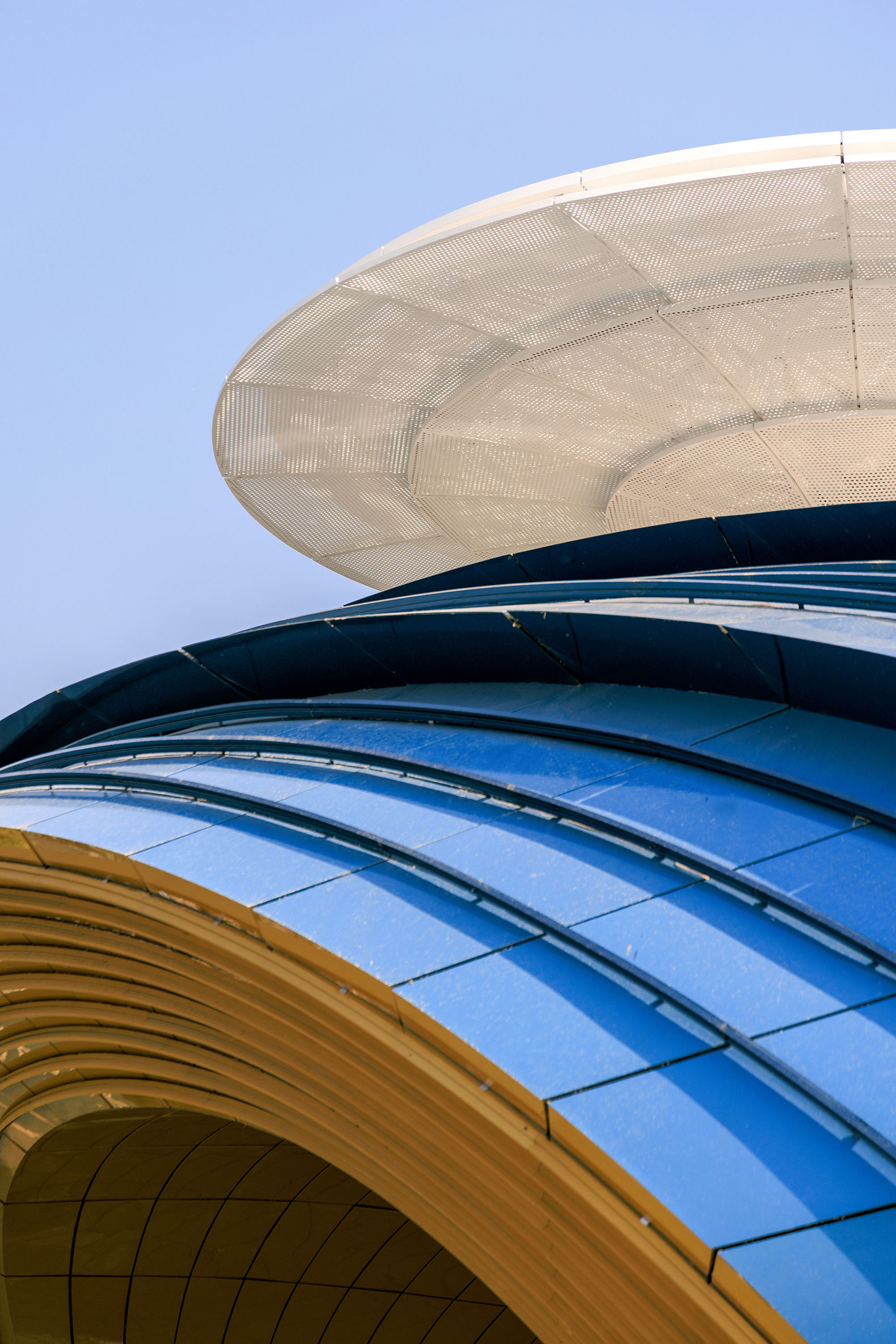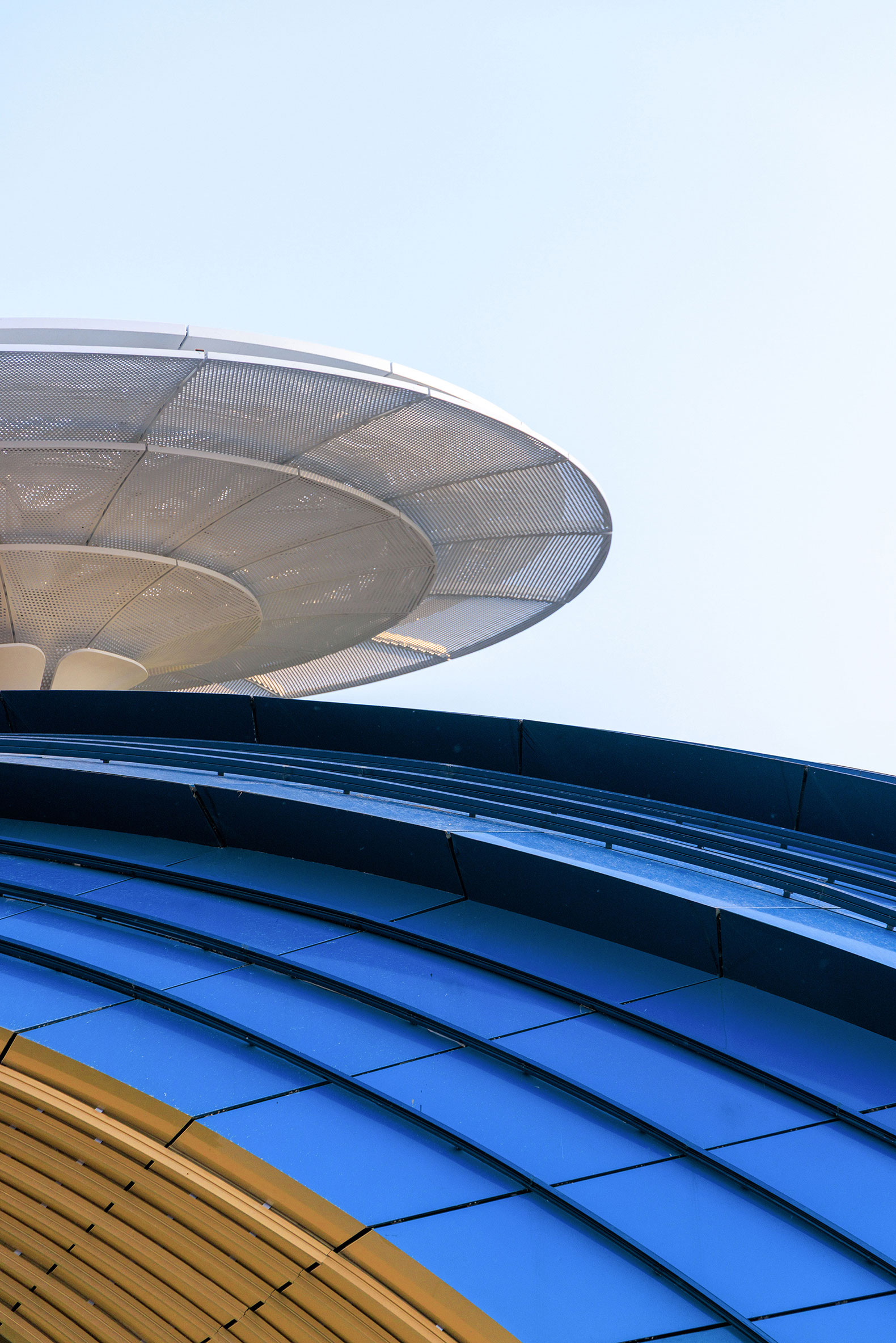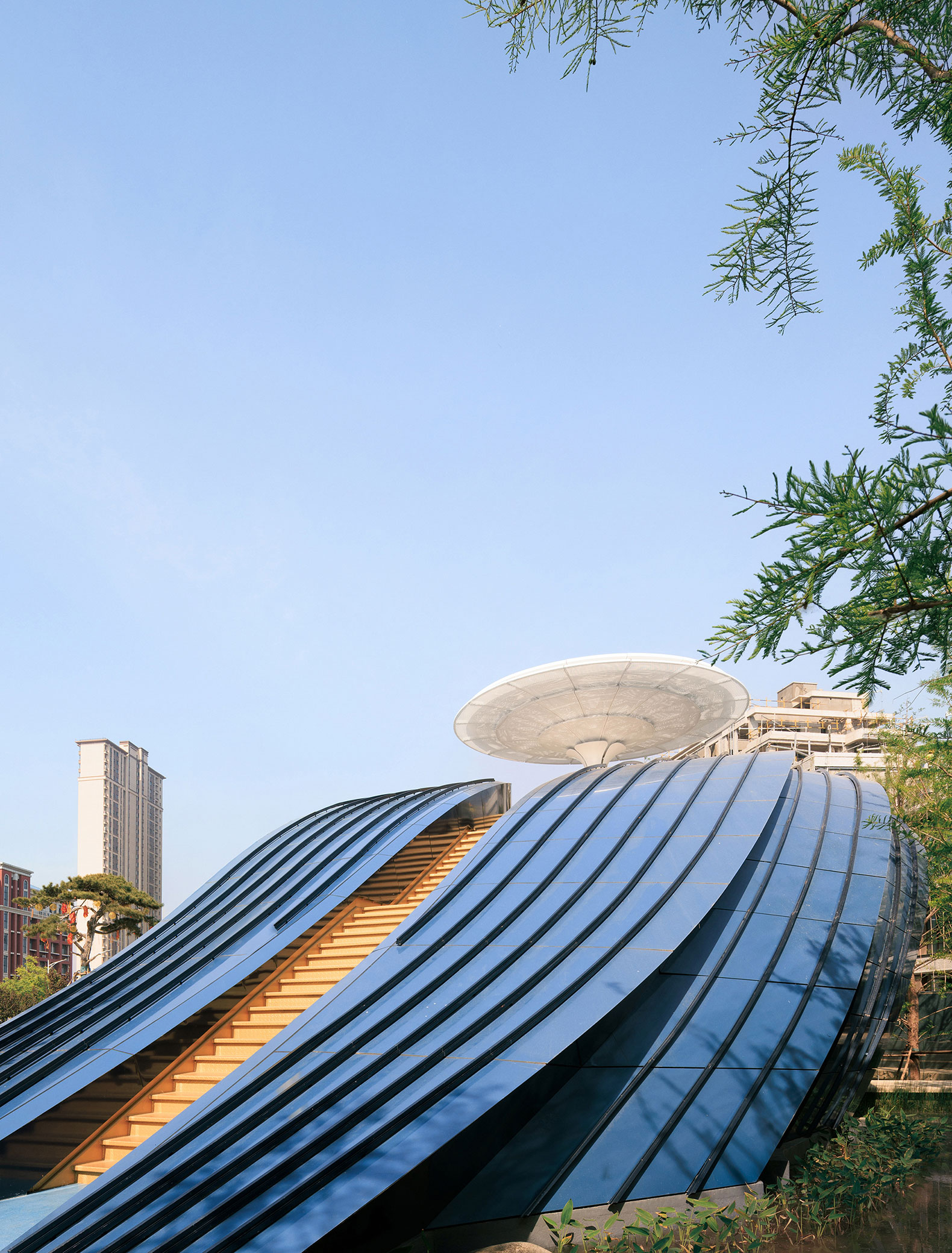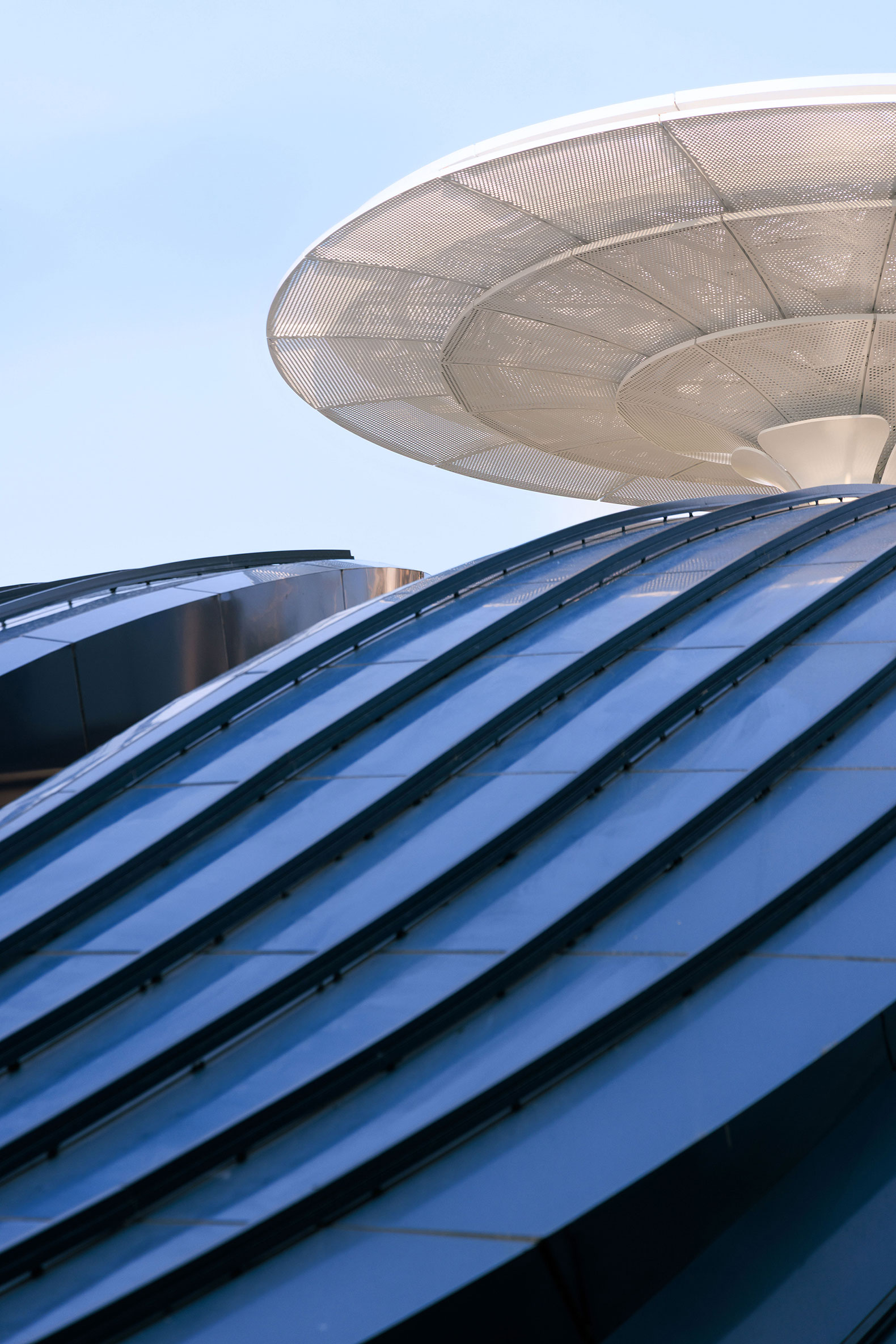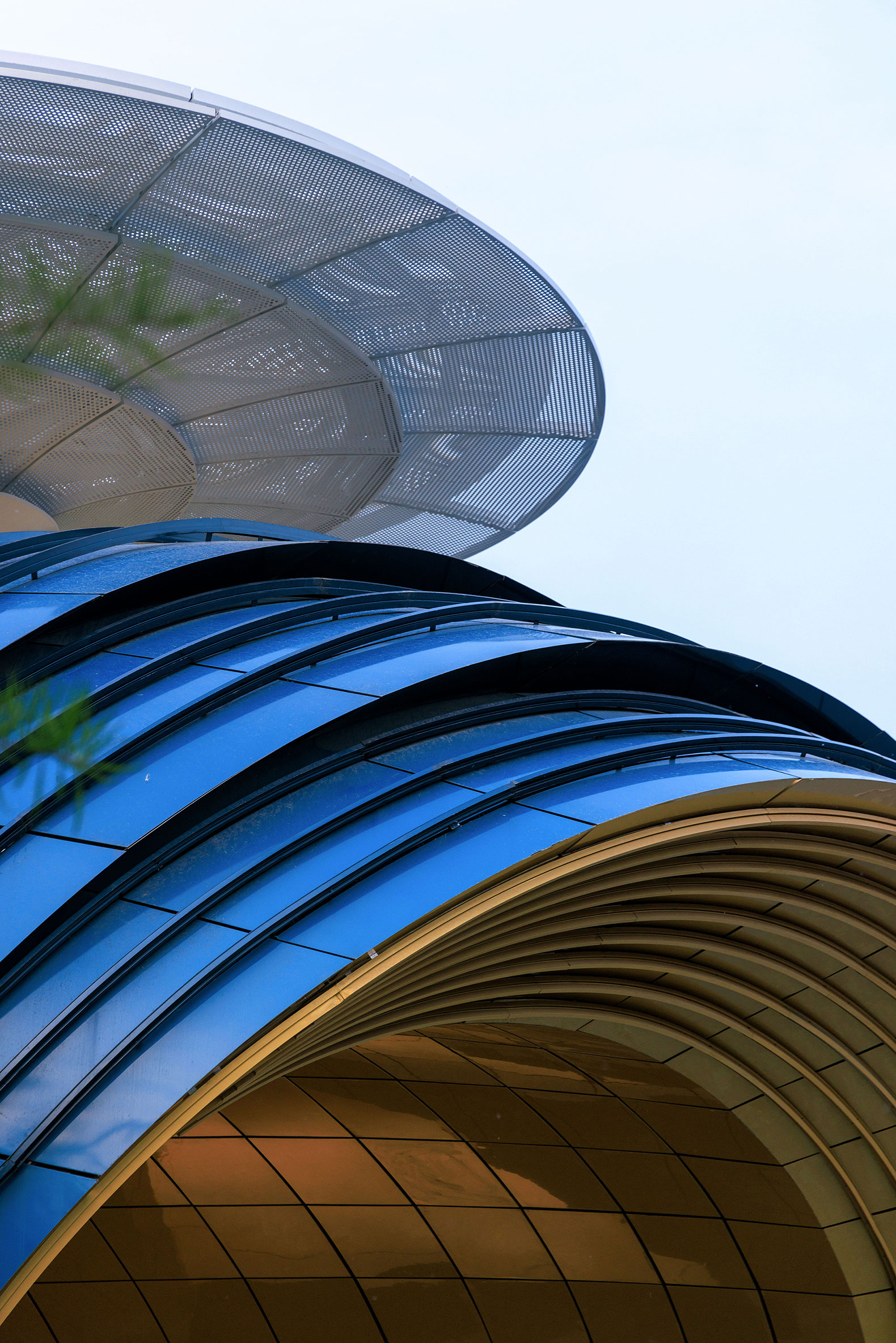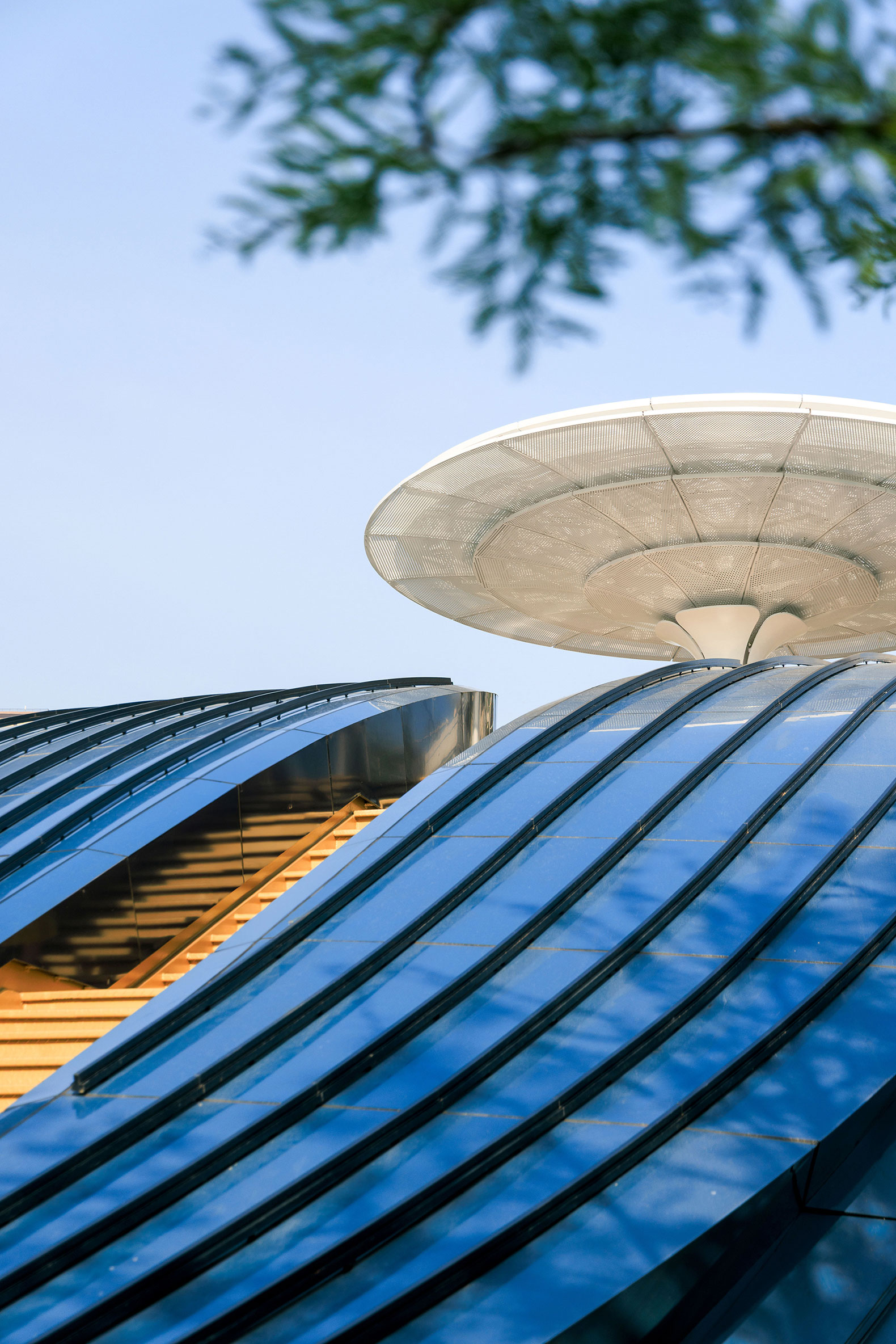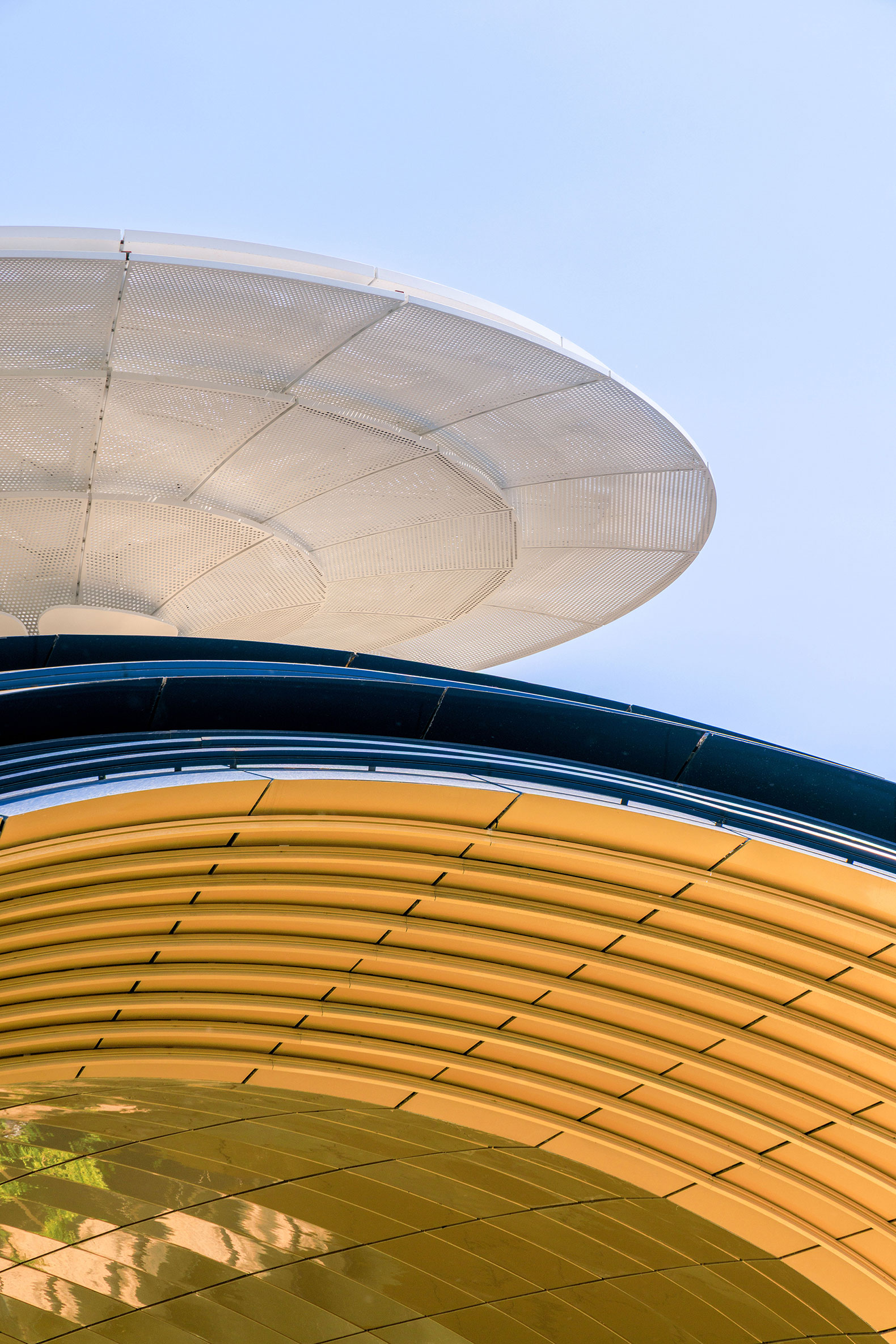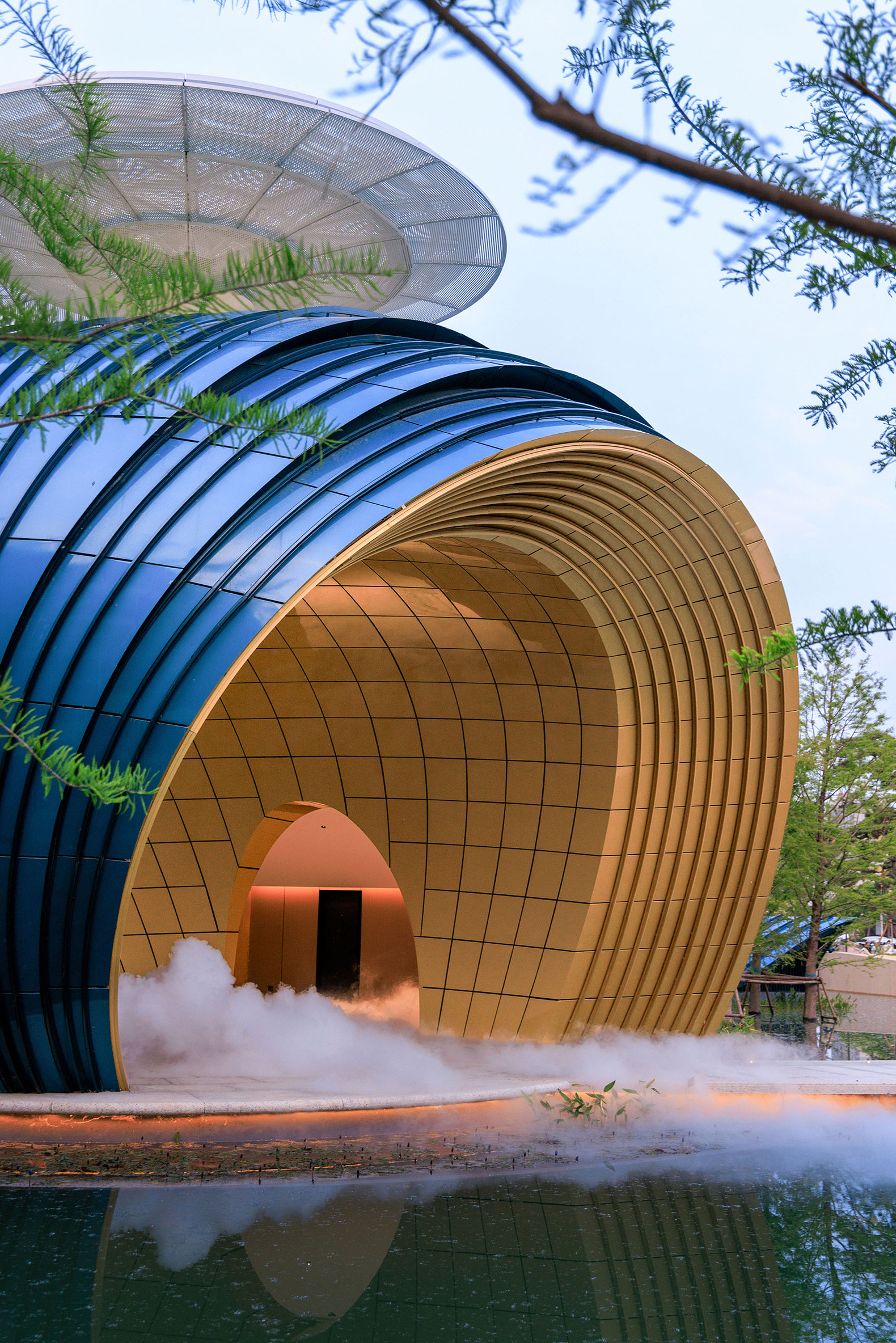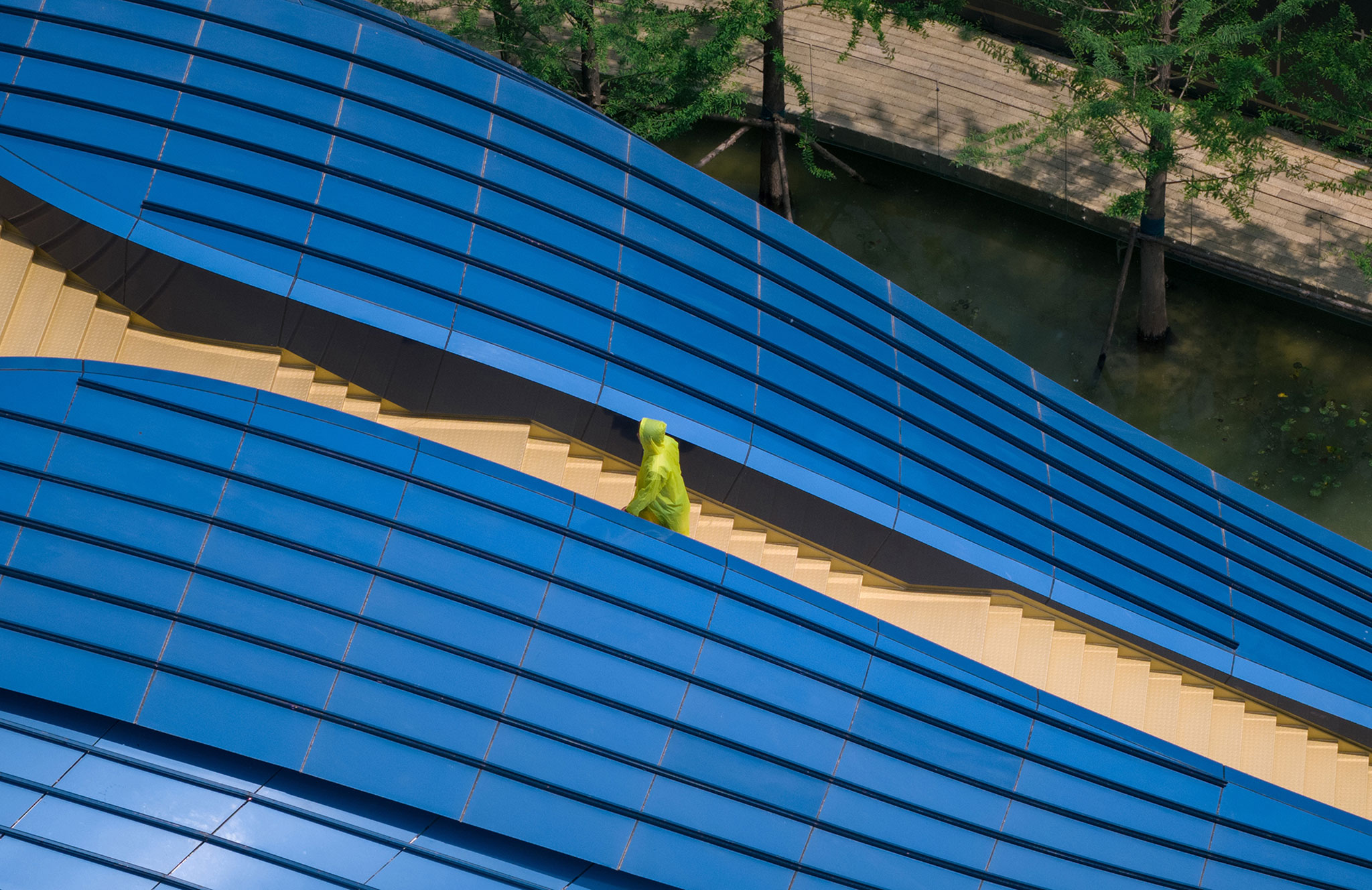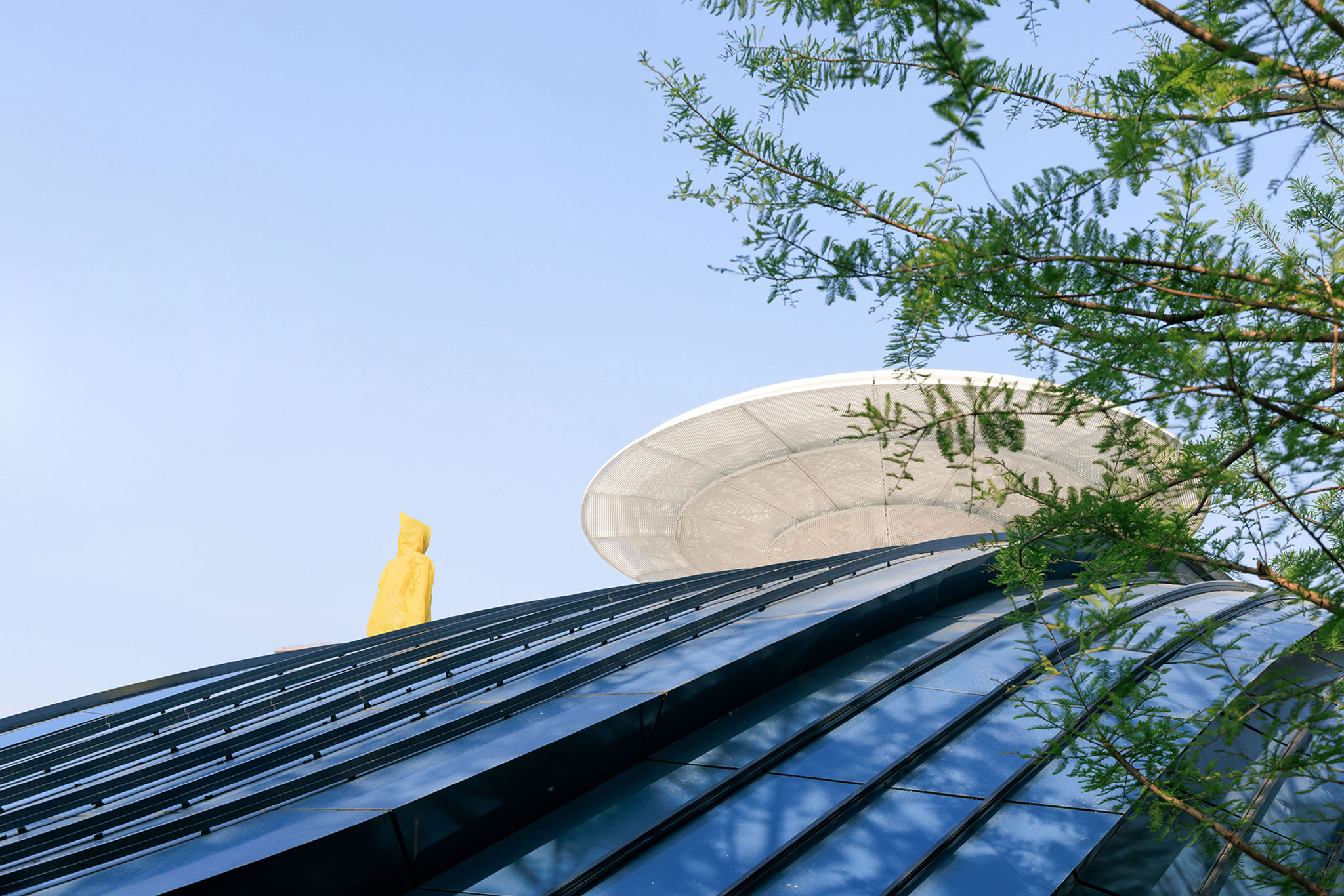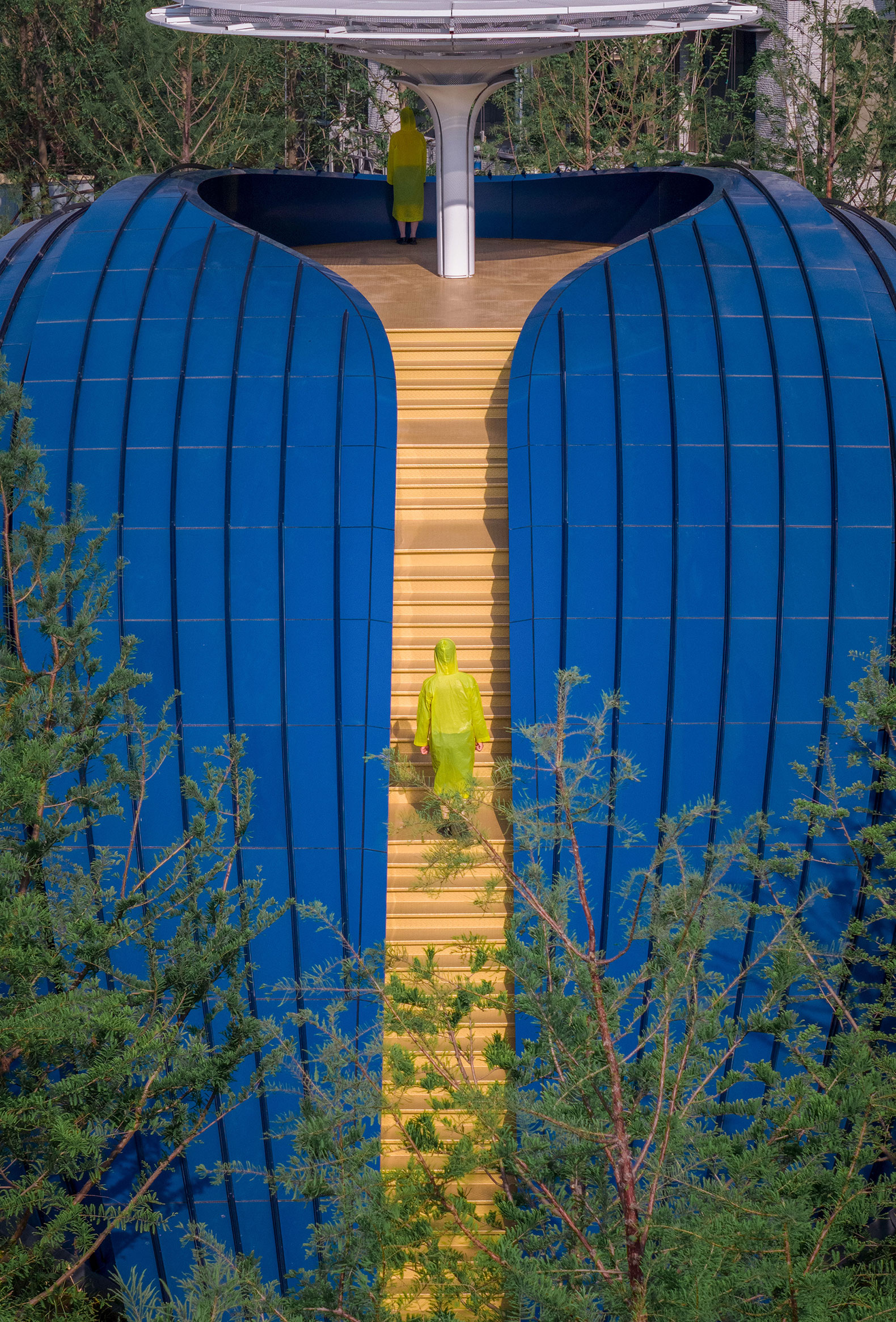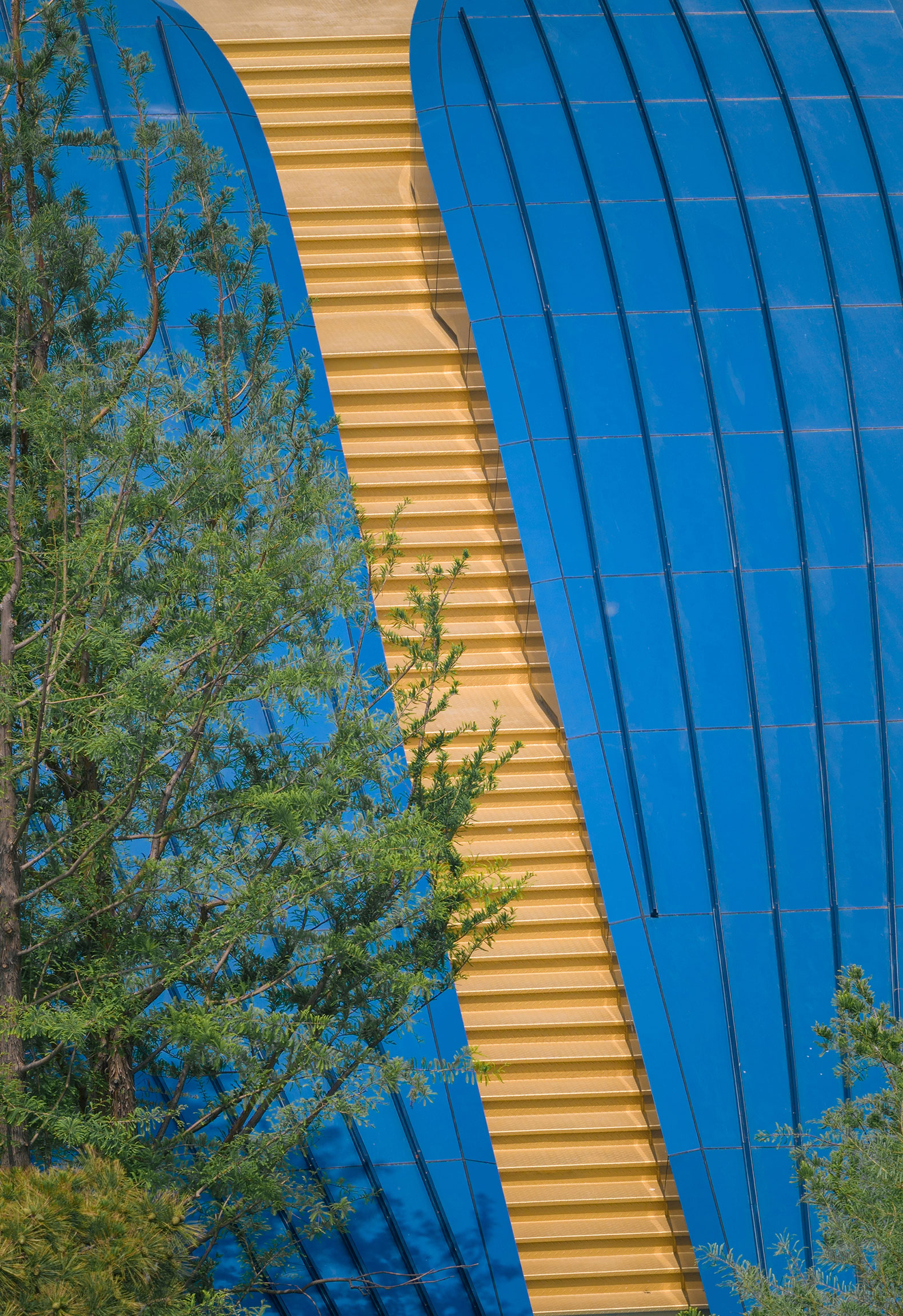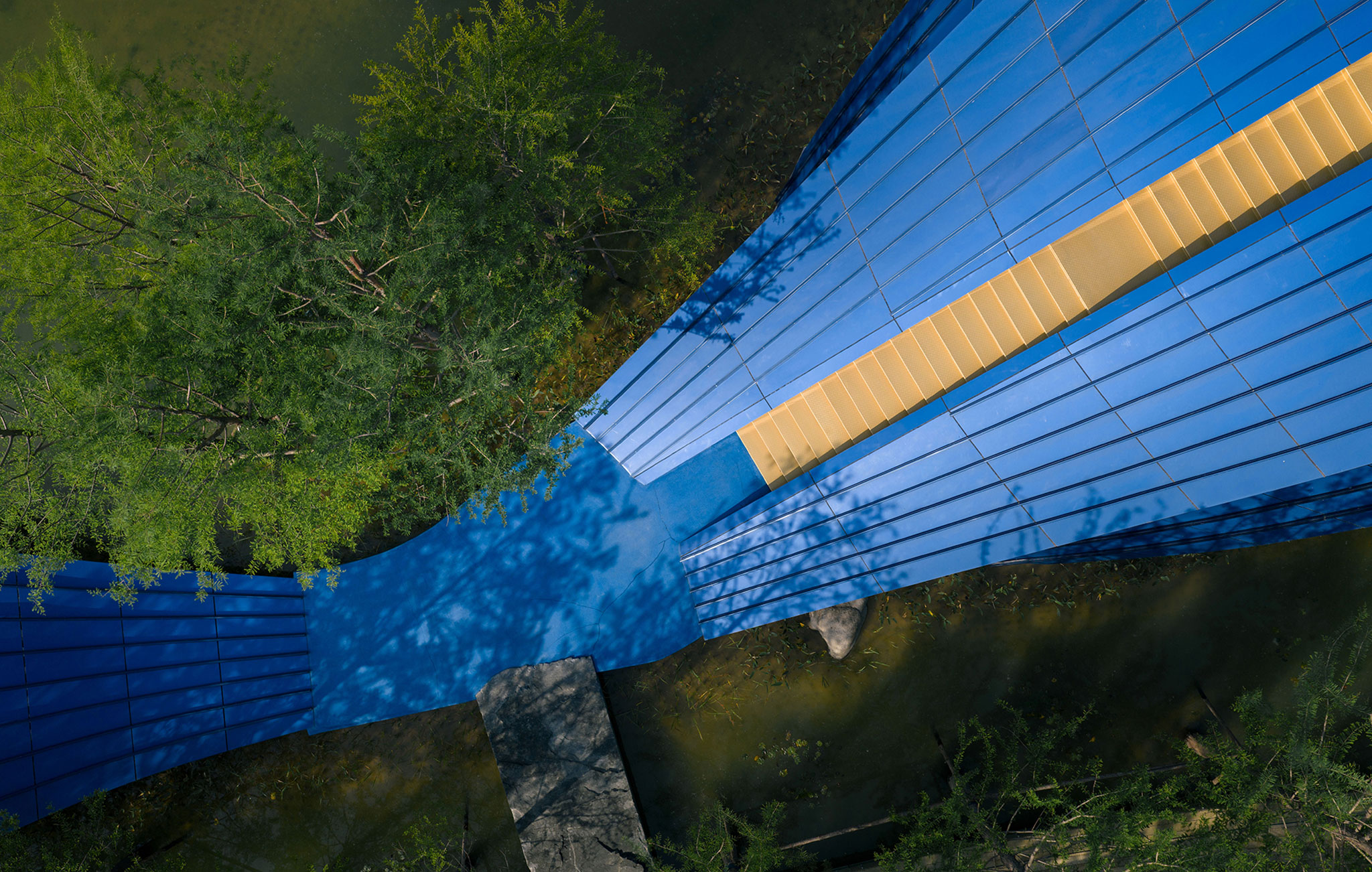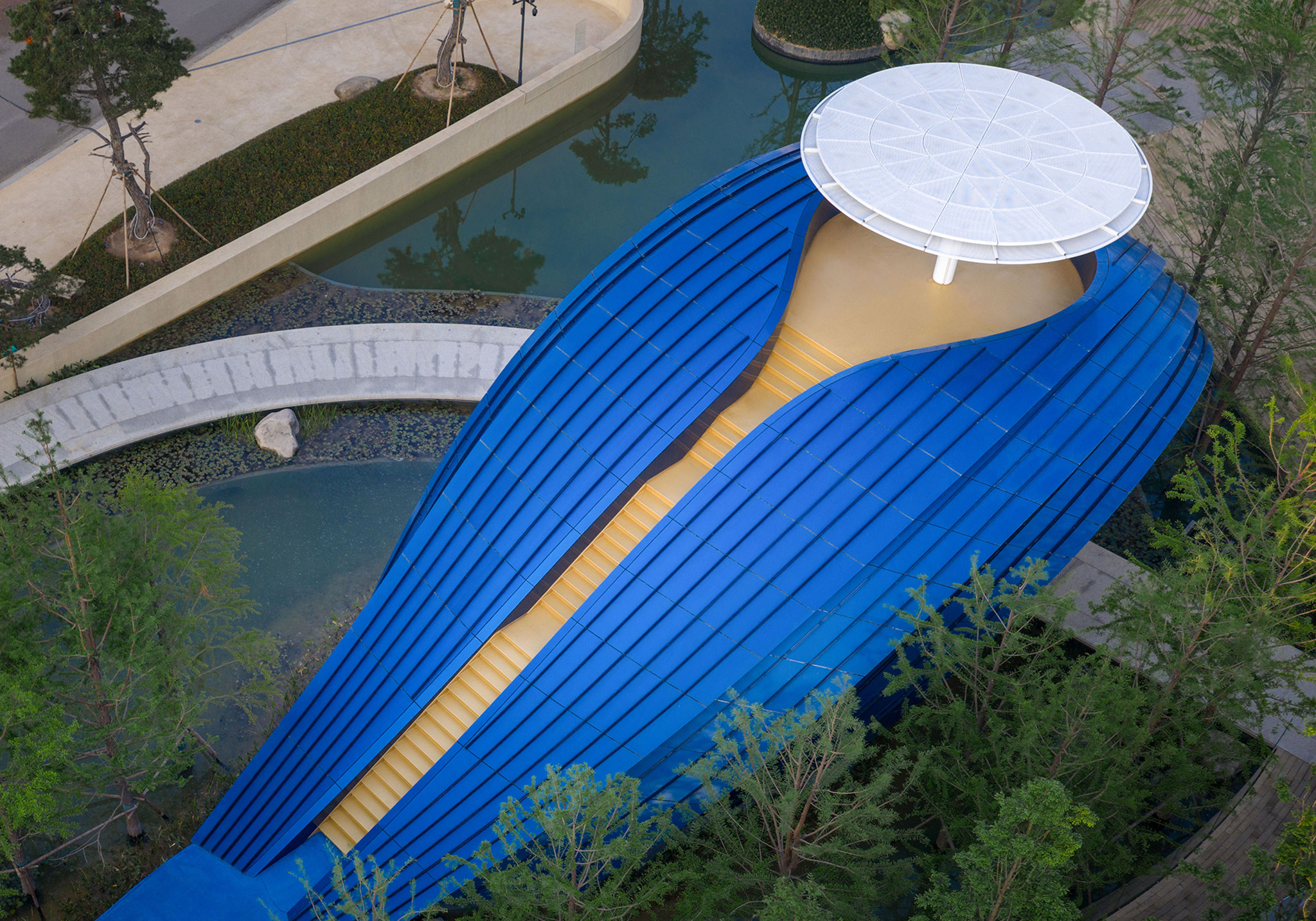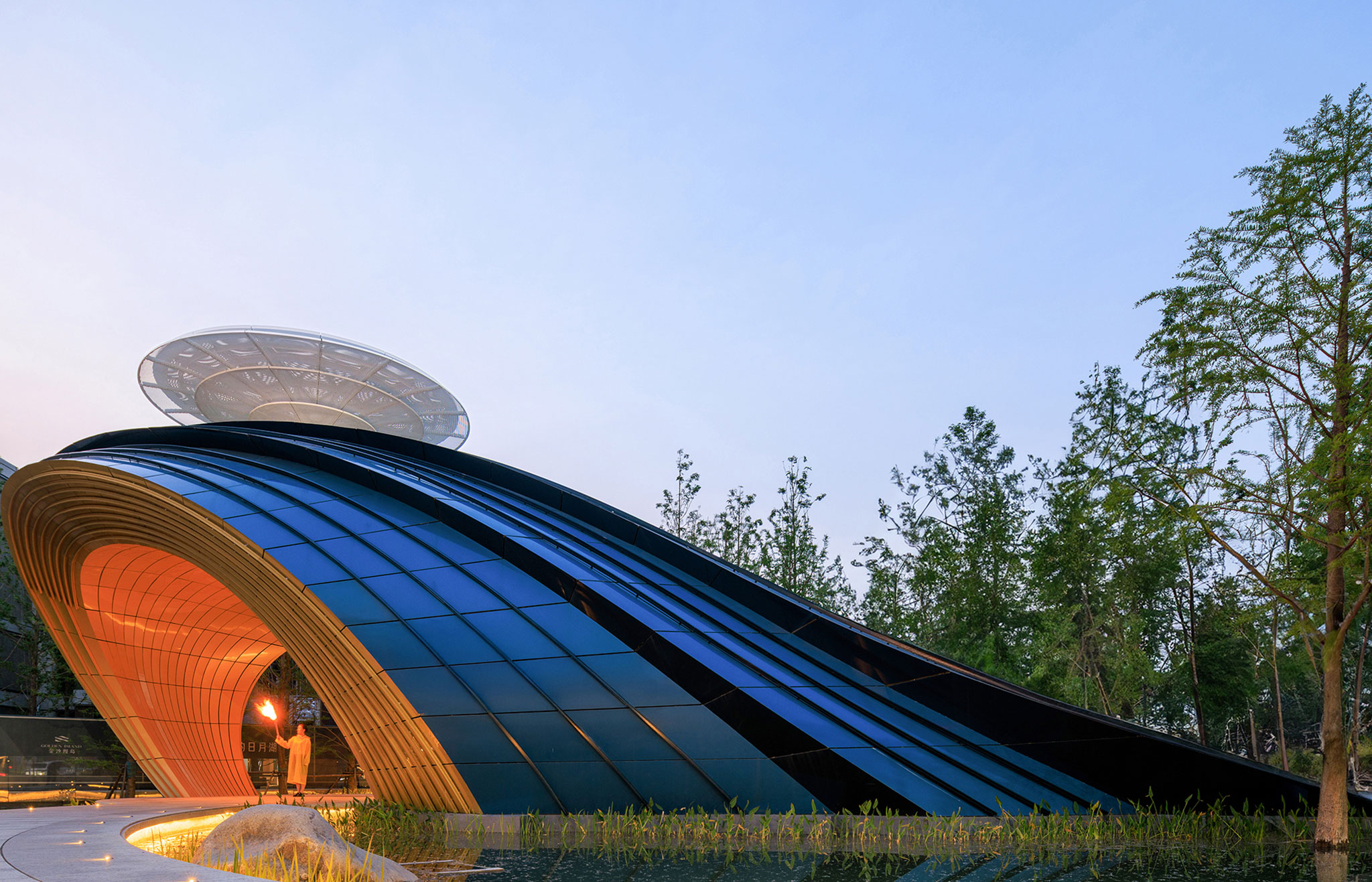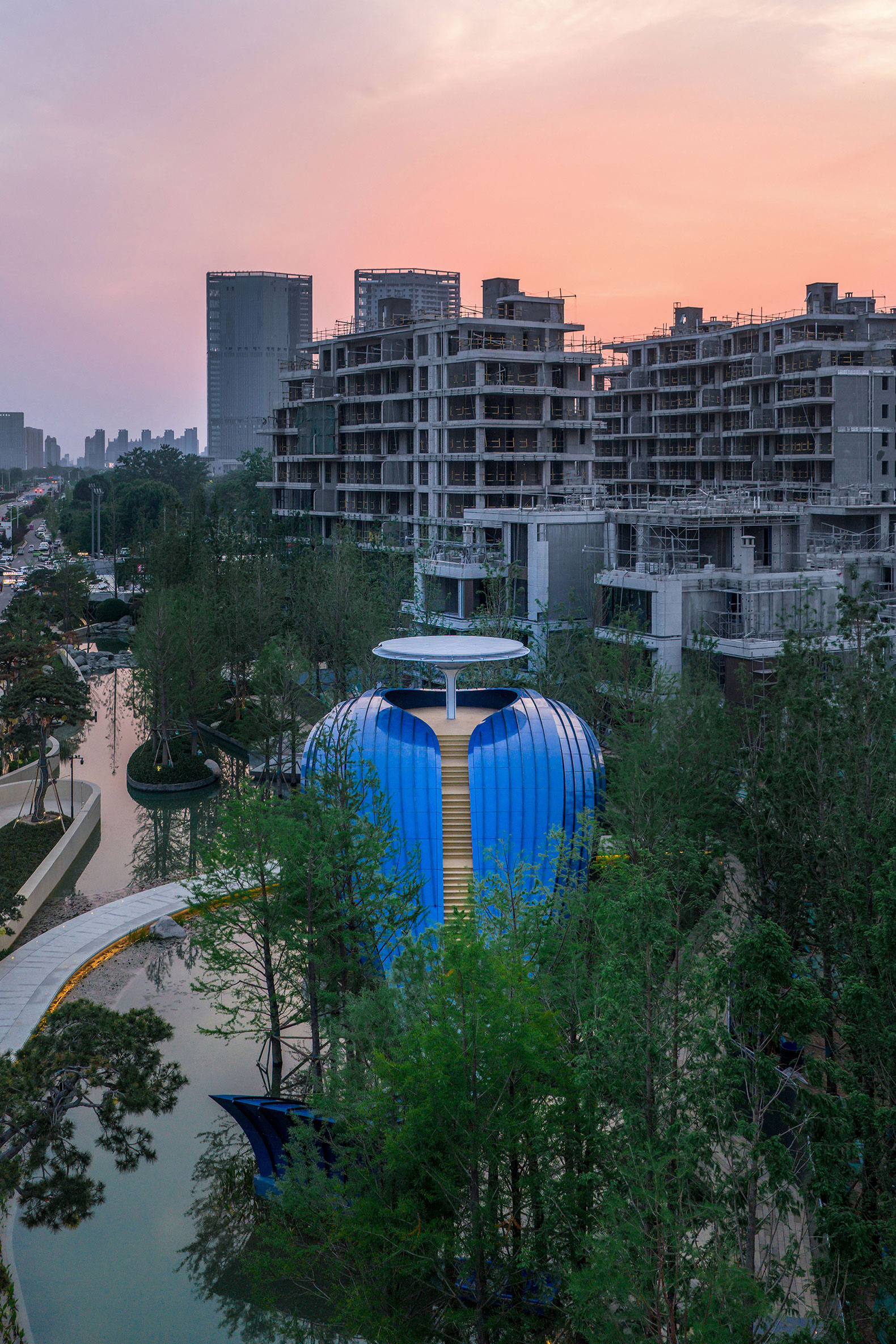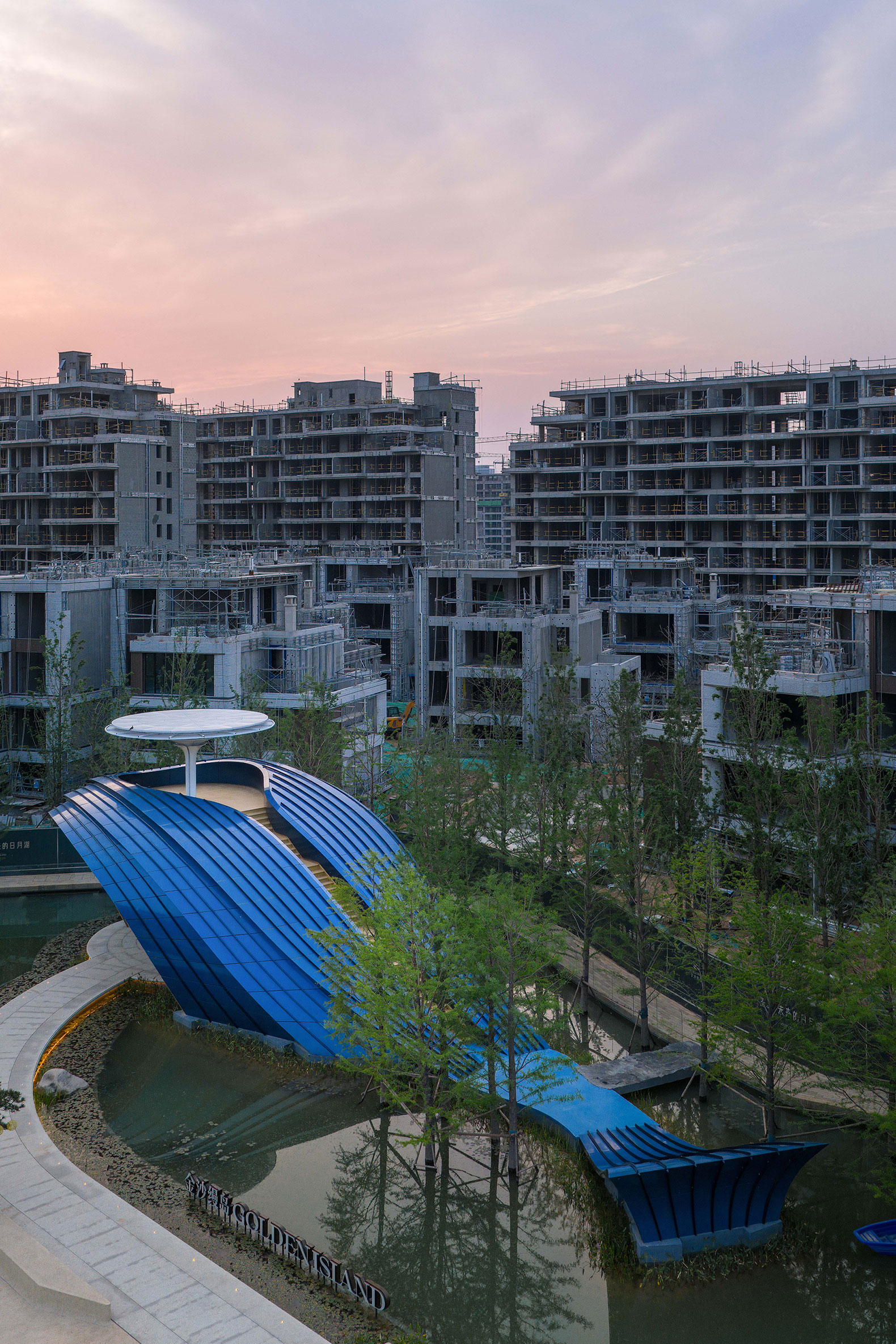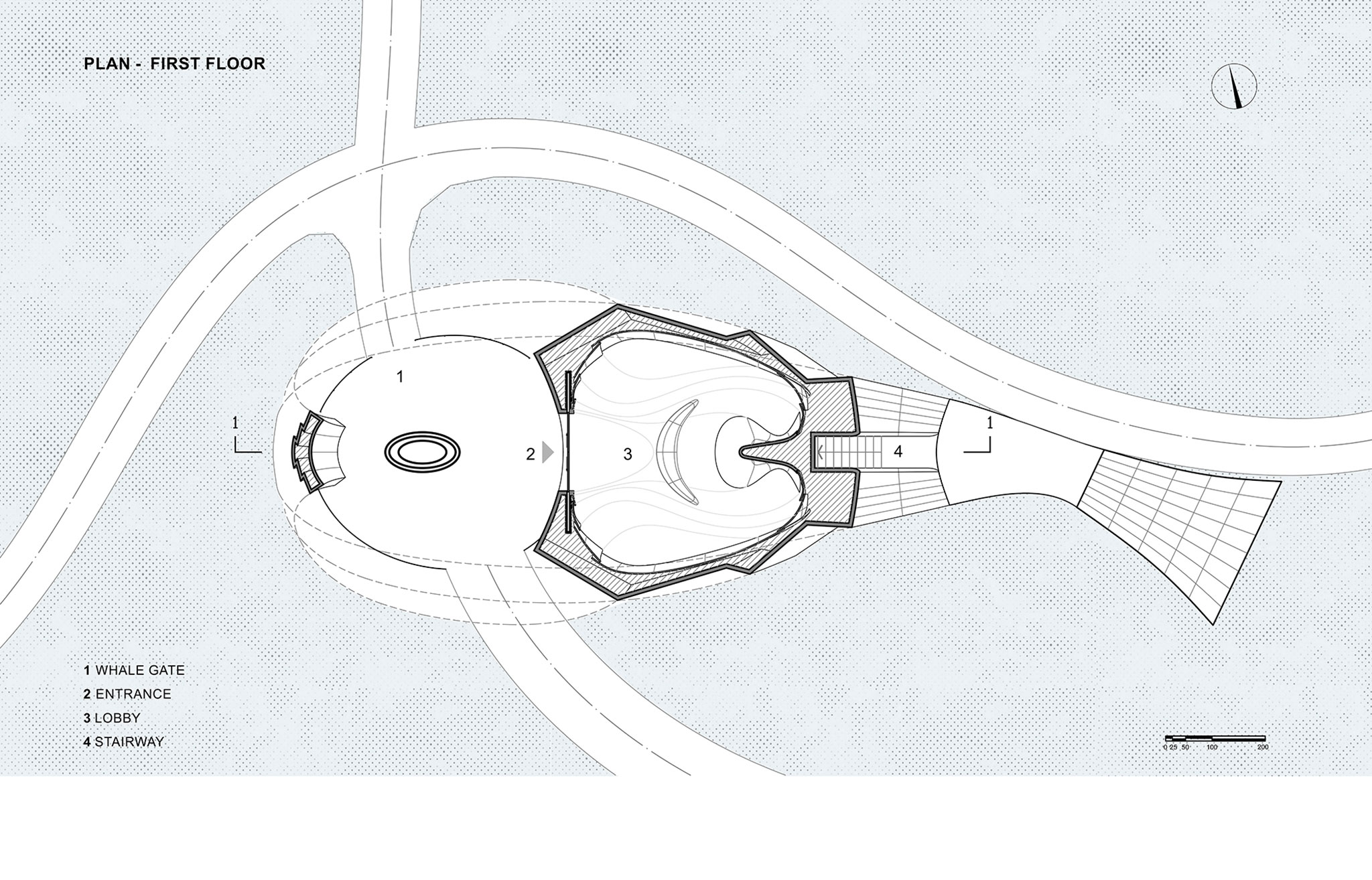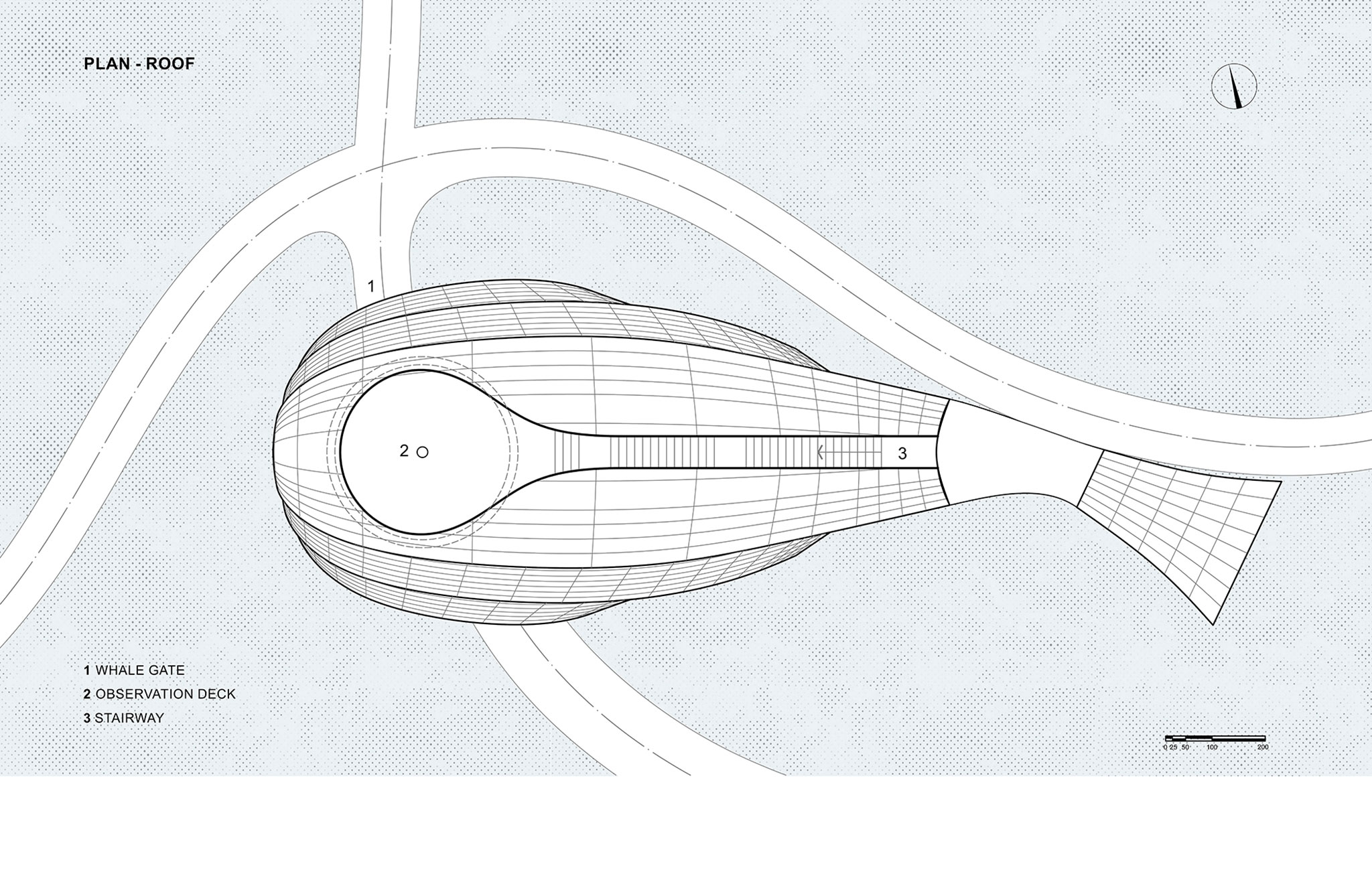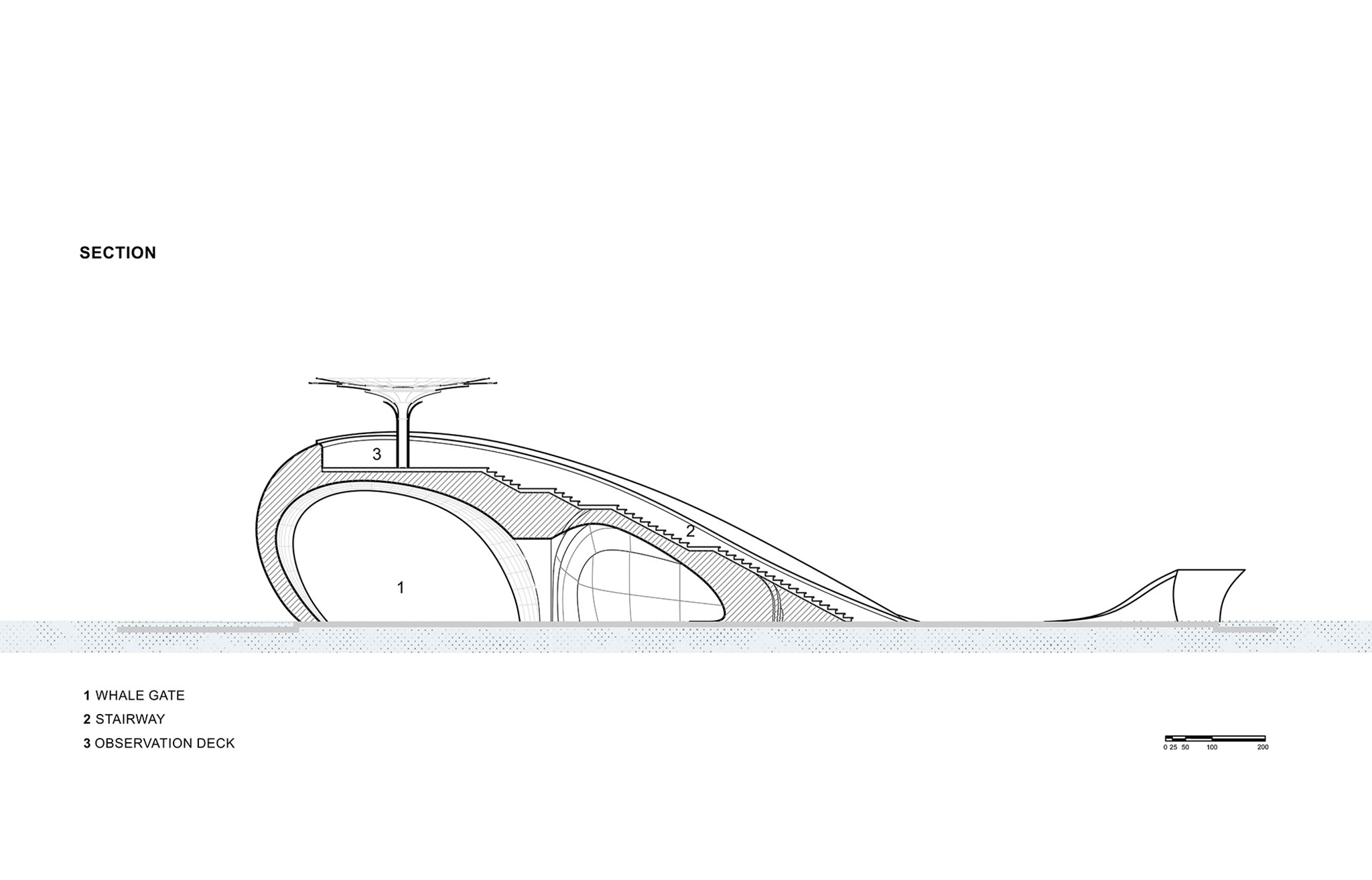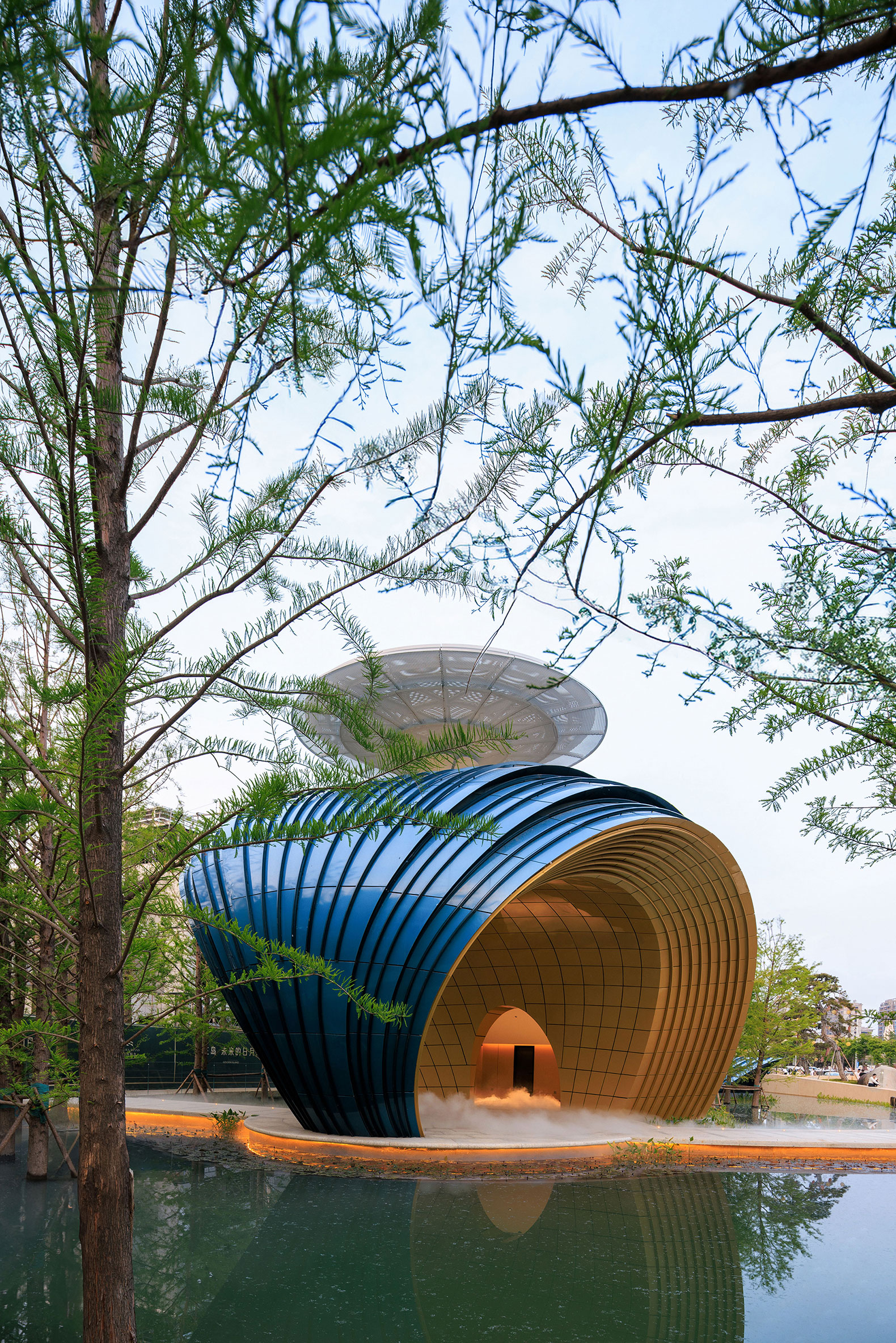
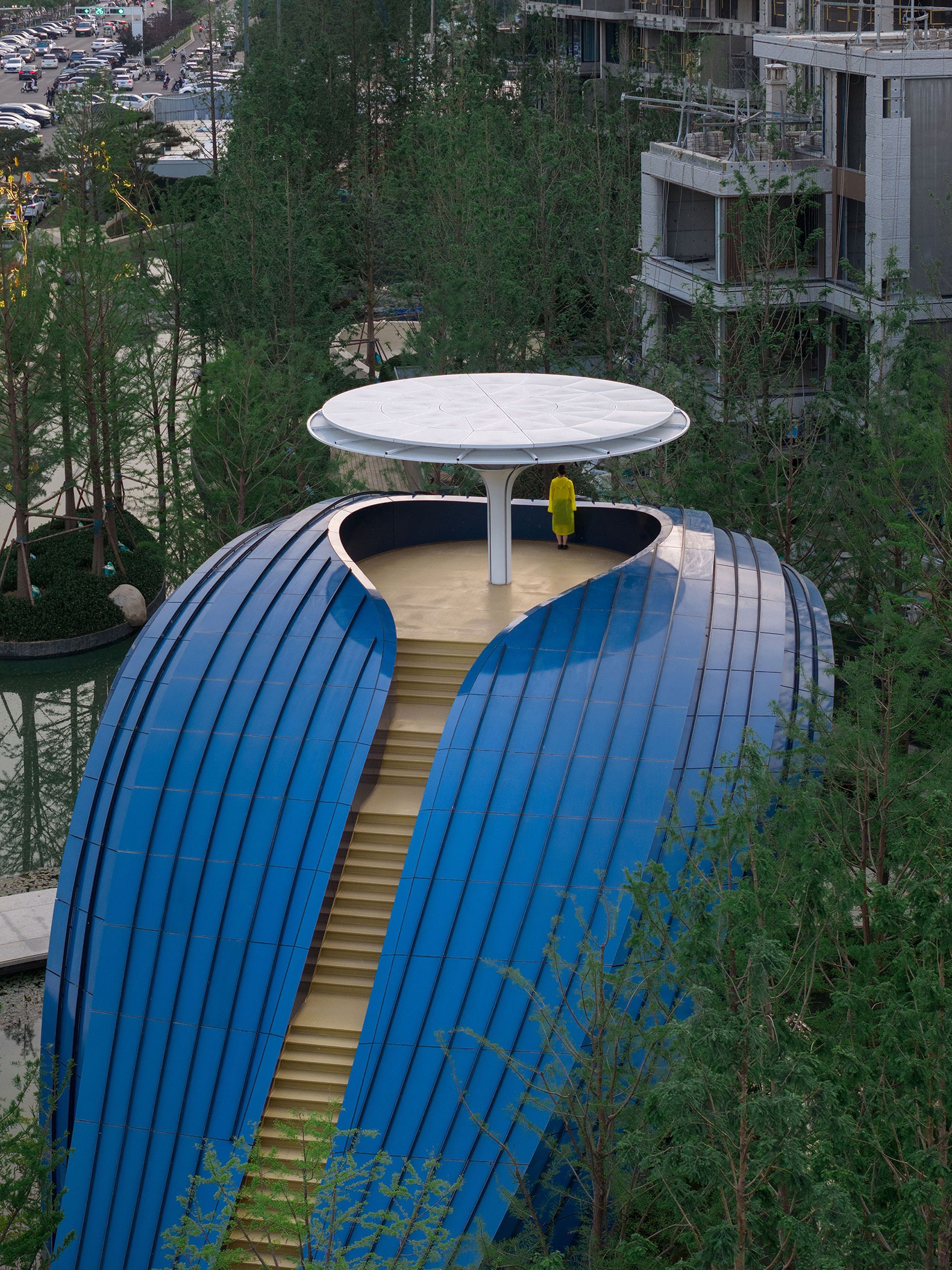
The project, designed by Wutopia Lab, features a main entrance to the residential complex through what would be the whale’s eye. In addition, a private staircase that runs through the structure provides access to a viewing platform, allowing visitors to observe the complex on a different scale.
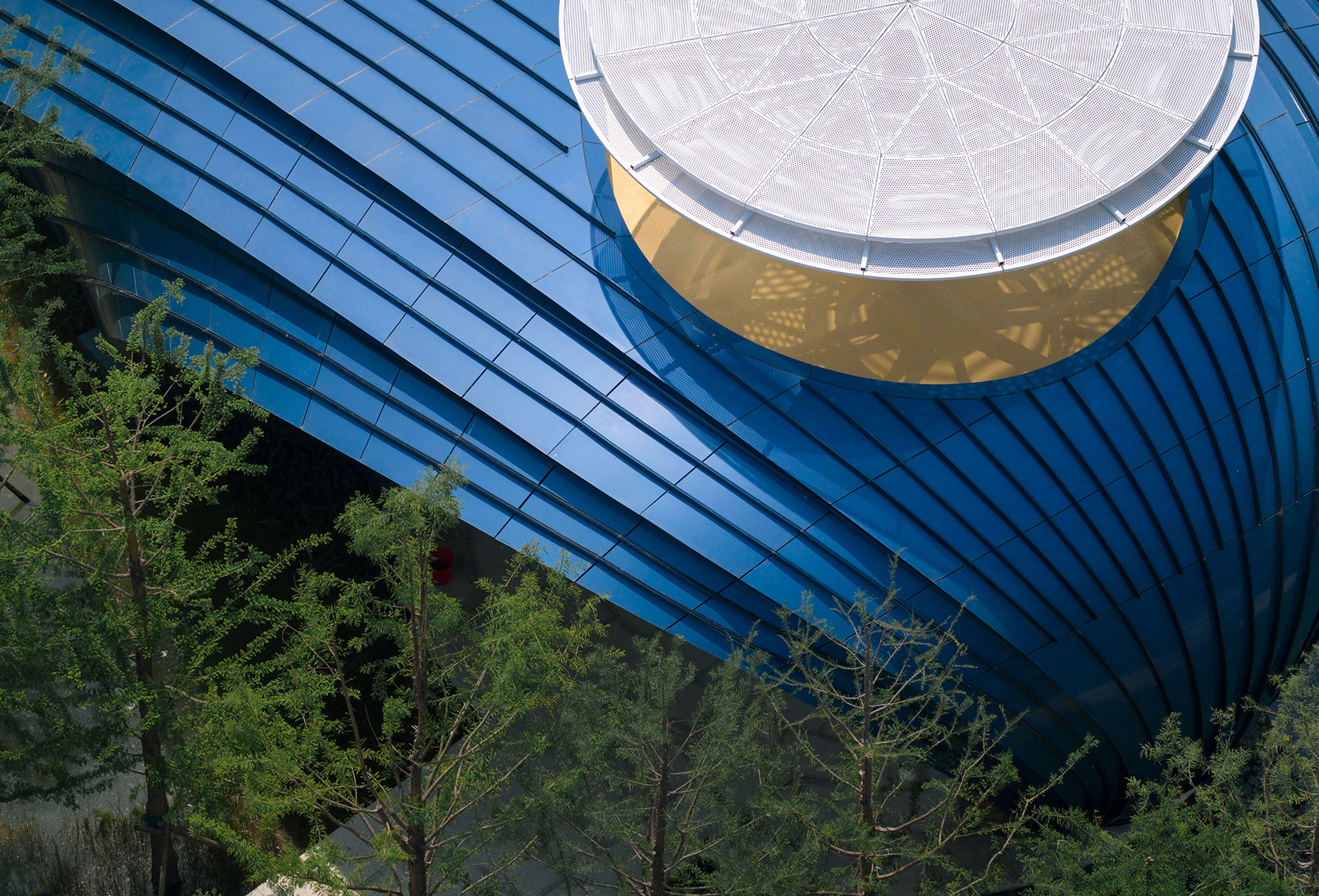
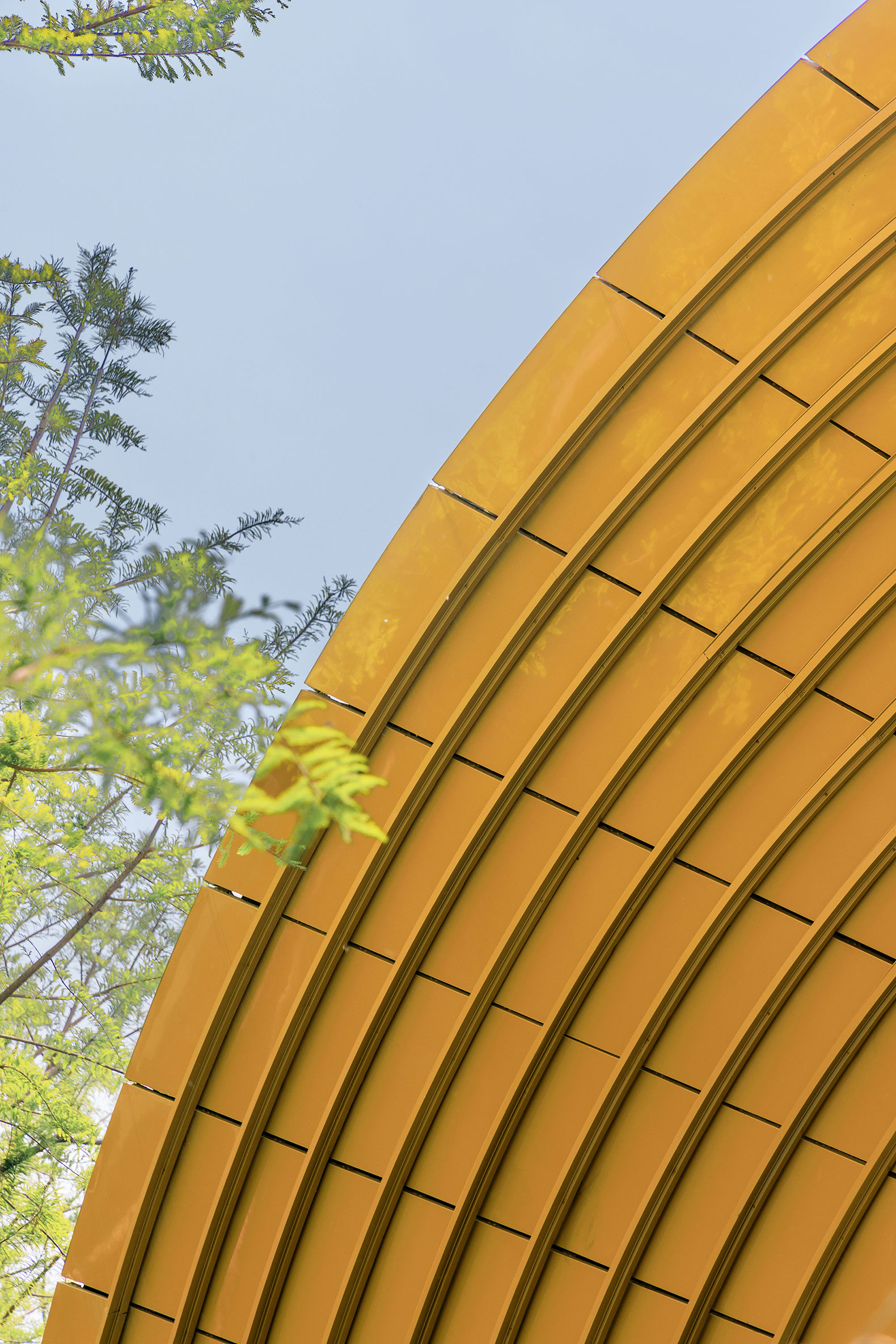
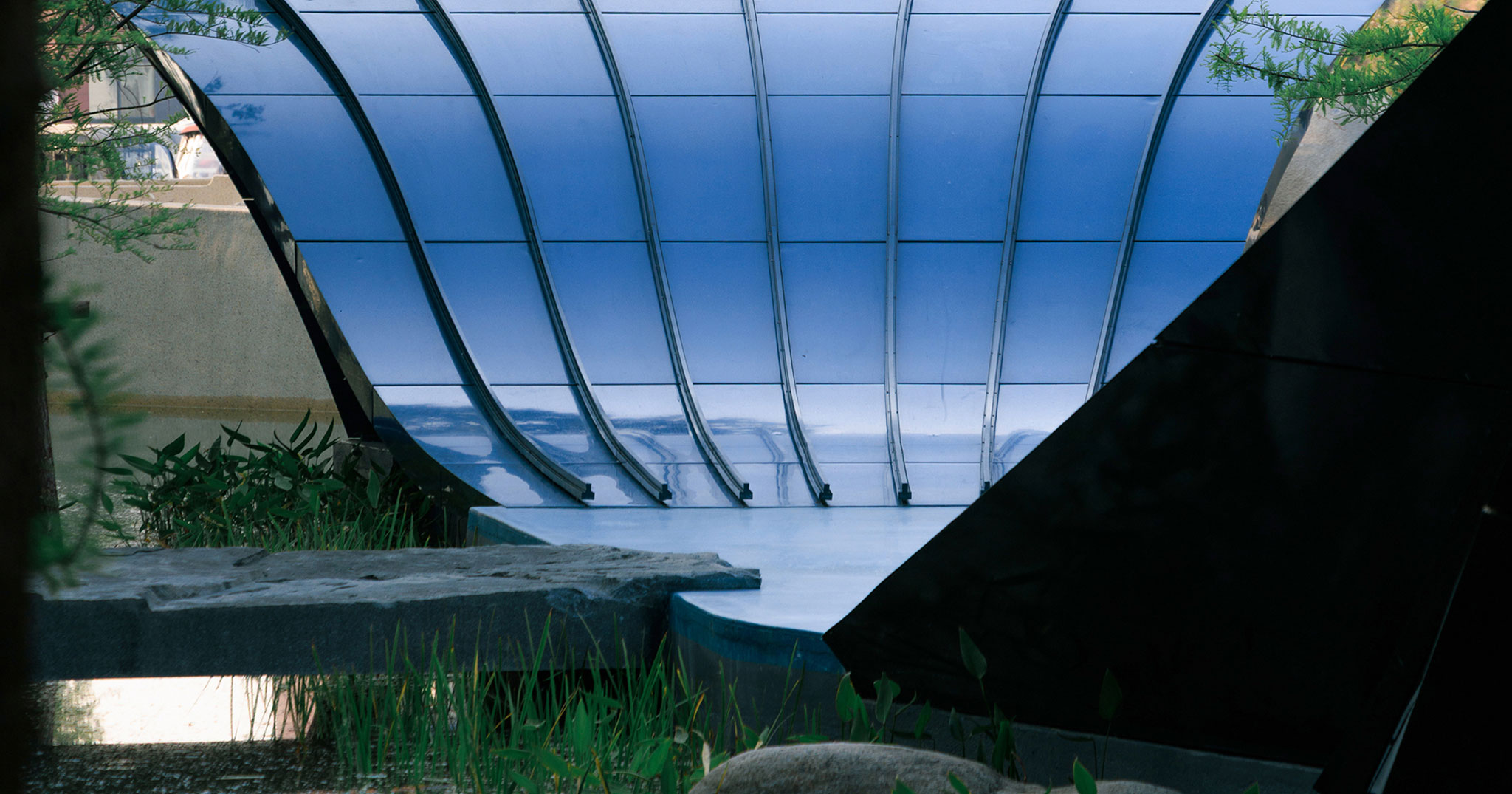
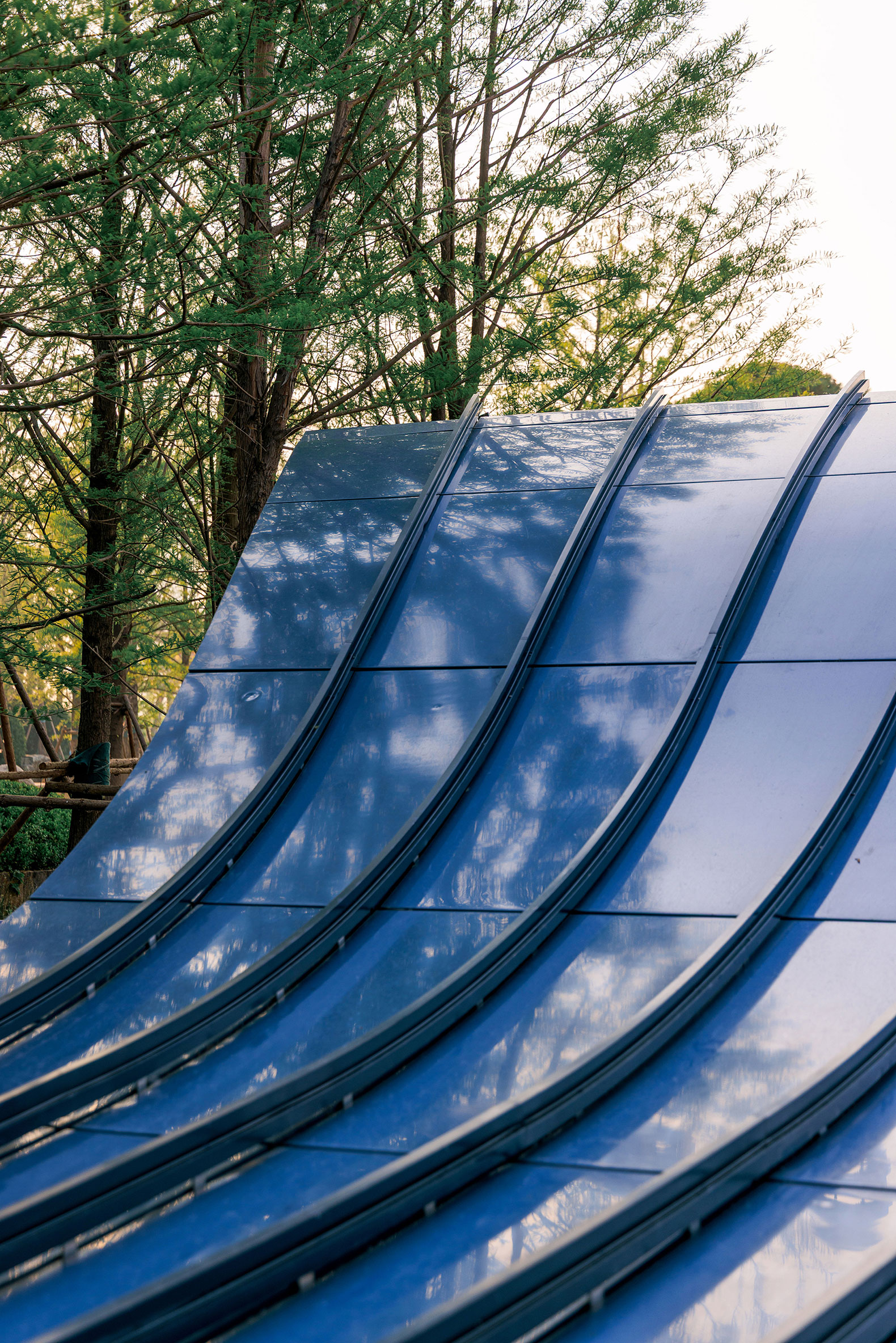
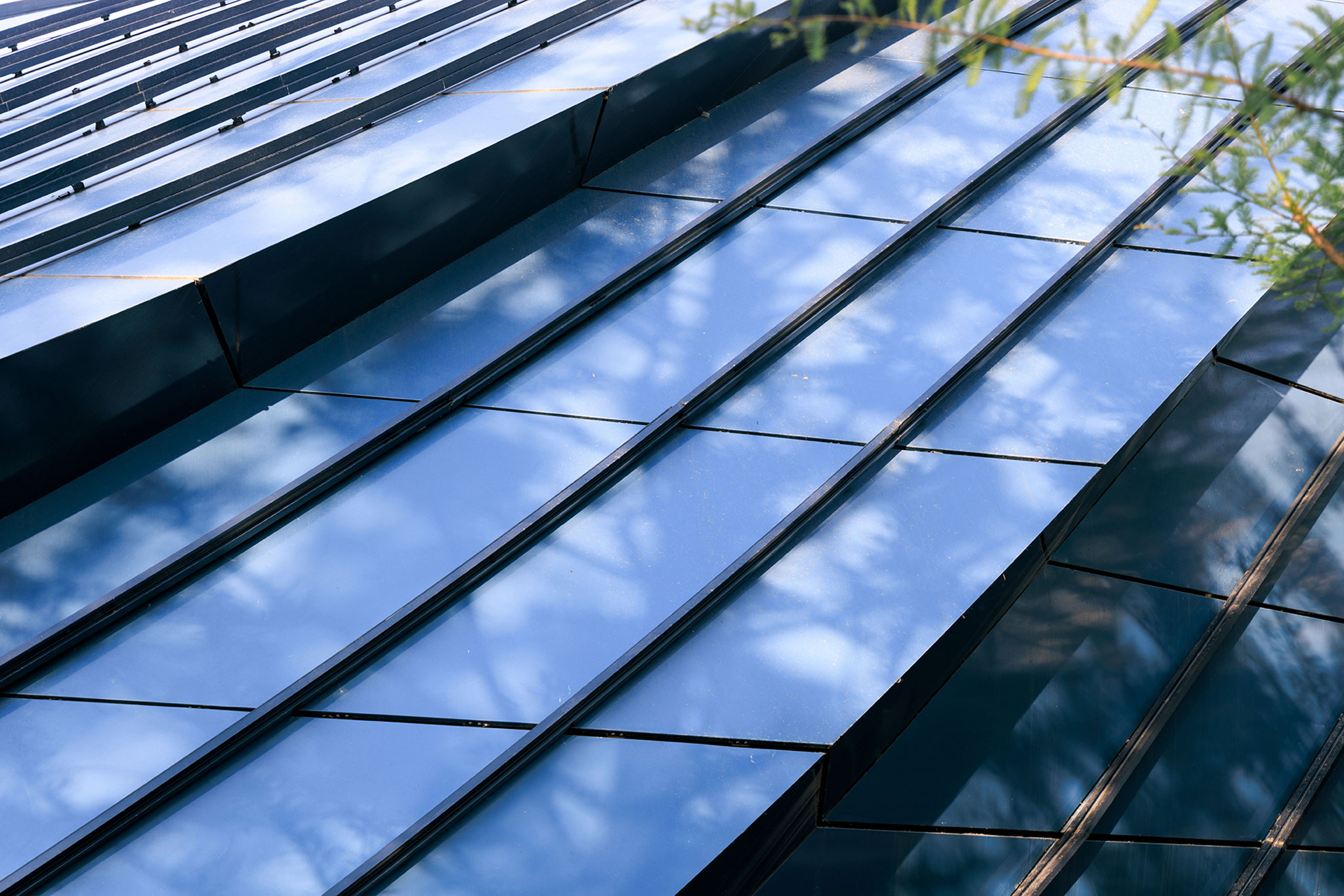
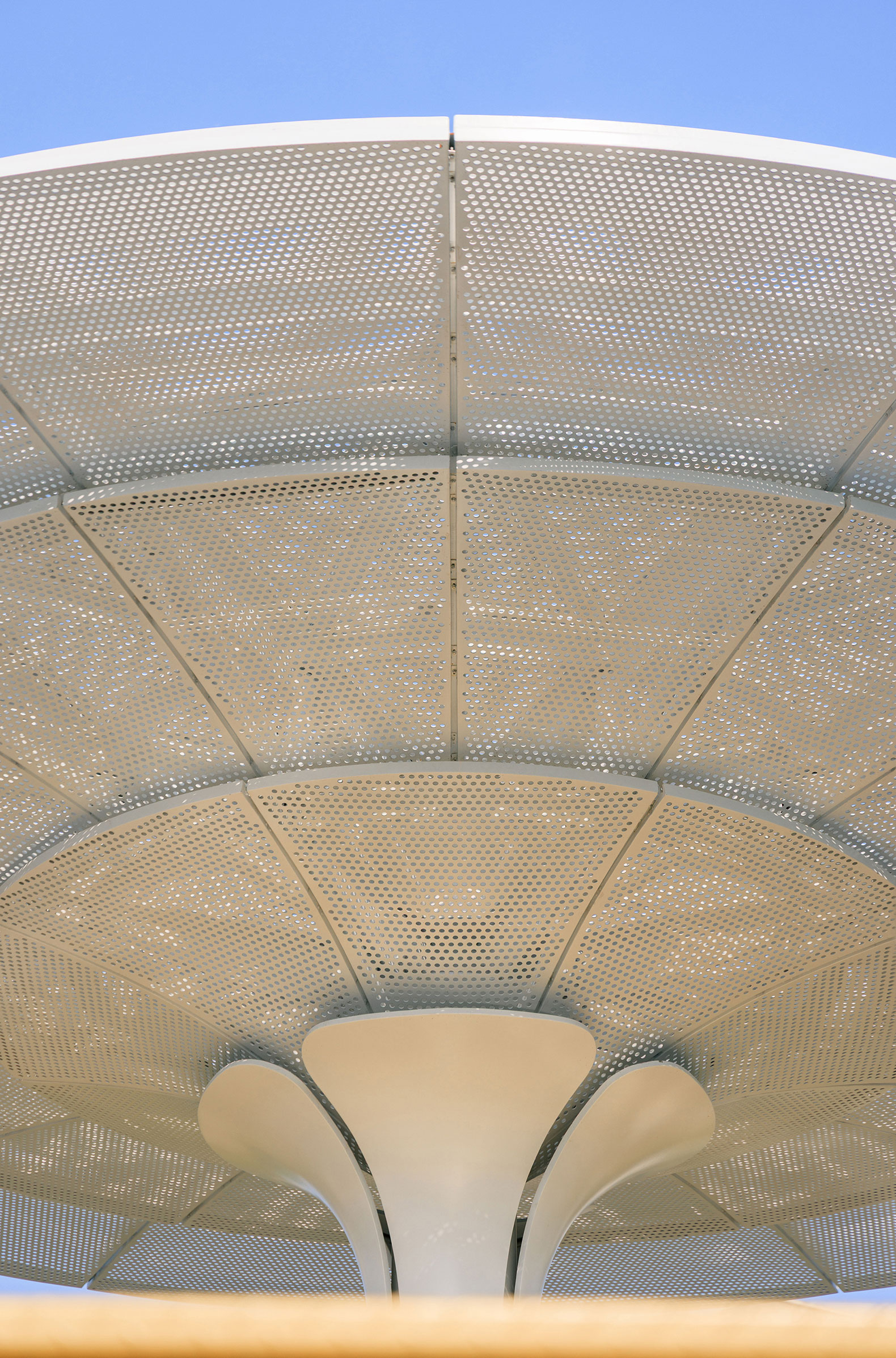
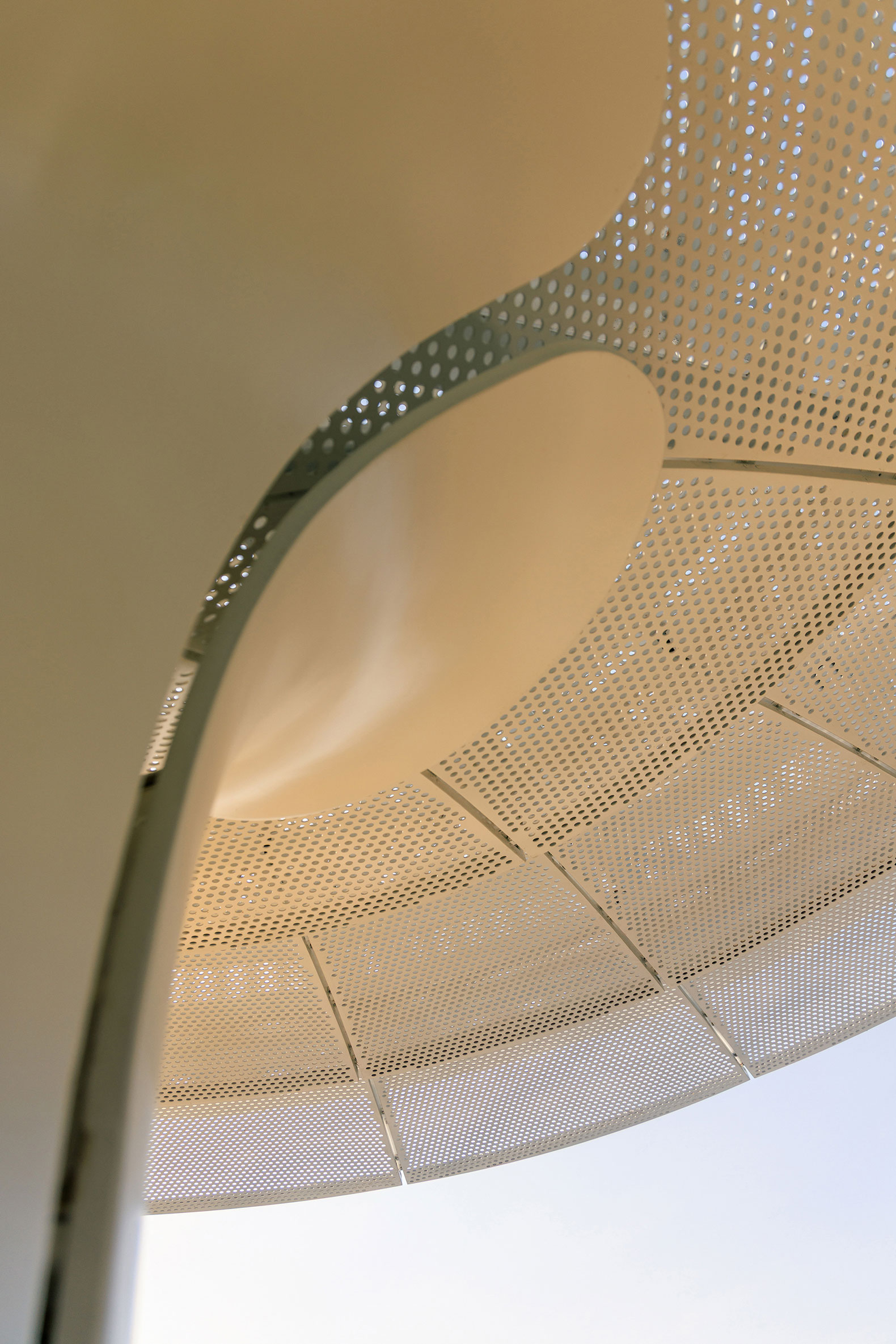
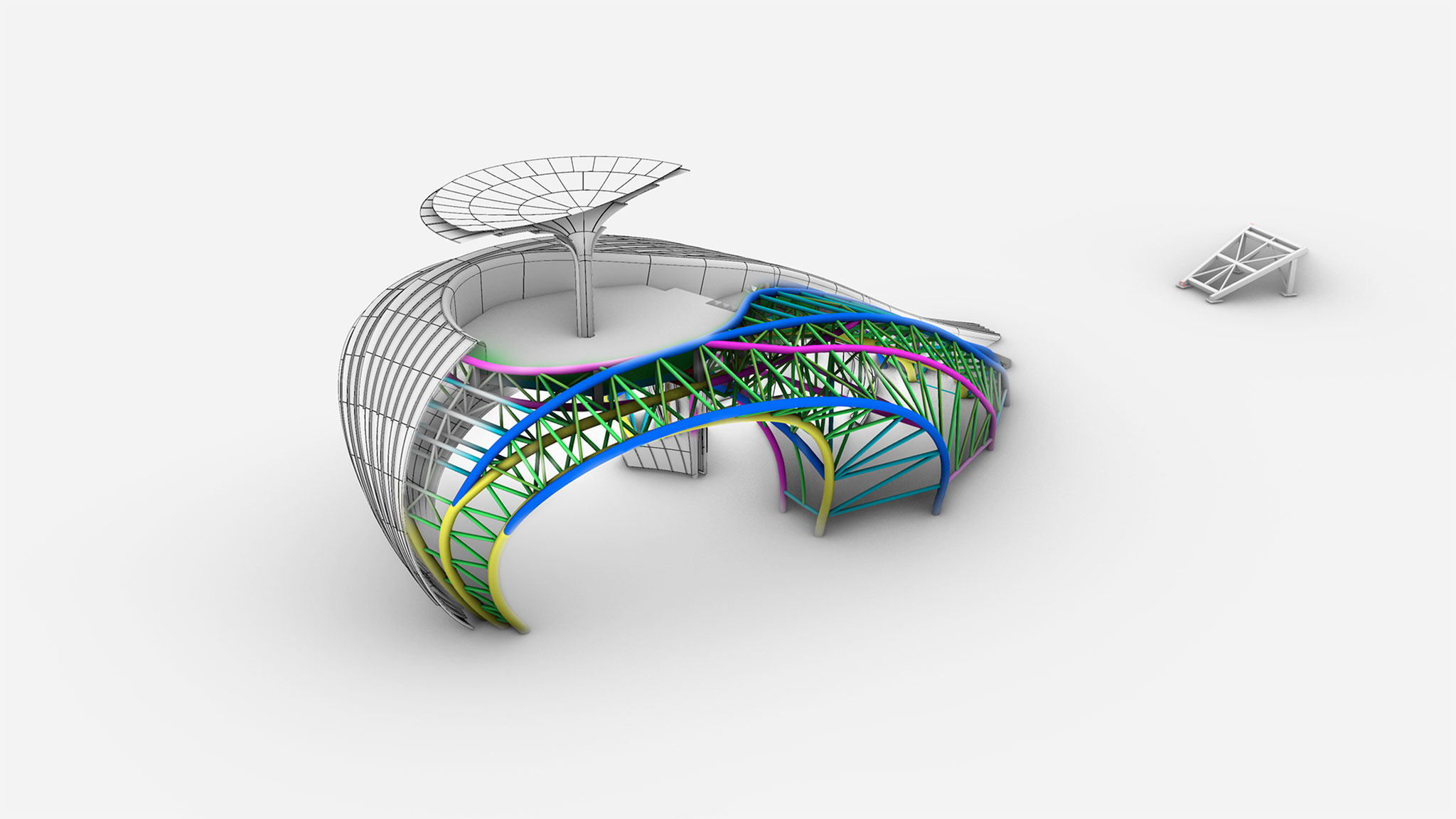
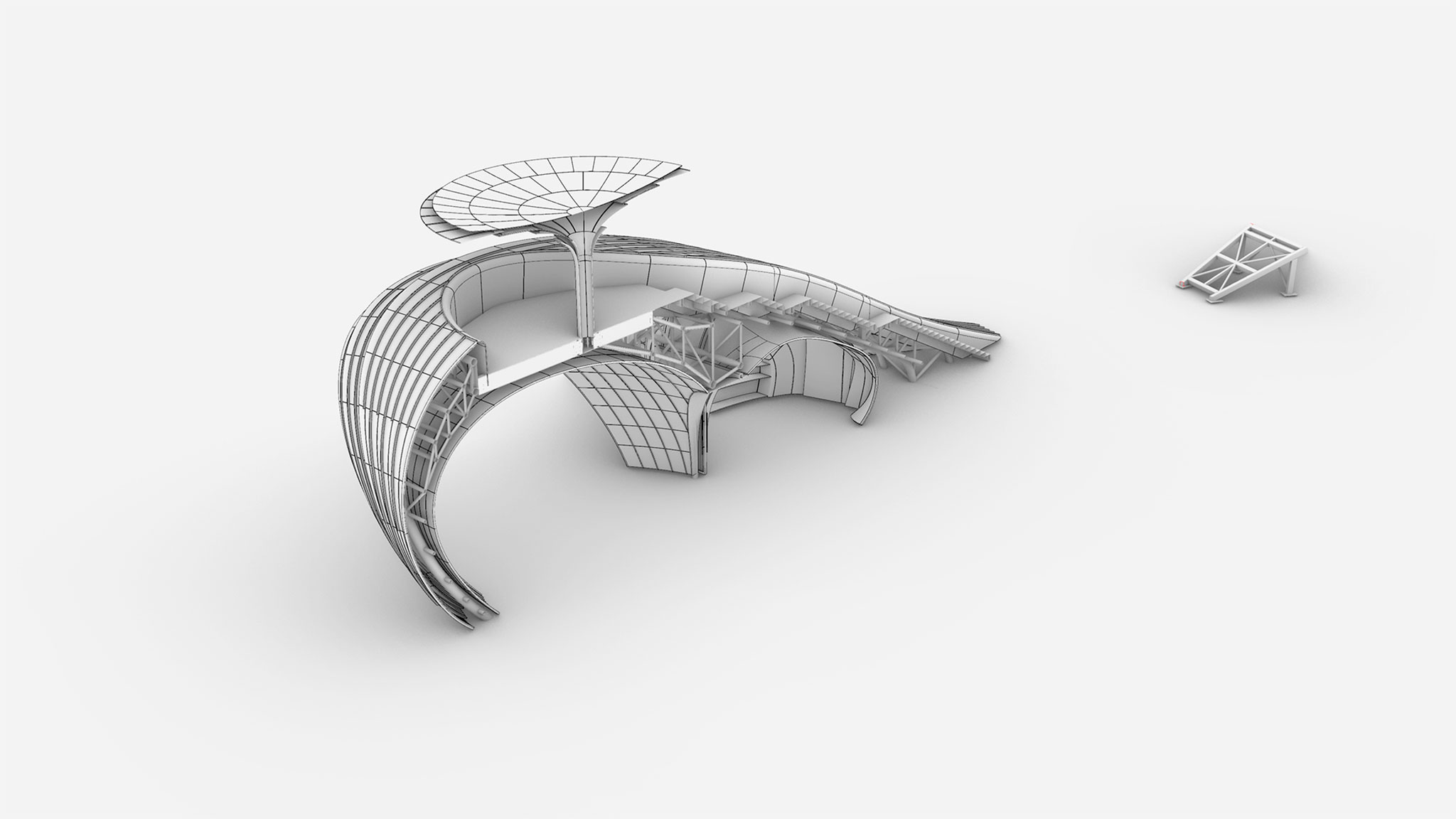
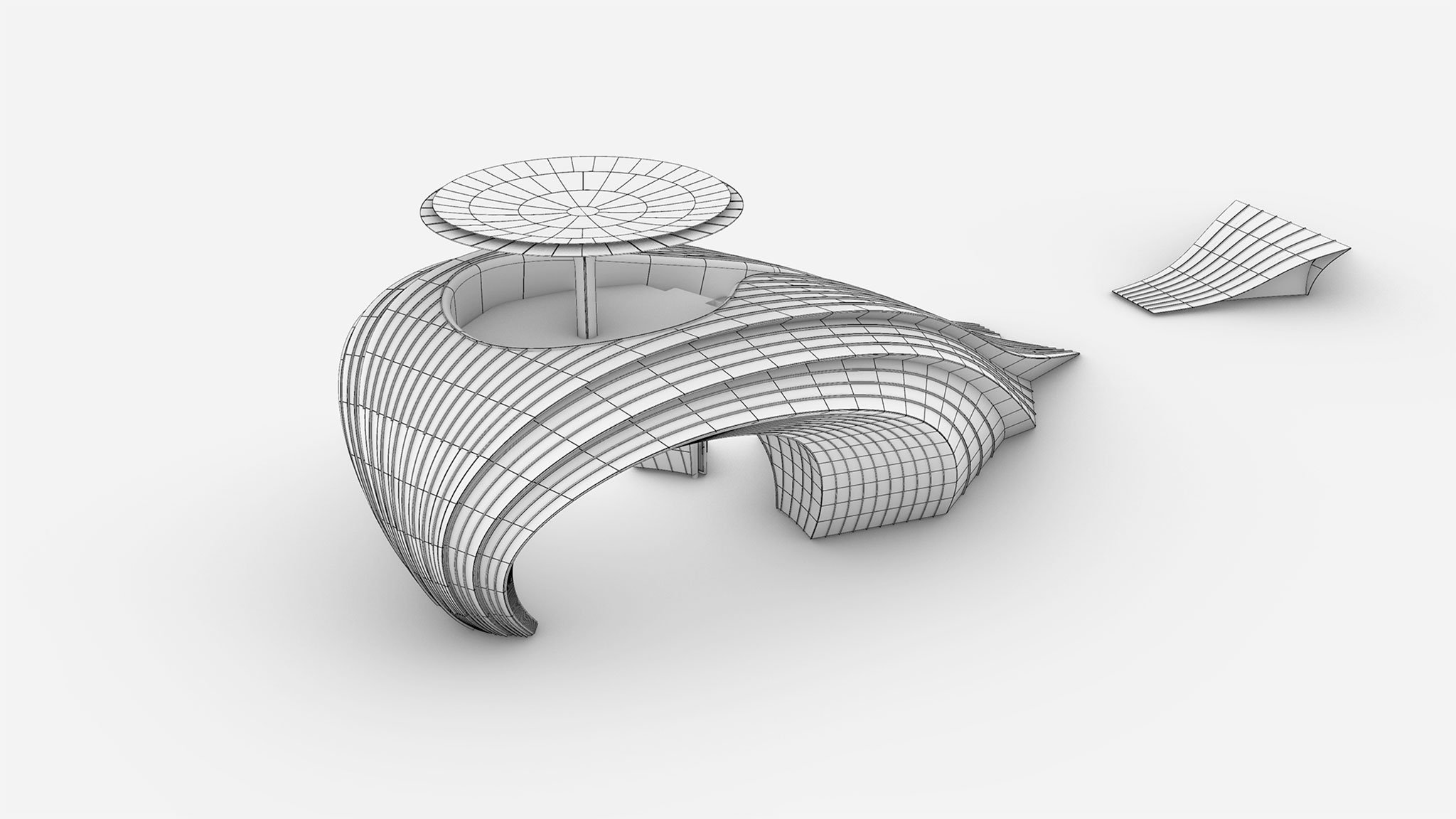
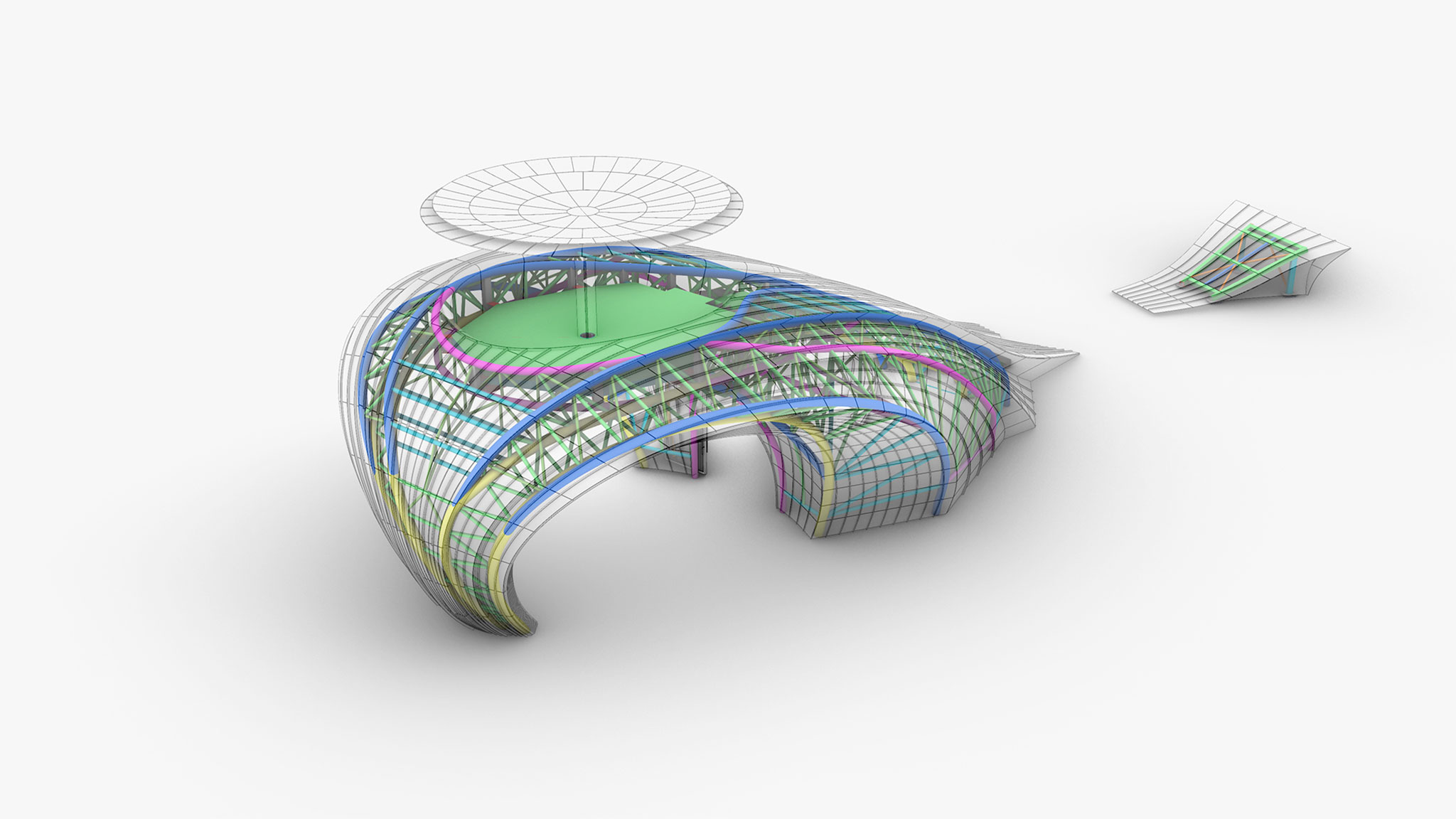
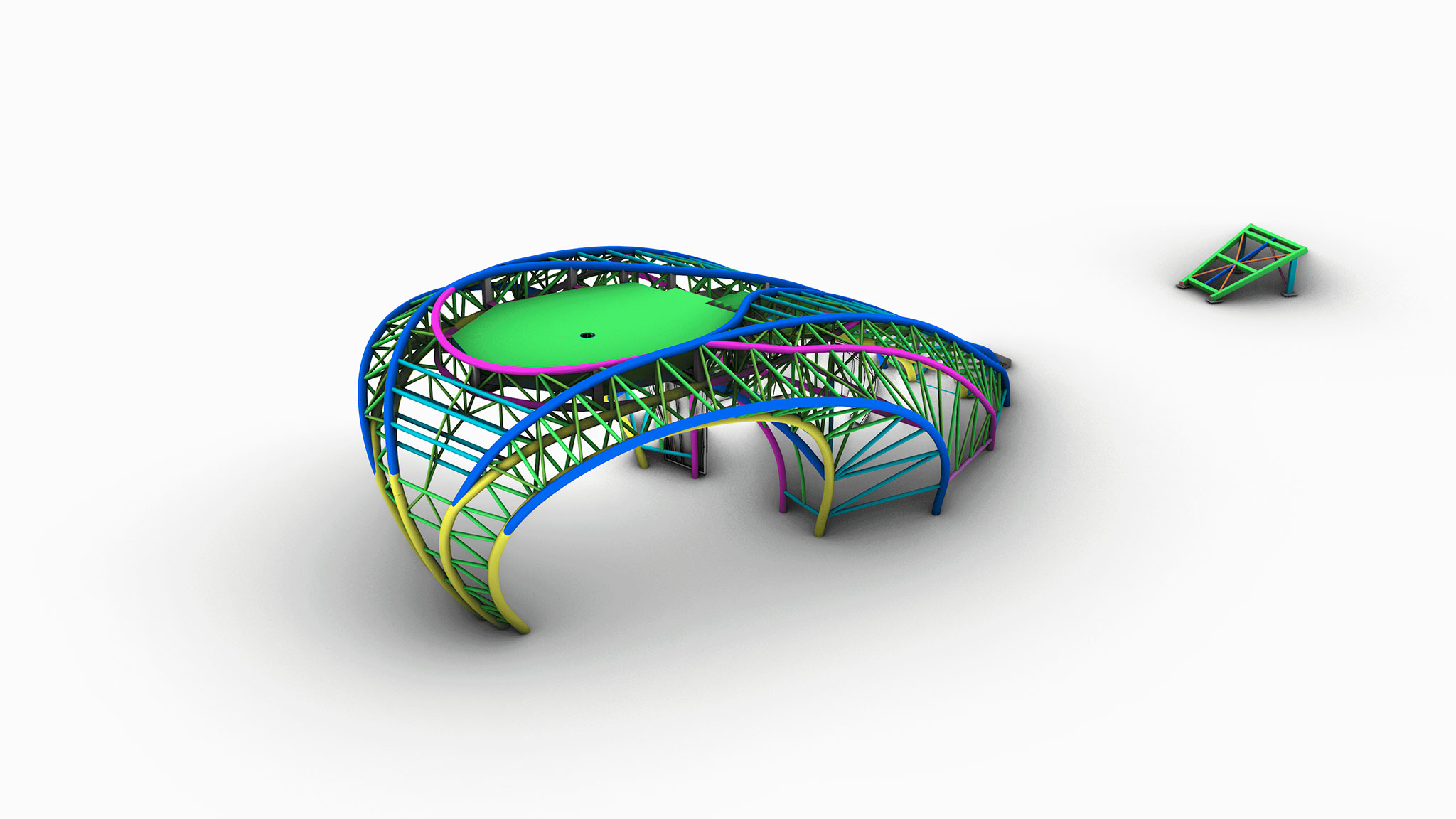
The project’s materiality is defined by the use of metal structures such as steel and aluminum. Six layers form the project’s roof, consisting of a main steel structure, connecting rods to an aluminum substructure, and honeycomb aluminum panels. Each panel in the assembly was custom-made due to its curved shape and complex arrangement. The staircase leading up to the observation deck also features a metal structure.
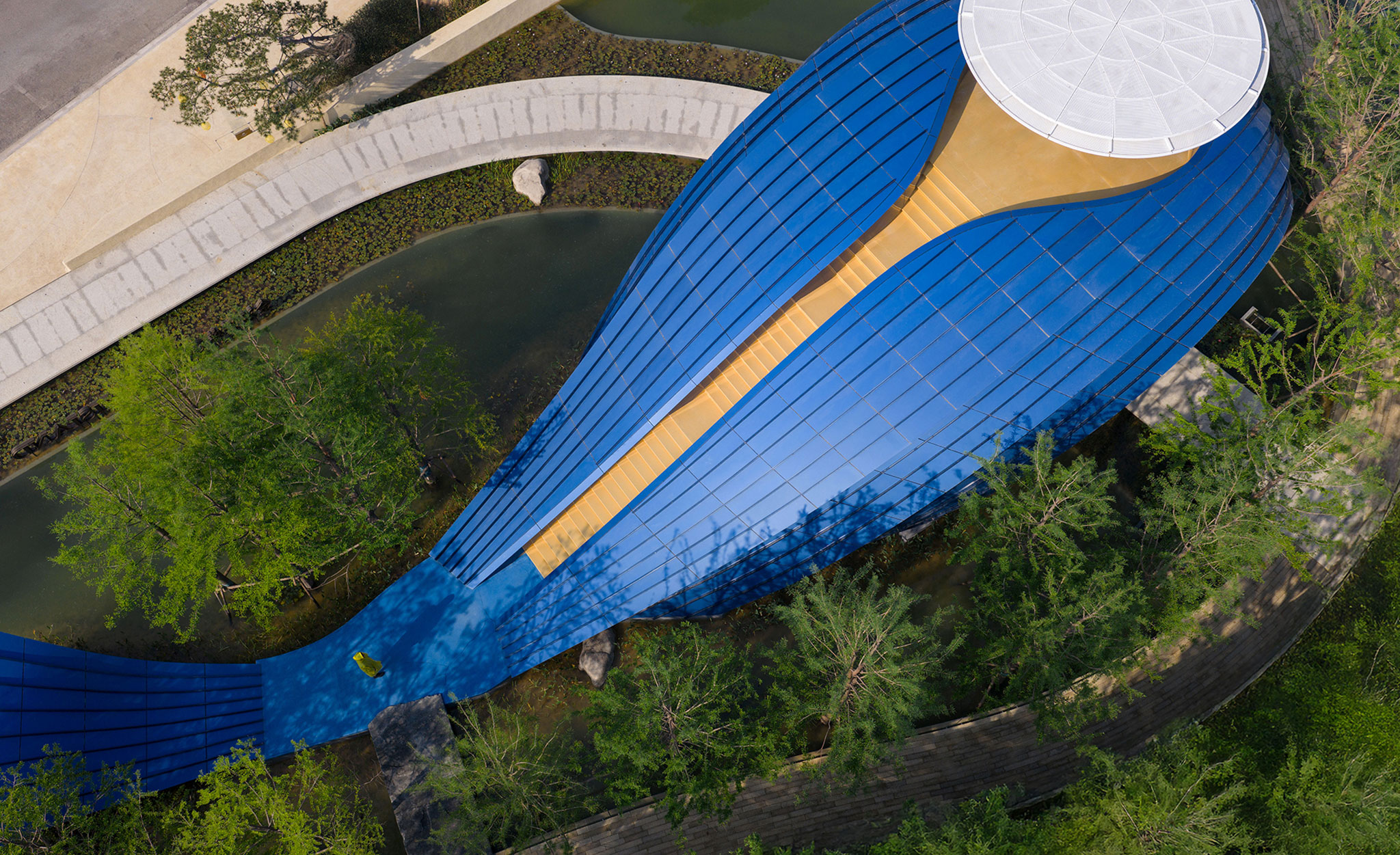
Whale Gate by Wutopia Lab. Photograph by LIU Guowei.
Project description by Wutopia Lab
Wutopia Lab completed the gateway for Golden Island by Jinsha Group in Shangqiu, Henan, in January 2026. Positioned within a water landscape and partially concealed by trees, the structure appears as a blue biomorphic object emerging from the garden rather than a conventional residential entrance.
The project was developed from the client’s ambition to create a sense of entering a different world upon returning home. Jinsha Golden Island adopts an archipelago-like masterplan in which residential buildings appear dispersed across a landscape of water and greenery. This prompted architect Yu Ting to reference ancient Chinese imaginaries of mythical islands in the sea — idealized places separated from the pressures of ordinary reality.
The gateway reinterprets the image of a whale as an architectural threshold. In many maritime myths and legends, whales occupy an ambiguous position between the familiar world and the unknown. Here, the act of returning home becomes a symbolic passage through the “eye” of the whale.
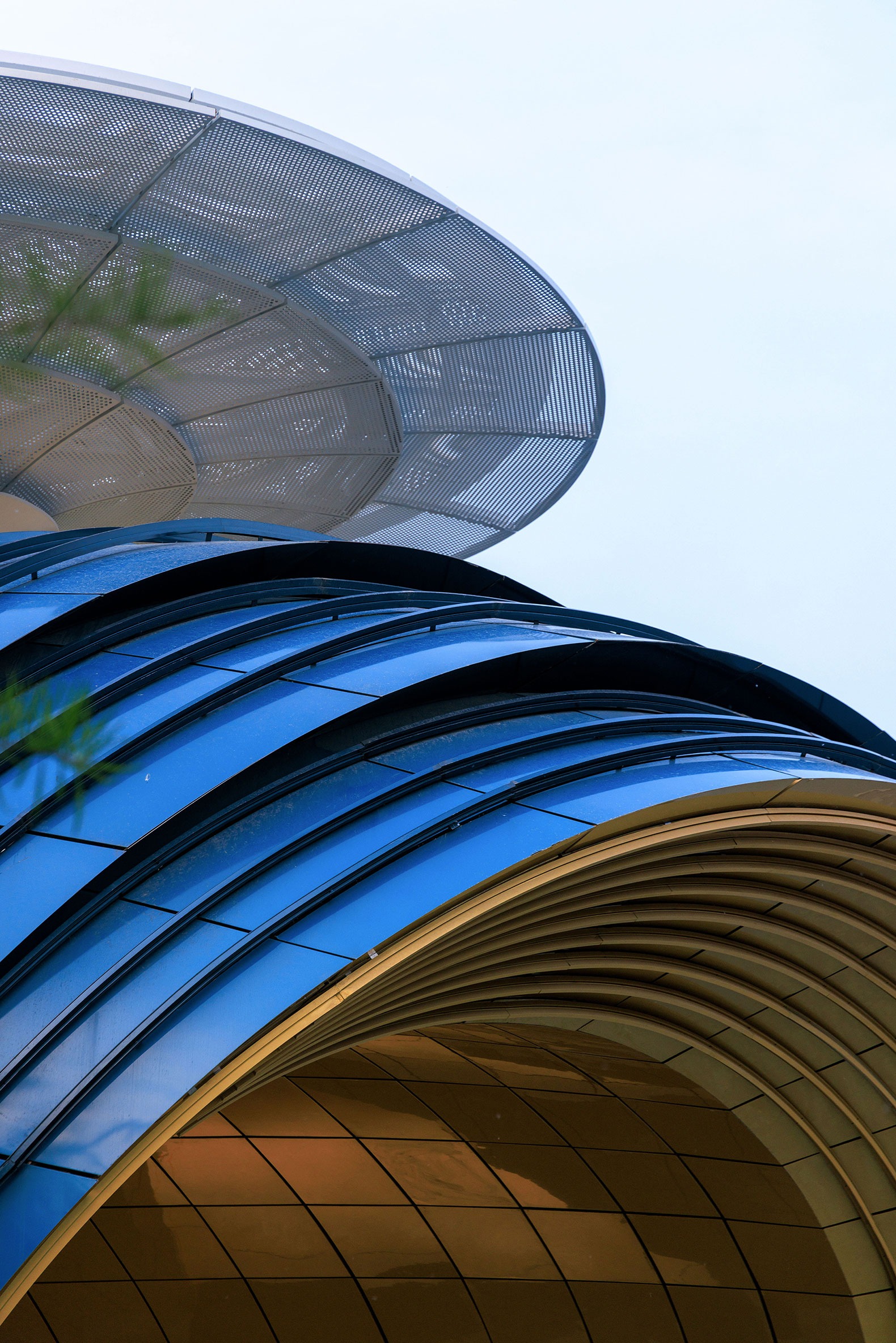
Rather than literally reproducing the animal, the project abstracts recognizable elements into a simplified architectural figure. A golden vertical opening cuts through the blue volume to form the main entrance, while perforated white aluminum panels above suggest water spray and simultaneously function as a canopy structure.
The project intentionally embraces symbolism instead of concealing it behind purely technical or parametric expression. For the architect, the gateway is not only an infrastructural object but also a psychological device capable of shaping emotional perception and memory.
A viewing platform connected by golden stairs leads to the top of the structure and is accessible exclusively to residents. From above, the landscape of the residential compound unfolds between water, trees, and buildings under construction. In this way, the gateway operates not simply as an entrance but as a transition between the density of the city and a more insulated domestic environment.
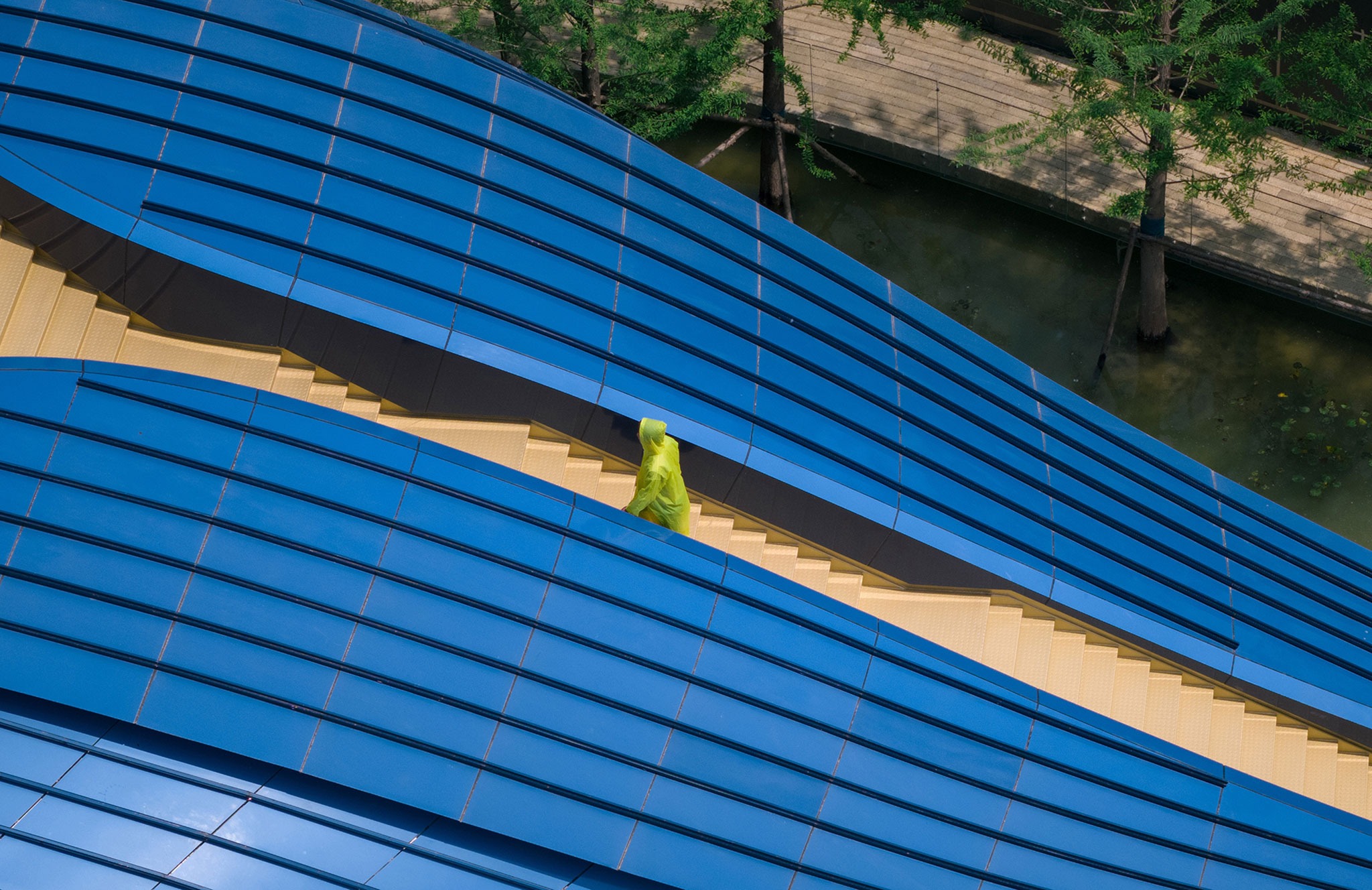
The Whale Gate consists of a six-layer structural system including a primary steel frame, connection rods, aluminum substructure, waterproof layers, double-curved aluminium honeycomb composite panels, and fin-shaped profiles. The structure contains nearly 4,000 individual components and weighs approximately 60 tons.
Due to its irregular twisted geometry, all steel and aluminum members were custom-fabricated according to varying curvatures and torsions. Each steel column was divided into seven to fifteen segments, while nearly 10,000 three-dimensional coordinate points were used throughout the construction process to achieve millimeter-level precision.
The design team selected an aluminum honeycomb composite panel system to balance lightweight performance, durability, and the ability to realize complex curved surfaces. A total of 1,170 uniquely shaped aluminum panels were fabricated for the project, allowing the whale form to remain visually continuous despite its highly customized geometry.
During the opening ceremony of Whale Gate, a red firework was ignited from the center of the gateway, briefly transforming the structure into what appeared to be a living object within the night landscape. The moment reinforced the project’s broader interest in fantasy, return, and the emotional construction of domestic space.
Rather than functioning solely as a visual landmark, Whale Gate operates as a small spatial allegory embedded within an ordinary residential development — a mythological fragment inserted into the realities of contemporary urban life.