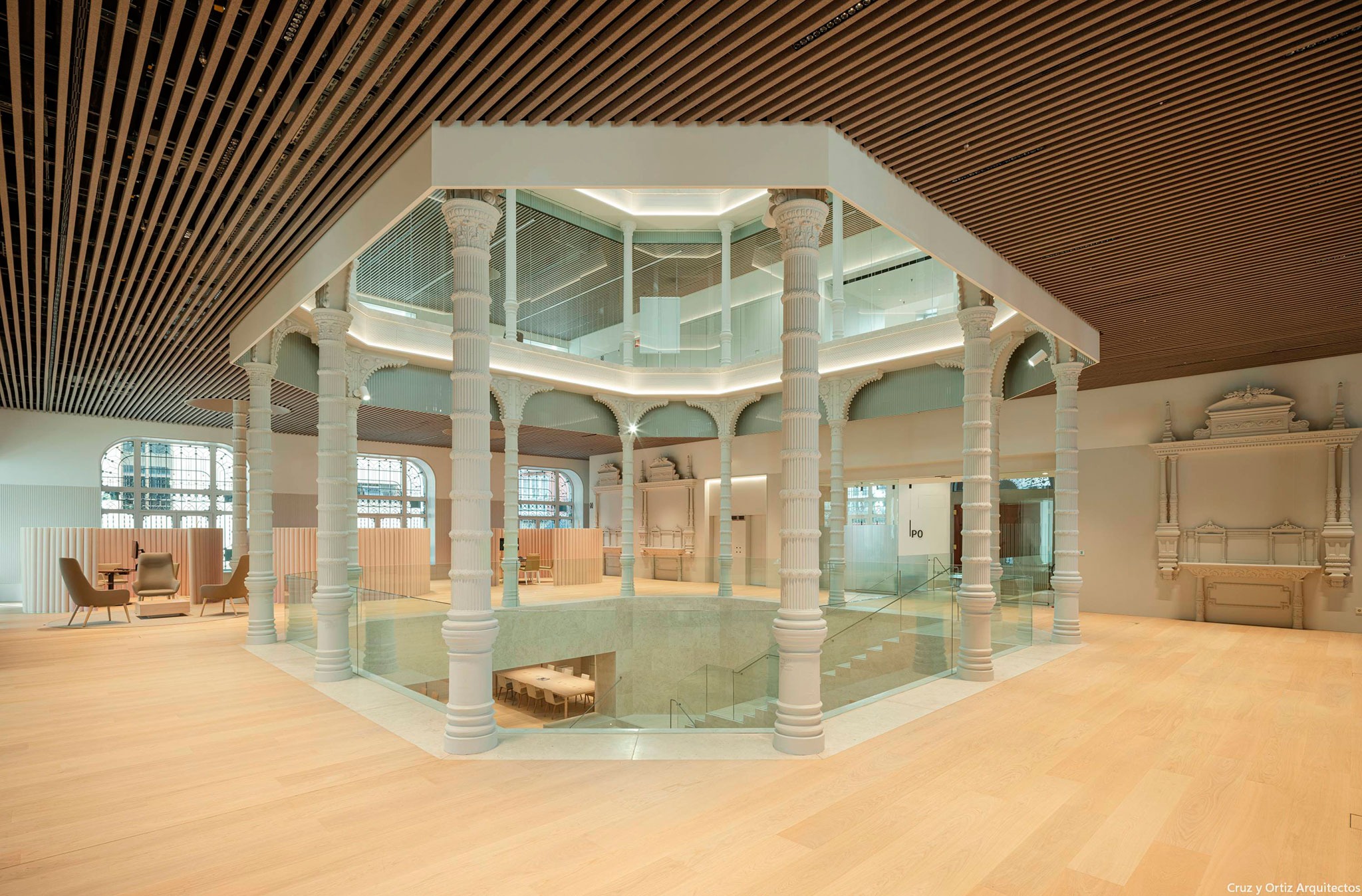
The building located on the central Hernán Cortés street in the city of Santander and former headquarters of the Banco Mercantil from 1900 that has undergone various transformations over time, now houses the model offices of Banco Santander, a project by Cruz y Ortiz Arquitectos that provides the building with services and activities different from those of a conventional office.

The project allows, through maximum transparency, to understand the entire building at once through a vertical courtyard that, originally narrower, extends on one side to the semi-basement and through the rest of the floors giving rise to a multifunctional space on the roof.

The project by Cruz y Ortiz Arquitectos allocates the first, second and third floors to offices, mostly open, and a series of offices in the southern area, giving the building a more unitary character.

The building maintains the clarity of its structure of cast iron pillars around the courtyard and is finished on the roof with a multipurpose space that allows for multipurpose use, giving rise to spaces for rest, presentations, talks, etc.

Banco Santander Offices by Cruz y Ortiz Architects. Photograph by Fernando Alda.

Project description by Cruz y Ortiz Arquitectos

The former headquarters of Banco Mercantil is a project from 1900 by architect Casimiro Pérez de la Riva. The building has undergone various transformations over time, but has maintained the clarity of its cast iron pillar structure around the courtyard.

The aim is to give the building a new, more unitary use than its last configuration. The original courtyard extends on one side to the semi-basement floor and, through the rest of the floors, to a multifunctional space on the roof, where it is crowned with a chandelier. This reinforces the verticality of the courtyard and the structural clarity of the building. Transparency will be maximum and will allow the entire building to be understood at once through the vertical courtyard.

Oficinas para Banco Santander por Cruz y Ortiz Arquitectos. Fotografía por Fernando Alda
Banco Santander Offices by Cruz y Ortiz Architects. Photograph by Fernando Alda.

On the lower floors, Banco de Santander will install a model office, which offers services and activities very different from those of a conventional office, as it is understood today. Areas for coffee, coworking, meeting rooms, will be available to those who request them.

The first, second and third floors will house Banco de Santander offices. Most of the offices will be open plan, with only a series of offices planned along the south façade.

The building is finished off on the roof with a multipurpose space, which can be used as a rest area, for talks, presentations, etc.

More information

Label
Architects
+ + copy Created with Sketch.
- + copy Created with Sketch.
Label
Project team
Text

Blanca Sánchez (project manager), Sergio Mota (deputy manager), Helena Fuentes, Federico Curti, Carlos Prisco, Pablo Navas, Alexandra Wideberg, Eneko Garín, Javier González.

+ + copy Created with Sketch.
- + copy Created with Sketch.
Label
Collaborators
Text

Model.- Jorge Queipo.
Structural engineering.- Cesma Ingenieros, IDOM.
Climate engineering.- IDOM, IS Ingenieros.
Acoustics.- IDOM, IS Ingenieros.
Fire protection.- IDOM.
Health and safety.- Naserges.
Construction management.- IDOM, Consulting-Engeenering-Architecture.
Construction control.- IDOM Consulting-Engeenering-Architecture.
Construction companies.- SIECSA Construcción y Servicios S.A.

+ + copy Created with Sketch.
- + copy Created with Sketch.
Label
Area
Text

Plot.- 807 sqm.
Main Building.- 4,083 sqm.

+ + copy Created with Sketch.
- + copy Created with Sketch.
Label
Dates
Text

Competition.- 2017.
Project design.- 2017-2019.
Construction.- 2019-2023.
Commissioning.- 2023.

+ + copy Created with Sketch.
- + copy Created with Sketch.
Label
Location
Text

Hernán Cortés 11, Santander, Spain.

+ + copy Created with Sketch.
- + copy Created with Sketch.
Label
Photography
+ + copy Created with Sketch.
- + copy Created with Sketch.

Cruz y Ortiz Arquitectos is an architectural practice founded in 1974 by Antonio Cruz Villalón (Seville, 17 March 1948) and Antonio Ortiz García (Seville, 17 September 1947), with its main office in Seville. Since 2002, it has had a permanent office in Amsterdam, and since 2020, an office in Lugano, Switzerland, as well as an associated studio in Madrid.

Antonio Cruz and Antonio Ortiz began their professional careers in 1971, after graduating from the Madrid School of Architecture. After completing their studies, both architects returned to Seville, where they founded Cruz y Ortiz Arquitectos in 1974. From there, they began a career defined by a sober, precise architecture, attentive to the urban dimension of each intervention, which soon established them as one of the most important Spanish practices of their generation.

In 2002, Cruz and Ortiz opened a studio in Amsterdam, from which they have developed a significant part of their Dutch and Central European work. These projects include Java Eiland in Amsterdam (1994), the Patio Sevilla residences in Céramique, Maastricht (2000), the towers in Wilhelminapier, Rotterdam (2002–2003, project), the transformation of the Rijksmuseum in Amsterdam (2001–2013), and the Atelier Building of the Rijksmuseum itself (2007).

Their best-known projects include a housing project on Calle Doña María Coronel, Seville (1976), the adaptation of the Baluarte de la Candelaria as the Museum of the Sea in Cádiz (1989), the housing blocks in Carabanchel, Madrid (1989), the Andalusian Regional Ministry of Culture in Seville (1989–1992), Santa Justa Station in Seville (1991), the adaptation and extension of Ceuta City Hall (1993), Huelva Bus Station (1994), Seville Public Library (1999), La Cartuja Stadium in Seville (1999), the Spanish Pavilion at Expo 2000 in Hanover, the extension of the SBB railway station in Basel, Switzerland (2003), the housing project in the former Tort Can Planell Factory in Sabadell (2007), the Community of Madrid Stadium (2012), the Central Building of the Health Sciences Campus of the University of Granada (2015), the new Atlético de Madrid stadium, also conceived as an Olympic stadium (2016), the offices for the Andalusian Regional Ministry of Public Works and Housing in Seville (2016), the five-star Mercer Hotel in the Casa Palacio Castelar in Seville (2016), the extension and refurbishment of the Reina Sofía School of Music in Madrid, a competition won in 2024, and the project for the rehabilitation of the GESA building and the transformation of Palma’s seafront, a competition won in 2026.

In 1997, they were awarded the Gold Medal of Andalusia for their contribution to the field of architecture. They later received the National Sports Architecture Award (1998), the Eduardo Torroja Award for the Olympic Stadium in Seville (1999), the Heimatschutz Award for the extension of Basel SBB railway station (2001), the Velux Foundation Daylight Award Special Mention for Basel SBB railway station (2006), and the Andalusian Architecture Award for the extension of Basel railway station (2008). In 2013, they received the CSCAE International Spanish Architecture Award for the Rijksmuseum and the Abe Bonnema Architecture Award for the New Rijksmuseum. In 2014, they received the International FAD Award for the New Rijksmuseum, The Brick Awards / Worldwide Brick Award for the New Rijksmuseum, were appointed Honorary Fellows of the American Institute of Architects, were distinguished as Knights of the Order of the Netherlands Lion, and received the CSCAE Gold Medal for Architecture. In 2015, they received the AD Architects of the Year Award; in 2018, the World Football Summit Best Stadium Award for the Wanda Metropolitano; in 2019, the UEFA Elite Stadium distinction for the Wanda Metropolitano; and in 2026, the Hispalyt “Excellence in Ceramic Architecture” Award. Since 2004, they have been honorary professors at the University of Seville and have held the Cátedra Blanca at its School of Architecture. They have also been visiting professors at the polytechnic schools of Lausanne and Zurich, as well as at Cornell University, Columbia University, and the School of Architecture in Pamplona, and have held the Kenzo Tange Chair at Harvard University’s Graduate School of Design. Among other distinctions, they have received the Spanish National Architecture Award, the City of Seville Award, the City of Madrid Award, the 92nd Brunei International Award, the Construmat Award, and the CEOE Foundation Award. They have twice been finalists for the Mies van der Rohe Award.

Over more than five decades of work, Cruz y Ortiz Arquitectos has built a career marked by continuity, constructive rigour, and the ability to intervene in highly diverse contexts, ranging from housing and public facilities to infrastructure, stadiums, and the rehabilitation of major historic buildings. Their work, developed across Spain and other European countries, combines a precise attention to place with architecture of great formal clarity, positioning the practice among the key references in contemporary Spanish architecture.

Read more
Published on: October 6, 2024
Cite:
metalocus, MINERVA GARCÍA DE CASTRO, FRANCISCO LANCHAS MORA
"Verticality and structural clarity. Banco Santander Offices by Cruz y Ortiz Architects" METALOCUS. Accessed
<https://www.metalocus.es/en/news/verticality-and-structural-clarity-banco-santander-offices-cruz-y-ortiz-architects> ISSN 1139-6415
Loading content ...
Loading content ...
Loading content ...
Loading content ...
Loading content ...
Loading content ...
Loading content ...
Loading content ...
Loading content ...
Loading content ...
Loading content ...
Loading content ...
Loading content ...
Loading content ...
Loading content ...
Loading content ...
Loading content ...
Loading content ...
Loading content ...
Loading content ...
Loading content ...
Loading content ...
Loading content ...
Loading content ...
Loading content ...
Loading content ...
Loading content ...
Loading content ...
Loading content ...
Loading content ...
Loading content ...
Loading content ...
Loading content ...
Loading content ...
Loading content ...
Loading content ...
Loading content ...
Loading content ...
Loading content ...
Loading content ...
Loading content ...
Loading content ...
Loading content ...
Loading content ...
Loading content ...
Loading content ...
Loading content ...
Loading content ...
Loading content ...
Loading content ...
Loading content ...
Loading content ...
Loading content ...
Loading content ...