

Taking advantage of the east-west orientation of 29th Street in which the building whose façade has been renovated by Scalar Architecture is located, and remembering the particular alignment of the streets, offset by 29 degrees with the true east-west, and the incidence of the solstices in them, known as Manhattanhenge, (the word was popularized in 2002 by Neil deGrasse Tyson, an astrophysicist at the American Museum of Natural History), the project is conceived as, an ingenious proposal that dialogues with the sun and is created through a skillful digital process.
An envelope that "breathes", providing high-performance insulation, selective ventilation, and porosity. The facade was thought of as a set of panels that can be further reconfigured through rotation and reflection.
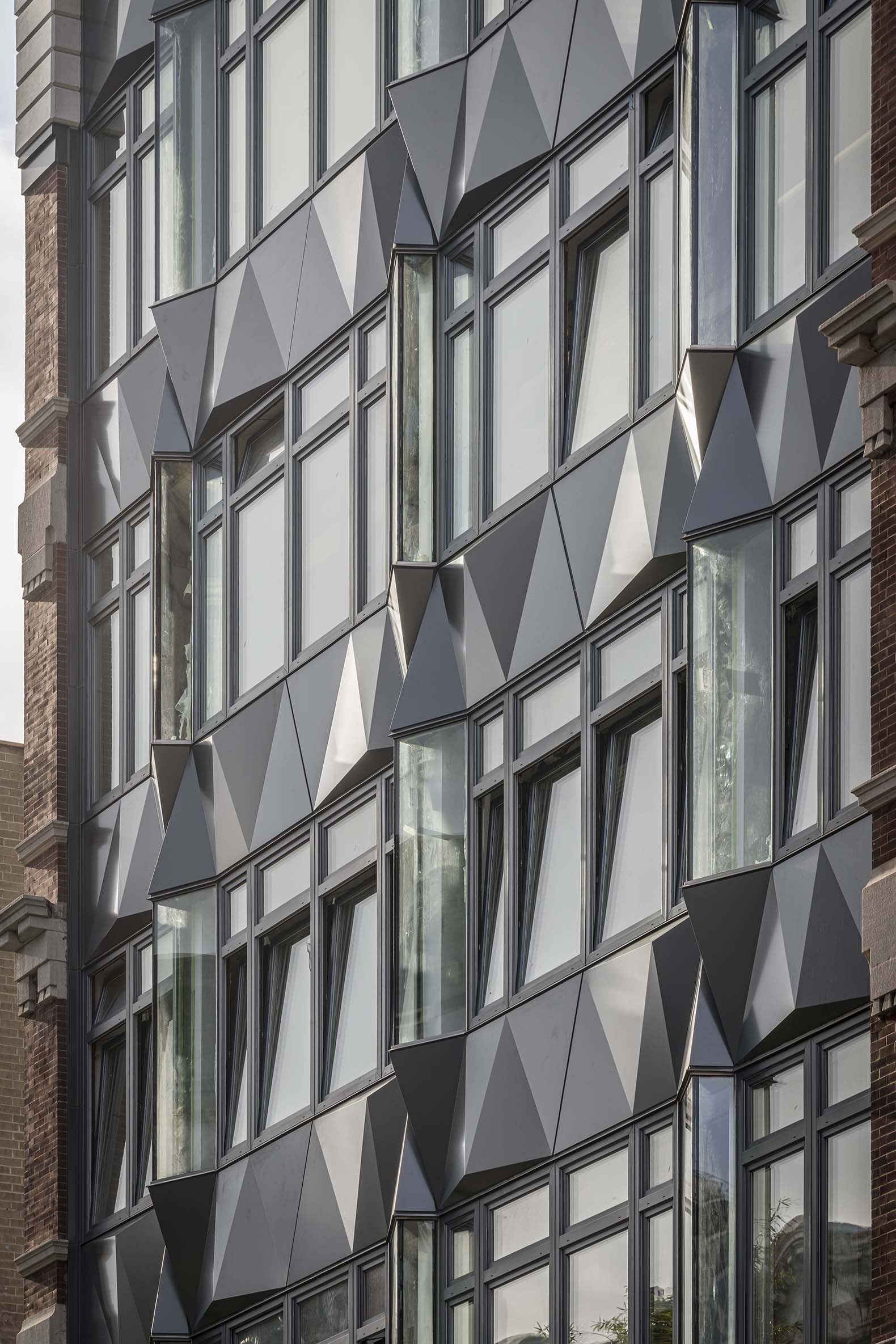
Manhattanhenge by Scalar Architecture. Photograph by Imagen Subliminal.
An envelope that "breathes", providing high-performance insulation, selective ventilation, and porosity. The facade was thought of as a set of panels that can be further reconfigured through rotation and reflection.
Manhattanhenge by Scalar Architecture. Photograph by Imagen Subliminal.
Project description by Scalar Architecture
Our project is a transformative intervention on an existing 6 story 30,000 sqf early XXth century structure located within Manhattan’s Commissioner city grid.
The ideas for the innovative restoration effloresce in a new environmentally performative and digitally-fabricated envelope. Being located on a narrow street - mostly oriented East-West, the design conjures a material and geometrical system that circumvents an existing facade steel structure to establish an oblique longitudinal relation with the street. The new oblique geometry allows for direct sun access - insolation- as well as a series of visual relations between the interior and the streetscape.
In addition, the new envelope provides high-performance insulation, elective ventilation, and porosity. The envelope was conceived as a system of panels that can be further reconfigured by rotation and mirroring. The metal and insulation panels are built by a digital process of cutting and folding. In such a manner, the capacity of the design software to flatten three-dimensional geometry is closely aligned with the fabrication protocols.
The folding of the panels hence operates at a variety of scales: the folding provides the necessary rigidity to thin material, negotiates the connections to the existing structure sidestepping old columns, sites the project in the urban context of a narrow street, and ultimately affords a solar and environmental connection. In so doing, the design recalls the Manhattanhenge phenomenon - the bi-annual alignment of the Manhattan’s Commissioner’s grid with the sunset and sunrise- and prolongs it further throughout the seasons.


