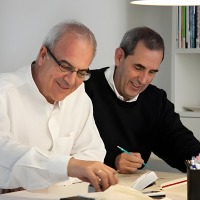
The new ICO Museum's autumn exhibition - which will run until January 22nd 2017 - has original models and sketches of some of the most important and characteristics works of Cruz y Ortiz Arquitectos.

The new exhibition Cruz and Ortiz 1/200...1/2000 hosted by the ICO Museum until January 22, takes us through the more than forty years of professional experience of the architects Antonio Cruz and Antonio Ortiz, characterized by rigor and sobriety, both the small and the large scale, new construction projects and renovations. Everything commissioned by the architect Jesús Ulargui Agurruza, and photographs by the artist José Manuel Ballester

Among the works exhibited in Cruz and Ortiz 1/200...1/2000 it should be noted the Santa Justa Station (1992) or more recent projects such as the expansion of the Rijksmuseum, one of the most important museums in Europe, which invites to reflect on the architecture of museums and the museum institution.
 
"The main objective of the ICO Museum is spread both Spanish and international contemporary architecture better. This year we've traveled from Olot to Seville to offer a broader perspective of our architecture. Thus, after RCR Arquitectes is an honor to have now Antonio Cruz and Antonio Ortiz." Said Monica de Linos, ICO Foundation Director. "Their architecture is characterized by rigor, sobriety and concern for the construction process, characteristics that make their work worthy of a detailed look" concludes Linos.

The ICO Museum devotes special attention to the project of one of the most emblematic sports facilities in Madrid: the new Atletico Madrid's stadium, which will be inaugurated the next August as the seat of †he Madrid's football club. From its initial conception as athletics stadium for the Community, until this football club plays its first game in, more than thirty years have elapsed, which makes this work the one with the longest time path in the studio.

Another 50 projects get joined to those, explained with sketches and models developed by Cruz and Ortiz since 1974, both the built ones - in most cases - as those who remained in the project phase for not being selected in the numerous national and international competitions in which they have participated.


Cruz and Ortiz 1/200 ... 1/2000. About the exhibition and the title:

The exhibition is provided with a great unity. The way to expound on identical tables, equally illuminated, accompanied by a transformation of the exhibition halls of the Museum ICO intended to achieve that unit purpose. "We have no doubt about the fascination for scale reproductions of reality which occurs in those who contemplate," says Antonio Ortiz. "Some of it is to be achieved through the profusion of models exposed and emphasized from the very title of the exhibition. It was pleasing to find a solution to something that all architects agree: an architecture exhibition is not an easy thing to do." Moreover he adds: "The architects know well this transition that happens by using progressively larger scales. It departs from a principle intuitive often to achieve the precision and accuracy that requires a technical document".

The museum is divided into three exhibition spaces and two projection areas. Each space contains long tables, on which information is available for each project. The tables, in addition to organizing the tour, divided into six different thematic exhibition ... Cruz and Ortiz 1/200 1/2000: essential projects, the new stadium of Atletico Madrid, outstanding projects, curve geometry projects, projects where dominates the interior space and projects with broken geometries. Four photographs of José Manuel Ballester, National Photography Prize 2010, placed in strategic places give magnitude and beauty to the exhibition. "The collaboration of José Manuel Ballester, with five of his photographs must be understood as a gesture of generosity and friendship on their part to accept a subsidiary role which is not usual for him. These photos in large formats accentuate - without illustrate - certain times of exhibition" adds Antonio Ortiz.

This is an exhibition Architects Cruz and Ortiz understood as an ongoing project, "and we made some years ago -the first exhibition called" Architecture Synthesis "- in which we also use models to illustrate what we have just explained. This exposure would therefore an intensification of the above. And his - more aseptic and less pretentious title, 1/200 ... 1 / 2000 - is the recognition of the undeniable ability of the small suggestion.


"The New Rijksmuseum" wek film Hoogendijk, 2014

The exhibition is completed with the screening The New Rijksmuseum by the Dutch director Oeke Hoogendijk, 2014. A documentary film that tells the development of works and vicissitudes between directors, curators, politicians, architects and the museum, which were filmed for more than 10 years. During this long process, Oeke Hoogendijk and his team were always present. There were no important moment of the process when they were missing - especially those who were supposed to be troubled. The petite presence of Oeke, accompanied by his team, became a kind of family surprise for those who were attending a more or less difficult meeting or whenever a major milestone in the process occurred. To Oeke Hoogendijk this film is not only the description of a construction, even the story of an institution's renewal. It is in fact a parable, an X-ray of Dutch society and its functioning, a critique of the permanent bureaucratic obstacles and at the same time, a compliment to their willingness to innovation and energy that many of its members demonstrate in front of the difficulties. 

Duration: 93 minutes. 
The documentary was assigned and edited by Arquia Foundation, will be broadcast on Tuesdays and Thursdays at 18:00 documentary.


EXHIBITION'S OUTSTANDING WORKS

- Housing in Doña Maria Coronel street in Sevilla (1974-1976).
- 'Santa Justa' Station in Sevilla (1988-1991).
- Real Novo Sancti Petri housing in Cádiz (1990-1991)
- Bus Station in Huelva (1990-1994) 
- Spain Pavilion at Expo 2000 Hanover (1999-2000)
- Marine World Museum in Doñana, Huelva (1999-2001)
- Train Station in Basel (1996-2003)
- Netherlands Institute for Cultural Heritage. Atelierbuilding Amsterdam (2002-2007)
- Remodeling and The Rijksmuseum, Amsterdam (2001-2013)
- Central Building in Health Sciencies and School of Medicine Campus (2006-2014)
- Offices for Junta de Andalucía in Picasso street in Seville (2005-2015)
- Athletics Stadium for the Community of Madrid (1989-1994)
- Atletico de Madrid's Football stadium (2010-2017)
Read more
Read less

More information

Label
Curator
Text
Jesús Ulargui
+ + copy Created with Sketch.
- + copy Created with Sketch.
Label
Venue.-
Text
Museo ICO, Zorrilla st, 3 28014 Madrid. Free entrance.
Tlf: 91 420 12 42
+ + copy Created with Sketch.
- + copy Created with Sketch.
Label
Dates.-
Text
From October 4th 2016 to January 22nd 2017.
Tuesday to Saturday: from 11.00 to 20.00 h.
Sunday and holydays: from 10.00 to 14.00 h.
Every monday of the year (including holydays): closed.
+ + copy Created with Sketch.
- + copy Created with Sketch.
Label
Guided visits.-
Text
Friday: 18:00-20:00 h.
Saturday: 11:00-14:00 h. and 18:00-20:00 h.
Sunday: 11:00-14:00 h.
+ + copy Created with Sketch.
- + copy Created with Sketch.

Cruz y Ortiz Arquitectos is an architectural practice founded in 1974 by Antonio Cruz Villalón (Seville, 17 March 1948) and Antonio Ortiz García (Seville, 17 September 1947), with its main office in Seville. Since 2002, it has had a permanent office in Amsterdam, and since 2020, an office in Lugano, Switzerland, as well as an associated studio in Madrid.

Antonio Cruz and Antonio Ortiz began their professional careers in 1971, after graduating from the Madrid School of Architecture. After completing their studies, both architects returned to Seville, where they founded Cruz y Ortiz Arquitectos in 1974. From there, they began a career defined by a sober, precise architecture, attentive to the urban dimension of each intervention, which soon established them as one of the most important Spanish practices of their generation.

In 2002, Cruz and Ortiz opened a studio in Amsterdam, from which they have developed a significant part of their Dutch and Central European work. These projects include Java Eiland in Amsterdam (1994), the Patio Sevilla residences in Céramique, Maastricht (2000), the towers in Wilhelminapier, Rotterdam (2002–2003, project), the transformation of the Rijksmuseum in Amsterdam (2001–2013), and the Atelier Building of the Rijksmuseum itself (2007).

Their best-known projects include a housing project on Calle Doña María Coronel, Seville (1976), the adaptation of the Baluarte de la Candelaria as the Museum of the Sea in Cádiz (1989), the housing blocks in Carabanchel, Madrid (1989), the Andalusian Regional Ministry of Culture in Seville (1989–1992), Santa Justa Station in Seville (1991), the adaptation and extension of Ceuta City Hall (1993), Huelva Bus Station (1994), Seville Public Library (1999), La Cartuja Stadium in Seville (1999), the Spanish Pavilion at Expo 2000 in Hanover, the extension of the SBB railway station in Basel, Switzerland (2003), the housing project in the former Tort Can Planell Factory in Sabadell (2007), the Community of Madrid Stadium (2012), the Central Building of the Health Sciences Campus of the University of Granada (2015), the new Atlético de Madrid stadium, also conceived as an Olympic stadium (2016), the offices for the Andalusian Regional Ministry of Public Works and Housing in Seville (2016), the five-star Mercer Hotel in the Casa Palacio Castelar in Seville (2016), the extension and refurbishment of the Reina Sofía School of Music in Madrid, a competition won in 2024, and the project for the rehabilitation of the GESA building and the transformation of Palma’s seafront, a competition won in 2026.

In 1997, they were awarded the Gold Medal of Andalusia for their contribution to the field of architecture. They later received the National Sports Architecture Award (1998), the Eduardo Torroja Award for the Olympic Stadium in Seville (1999), the Heimatschutz Award for the extension of Basel SBB railway station (2001), the Velux Foundation Daylight Award Special Mention for Basel SBB railway station (2006), and the Andalusian Architecture Award for the extension of Basel railway station (2008). In 2013, they received the CSCAE International Spanish Architecture Award for the Rijksmuseum and the Abe Bonnema Architecture Award for the New Rijksmuseum. In 2014, they received the International FAD Award for the New Rijksmuseum, The Brick Awards / Worldwide Brick Award for the New Rijksmuseum, were appointed Honorary Fellows of the American Institute of Architects, were distinguished as Knights of the Order of the Netherlands Lion, and received the CSCAE Gold Medal for Architecture. In 2015, they received the AD Architects of the Year Award; in 2018, the World Football Summit Best Stadium Award for the Wanda Metropolitano; in 2019, the UEFA Elite Stadium distinction for the Wanda Metropolitano; and in 2026, the Hispalyt “Excellence in Ceramic Architecture” Award. Since 2004, they have been honorary professors at the University of Seville and have held the Cátedra Blanca at its School of Architecture. They have also been visiting professors at the polytechnic schools of Lausanne and Zurich, as well as at Cornell University, Columbia University, and the School of Architecture in Pamplona, and have held the Kenzo Tange Chair at Harvard University’s Graduate School of Design. Among other distinctions, they have received the Spanish National Architecture Award, the City of Seville Award, the City of Madrid Award, the 92nd Brunei International Award, the Construmat Award, and the CEOE Foundation Award. They have twice been finalists for the Mies van der Rohe Award.

Over more than five decades of work, Cruz y Ortiz Arquitectos has built a career marked by continuity, constructive rigour, and the ability to intervene in highly diverse contexts, ranging from housing and public facilities to infrastructure, stadiums, and the rehabilitation of major historic buildings. Their work, developed across Spain and other European countries, combines a precise attention to place with architecture of great formal clarity, positioning the practice among the key references in contemporary Spanish architecture.

Read more
Published on: November 1, 2016
Cite:
metalocus, ELENA GALLEGO DE VELASCO
"Cruz y Ortiz 1/200...1/2000: the new exhibition at ICO Museum" METALOCUS. Accessed
<https://www.metalocus.es/en/news/cruz-y-ortiz-120012000-new-exhibition-ico-museum> ISSN 1139-6415
Loading content ...
Loading content ...
Loading content ...
Loading content ...
Loading content ...
Loading content ...
Loading content ...
Loading content ...
Loading content ...
Loading content ...
Loading content ...
Loading content ...
Loading content ...
Loading content ...
Loading content ...
Loading content ...
Loading content ...
Loading content ...
Loading content ...
Loading content ...
Loading content ...
Loading content ...
Loading content ...
Loading content ...
Loading content ...
Loading content ...
Loading content ...
Loading content ...
Loading content ...
Loading content ...
Loading content ...
Loading content ...
Loading content ...
Loading content ...
Loading content ...
Loading content ...
Loading content ...
Loading content ...
Loading content ...
Loading content ...
Loading content ...
Loading content ...
Loading content ...
Loading content ...
Loading content ...
Loading content ...
Loading content ...
Loading content ...
Loading content ...
Loading content ...
Loading content ...
Loading content ...
Loading content ...
Loading content ...