The Norman Foster Foundation and Holcim have presented the research project "Essential Homes" on the occasion of the opening of the Venice Architecture Biennale 2023.

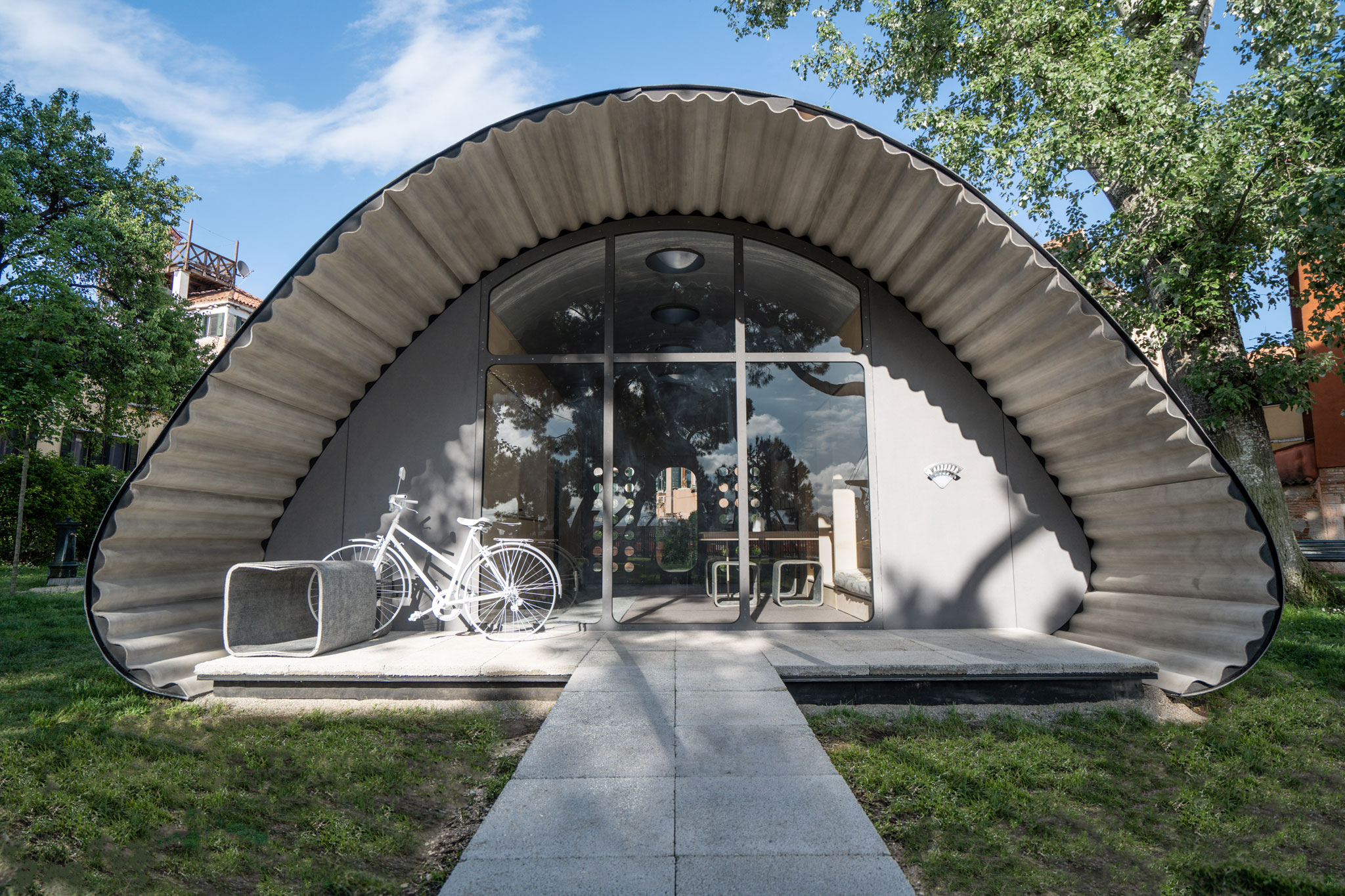
The Norman Foster Foundation has designed a housing prototype to provide an adequate response (providing security, comfort, and well-being) to displaced populations who need housing and who can live for decades in "temporary" settlements. Holcim has brought the project to life with a series of sustainable construction solutions, making it low carbon, energy efficient, and circular, thus demonstrating how emergency sustainable construction can be possible.
 

METALOCUS is live reporting from the Venice Architecture Biennale, which takes place from 20 May to 26 November 2023. See METALOCUS Guide LA BIENNALE DI VENEZIA for all the latest information you need to know to attend and know the best events and pavilions in LA BIENNALE.
A life-size prototype will be on display in the Marinaressa Gardens throughout the Biennale, accompanied by an exhibition at Palazzo Mora explaining the development of the project. Framed in the theme of the Biennale, "Laboratories of the future", this research project focuses on the debate on access to basic housing for all.
“How can we ensure that everyone, including some of the world's most vulnerable populations, can have decent living conditions? During the Venice Biennale we show our starting point around this idea: the result of our collaboration with Holcim.”
Norman Foster, President of the Norman Foster Foundation.


Essential Homes Research Project, by Norman Foster Foundation. Photograph by Chiara Becattini.
 
“I am very excited about the potential impact of this collaboration. It enables the construction of essential housing with circular, energy-efficient, and low-carbon building solutions, demonstrating that sustainable construction can be possible.”
Jan Jenisch, President and CEO of Holcim.


Essential Homes Research Project, by Norman Foster Foundation. Photograph by Chiara Becattini.
 

The Essential Homes research project provides security, comfort, and well-being. Highly sustainable, this prototype has a 70% lower CO2 footprint than traditional structures. This is because it includes a number of sustainable construction solutions from Holcim that make it low-carbon, efficient, and circular. It is composed of:
 
- Roll-up concrete sheets that serve as exterior coating and provide security.
- ECOPact low-carbon concrete pathways that connect homes and include aggregates that absorb light and reflect light at night, reducing energy consumption and light pollution.
- Energy efficient insulation systems, from Elevate boards to low carbon Airium foam, to guarantee thermal and acoustic comfort.
- Driving circular construction, Holcim's ECOCycle® recycled demolition materials are used to make the base of the Essential Home more resistant.
- Circular design, each component of the Essential Homes model can be reused or recycled.
 
The Essential Homes research project opens a fundamental debate on how to make sustainable construction accessible to all, thus guaranteeing the future of people and the planet.

METALOCUS is live reporting from the Venice Architecture Biennale, which takes place from 20 May to 26 November 2023. See METALOCUS Guide LA BIENNALE DI VENEZIA for all the latest information you need to know to attend and know the best events and pavilions in LA BIENNALE.
More information

Label
Architects
+ + copy Created with Sketch.
- + copy Created with Sketch.
Label
Developer
Text

Norman Foster Foundation and Holcim.

+ + copy Created with Sketch.
- + copy Created with Sketch.
Label
Dates
Text

May 20 to November 26, 2023.

+ + copy Created with Sketch.
- + copy Created with Sketch.
Label
Venue / Localitation
Text

-Physical prototype in the Marinaressa Gardens.
- Exhibition in Palazzo Mora.
Venice, Italy.

+ + copy Created with Sketch.
- + copy Created with Sketch.
Label
Photography
Text

Chiara Becattini, Mika Cartier, Pablo Gómez-Ogando.

+ + copy Created with Sketch.
- + copy Created with Sketch.

Norman Robert Foster (Reddish, Greater Manchester, United Kingdom, 1 June 1935) is a British architect, founder of Foster + Partners, and one of the leading figures in contemporary architecture. His career is closely associated with the development of high-tech architecture, structural innovation, and the integration of environmental considerations into buildings and infrastructure.

He studied architecture and urban planning at the University of Manchester, graduating in 1961. He subsequently received a Henry Fellowship to continue his education at Yale University in the United States, where he earned a master's degree in architecture and met Richard Rogers. In 1963, he co-founded Team 4 with Rogers, Su Rogers, Georgie Wolton, and Wendy Cheesman. Following the group's dissolution, he established Foster Associates in London in 1967 with Wendy Cheesman. The practice was later renamed Foster + Partners and is now headquartered in London, with offices worldwide.

His early work explored technological innovation, prefabrication, and spatial flexibility, influenced in part by his collaboration with Richard Buckminster Fuller. Notable early projects include the Willis Faber & Dumas headquarters in Ipswich (1975) and the Sainsbury Centre for Visual Arts in Norwich (1978). His international reputation grew with the Hongkong and Shanghai Banking Corporation headquarters in Hong Kong (1985), Stansted Airport in London (1991), and the Commerzbank Tower in Frankfurt (1997).

His career encompasses architecture, urban planning, and infrastructure projects across numerous countries. Among his best-known works are the reconstruction of the Reichstag in Berlin (1999), the Great Court of the British Museum (2000), the Millennium Bridge (2000), and London City Hall (2002). Other major projects include the Bilbao Metro, Canary Wharf Underground Station, 30 St Mary Axe in London (2004), the Millau Viaduct in France (2004), the Hearst Tower in New York (2006), Terminal 3 at Beijing Capital International Airport (2008), Apple Park in Cupertino (2017), and Bloomberg's European headquarters in London (2017).

Alongside his architectural practice, Foster has pursued research and educational initiatives focused on the future of cities. In 1999, he established the Norman Foster Foundation, whose headquarters opened in Madrid in 2017. The foundation promotes interdisciplinary research in architecture, urbanism, technology, and infrastructure, preserves his professional archive, and develops international educational programmes. In 2024, the Norman Foster Institute began its academic activities, focusing on the study of sustainable cities.

His numerous honours include the Royal Gold Medal from the Royal Institute of British Architects (1983), the Gold Medal from the American Institute of Architects (1994), the Pritzker Architecture Prize (1999), the Praemium Imperiale for Architecture (2002), and the Prince of Asturias Award for the Arts (2009). He was knighted in 1990 and appointed a life peer in 1999, taking the title Lord Foster of Thames Bank.

Read more

Norman Foster Foundation was founded in London in 1999, and headquartered in Madrid since 2017. It promotes interdisciplinary thinking and research to help new generations anticipate the future. Central to its work is Norman Foster’s enduring philosophy that architecture, infrastructure and urbanism directly impact the quality of our lives as new cities are created and existing ones evolve. Since its launch, the Foundation’s educational programmes— comprising workshops, forums and fellowships —have encouraged new thinking and research to help future civic leaders prepare for the challenges they will face, based on data rather than fashion. Those programmes and principles led to the creation of the Norman Foster Institute which launched its first Master’s Course on Sustainable Cities in January 2024.  

The Foundation is also home to the Norman Foster Archive and part of his Library, which provides a window into the larger narrative and history of our built environment through the work of Norman Foster and other prominent architects. The Archive is an open online resource and contributes to exhibitions worldwide. The education programmes and research teams are supported by the Foundation’s in-house architectural team. The work of the Foundation is shared with a wider audience through the books and reports created by the Norman Foster Foundation publications team.  

The Norman Foster Foundation is the recipient of various awards and was recognised as a Centre of Excellence by the United Nations Economic Commission for Europe (UNECE) in 2021. The Foundation is headquartered in Madrid and operates globally.

Read more
Published on: May 18, 2023
Cite:
metalocus, ADELA BONAS
"Essential Homes Research Project by Norman Foster, at Venice Architecture Biennale 2023" METALOCUS. Accessed
<https://www.metalocus.es/en/news/essential-homes-research-project-norman-foster-venice-architecture-biennale-2023> ISSN 1139-6415
Loading content ...
Loading content ...
Loading content ...
Loading content ...
Loading content ...
Loading content ...
Loading content ...
Loading content ...
Loading content ...
Loading content ...
Loading content ...
Loading content ...
Loading content ...
Loading content ...
Loading content ...
Loading content ...
Loading content ...
Loading content ...
Loading content ...
Loading content ...
Loading content ...
Loading content ...
Loading content ...
Loading content ...
Loading content ...
Loading content ...
Loading content ...
Loading content ...
Loading content ...
Loading content ...
Loading content ...
Loading content ...
Loading content ...
Loading content ...
Loading content ...
Loading content ...
Loading content ...
Loading content ...
Loading content ...
Loading content ...
Loading content ...
Loading content ...
Loading content ...
Loading content ...
Loading content ...
Loading content ...
Loading content ...
Loading content ...
Loading content ...
Loading content ...
Loading content ...
Loading content ...
Loading content ...
Loading content ...