Architecture studio Junya Ishigami completed this giant art museum that houses a visitor center, cafes and a chocolate exhibition area. It is located next to the Chaohe River in an artificial lake in Shandong province, China, a region with a strong urbanization process.

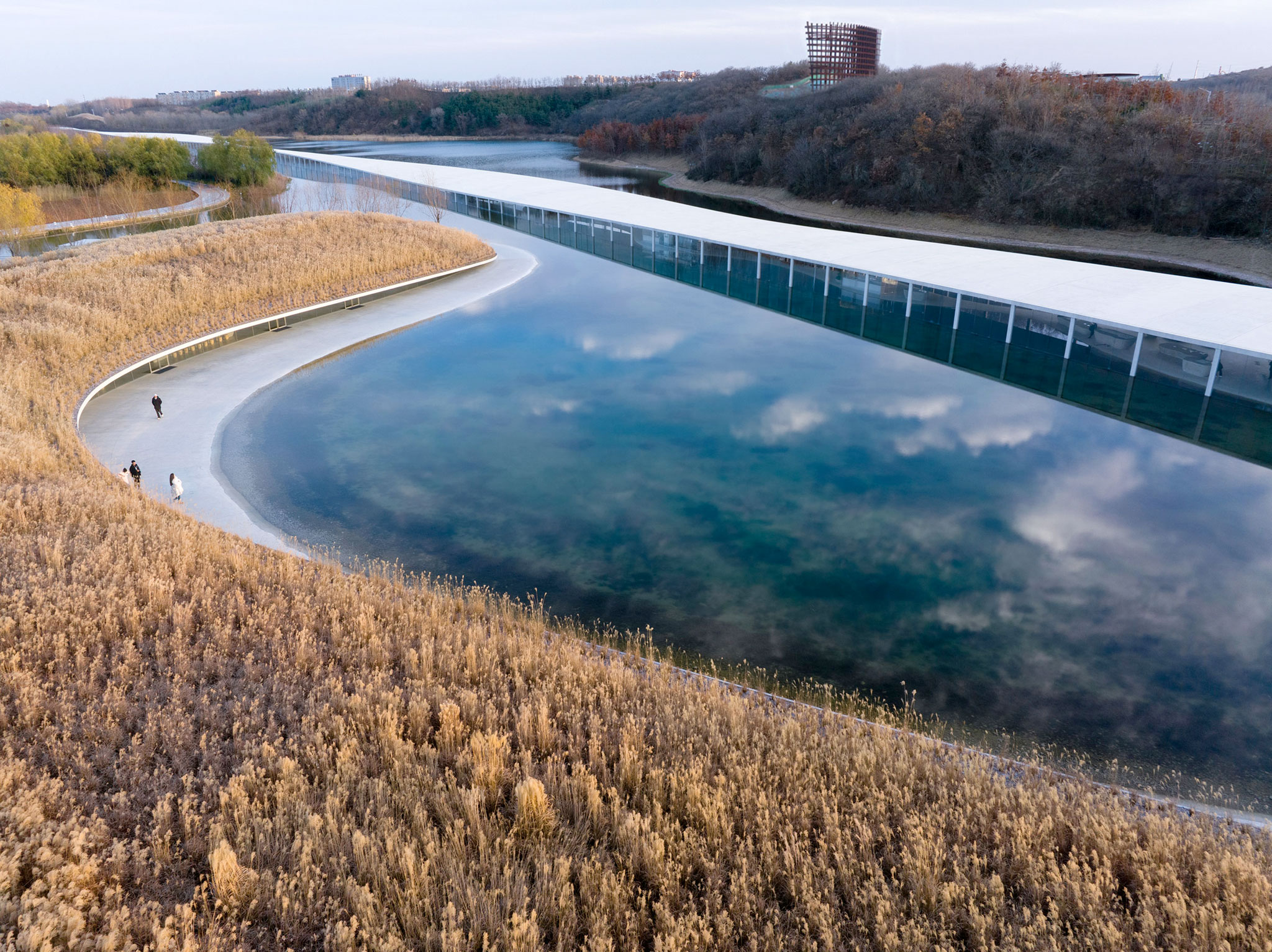
The design interpreted the architecture on a landscape scale for this large project. To reduce the visual impact of the built surface, it was decided to project part of the building crossing an artificial lake and forcing visitors to leave their cars in the parking area, located on the southeast side of the lake, taking a long journey across this lake. -pond to visit the museum.
Zaishui Art Museum designed by Junya Ishigami aims to be more sensitive to the landscape than the neighboring neighborhoods developed through serial blocks without any identity. It is located at the entrance of these housing developments as an illusory mirage of a landscape that visitors will not find when they see the housing blocks.

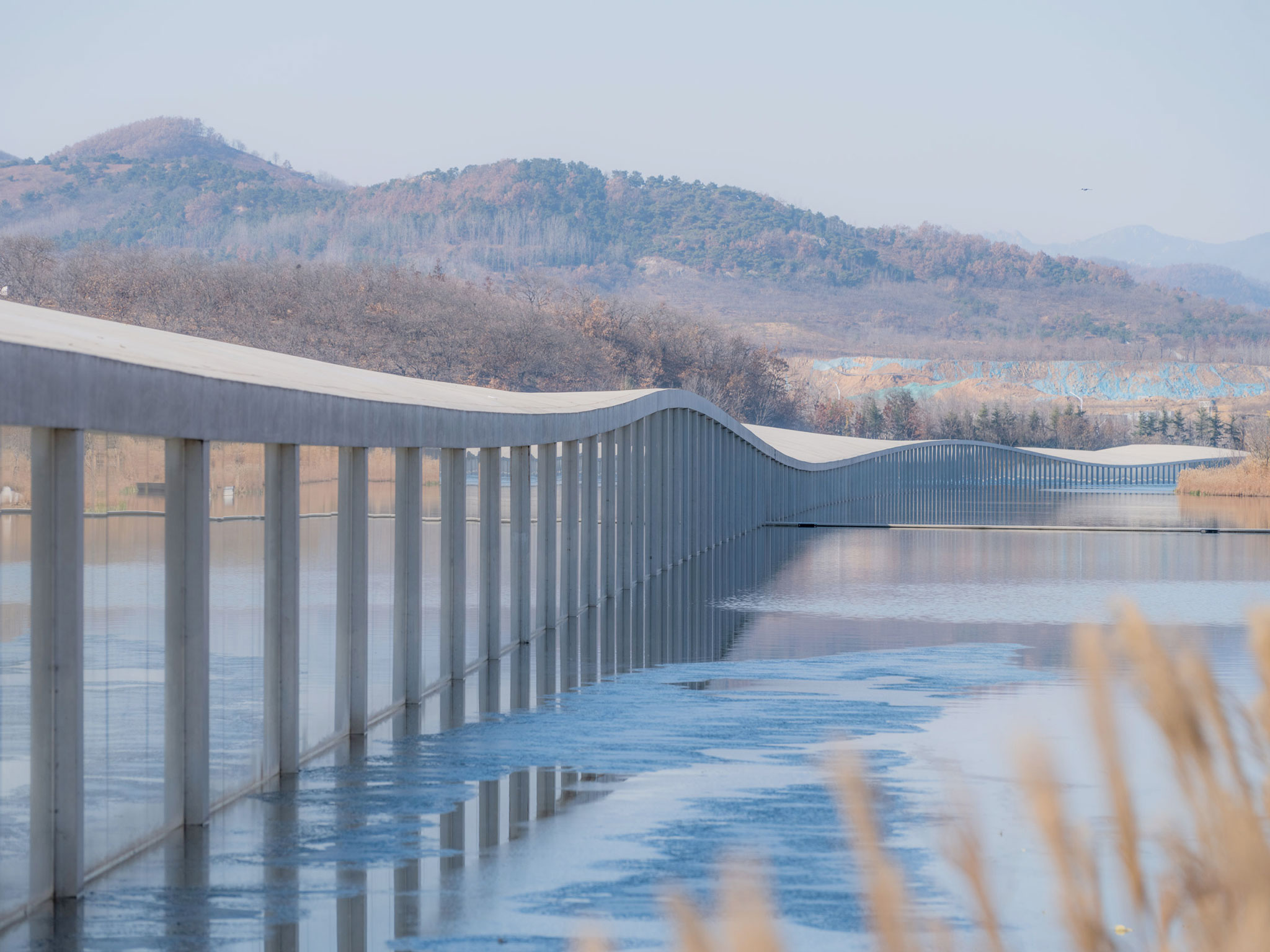
Juna Ishigami raises a structure above the pond, which at times seems to submerge in it, with the aim of creating an "architectural promenade" in this abstract landscape. In its linear development, the building undergoes variations in width and curvature.

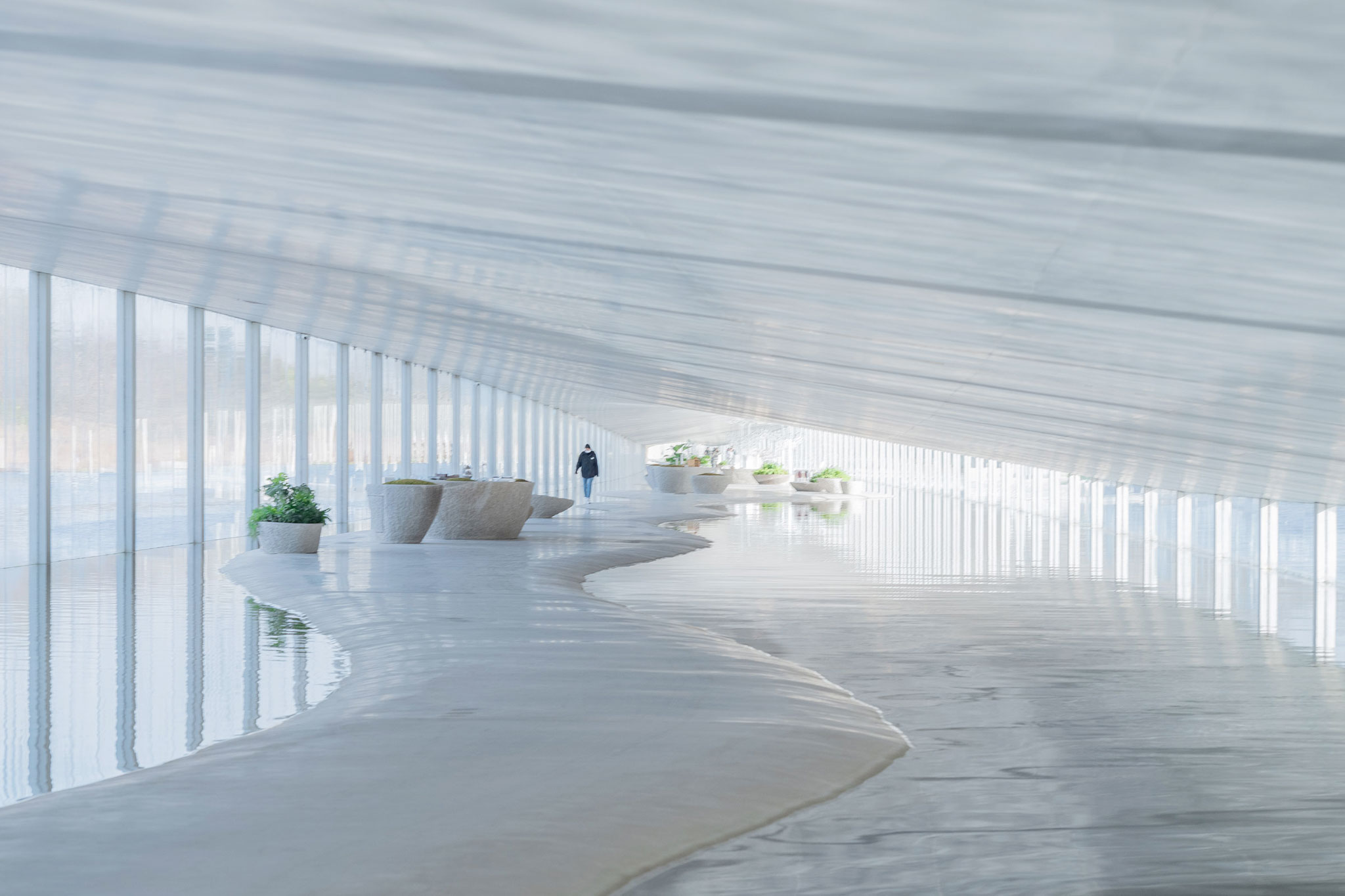
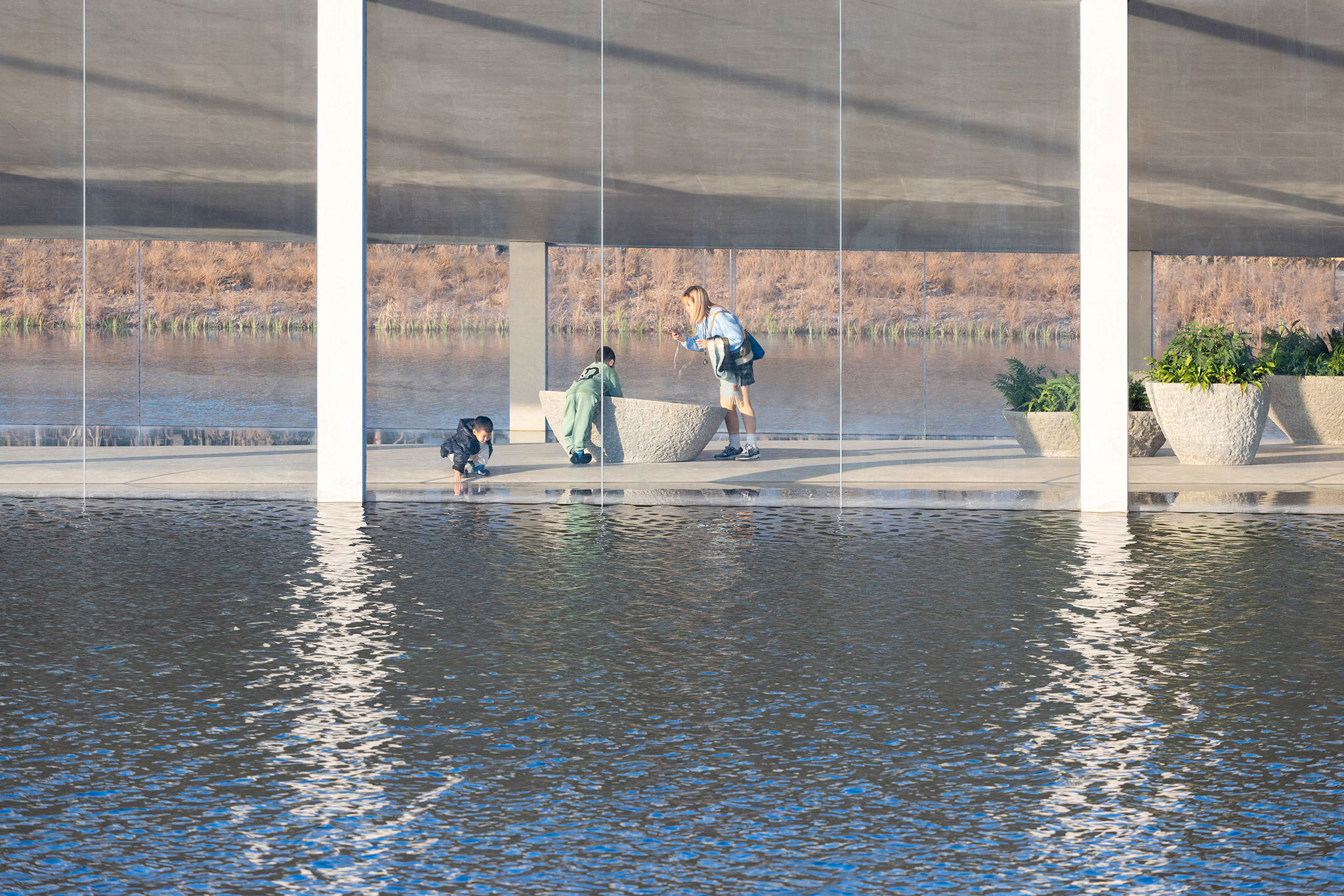
The building is supported by pillars, which seem to emerge from the bottom of the lake, a closed loggia with glass placed between the pillars. A system of openings allows water to enter the interior to generate the sensation of being in a sandbank. The project attempts to generate new external environments created within the architecture by different places and conditions, manifested as landscapes and natural phenomena with different characteristics.


Zaishui Art museum by Junya Ishigami. Photograph by arch-exist.

Zaishui Art museum by Junya Ishigami. Photograph by arch-exist.

Description of project by Junya Ishigami

This project is a large scale, where I endeavored to interpret architecture at the scale of landscape. It is located in Shandong Province, China, in an urbanizing region. Development in China takes place on a massive scale, and this project is no exception. Beside the Chaohe River, there is an artificial lake, and the development zone extends to the southwest of this lake, the site is located at its entrance.

I have designed a facility that integrates a visitor center, cafes, and a display area for chocolate. Visitors will park their cars in the parking area on the southeast side of the lake and cross it to the visit or proceed to the development zone. I had the idea of erecting a structure on top of the lake, intending to create an environment where people pass through this structure to cross the lake and naturally arrive at the development zone. With a length of approximately one kilometer, it will be as long as the distance from one bank of the lake to the other. From place to place, this extremely long roof will curve or vary in width and height, supported by columns rising from the bottom of the lake, with glass fitted between the columns. Apertures at the lower edge of the glass will open the interior to the lake's water. The water will enter and fill the interior, to make the floor emerge like a sandbank.

Zaishui Art museum by Junya Ishigami. Photograph by arch-exist.

Zaishui Art museum by Junya Ishigami. Photograph by arch-exist.


A landscape at the same scale as the exterior scenery will appear inside the building, generating a new external environment inside the architecture. The people will experience the exterior landscape newly manifested in the interior space as if they are strolling along the shoreline, and at the same time, they will be enveloped in a pleasant openness amid the continuity with the existing landscape surrounding the architecture. In winter, the surface of the lake will freeze, but the water beneath the ice connecting to the interior remains liquid. In this project, I recognized new external environments, created inside architecture by different places and conditions, manifest as landscapes and natural phenomena with distinct characteristics.

More information

Label
Architects
Text
junya.ishigami+associates. Lead architects.- Junya Ishigami, Zenan Li.
+ + copy Created with Sketch.
- + copy Created with Sketch.
Label
Project team
Text
Zhirui Lin, Sellua Di Ceglie, Rui Xu, Tong Zhang, Cing Lu, Yuxuan Zhou, Zhixuan Wei, Yunyi Zhang, Hanyang Zhou, Qinxuan Li, Jason Tan, Anping Song, Yichen Ji.
+ + copy Created with Sketch.
- + copy Created with Sketch.
Label
Collaborators
Text
Structure.- XinY structural consultants, Xin Yuan.
MEP.- Environment-friendly solution to Building services Engineering, Xueqin Yin.
Lighting adviser.- Environment-friendly solution to Building services Engineering, Xueqin Yin.
Furniture design.- Junya.ishigami+ associates, Junya Ishigami, Zenan Li, Rui Xu, Yuxuan Zhou, Jason Tan, Anping Song, Yichen Ji.
Supervision.- Junya.ishigami+ associates, Junya Ishigami, Zenan Li, Zhixuan Wei, Rui Xu, Cing Lu, hanyang Zhou, Qinxuan Li, Yunyi Zhang.
Construction (Reinforced concrete part).- Beijing Yihuida Architectural Concrete Engineering Co.,Ltd.
+ + copy Created with Sketch.
- + copy Created with Sketch.
Label
Client
Text
Shandong Bailuwan Co.,Ltd.
+ + copy Created with Sketch.
- + copy Created with Sketch.
Label
Area/Dimensions
Text
Site area.- 18,417 sqm.
Building area.- 15,810 sqm.
Total floor area.- 20,220 sqm.
Floor-area ratio.- 85.8%.
Each floor area.- B1/3,469 sqm, GF/15,810 sqm.
Floor height/ceiling height.- 0-4.5 m.
Maximum eave height/maximum height.- 4.95 m.
+ + copy Created with Sketch.
- + copy Created with Sketch.
Label
Dates
Text
Design period.- December 2016 - July 2019.
Construction period.- August 2019 - December 2023.
+ + copy Created with Sketch.
- + copy Created with Sketch.
Label
Location
Text
Rizhao, Shandong, China.
+ + copy Created with Sketch.
- + copy Created with Sketch.
Label
Photography
+ + copy Created with Sketch.
- + copy Created with Sketch.

Junya Ishigami, was born in Kanagawa Prefecture, Japan, in 1974. He studied at the Musashi Institute of Technology from 1994 to 1998 and subsequently completed his education at the Tokyo National University of Fine Arts and Music, where he studied between 1998 and 2000. After graduating, he worked for Kazuyo Sejima + Associates (SANAA) from 2000 to 2004. That same year, he founded his own architectural practice, Junya Ishigami + Associates.

Throughout his career, Ishigami has questioned conventional understandings of architecture. His approach allows him to work beyond prevailing trends, established principles and traditional definitions, creating new structures and spaces and proposing alternative ways of organizing the environment. Through his projects, he seeks to radically transform the lifestyles associated with modern architecture and enrich them with new values.

His early projects include Table, created in Tokyo in 2005, and T Project, which received first prize in a residential architecture competition sponsored by the Tokyo Electric Power Company that same year. These were followed by Balloon in Tokyo in 2007, the Kanagawa Institute of Technology KAIT Workshop in Kanagawa in 2008, and the Yohji Yamamoto Gansevoort Street Store in New York in 2008. Other significant works include the Japanese Pavilion for the 11th Venice Architecture Biennale in 2008, Art Biotop Water Garden in Tochigi in 2018, the Serpentine Pavilion in London in 2019, KAIT Plaza in Kanagawa in 2020, House & Restaurant in Ube in 2022 and the Zaishui Art Museum in Rizhao, China, completed in 2023.

Ishigami’s work has received considerable international recognition. In 2004, Low Chair and Round Table were acquired by the Centre Pompidou. In 2005, he received the SD Prize for Small Garden of a Row House, the Kirin Prize for Table and first prize in the residential architecture competition for T Project. In 2006, Table was presented by Gallery Koyanagi at Art Basel and was later acquired by the Israel Museum. He subsequently received the Architectural Institute of Japan Prize for KAIT Workshop in 2009, the Golden Lion for Best Project at the 12th Venice Architecture Biennale in 2010, the OBEL Award for Art Biotop Water Garden in 2019 and the Frederick Kiesler Prize for Architecture and the Arts in 2024.

Read more
Published on: February 1, 2024
Cite:
metalocus, JORGE MARTINEZ
"Illusory and gigantic relationship with nature. Zaishui Art museum by Junya Ishigami" METALOCUS. Accessed
<https://www.metalocus.es/en/news/illusory-and-gigantic-relationship-nature-zaishui-art-museum-junya-ishigami> ISSN 1139-6415
Loading content ...
Loading content ...
Loading content ...
Loading content ...
Loading content ...
Loading content ...
Loading content ...
Loading content ...
Loading content ...
Loading content ...
Loading content ...
Loading content ...
Loading content ...
Loading content ...
Loading content ...
Loading content ...
Loading content ...
Loading content ...
Loading content ...
Loading content ...
Loading content ...
Loading content ...
Loading content ...
Loading content ...
Loading content ...
Loading content ...
Loading content ...
Loading content ...
Loading content ...
Loading content ...
Loading content ...
Loading content ...
Loading content ...
Loading content ...
Loading content ...
Loading content ...
Loading content ...
Loading content ...
Loading content ...
Loading content ...
Loading content ...
Loading content ...
Loading content ...
Loading content ...
Loading content ...
Loading content ...
Loading content ...
Loading content ...
Loading content ...
Loading content ...
Loading content ...
Loading content ...
Loading content ...
Loading content ...