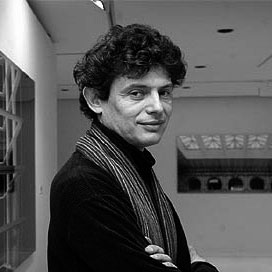
José Manuel Ballester aims to reflect and make the viewer of his work reflect on the consequences of events that loom over humanity, such as wars or pandemics.
The technique used by the artist is something that he has been developing for several years, such as in the series Hidden Spaces, in which he reinterprets relevant paintings in the history of art by casting them.
The technique used by the artist is something that he has been developing for several years, such as in the series Hidden Spaces, in which he reinterprets relevant paintings in the history of art by casting them.
"I think people talk too much; that's the truth of the matter. I don't believe in words. People use too many words and usually wrongly. I am sure that in the distant future people will talk much less and in a more essential way."
Michelangelo Antonioni, 1969.
The dialogue that takes place between this new interpretation of Guernica and the images of Bilbao converges on an empty stage, which gives way to the spectator's imagination.
“The human absence on the street created unusual images of empty roads, avenues, and squares, but the most disturbing thing was knowing that all the inhabitants were there, that they were a few meters from me, protected between the walls of their houses. Despite being so close, the silence was imposed.”
José Manuel Ballester.
Around the Guernica it has the same size as the original work, for the process of emptying the characters in the space, a digital treatment process has been carried out.
"The signs of the inhuman and the flames of the fire that is still active remain present, like the flower that sprouts from the sword."
José Manuel Ballester.
This artistic experience can be complemented with a digital project accessible from the Museum's website. Similarly, if you want to know more about the production process of both the Bilbao photographs and the Guernica project, a book has been published that includes comments by Carlos del Amor.
A collaborative project
After the pandemic, the Museum has been affected like most leisure places or companies, which has made it very difficult to carry out new initiatives. For this reason, the collaboration of three companies that have helped to make this exhibition go forward should be named.
Estudios Durero, which has been in charge of the production of the photographic reproductions and the publication of the aforementioned book of the same name. Giroa-Veolia has carried out both the installation and the lighting of the works. Finally, LIN3S has developed the digital experience that shows the works in the room but also relates it to other works by the artist, something is done in an unprecedented way at the Museum.