Marco Kogan's architecture firm, Studio MK27, has designed the project for Casa Lima, their first work in Lima, Peru. The design of the house consists of the superposition of three volumes, visible from the outside. Inside, a similar premise is followed to configure and divide the space into programmatic spaces, using panels and doors as compartmentalizing elements.

The plot where the project is developed has dimensions of 16m wide and 30m deep, which is why one of the premises was the relationship of the project with the layout and size of the plot, and its occupation coefficient. The result is a "meta box" project with a playful perspective on space.
The 1,000 m² project developed by Studio MK27 blurs the boundaries between exterior and interior, thanks to its formal composition and use of space, to guarantee the full development of the program. Likewise, the use of local materials such as wood, stone, and concrete makes it possible to generate a cozy and comfortable space.

The program is organized on the ground floor with common spaces and a kitchen. On the second, level the main room and complementary spaces to it. On the third floor, the rooms for children, guests, and a terrace. The house has a basement with a garage, gym, and pool.
 

Description of project by Studio MK27

Lima House is studio MK27’s first project in Lima, Peru.  Located on an urban site, measuring 16m width by 30m depth, the main idea was to first create the sensation for the clients of living in a townhouse, taking into consideration all the possibilities that we had relative to the arrangement and size of the plot, and its occupancy coefficient.

The solution was to create 3 overlapping boxes. A similar resource was also used on the interiors which are divided into programmatic boxes, with wooden panels and doors that exercise the function of separation elements. The house is therefore composed of three external boxes, placed one on top of another, and internal boxes that resolve the program. It is a ludic perspective of the space, a “metabox” project. 

The external boxes are made of slatted exposed concrete, with the front and back façades clad in different materials and acting as side covers. These materials form uniform skins that hide the openings. Despite the concrete structure which is necessarily robust, due to the great incidence of earthquakes in this region, the creation of cantilevers gives the structure a lighter feeling.

The first volume (ground floor) houses the social areas, comprised of a terrace and the kitchen. On the second floor, there is the master bedroom with its own living room, walk-in closet and a terrace. The third floor is dedicated to the children. There are two en-suites, a living room, a guest bedroom and bathroom and a terrace with a wall of cobogós (hollow bricks). This cobogó façade guarantees visual protection while also permitting the entrance of natural light and cross-ventilation. There is also a rooftop and a “semi-underground” with a garage, utility area, gym and pool, which can be appreciated through a glass strip on the garden in the ground floor, next to the main living room. 
    
The palette of materials is quite small: wood, stone, concrete and aluminium. The wood is of Brazilian origin, given its resistance to the weather. The stone (Basalt) and marble (Travertine) are local.   
 
The greatest challenge of this project was filling the space with the necessary density while simultaneously guaranteeing that the quality external spaces could be used, diluting the limits between external and internal.

Read more
Read less

More information

Label
Architects
+ + copy Created with Sketch.
- + copy Created with Sketch.
Label
Project team
Text
Carlos Costa, Eduardo Gurian, Gabriela Gurgel, Mariana Simas, Renato Périgo.
+ + copy Created with Sketch.
- + copy Created with Sketch.
Label
Collaborators
Text
Architect.- Marcio Kogan. Co-architect.- Samanta Cafardo, Elisa Friedmann. Interior design.- Diana Radomysler. Co-interior architect.- Mariana Ruzante. Local Architect.- Jorge Baertl. Landscape Designer.- Rosie Benavides. Structure Engineer.- GCAQ. Electrical.- JALE ingenieros. Plumbing.- Efreyre instalaciones. Air conditioning. Integ.
+ + copy Created with Sketch.
- + copy Created with Sketch.
Label
Builder
Text
CG277.
+ + copy Created with Sketch.
- + copy Created with Sketch.
Label
Area
Text
Site area.- 500 sqm. Built area.- 1,000 sqm.
+ + copy Created with Sketch.
- + copy Created with Sketch.
Label
Dates
Text
Project.- October 2013. Completion.- July 2018.
+ + copy Created with Sketch.
- + copy Created with Sketch.
Label
Manufacturers
Text
Vitrocsa.- Window frames. Plancus.- doors, panels e façades. Valcucine.- kitchen. Erwin Hauer Studio.- Hollowed wall module. Plancus e arquitecma peru.- Internal furniture.
+ + copy Created with Sketch.
- + copy Created with Sketch.
Label
Location
Text
Lima, Peru.
+ + copy Created with Sketch.
- + copy Created with Sketch.
Label
Photography
+ + copy Created with Sketch.
- + copy Created with Sketch.

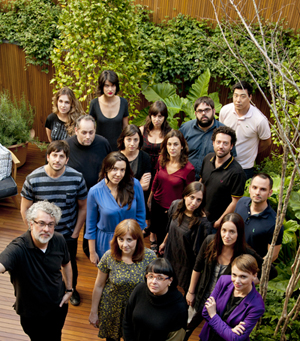
Studio MK27, located in the chaotic city of São Paulo, was founded in the late 70’s by architect Marcio Kogan (b. 6 de marzo de 1952) and today comprises 56 members and various collaborators worldwide.

Kogan is an honorary member of the AIA (American Institute of Architecture), Professor at Politecnico di Milano and on the board of the Museum of Art of São Paulo (MASP) and the Brazilian Museum of Sculpture and Ecology (MUBE). He was considered by Época magazine as one of the 100 Most Influential persons in Brazil, is part of “Wallpaper’s 150 Famous for 15 Years”, and came in 39th in Dezeen’s Hot List 2017. He leads a team of architects who, for the most part, have been working with him for over a decade.

The team, coordinated by four directors, constitutes three main squads. Diana Radomysler, Marcio’s partner since the 90s, is the author of the interior design projects and coordinates its team. Partners since the beginning of the 2000s, Renata Furlanetto and Suzana Glogowski direct the architecture team and sign most of the designs. The architect Mariana Simas, partner since 2008, is the executive director leading the new projects, human resources, finance and communications teams.

The architects of the team, great admirers of the Brazilian modernism generation, seek to fulfil the task of rethinking and giving continuity to this iconic architectural movement. The projects of Studio MK27 place value on formal simplicity and are elaborated with extreme care and attention to detail.

Since 2001, when he started a co-creation and cooperative work system at the office, studio mk27 has won more than 250 national and international awards, such as: IAB (Institute of Brazilian Architects), São Paulo Architectural Biennial, WAF, Architectural Review, Dedalo Minosse, Record House, Leaf, D&AD, Spark, Barbara Cappochin, Iconic, AZ, Buenos Aires Ibero-american Architectural Biennial, Wallpaper Design Award and Prix Versailles. MK27 represented Brazil at the Venice Biennale of 2012.

Kogan and the directors have lectured and workshopped at the Royal Academy of Arts, AIA, Société Française des Architectes, Clubovka, FAUUSP, Mackenzie, FAAP, Politecnico di Milano, Mantova, Porto Academy, Verona, Valencia, South Florida, Rice, Texas, Cornell and Yale universities, among others.

Read more
Published on: September 9, 2020
Cite:
metalocus, VALERIA OZUNA
"Playful perspective of space, a metabox project. Lima house by Studio MK27" METALOCUS. Accessed
<https://www.metalocus.es/en/news/playful-perspective-space-a-metabox-project-lima-house-studio-mk27> ISSN 1139-6415
Loading content ...
Loading content ...
Loading content ...
Loading content ...
Loading content ...
Loading content ...
Loading content ...
Loading content ...
Loading content ...
Loading content ...
Loading content ...
Loading content ...
Loading content ...
Loading content ...
Loading content ...
Loading content ...
Loading content ...
Loading content ...
Loading content ...
Loading content ...
Loading content ...
Loading content ...
Loading content ...
Loading content ...
Loading content ...
Loading content ...
Loading content ...
Loading content ...
Loading content ...
Loading content ...
Loading content ...
Loading content ...
Loading content ...
Loading content ...
Loading content ...
Loading content ...
Loading content ...
Loading content ...
Loading content ...
Loading content ...
Loading content ...
Loading content ...
Loading content ...
Loading content ...
Loading content ...
Loading content ...
Loading content ...
Loading content ...
Loading content ...
Loading content ...
Loading content ...
Loading content ...
Loading content ...
Loading content ...