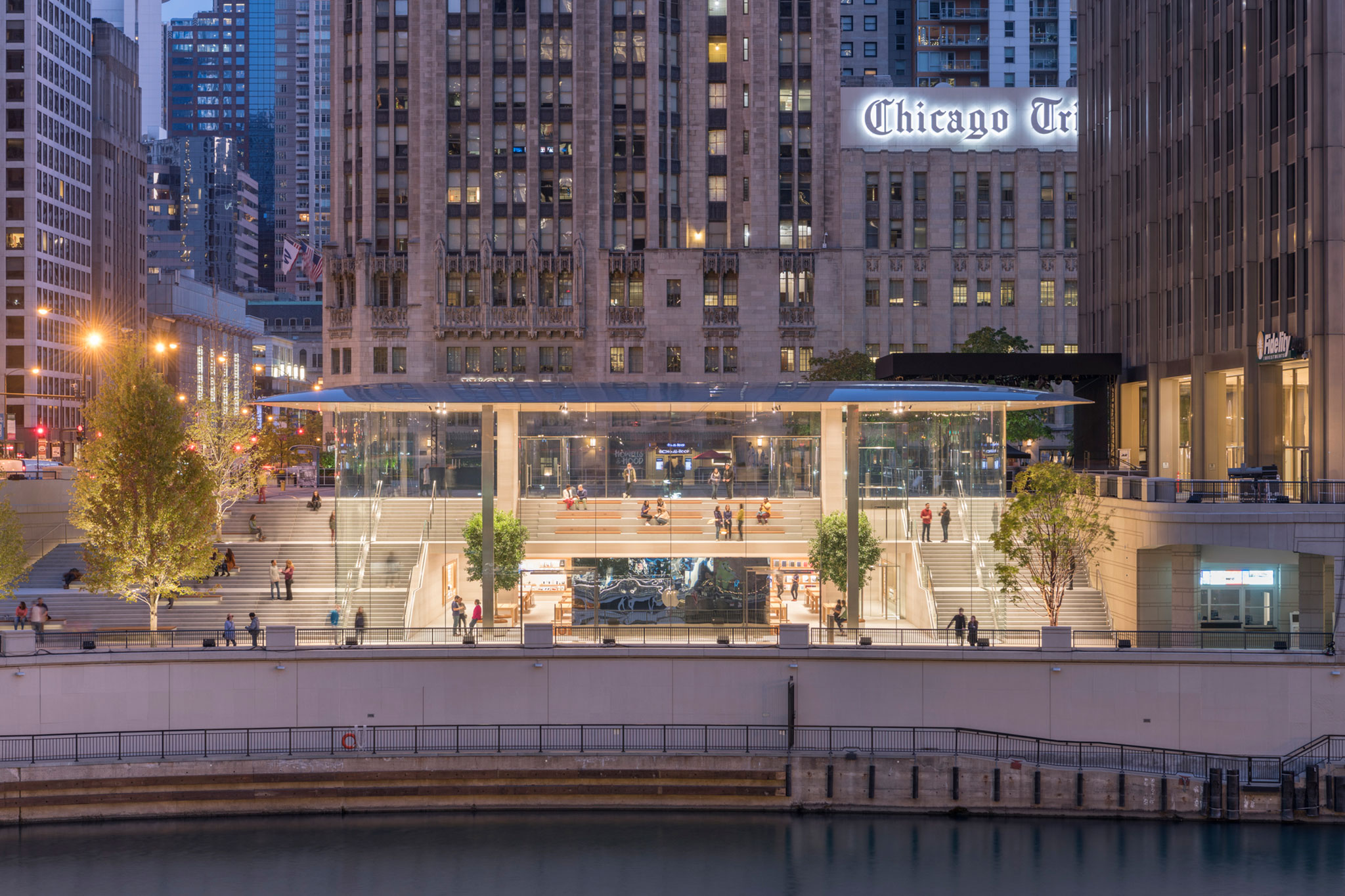
Foster + Partners has designed a new Apple Store for Chicago, an "ambitious design" with huge glass walls and a slender roof.
The Apple Michigan Avenue store is located on the city's river edge beside the North Michigan Avenue, an area also known as the Magnificent Mile, and in front of the higher-level Pioneer Court, a public plaza.

Foster + Partners designed  a pavilion that looks like a scaled-up version of the company's laptop computer. The project placed a pair of granite staircases either side of the store to create a new pathway from the plaza to the river esplanade, while the huge glass walls rise, of approximately 10 metres, to maintain views of urban south side of river.

Notes by Foster+Partners.-

• The store features an extremely thin Carbon Fiber Reinforced Polymer (CFRP) roof profile (3’-4” max depth over 110’-8” span)
• 10’ to 17’ long roof overhang on all four sides for solar protection and open views
• Brushed stainless steel structural columns (no joints or seams)
• 4 layers of ½” thick laminated ultra-low-iron glass façade

Description of project by Foster+Partners

Inspired by the pulse of Chicago’s artistic energy, Apple has created a new platform for performance in a city charged by music. Located at the intersection of the Chicago River and North Michigan Avenue’s ‘Magnificent Mile’, Apple Michigan Avenue cascades down from Pioneer Court to the river’s edge, creating new connections between the city and the river.

The project reflects Apple’s commitment to the cities and communities it inhabits, and is the result of a close collaboration between the design team at Apple led by chief design officer, Sir Jonathan Ive and Angela Ahrendts, senior vice president of Retail and Online Stores and Foster + Partners.
 

Sir Jonathan Ive said, “Apple Michigan Avenue is about removing boundaries between inside and outside, reviving important urban connections within the city. It unites a historic city plaza that had been cut off from the water, giving Chicago a dynamic new arena that flows effortlessly down to the river.”


Pioneer Court is an urban plaza steeped in Chicago history. It is the spot where Point de Sable – the founding father of Chicago – first lived and worked. Apple Michigan Avenue sits atop a wide new public stair, created to lead down from the plaza to the river. The gentle descent of levels creates active spaces where people can connect, create, and experience the city and river together.

The stairway transitions seamlessly between the outside and inside. It passes through the building’s walls – dematerialized to pure glass – and connects to the store’s buzzing center, sheltered by an impossibly thin carbon fiber roof, supported on slender stainless-steel columns. As the interior steps down to the river, it acts as a seating space around the Forum – the hub of Today at Apple and a live source of creativity, education and entertainment.

More information

Label
Architects
Text
Foster + Partners
+ + copy Created with Sketch.
- + copy Created with Sketch.
Label
Area
Text
20,000.0 m²
+ + copy Created with Sketch.
- + copy Created with Sketch.
Label
Venue
Text
401 Michigan Avenue, Chicago, IL, United States
+ + copy Created with Sketch.
- + copy Created with Sketch.
Label
Dates
Text
Project Year.- 2017
+ + copy Created with Sketch.
- + copy Created with Sketch.

Norman Robert Foster (Reddish, Greater Manchester, United Kingdom, 1 June 1935) is a British architect, founder of Foster + Partners, and one of the leading figures in contemporary architecture. His career is closely associated with the development of high-tech architecture, structural innovation, and the integration of environmental considerations into buildings and infrastructure.

He studied architecture and urban planning at the University of Manchester, graduating in 1961. He subsequently received a Henry Fellowship to continue his education at Yale University in the United States, where he earned a master's degree in architecture and met Richard Rogers. In 1963, he co-founded Team 4 with Rogers, Su Rogers, Georgie Wolton, and Wendy Cheesman. Following the group's dissolution, he established Foster Associates in London in 1967 with Wendy Cheesman. The practice was later renamed Foster + Partners and is now headquartered in London, with offices worldwide.

His early work explored technological innovation, prefabrication, and spatial flexibility, influenced in part by his collaboration with Richard Buckminster Fuller. Notable early projects include the Willis Faber & Dumas headquarters in Ipswich (1975) and the Sainsbury Centre for Visual Arts in Norwich (1978). His international reputation grew with the Hongkong and Shanghai Banking Corporation headquarters in Hong Kong (1985), Stansted Airport in London (1991), and the Commerzbank Tower in Frankfurt (1997).

His career encompasses architecture, urban planning, and infrastructure projects across numerous countries. Among his best-known works are the reconstruction of the Reichstag in Berlin (1999), the Great Court of the British Museum (2000), the Millennium Bridge (2000), and London City Hall (2002). Other major projects include the Bilbao Metro, Canary Wharf Underground Station, 30 St Mary Axe in London (2004), the Millau Viaduct in France (2004), the Hearst Tower in New York (2006), Terminal 3 at Beijing Capital International Airport (2008), Apple Park in Cupertino (2017), and Bloomberg's European headquarters in London (2017).

Alongside his architectural practice, Foster has pursued research and educational initiatives focused on the future of cities. In 1999, he established the Norman Foster Foundation, whose headquarters opened in Madrid in 2017. The foundation promotes interdisciplinary research in architecture, urbanism, technology, and infrastructure, preserves his professional archive, and develops international educational programmes. In 2024, the Norman Foster Institute began its academic activities, focusing on the study of sustainable cities.

His numerous honours include the Royal Gold Medal from the Royal Institute of British Architects (1983), the Gold Medal from the American Institute of Architects (1994), the Pritzker Architecture Prize (1999), the Praemium Imperiale for Architecture (2002), and the Prince of Asturias Award for the Arts (2009). He was knighted in 1990 and appointed a life peer in 1999, taking the title Lord Foster of Thames Bank.

Read more
Published on: October 27, 2017
Cite:
metalocus, ÁNGEL BLANCO
"Reconnecting Chicago to its river. Apple Store Michigan Avenue, Chicago by Foster + Partners " METALOCUS. Accessed
<https://www.metalocus.es/en/news/reconnecting-chicago-its-river-apple-store-michigan-avenue-chicago-foster-partners> ISSN 1139-6415
Loading content ...
Loading content ...
Loading content ...
Loading content ...
Loading content ...
Loading content ...
Loading content ...
Loading content ...
Loading content ...
Loading content ...
Loading content ...
Loading content ...
Loading content ...
Loading content ...
Loading content ...
Loading content ...
Loading content ...
Loading content ...
Loading content ...
Loading content ...
Loading content ...
Loading content ...
Loading content ...
Loading content ...
Loading content ...
Loading content ...
Loading content ...
Loading content ...
Loading content ...
Loading content ...
Loading content ...
Loading content ...
Loading content ...
Loading content ...
Loading content ...
Loading content ...
Loading content ...
Loading content ...
Loading content ...
Loading content ...
Loading content ...
Loading content ...
Loading content ...
Loading content ...
Loading content ...
Loading content ...
Loading content ...
Loading content ...
Loading content ...
Loading content ...
Loading content ...
Loading content ...
Loading content ...
Loading content ...