Richard Meier & Partners has completed its first international residential tower and its first project in Israel. The new Rothschild Tower is inspired by the scale and Bauhaus design principles of its neighbors in Tel Aviv’s White City.

The building’s image of lightness and transparency is the result of a double layer façade comprised of clear glass with a delicate white louver screen inspired by traditional Middle Eastern clothing and prominent corner balconies derived from the low to mid-rise neighboring buildings. A large “urban window” frames the western views to the sea from the Penthouse terraces.
The new residential tower, designed by Richard Meier & Partners is anchored to Rothschild Boulevard in the heart of Tel Aviv’s White City, a UNESCO World Heritage Site.

The neighborhood is filled with thousands of Bauhaus buildings designed by German Jewish architects who began immigrating to Israel before WWII. The city holds the world’s largest concentration of Bauhaus buildings, 4,000 in total, dating mostly from 1931 to 1956, but also encompassing subsequent designs that were built as a tribute to the style.
 

Description of project by Richard Meier & Partners

Rothschild Tower is a simple graceful residential tower lightly resting on a retail base. The design is inspired by Bauhaus principles that were based on functionality and a certain sparseness or economy of means using modern mass produced materials, and in this case a repetitive planning module. The fundamental considerations that shape the tower design are the quality of light in the plan, views to the city and sea, an efficient assembly of “served” and “service” spaces around the core, and the building’s relationship with the existing fabric and massing on Rothschild Boulevard.

Reynolds Logan, design partner-in-charge, comments: “The tower and all its contents are designed to recognize a role as a citizen to the city, with gestures to different scales at the base, shaft, and top of the building. The tower is deliberately lifted above the street on graceful piloti, with an undulating glass wall in deference to the importance of this important intersection of Rothschild and Allenby. The transparency and lofty openness of the ground floor lobby, garden, and retail spaces contribute to a vibrant streetscape."

Lightness and transparency of the tower and base are the primary goals, not only to reduce the apparent scale and mass in the context of the low to mid-rise neighborhood, or the scale-less reflective towers in the area, but to express the optimism, openness, and energy of the more secular modern character of Tel Aviv. The delicate louver screen is an elegant white “veil,” inspired by the ventilated protective layers of more traditional Middle Eastern clothing. It both defines and obscures the distinction between the public image of the building and the private realm within. The louver elements of the screen protect the delicate clear glass skin, and have local architectural precedents in the ubiquitous “treeseem”, the sliding louver blinds enclosing open air porches or negative spaces so common in the existing neighborhood Bauhaus buildings.

“Transparency and the related accessibility and connection issues merit respect for the circumstances of each project, especially in dense urban environments. We well recognize the paradoxical nature of balancing those issues, and at the Rothschild Tower the delicate louver screen is an elegant white veil inspired by the ventilated protective layers of more traditional Middle Eastern clothing. It is also a “buffer” of sorts, and obscures the distinction between the public image of the building and the private realm within,” states Mr. Logan.

The Lobby and Retail spaces are spare, lofty, and open to the surrounding streets and neighborhood. Behind the tower a former through-block retail arcade is being restored to its former glory to firmly embed the building and its residents in the pulse of the neighborhood.

At the larger scale of the city, the lightness and transparency of the tower will distinguish it dramatically among the glass and heavy neighboring towers, and perhaps inspire sustainable approaches to a more “accessible” character for large buildings in this climate in the future.

Read more
Read less

More information

Label
Architects
Text
Richard Meier & Partners. Design Principals.- Richard Meier, Reynolds Logan
+ + copy Created with Sketch.
- + copy Created with Sketch.
Label
Project Architects
Text
Thibaut Degryse, Ananth R. Sampathkumar
+ + copy Created with Sketch.
- + copy Created with Sketch.
Label
Collaborators
Text
Gil Even-Tsur, John Jourden
+ + copy Created with Sketch.
- + copy Created with Sketch.
Label
Dates
Text
Project Year.- 2016
+ + copy Created with Sketch.
- + copy Created with Sketch.
Label
Location
Text
Rothschild Blvd 36, Tel Aviv-Yafo, Israel
+ + copy Created with Sketch.
- + copy Created with Sketch.
Label
Owner
Text
Berggruen Residential ltd.

+ + copy Created with Sketch.
- + copy Created with Sketch.
Label
Associate Architects
Text
BLK Architects and Town Planners
+ + copy Created with Sketch.
- + copy Created with Sketch.
Label
Measures
Text
Floors.-42 floors above ground. Number of Units.- 147 apartments. Ground Footprint.- 2470 m² (26,586 sqft).
 Net Floor Area (Typical floor).- 750 m² (8,072 sqft). Height of Building.- 154m (505 ft)
+ + copy Created with Sketch.
- + copy Created with Sketch.

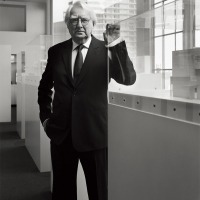
Richard Meier (Newark, New Jersey, United States, 12 October 1934) is an American architect. He graduated with a Bachelor of Architecture from Cornell University in 1957. He began his professional career in New York, working at Davis, Brody & Wisniewski, Skidmore, Owings & Merrill (SOM), and Marcel Breuer's office between 1959 and 1963. In 1963, he established his own architectural practice in New York.

During the 1960s, Meier became associated with the New York Five, a group of architects that also included Peter Eisenman, Michael Graves, Charles Gwathmey and John Hejduk. Their work was presented in the 1972 publication Five Architects. His early residential projects include the Smith House in Darien, Connecticut (1967), and the Douglas House in Harbor Springs, Michigan (1973).

During the 1970s and 1980s, his practice expanded to public, institutional and cultural buildings. Projects from this period include the Twin Parks Northeast housing complex in the Bronx, New York (1974), the Bronx Developmental Center (1977), the Atheneum in New Harmony, Indiana (1979), the High Museum of Art in Atlanta (1983), and the Museum of Decorative Arts in Frankfurt, Germany (1985).

In 1984, Meier received the Pritzker Architecture Prize, becoming its youngest recipient at the age of 49. That same year, he was selected to undertake the Getty Center in Los Angeles, completed in 1997. His subsequent projects include the Canal+ Television Headquarters in Paris (1992), the Barcelona Museum of Contemporary Art (MACBA, 1995), The Hague City Hall and Central Library in the Netherlands (1995), and the Jubilee Church in Rome (2003). Later works include the Ara Pacis Museum in Rome (2006), the Arp Museum in Remagen, Germany (2007), and San Jose City Hall in California (2005).

His architectural awards include the Royal Gold Medal from the Royal Institute of British Architects (1988), the Deutscher Architekturpreis (1993), the AIA Gold Medal from the American Institute of Architects (1997), and the Praemium Imperiale for Architecture from the Japan Art Association (1997). In 1992, he was appointed an Officer of the French Order of Arts and Letters, and in 1995 he was elected to the American Academy of Arts and Sciences.

Alongside his professional practice, Meier taught and lectured at several universities, including Cooper Union, Princeton University, Pratt Institute, Harvard University, Yale University and the University of California, Los Angeles (UCLA). In 2000, Cornell University appointed him Frank H. T. Rhodes Class of 1956 Professor, a position he held until 2005. He has also received honorary degrees from several academic institutions and is a member of the American Academy of Arts and Letters.

In June 2021, Richard Meier retired from the architectural practice he had founded in 1963. The firm, previously known as Richard Meier & Partners Architects, was reorganised under the name Meier Partners, with Dukho Yeon and George H. Miller assuming leadership roles.

Read more
Published on: September 21, 2017
Cite:
metalocus, ÁNGEL BLANCO
"Rothschild Tower in Tel Aviv by Richard Meier & Partners " METALOCUS. Accessed
<https://www.metalocus.es/en/news/rothschild-tower-tel-aviv-richard-meier-partners> ISSN 1139-6415
Loading content ...
Loading content ...
Loading content ...
Loading content ...
Loading content ...
Loading content ...
Loading content ...
Loading content ...
Loading content ...
Loading content ...
Loading content ...
Loading content ...
Loading content ...
Loading content ...
Loading content ...
Loading content ...
Loading content ...
Loading content ...
Loading content ...
Loading content ...
Loading content ...
Loading content ...
Loading content ...
Loading content ...
Loading content ...
Loading content ...
Loading content ...
Loading content ...
Loading content ...
Loading content ...
Loading content ...
Loading content ...
Loading content ...
Loading content ...
Loading content ...
Loading content ...
Loading content ...
Loading content ...
Loading content ...
Loading content ...
Loading content ...
Loading content ...
Loading content ...
Loading content ...
Loading content ...
Loading content ...
Loading content ...
Loading content ...
Loading content ...
Loading content ...
Loading content ...
Loading content ...
Loading content ...
Loading content ...