Snøhetta has won the competition for the new cable car stations in the German city of Koblenz, located in the Upper Middle Rhine Valley, a UNESCO World Heritage Site, with a proposal that is sensitive to the context and whose respectful expressiveness blends into the surroundings like a sculpture that unites the valley and the mountain.

The valley station pays homage in its form to the Basilica of St. Castor, next to which it is located, reinterpreting both its architectural heritage and that of the city, through a sober and elegant appearance that blends into the urban and natural landscape.

Since 2011, a cable car has connected the city centre of Koblenz with Ehrenbreitstein Fortress on the other side of the Rhine. Originally planned as a temporary structure for the Federal Horticultural Show, the intention has since become to operate the popular, environmentally friendly means of transport on a permanent basis. The location in a sensitive historical context and technical requirements made a redesign of the stations necessary. In the architectural competition organised by the cable car operator, Snøhetta won with the proposal of sculptural forms for the valley and mountain stations, which form a “cohesive pair” and react sensitively to the respective context.

The expressive stations blend respectfully into the historical context as contemporary statements. “The design shows restraint within the World Heritage Site without losing any of its architectural significance,” the jury stated. “The elegant roof shape creates a design reference to the St Castor Church.”
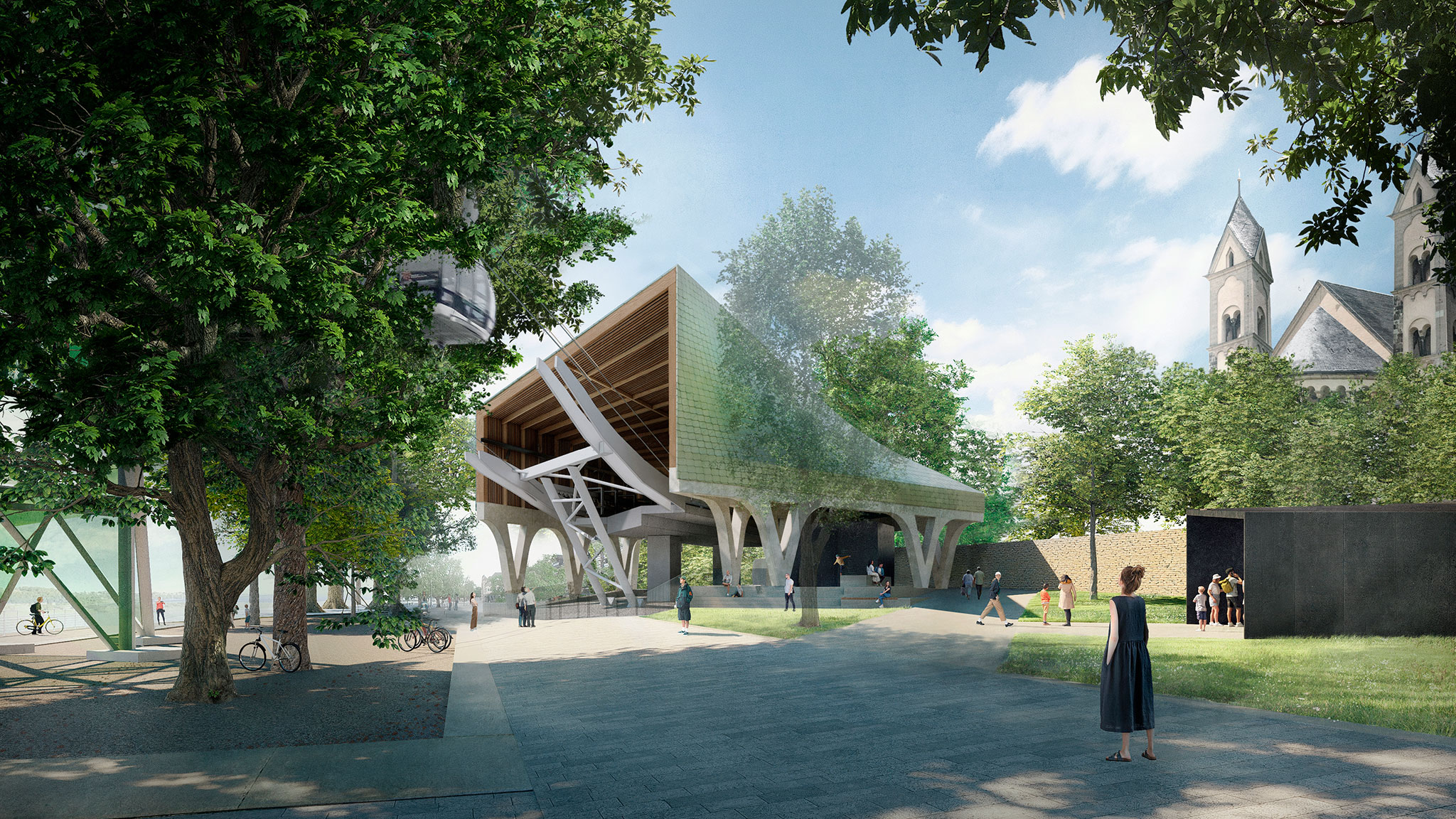
Cable car station by Snøhetta. Rendering by Snøhetta

Cable car station by Snøhetta. Rendering by Snøhetta.

The metal roof shell is supported by a wooden structure resting on V-shaped concrete columns. The metal shingles of the roof are inspired by traditional façade and roof motifs of the city, while the gently sculpted concrete columns are reminiscent of the vaulted stonework of the church and traditional masonry along the river. The subtle green colours and the glossiness of the metal cladding continue the reflections and play of light and shadow along the river and the tree-lined riverbank. The curved shape of the station reinforces this subtle effect. The open space at the station is integrated into the landscape of the Rhine promenade.

A common, gently chamfered metal roof also covers the technical facilities of the mountain station. Stoic, robust forms create a link to the Ehrenbreitstein fortress. Slender columns support the wooden construction with metal cladding, whose warmer colours refer to the earthy tones of the fortress walls. A “flying” roof in front of the station spans the kiosk, ticket office and technical rooms, integrates an existing tree and creates a sheltered waiting area. The station and the cantilevered canopy emphasise the clear horizontality of the historic landscape in front of the fortress. As with the bottom station, the entire technical installations of the cable car will be retained in the top station and supplemented with facilities for the permanent operation.

“The cultural landscape and identity of the Upper Middle Rhine Valley are characterised by centuries of human intervention. The new stations are part of this natural and cultural context and with our design we continue the dialogue with the significant cultural landscape of Koblenz."

Patrick Lüth, Snøhetta Partner and Managing Director of the Innsbruck studio.

More information

Label
Architects
+ + copy Created with Sketch.
- + copy Created with Sketch.
Label
Collaborators
Text

Structural engineering, façade & cost.- Sbp schlaich bergermann partner.

+ + copy Created with Sketch.
- + copy Created with Sketch.
Label
Dates
Text

Competition.- 2024.

+ + copy Created with Sketch.
- + copy Created with Sketch.
Label
Location
Text

Koblenz, Germany.

+ + copy Created with Sketch.
- + copy Created with Sketch.
Label
Rendering
+ + copy Created with Sketch.
- + copy Created with Sketch.

Snøhetta is an architecture, landscape, and interior design studio with offices in Oslo, Norway, and New York City, USA. Founded in 1989, it is led by Craig Dykers and Kjetil Thorsen. The studio, named in honour of Mount Snøhetta, the highest peak in the Dovrefjell mountains of Norway, has approximately 100 collaborators working on large-scale international projects across a wide range of typologies. Their approach is deeply collaborative and transdisciplinary, bringing together architects, designers, engineers, and landscape professionals to explore multiple perspectives depending on the nature of each project.

Snøhetta has completed a series of world-renowned cultural and landmark projects, including the Bibliotheca Alexandrina in Egypt, the Oslo Opera House and Ballet, and the Lillehammer Art Museum in Norway. Current projects include the National Pavilion of the September 11 Memorial Museum at the World Trade Center site in New York, as well as urban and landscape developments that aim to merge local identity, sustainability, and public experience.

In 2004, Snøhetta was awarded the Aga Khan Award for Architecture, and in 2009, the Mies van der Rohe Award. The studio is the only practice to have won the World Architecture Award for Best Cultural Building twice in consecutive years: in 2002 for the Bibliotheca Alexandrina and in 2008 for the Oslo Opera House and Ballet, consolidating its international prestige.

Kjetil Trædal Thorsen (born 1958 on the coastal island of Karmøy, Norway) is a co-founder of the studio and a multiple award-winning architect. He is a visionary and humanist designer who has redefined the boundaries of contemporary practice. Under his leadership, Snøhetta has produced iconic, sustainable structures that are highly sensitive to their cultural context, combining technological innovation with a profound environmental awareness. Thorsen’s work is recognized for its focus on social interaction, sustainability, and the creation of spaces that foster human connection and sensory experience, establishing a benchmark in contemporary global architecture.

Craig Dykers (born 1961 in Frankfurt, Germany) is also a co-founder of the studio and director of its New York office. Snøhetta has earned a reputation for maintaining a deep integration of landscape, architecture, and urban experience across all its projects. Key works include the Bibliotheca Alexandrina in Egypt, the Oslo Opera House and Ballet, the National Pavilion of the September 11 Memorial Museum in New York, and the redesign of Times Square. Professionally and academically active, Dykers has been a member of the Norwegian Association of Architects (NAL), the American Institute of Architects (AIA), and the Royal Society of Arts in England. He has served as a diploma juror at the Architectural College in Oslo and as a distinguished professor at City College, New York. He has delivered numerous lectures across Europe, Asia, and the Americas, and has undertaken public art installation projects, many of which explore the interplay between context, landscape, and human experience.

Read more
Published on: December 23, 2024
Cite:
metalocus, MINERVA GARCÍA DE CASTRO
"Sculpture of the union between the valley and the mountain. Cable car station by Snøhetta" METALOCUS. Accessed
<https://www.metalocus.es/en/news/sculpture-union-between-valley-and-mountain-cable-car-station-snohetta> ISSN 1139-6415
Loading content ...
Loading content ...
Loading content ...
Loading content ...
Loading content ...
Loading content ...
Loading content ...
Loading content ...
Loading content ...
Loading content ...
Loading content ...
Loading content ...
Loading content ...
Loading content ...
Loading content ...
Loading content ...
Loading content ...
Loading content ...
Loading content ...
Loading content ...
Loading content ...
Loading content ...
Loading content ...
Loading content ...
Loading content ...
Loading content ...
Loading content ...
Loading content ...
Loading content ...
Loading content ...
Loading content ...
Loading content ...
Loading content ...
Loading content ...
Loading content ...
Loading content ...
Loading content ...
Loading content ...
Loading content ...
Loading content ...
Loading content ...
Loading content ...
Loading content ...
Loading content ...
Loading content ...
Loading content ...
Loading content ...
Loading content ...
Loading content ...
Loading content ...
Loading content ...
Loading content ...
Loading content ...
Loading content ...