The OMA expansion introduces new vertical connections, a central atrium visible from the street, and an entrance plaza that redefines the museum's relationship with the Bowery, offering a more open and dynamic experience for visitors. The faceted facade combines laminated glass with metal mesh, evoking the texture of the SANAA building while maintaining its own distinct identity. The main staircase, which traverses the atrium, functions as a "social condenser," connecting both buildings and organizing circulation.
The new building includes a Sky Room on the seventh floor with panoramic views of Manhattan, a 74-seat auditorium, an expanded lobby, a larger bookstore, and a restaurant designed with cork and polycarbonate, serving a menu by chef Julia Sherman and incorporating artist commissions and furniture by Minjae Kim. The upper levels house offices and artist incubation spaces, considered the "brain" of the building, along with a studio for resident artists and a permanent space for New Inc., the museum's art and technology incubator.
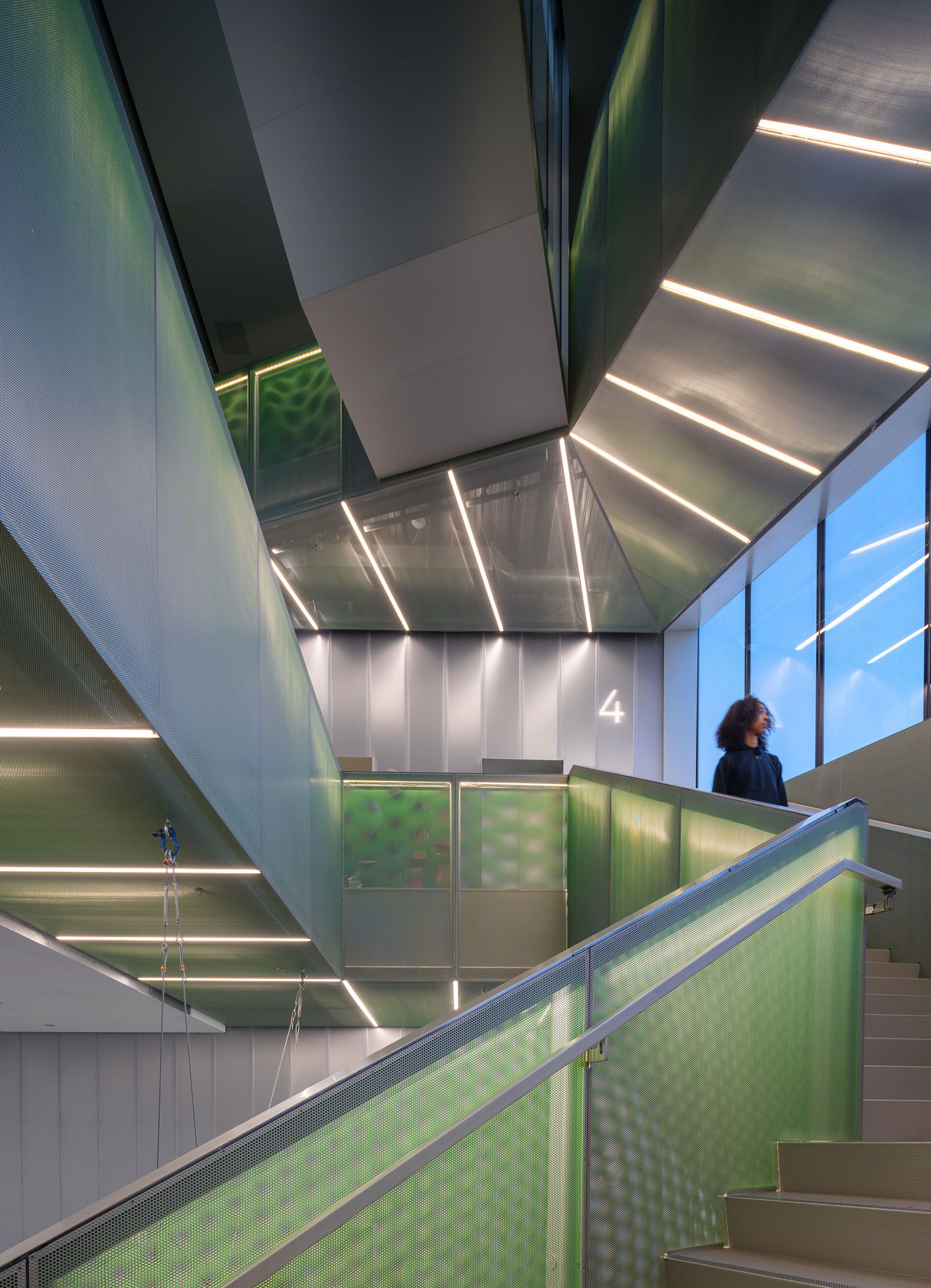
Expansion New Museum by OMA. Photograph by Jason O'Rear.
Among the permanent art installations are Tschabalala Self’s façade, a sculpture by Klára Hosnedlová for the atrium staircase, and an installation by Sarah Lucas in the plaza. The opening will coincide with the exhibition New Humans: Memories of the Future, which brings together works by more than 200 contemporary and 20th-century artists, exploring how technological and social advancements are redefining the idea of humanity.
The building, named after the late curator and philanthropist Toby Devan Lewis, is unique in that it brings together two Pritzker Prize-winning architects who are still active. The opening will offer free admission during the inaugural weekend, with pay-what-you-wish hours on Thursdays and free entry for those under 18.
Since its founding in 1977 as a small office on Hudson Street, the New Museum has evolved into a global landmark, combining exhibitions, research, and programs supporting emerging artists in a space that continues to be a real-time incubator of ideas and art.
Project description by OMA
Our first cultural institution in New York is a new addition to the New Museum next door to its iconic SANAA-designed building at 235 Bowery. The New Museum has been growing in visitors, exhibitions, and activities. Its diverse engagements, including its expansive education programs, its cultural incubator NEW INC, and, of course, its globally recognized exhibition program have been transforming the institution into a cultural laboratory. We were asked to add a new building that provides much-needed space for its expanded activities and simultaneously reflects increasingly public ambitions—duplicating the program and square footage on a site immediately adjacent to the existing SANAA-designed building—part and counterpart, side-by-side.
This condition was entrenched in dichotomies. While dichotomies are inherent to museum expansions, they can suppress the full potential of the pair. We looked to less didactic, more unexpected, and maybe even romantically entangled relationships that could exist between two parts of a whole. Can one be highly infrastructural to give support and free agency to the other? Can it be two equal entities in complete harmony? Can the two be distinct and independent but reciprocal as a pair?
Our approach complements and respects the integrity of the adjoining SANAA building, while asserting its own distinct identity. The New Museum will be a synergistic pair working spatially and programmatically in tandem, offering a repertoire of spaces for the institution’s curatorial ambitions and diverse programs. We stacked the required programs exactly at the same level of the existing building—three floors of galleries, a permanent home for NEW INC, offices, and multifunctional education and event spaces—new and old conjoined. Ceiling heights of the newly connected galleries align on each floor, creating expanded space for exhibitions and horizontal flow between the buildings.
Galleries can be used singularly across the floorplate to host larger exhibitions or separately for diversity and curatorial freedom. Due to the horizontality of the site, the galleries in the new building increase in size on the upper levels while the galleries in the existing building decrease in size—the total area per connected floor remains balanced. A distinction between the two buildings is created by taking advantage of our site’s depth to insert an interstitial space, in between art and city, containing an Atrium Stair and dedicated gallery elevators for improved vertical circulation. This highly public face—starting from the exterior plaza and Atrium Stair to terraced multi-purpose rooms at the top—is a conduit of art and activities that provides an openness to engage the Bowery and the city.

The existing tower’s verticality treats the different programs within in the same expression. We wanted to create a healthy contrast by expanding the galleries horizontally and introducing two setbacks. An angled setback starting from the top of gallery stack to the street defines a new public plaza at the terminus of Prince Street that becomes a focal point and a buffer zone between existing and new. A second setback above the galleries makes the top of the building disappear, while opening up the upper-level terraces to the sky. Clad in laminated glass with a layer of metal mesh, the building appears monolithic during the day, establishing a unified exterior alongside the existing building’s metal mesh facade. In the evening, the transparency of the facade is enhanced as light permeates through its openings, exposing the museum’s anatomy.
The new, New Museum is a partnership of two different personalities with high compatibility—independent but in constant dialogue. The result is an expanded platform that provokes even more dynamic interactions between art, artists, and people, which are then exposed to communicate the museum’s civic ambitions to the city.