Memory of project by Bureau A
Bada Bing
James Gandolfini died on the 19th of June 2013, a few weeks before the 47th Montreux Jazz Festival. He was the leading character of one of HBO’s best series: The Sopranos. He embodied the complete range of clichés of the Italian American mafia developed beforehand by great film directors such as Martin Scorsese or Francis Ford Coppola (The Godfellas in 1990 for the first, The Godfather in 1972 for the second). The Sopranos was a mixture of the characters' specific bad taste, filmed with an incredible amount of precision and aesthetic rigour. The Bada Bing is Tony Soprano’s strip club; his hideout and location from where he conducts his business. Bada Bing is an expression used by Sonny Corleone in The Godfather.
Montreux is a peculiar spot on the east end of the Lake of Geneva. It has its own marine west coast microclimate, palm trees and a peculiar wealthy population. The views on the lake are breathtaking, directly hitting the base of the high French Alps. It’s a scene of natural beauty. The boardwalk provides a feeling of an everlasting vacation. The Montreux Jazz Festival has existed since 1967 and has been the place of many legendary jazz and rock concerts. During the festival, the town merges with the music and festivities of the festival.
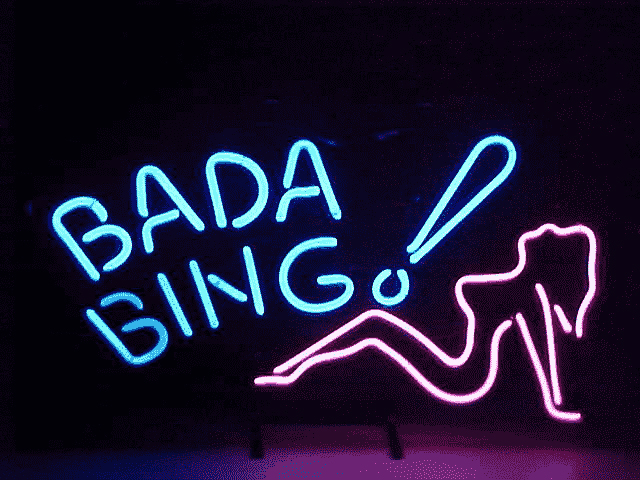
Web open source from the TV series The Sopranos.
The natural and simple thing to do when commissioned to revise the boardwalk for the Jazz Festival was to “go with the flow” of Montreux, to work with this ambience of shiny lights and glamour. The Bada Bing sign came to mind as a logotype for the 1980s aesthetic. Working with neon lights seemed quite straightforward. Neon signs represented not only the aesthetic of the Las Vegas strip and of the nightlife of Chicago’s jazz clubs but also the work of several important conceptual artists working from the 1960’s onwards. Artists like Dan Flavin, Lucio Fontana, Bruce Nauman, Joseph Kosuth, and Mario Merz took the light tubes out of the jazz clubs and hung them on the walls of art galleries and museums. Neon writings have this magical power to turn words into signs, opening thus possibilities of interpretation. The impossible ambition was probably to bridge these two cultures: the sharpness and diagrammatic design of conceptual art neon signs, with the culture of the strip
The boardwalk has been reorganised entirely for the festival with a series of new decks, temporarily installed over the water, taking advantage of the great scenery. Neon signs have been placed at the entrance of every deck. They have obsessively occupied the boardwalk through two series of generic words: one designating generic food (pizza, paella, kebab) for the catering area and another series of jazz-history-based styles (bebop, latin-jazz, jazz-rock, boogie-woogie, etc) for the lake decks. The neon writing was supported by a freestanding structure, using the classical figure of the arch as a framing device capable of capturing the romantic scenery of the lake and the Alps. The main deck, 40 meters long by 10 meters wide, “dives” into the lake, providing a large public and romantic space. 12 arches and neon signs, placed randomly, illuminate the platform filled with deckchairs.