
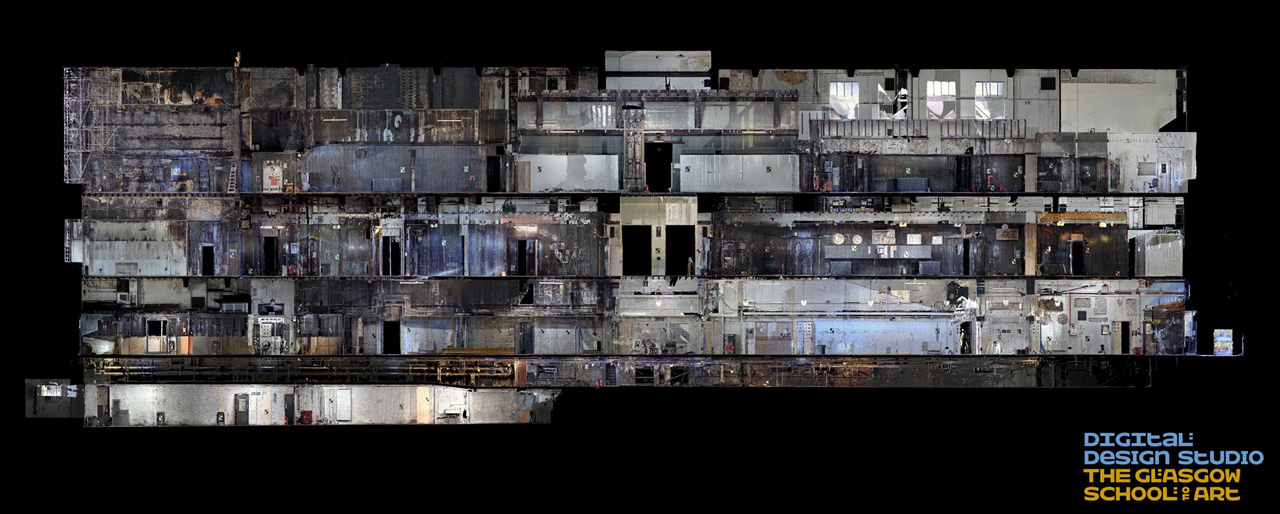
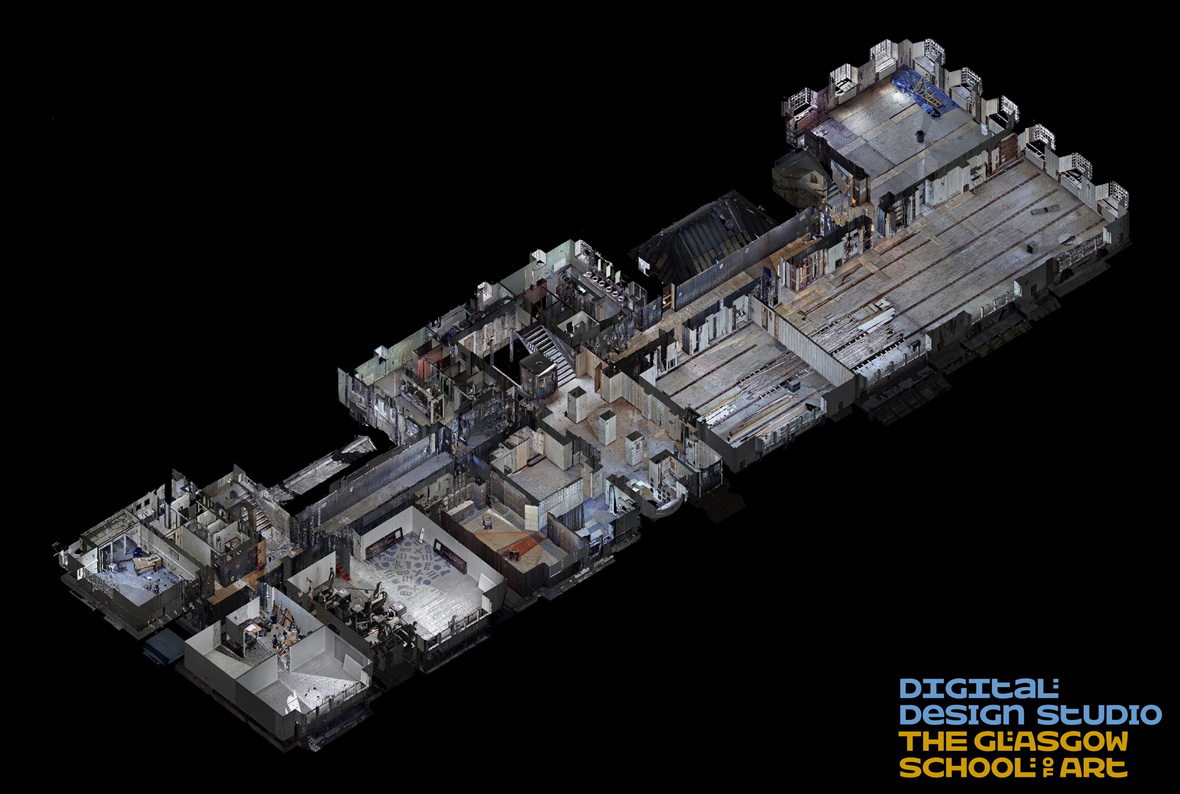
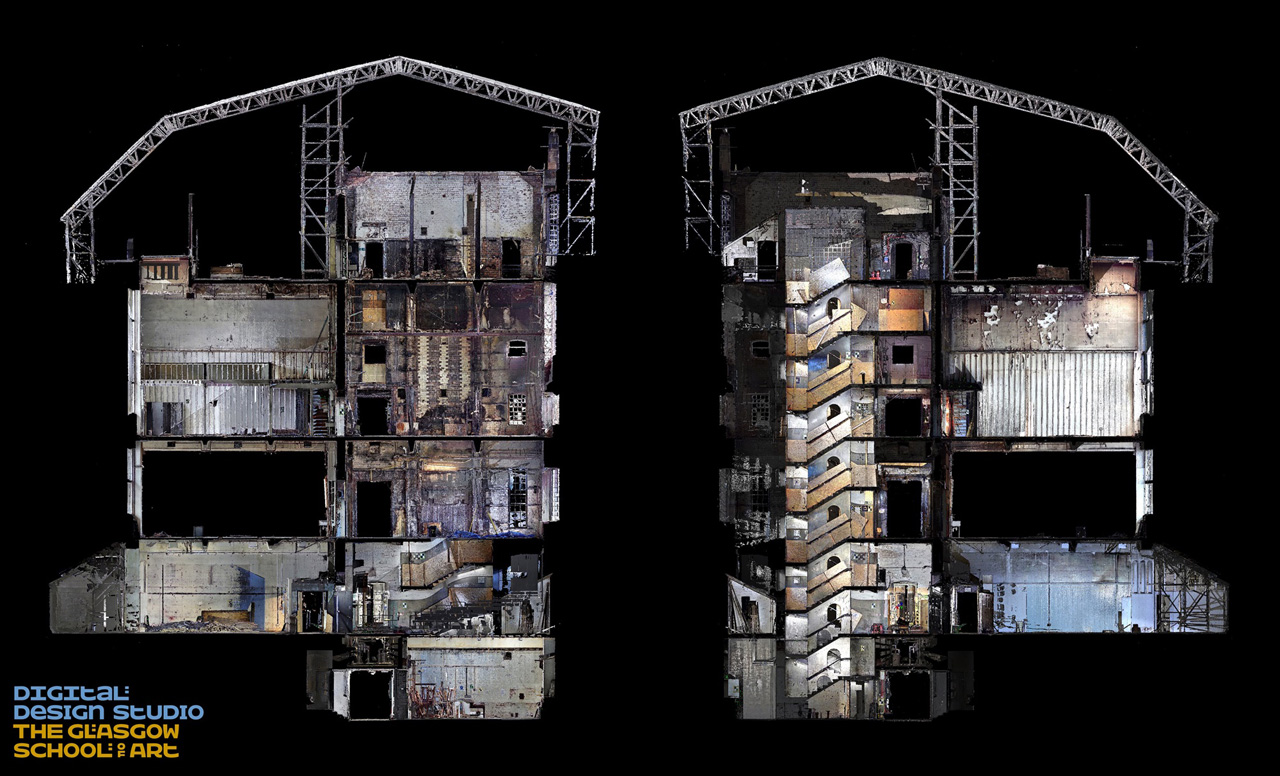
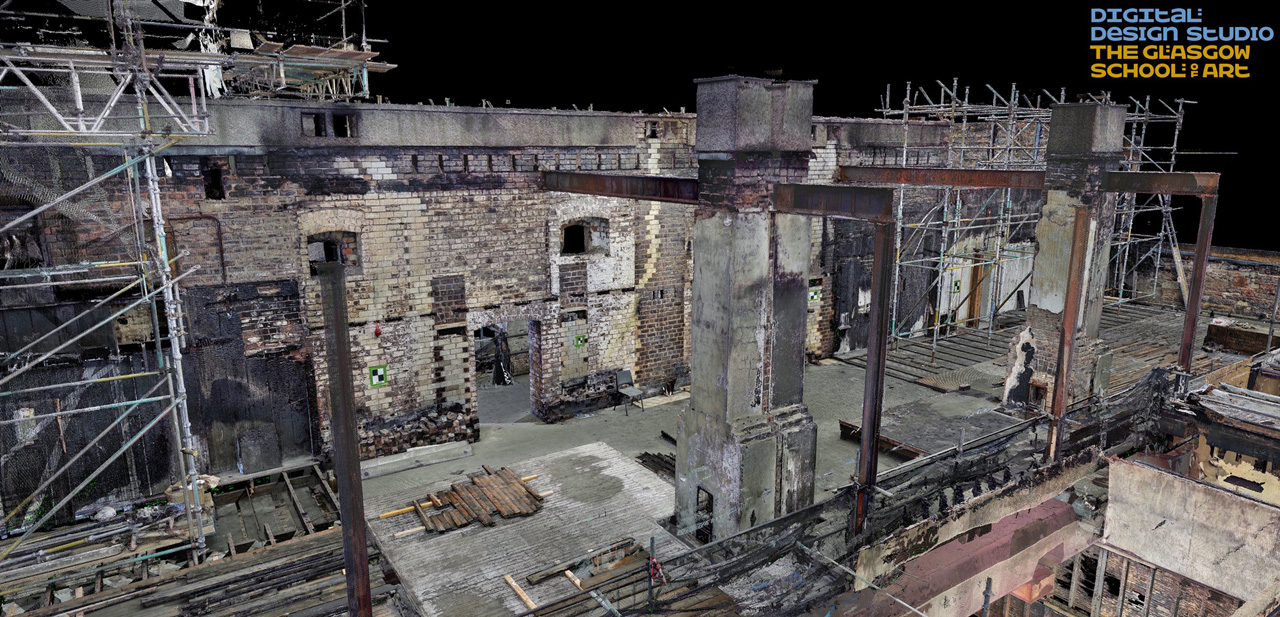
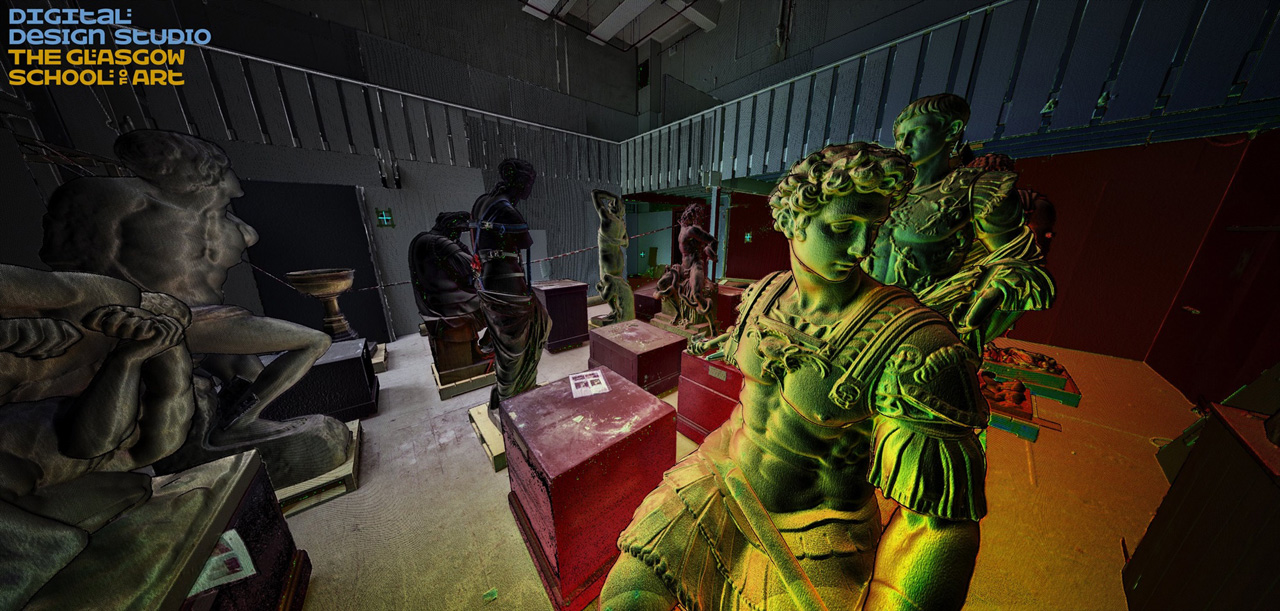
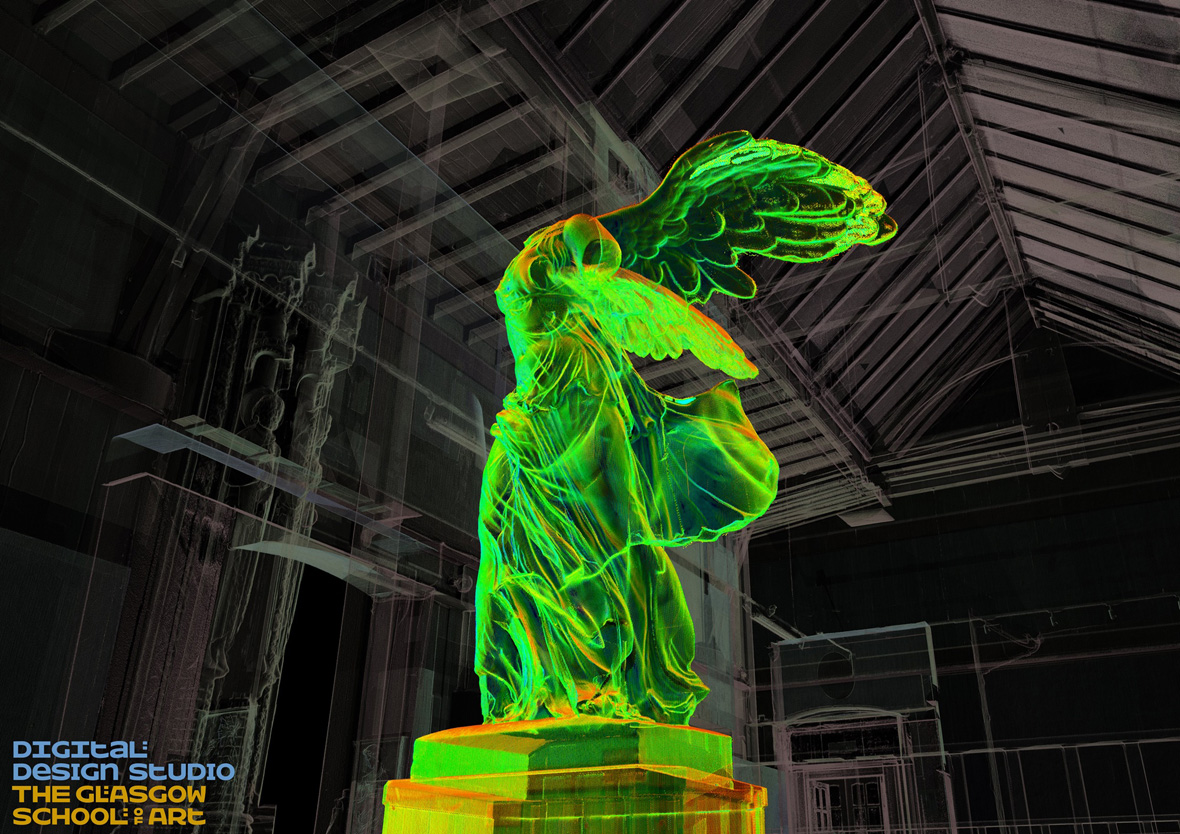
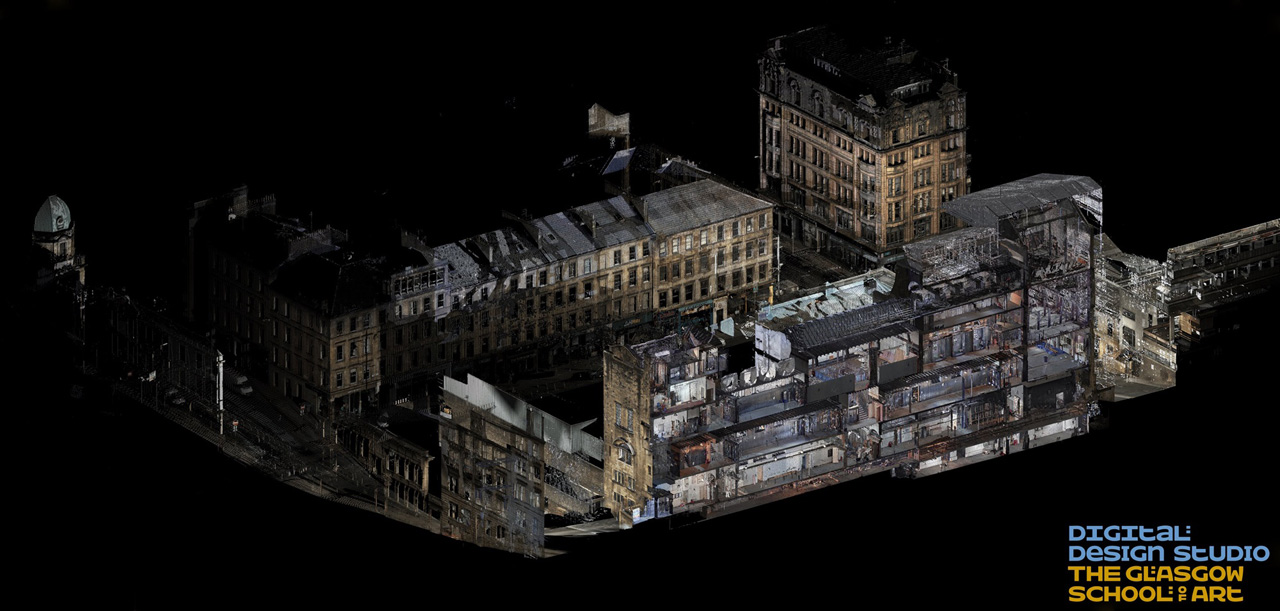
Experts of the Glasgow School of Art’s Digital Design Studio have created the images, which were generated using laser scanning techniques and will form the database for a BIM model that will document all the stages of the restoration of the building to create a detailed record of the works done for future use by both the GSA and other organizations that carry out complex restorations of historic buildings.
The detailed 3D images were released as the Glasgow School of Art issued the invitation to tender for the main contractor. The images show the damage and the huge task ahead for those working on the restoration. The restoration project of the school is being led by the studio based in Glasgow Page\Park.
Restoration works of Grade A listed building are set to begin after the school’s degree show closes in the summer. It will start with the removal of the stonework of the library’s window gable and following that the roofs which were totally destroyed by the fire will be reconstructed.
The restoration project is set to complete in 2018.
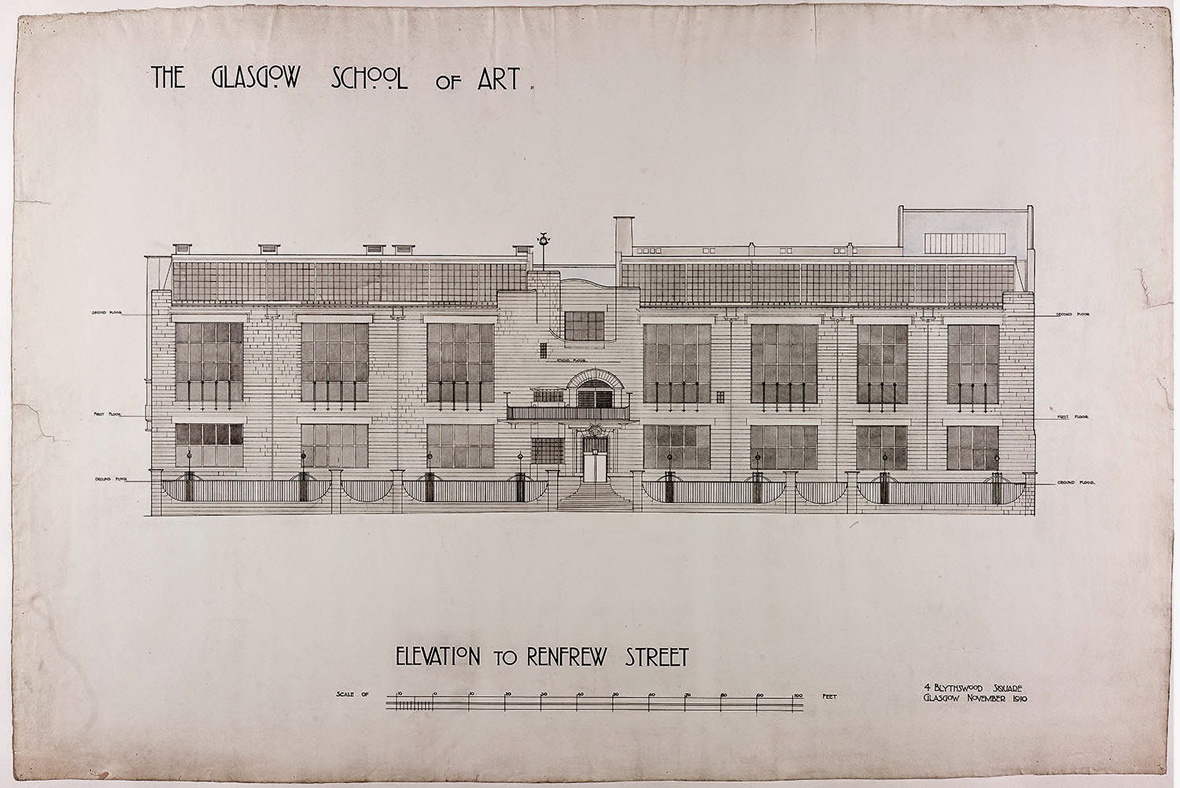
The Glasgow School of Art (GSA) has published a series of 3D images of the Mackintosh Building, as it is today, after the fire it suffered in 2014, to assist in the restoration works.



More information

Charles Rennie Mackintosh was an architect, designer and Scottish watercolorist, which had fundamental importance in the Arts and Crafts movement and was also the leading exponent of Art Nouveau in Scotland. He was the father of Elizabeth Nicol Rennie also followed in his footsteps.
Protomodernist (forerunner of modernism). Tries to reform breaking with the above. He rose to fame after exposing your furniture in the Secession in Vienna in 1900 and was part of the group "The Four" of Glasgow, created in 1897, its main figure.
He took elements of Arts and Crafts, and was very well accepted by the Belgian Art Nouveau opposition (he was a hero to the Secession).
It was one of the most prominent architects of characters linked to Art Nouveau (including Victor Horta), but after 1913 did not receive more orders.
In 1884 he was apprenticed in the studio of architect John Hutchinson, where you would be forming for five years. At the same time, he attended night classes in drawing and painting at the Glasgow School of Art, acquiring great skill in drawing and design as well as a watercolorist. This was a period of hard work but at the same time, rewarded with several awards. It would be in the evening classes where he met the people who later formed The Four group (Four), the sisters Frances Macdonald and Margaret Macdonald, who would later marry, and Herbert MacNair, colleague working at studio Honeyman & Keppie, where come to work in 1889 and remained until 1913. in 1890, the granting of travel grant Alexander-Thomson, which won the design of a public building of classic Greek style allowed him to go in 1891 France, Italy and Belgium for three months. In 1896, his project won the competition for the Glasgow School of Art (1896-1909), his masterpiece.
In collaboration with his wife, he furnished from 1896 several tearooms in Glasgow; also he received orders from England and abroad for villas and homes; including one for a music room for Fritz Waerndorfer.
The Four group also participated in the VIII exhibition of the Viennese Secession 1900.
In 1915 the marriage Mackintosh moved to London, where he remained until the end of his life, except for the years 1923 to 1927, during which he lived in Port-Vendres (France), where he devoted himself to painting (watercolors).
Mackintosh in London devoted to graphic works and book arts.
Protomodernist (forerunner of modernism). Tries to reform breaking with the above. He rose to fame after exposing your furniture in the Secession in Vienna in 1900 and was part of the group "The Four" of Glasgow, created in 1897, its main figure.
He took elements of Arts and Crafts, and was very well accepted by the Belgian Art Nouveau opposition (he was a hero to the Secession).
It was one of the most prominent architects of characters linked to Art Nouveau (including Victor Horta), but after 1913 did not receive more orders.
In 1884 he was apprenticed in the studio of architect John Hutchinson, where you would be forming for five years. At the same time, he attended night classes in drawing and painting at the Glasgow School of Art, acquiring great skill in drawing and design as well as a watercolorist. This was a period of hard work but at the same time, rewarded with several awards. It would be in the evening classes where he met the people who later formed The Four group (Four), the sisters Frances Macdonald and Margaret Macdonald, who would later marry, and Herbert MacNair, colleague working at studio Honeyman & Keppie, where come to work in 1889 and remained until 1913. in 1890, the granting of travel grant Alexander-Thomson, which won the design of a public building of classic Greek style allowed him to go in 1891 France, Italy and Belgium for three months. In 1896, his project won the competition for the Glasgow School of Art (1896-1909), his masterpiece.
In collaboration with his wife, he furnished from 1896 several tearooms in Glasgow; also he received orders from England and abroad for villas and homes; including one for a music room for Fritz Waerndorfer.
The Four group also participated in the VIII exhibition of the Viennese Secession 1900.
In 1915 the marriage Mackintosh moved to London, where he remained until the end of his life, except for the years 1923 to 1927, during which he lived in Port-Vendres (France), where he devoted himself to painting (watercolors).
Mackintosh in London devoted to graphic works and book arts.

José Juan Barba (1964). Architect from the Madrid School of Architecture (ETSAM) in 1991. He received his PhD in Architecture from ETSAM in 2004, graduating summa Cum laude with the doctoral thesis "Inventions: New York vs. Rem Koolhaas, Bernard Tschumi, Piranesi." In 1991, he received a Special Mention in the Spanish National Graduation Awards. Until 1997, he worked as an advisor to several NGOs. In 1992, he founded his architectural practice in Madrid (www.josejuanbarba.com).
He is an architectural critic and, since 1998, Editor-in-Chief of the internationally acclaimed bilingual architecture journal METALOCUS (Spanish/English), recipient of several national and international awards.
Barba is an Associate Professor at the University of Alcalá and a member of several research groups. He has been invited to participate in numerous international forums on architecture and urbanism, including the II Forum of Mexican World Heritage Cities, Urban Development, History and Modernity, organized by the Pan-American Committee for Urban Development and Historical Heritage; the World Urban Development Forum (FMDU), held in Culiacán, Sinaloa, Mexico; and the International Conference on Architecture and Urbanism from the Perspective of Women Architects. He has also been invited as lecturer and guest critic at numerous national and international institutions, including the National Building Museum, Roma Tre University, Politecnico di Milano, University of Genoa, Université Pierre Mendès France Grenoble, the Madrid and Barcelona Schools of Architecture, National Autonomous University of Mexico, the Faculty of Architecture in Montevideo, the Schools of Architecture of Medellín and Ecuador, Universidad Iberoamericana, IE University, as well as the Schools of Architecture of Zaragoza, Valladolid, Málaga, Granada, Seville, and A Coruña, among others.
He has extensive professional experience in architecture, urbanism, landscape intervention, and territorial regeneration. His work has received numerous awards, including First Prize in the “Gran Vía Posible” competition for Delirious Gran Vía, Madrid; recognition for the Rivers Interpretation Centre in Zamora, awarded and exhibited at the World Architecture Festival 2008; and recognition for the Santa Bárbara Park project in Toledo. He was also awarded the Erich Degner Prize for Architecture (1995), promoted by the BBVA Foundation. His project for a Day Centre for the Elderly was included in Volume 3 of the Madrid Architecture Guide published by the Official College of Architects of Madrid (COAM) in 2007. His work has been widely published in national and international books and journals.
He served as Maître de Conférences at the Institut d’Urbanisme de Grenoble, Université Pierre Mendès France Grenoble, during the 2013–14 academic year, following his appointment through a European open competition. His work has been published internationally. He regularly serves on academic and professional juries, including the editorial competition jury for the journal Quaderns (2011), the selection committee for the European Union Prize for Contemporary Architecture – Mies van der Rohe Awards (2007–present), and the jury panels for EUROPAN 13 (2015–16) and TRANSFER, Zurich (2019). He was also invited to participate in the Biennale di Venezia 2016 as part of the exhibition Spaces of Exception / Spazi d’Eccezione.
He has authored several books, including "The Dark Line. michele&miquel, dA Vision Design" (2024), "CONGRESO ANYWAY. La ciudad de las ciudades" (2020), "#Positions" (2016), and "Inventions: New York vs. Rem Koolhaas, Bernard Tschumi, Piranesi" (2015). He has also contributed to publications such as "Espacio público Gran Vía. La Ciudad del Turismo" (2020), "Spaces of Exception / Spazi d’Eccezione" (2016), "La manzana de la discordia" (2015), and "Contemporary Japanese Architecture: New Territories" (2015), as well as chapters in numerous books, including "Women Architects: A Professional Challenge" (2009), "21st Century Architectures" (2007), "Ruta de la Plata, New Conquerors of Space" (2019), and "The City of Tourism" (2020).
Selected awards include:
• “SANTIAGO AMÓN” AWARD, award for the promotion of architecture, COAM Madrid, 2000.
• “PANAYIOTI MIXELI AWARD,” SADAS-PEA, award for the promotion of architecture, Athens, 2005.
• “PIERRE VAGO” ICAC. International Committee of Art Critics Award, London, 2005.
• FAD Award 07, Ephemeral Interventions, First Prize, M.C. Escher Exhibition, Arquin-FAD, Barcelona, 2007.
• World Architecture Festival, Center for Research and Interpretation of the Rivers, Tera, Esla, and Órbigo, Finalist, Barcelona, 2008.
• Gran Vía Posible, First Prize, Delirious Gran Vía, Madrid, 2010.
• Reform of the Río Segura Surroundings, Award, Murcia, 2010.
Published on:
April 18, 2016
Cite:
"Fire damaged Mackintosh building in 3D" METALOCUS.
Accessed
<https://www.metalocus.es/en/news/fire-damaged-mackintosh-building-3d>
ISSN 1139-6415


