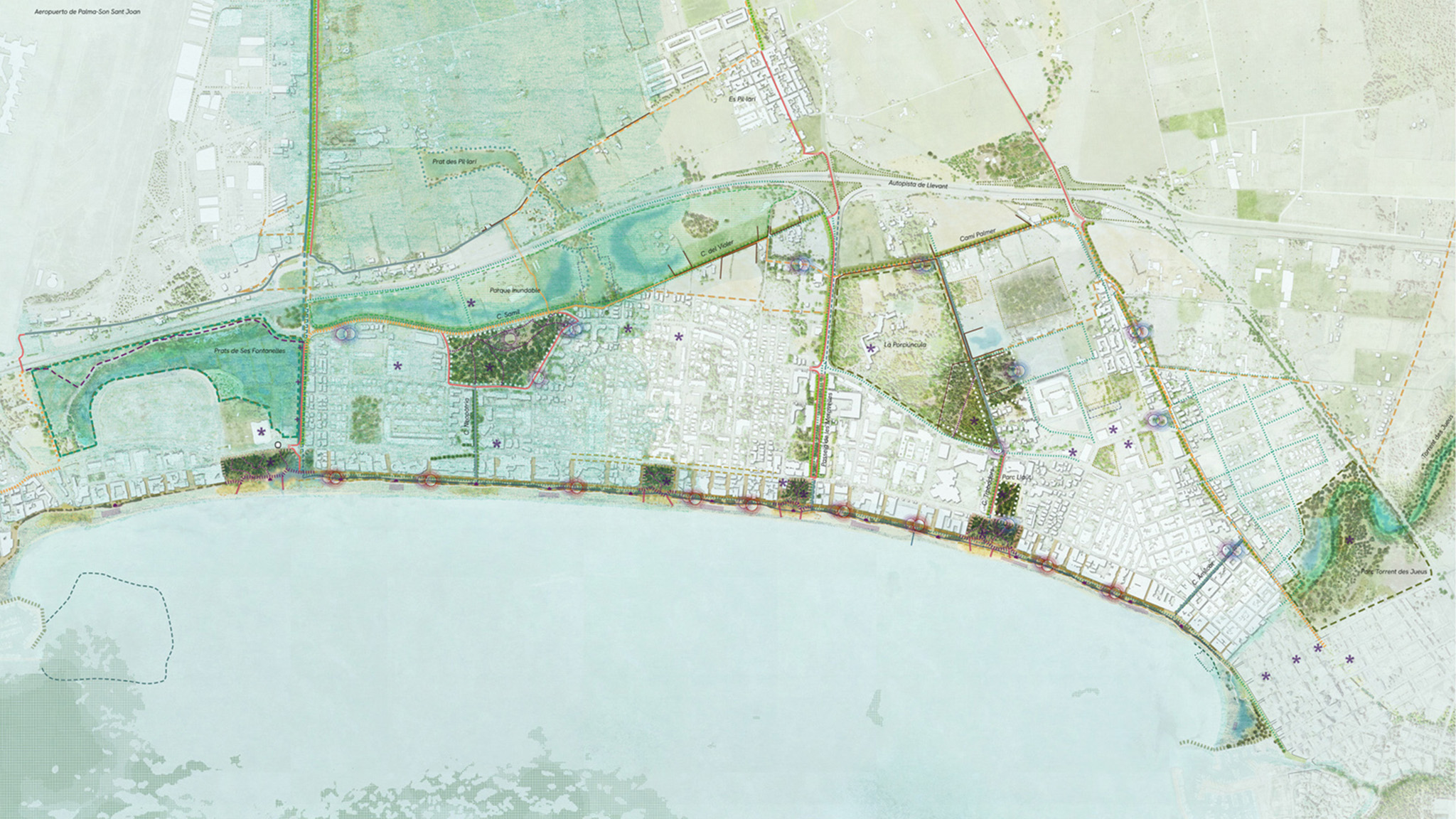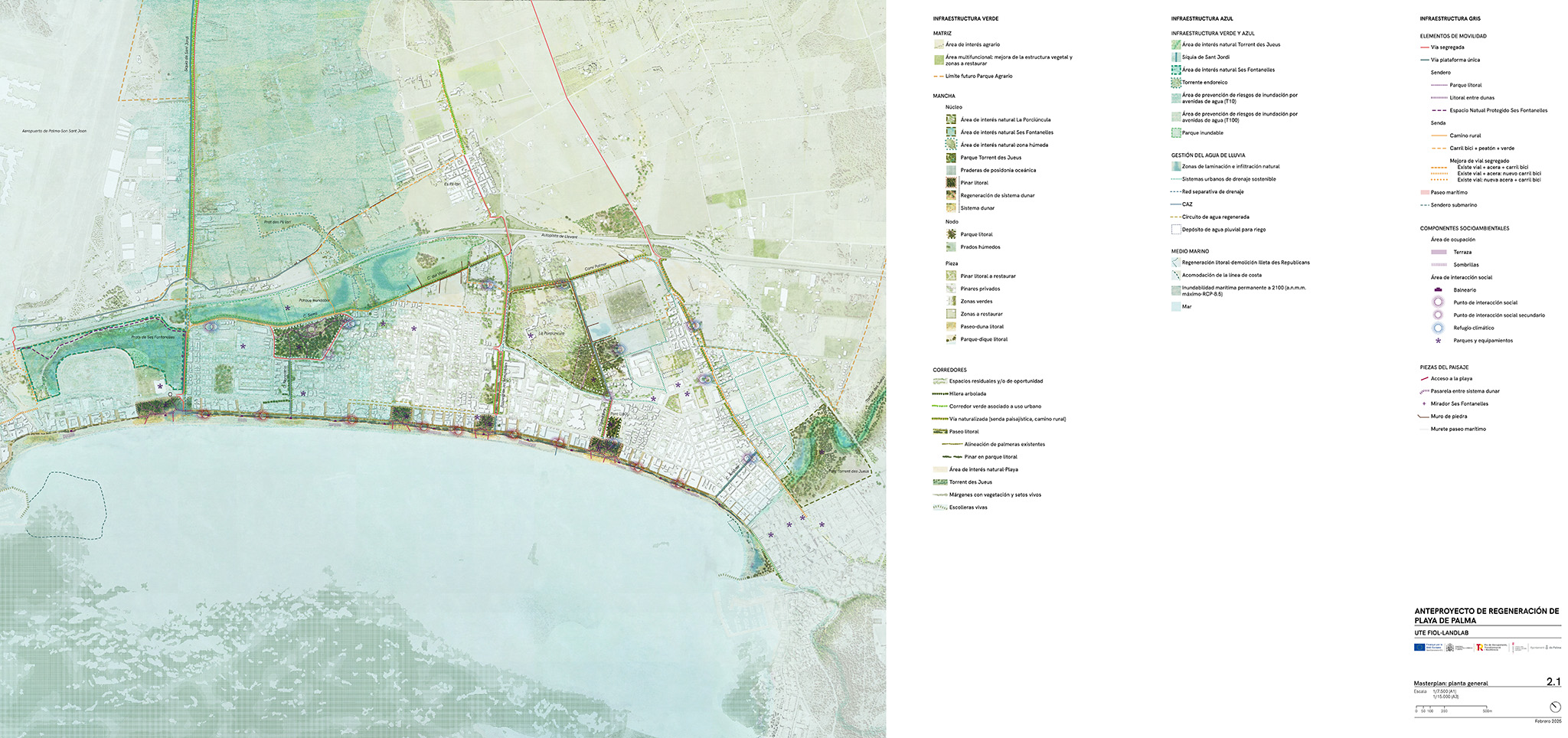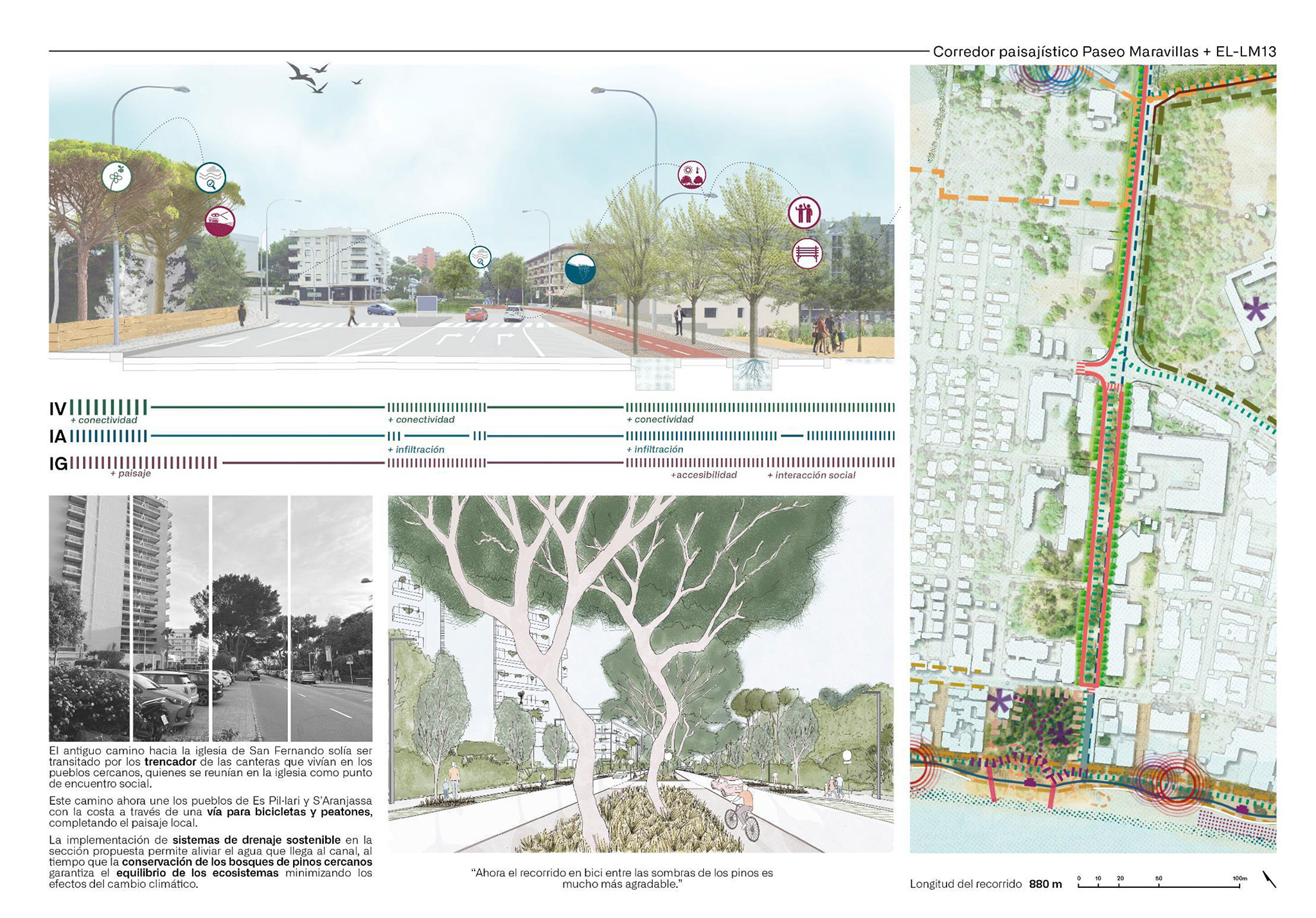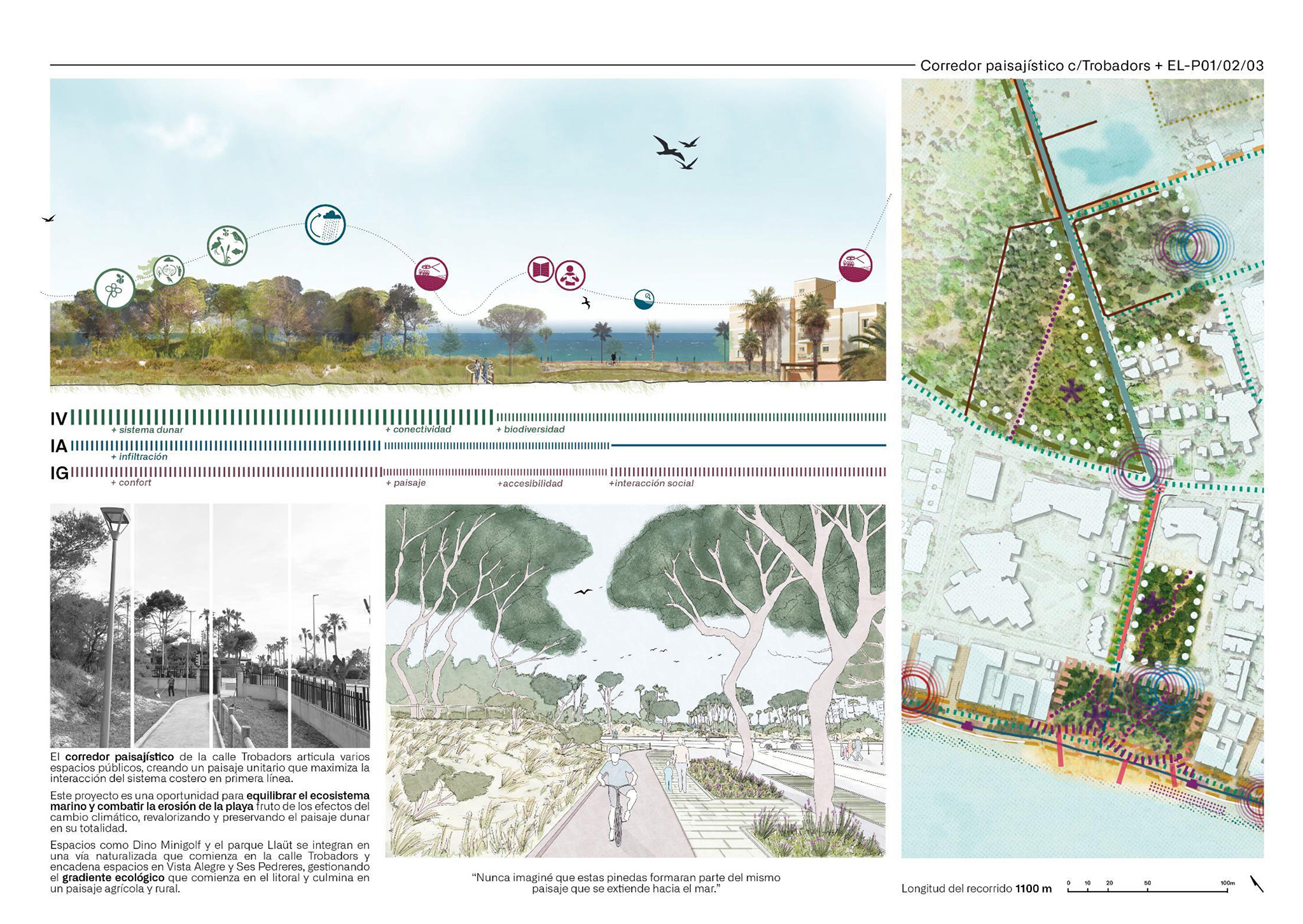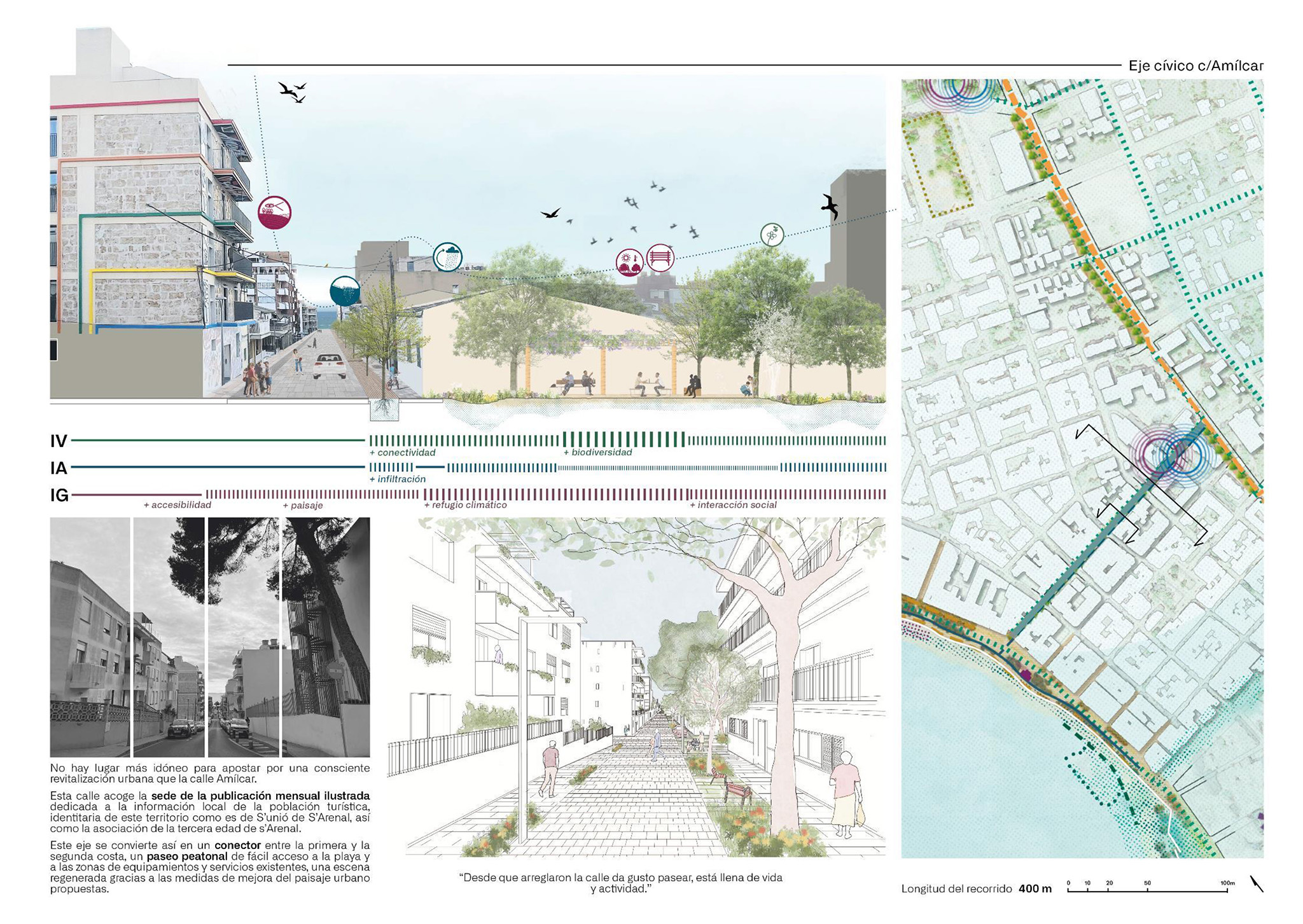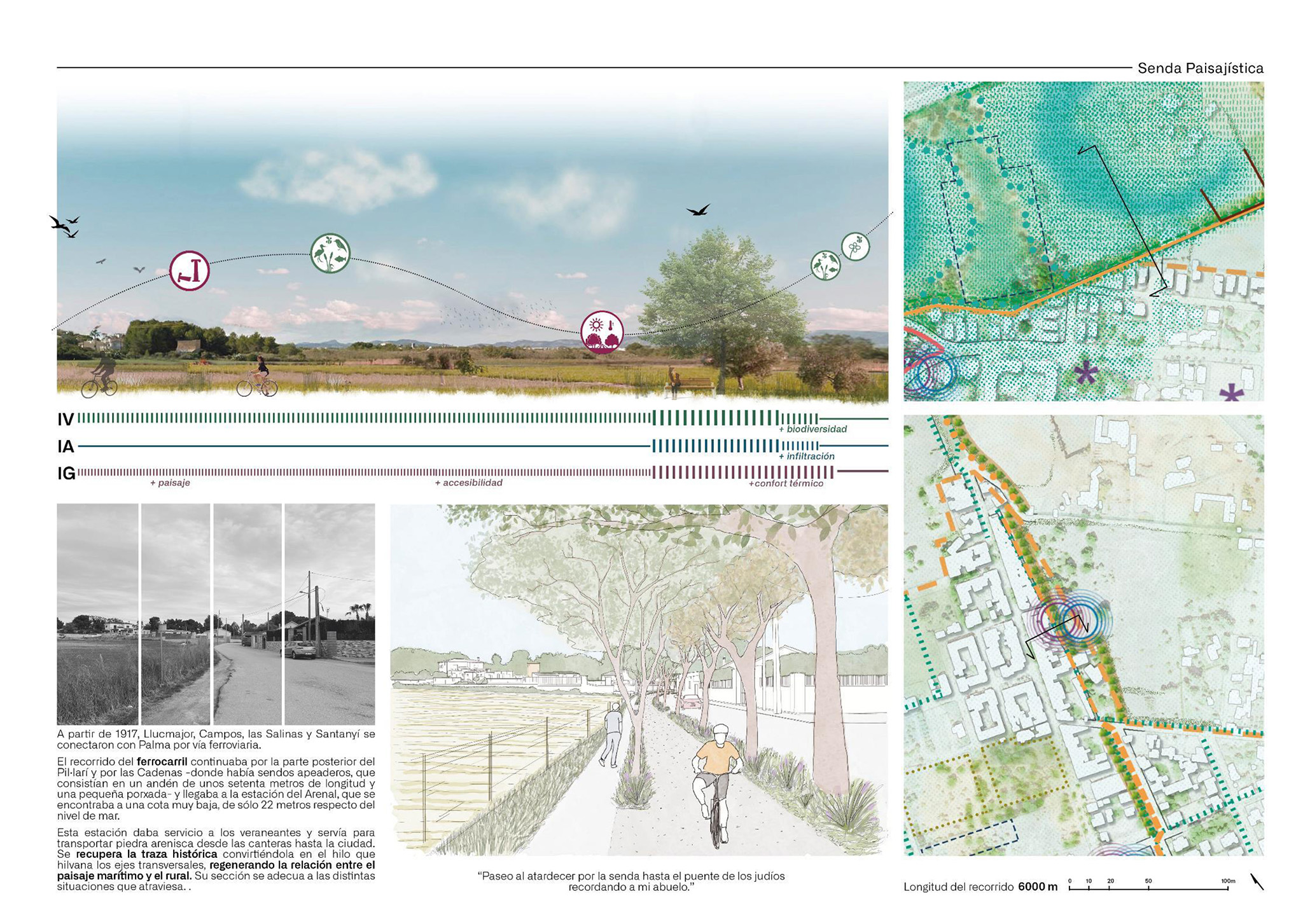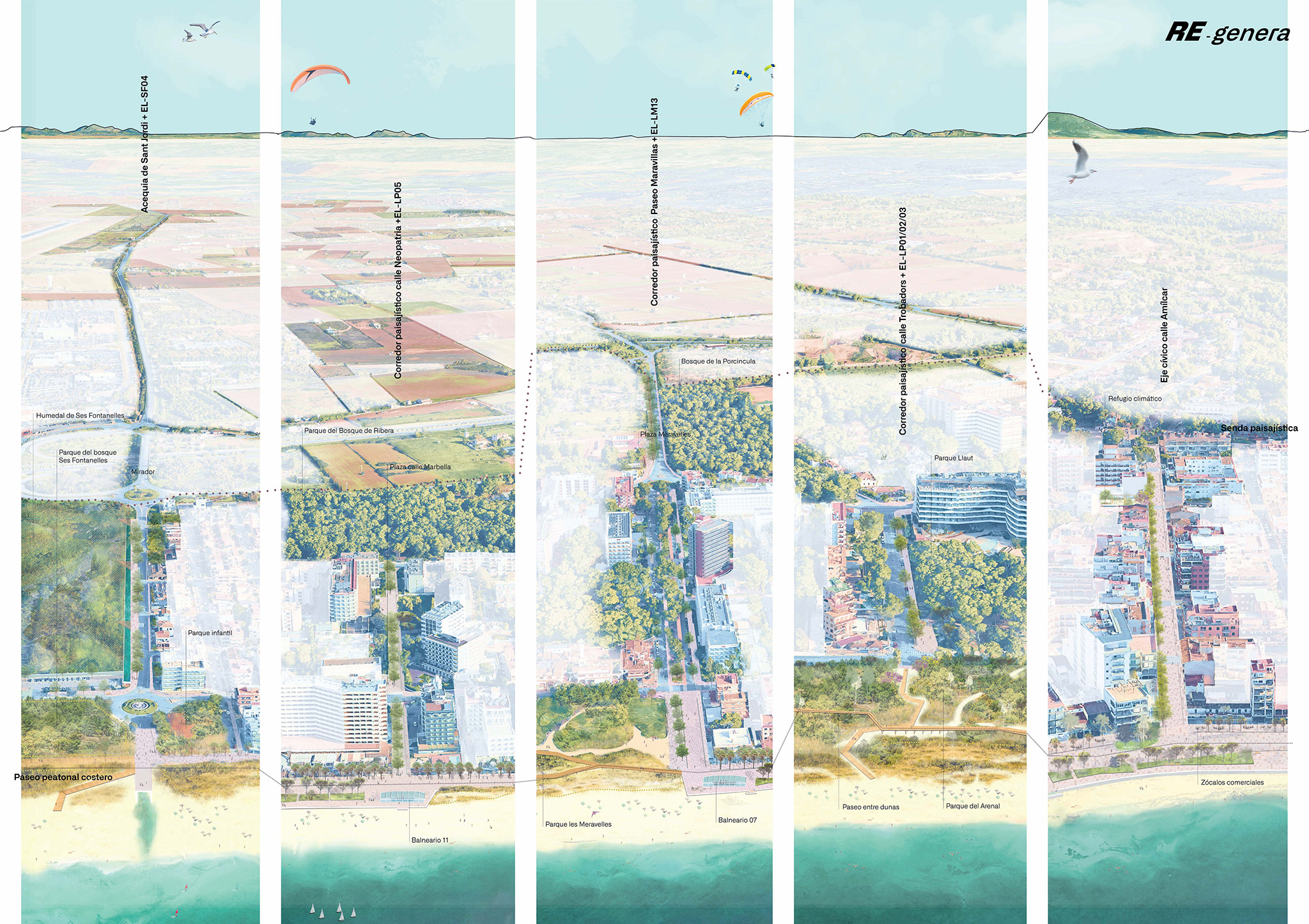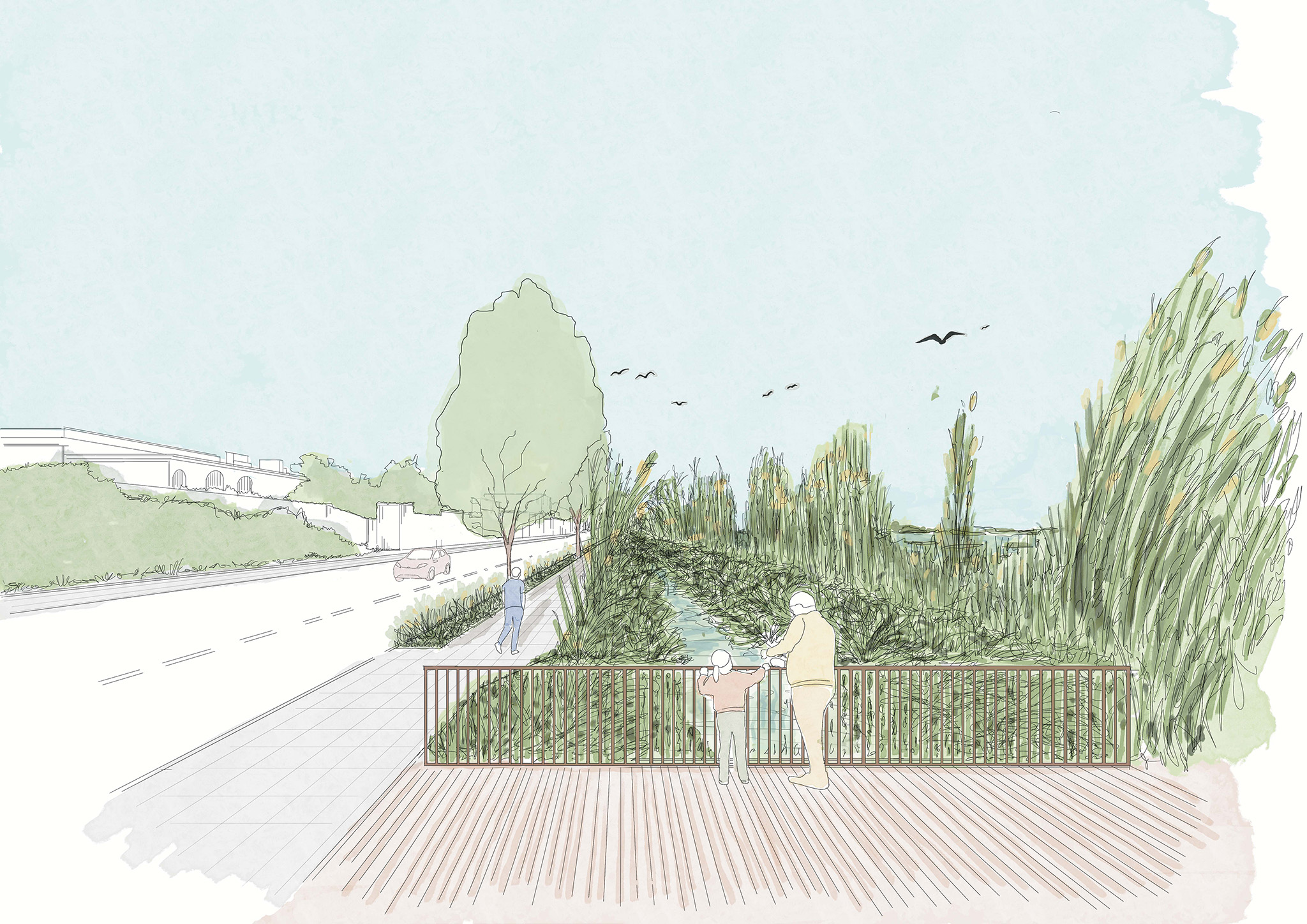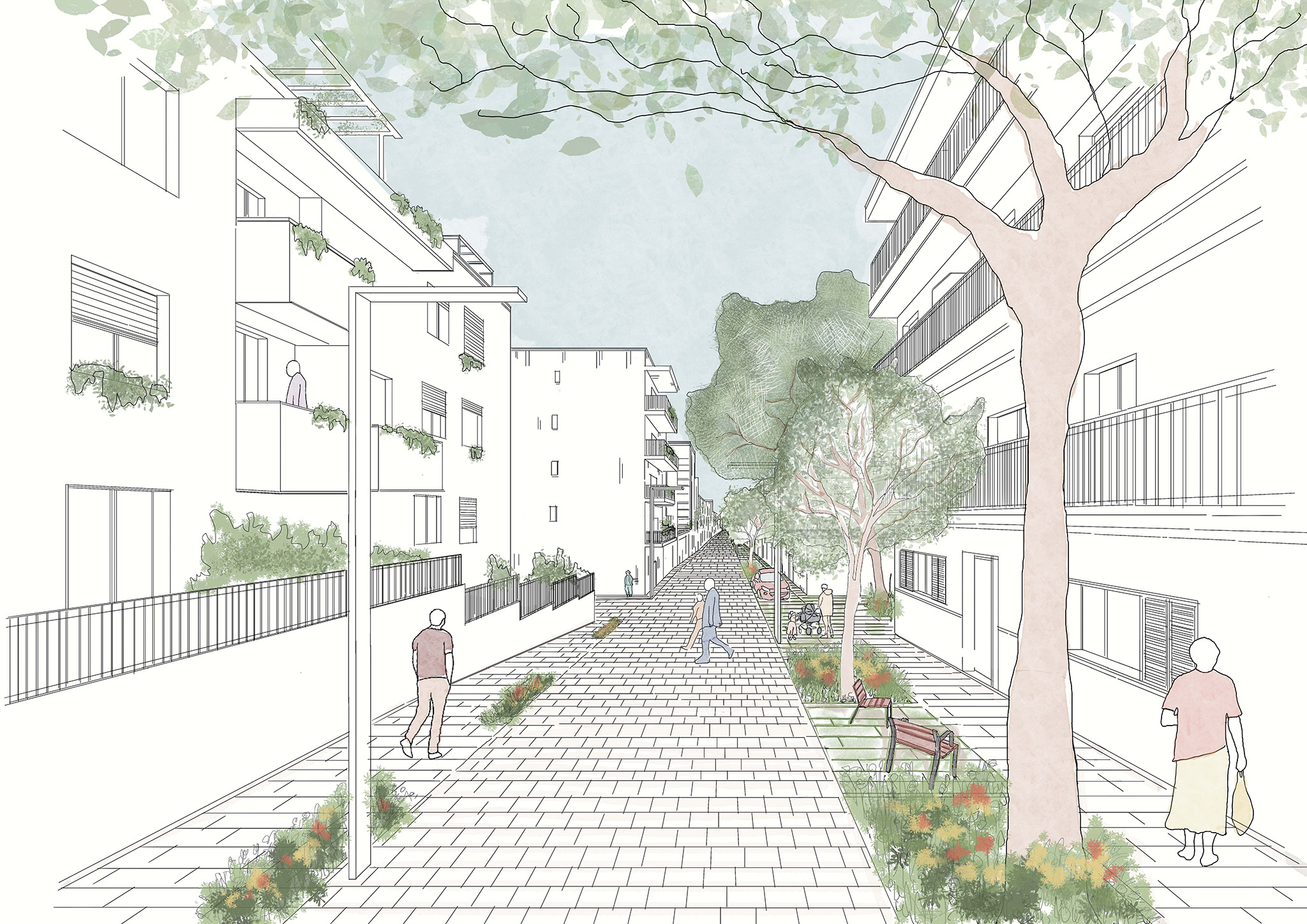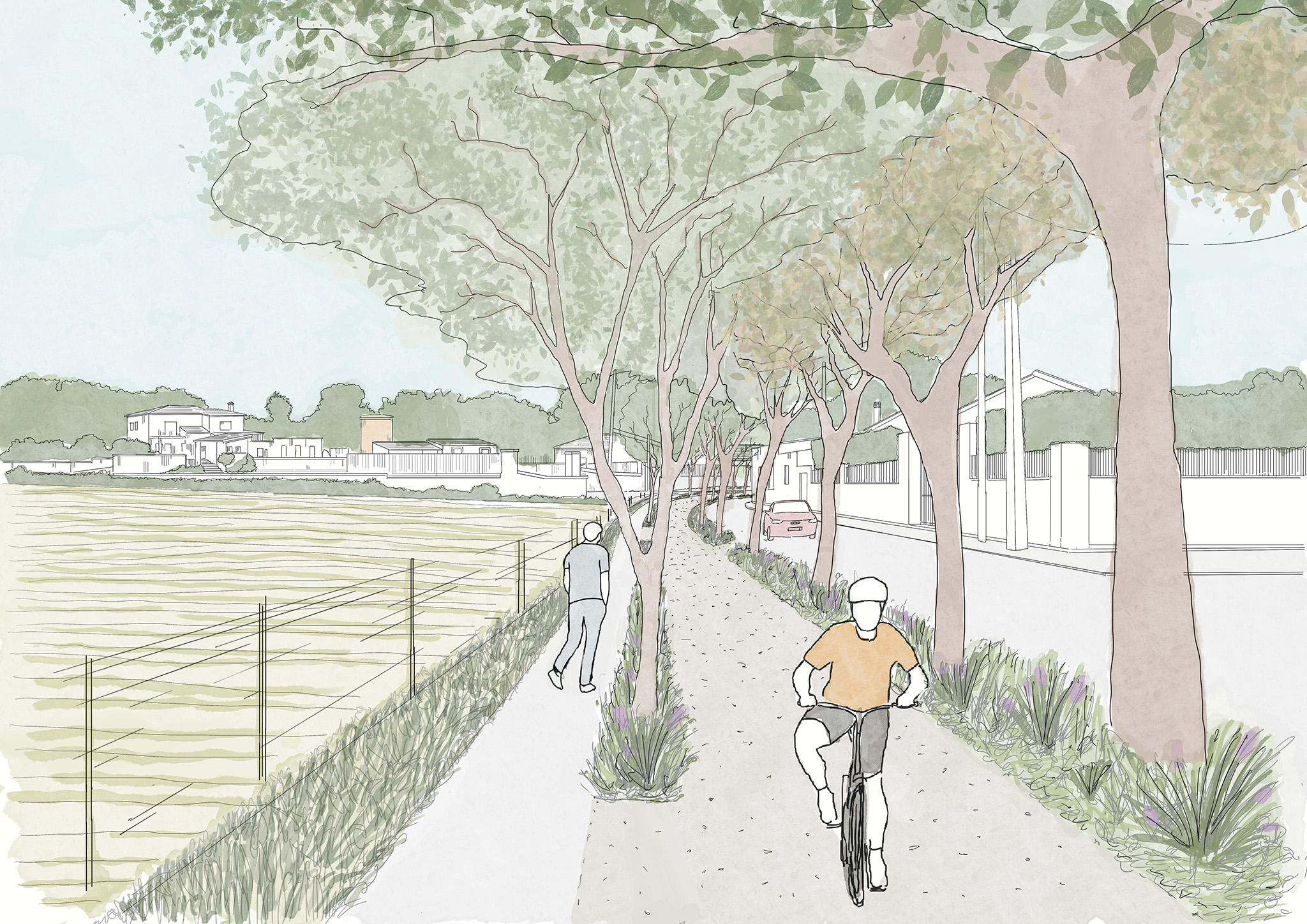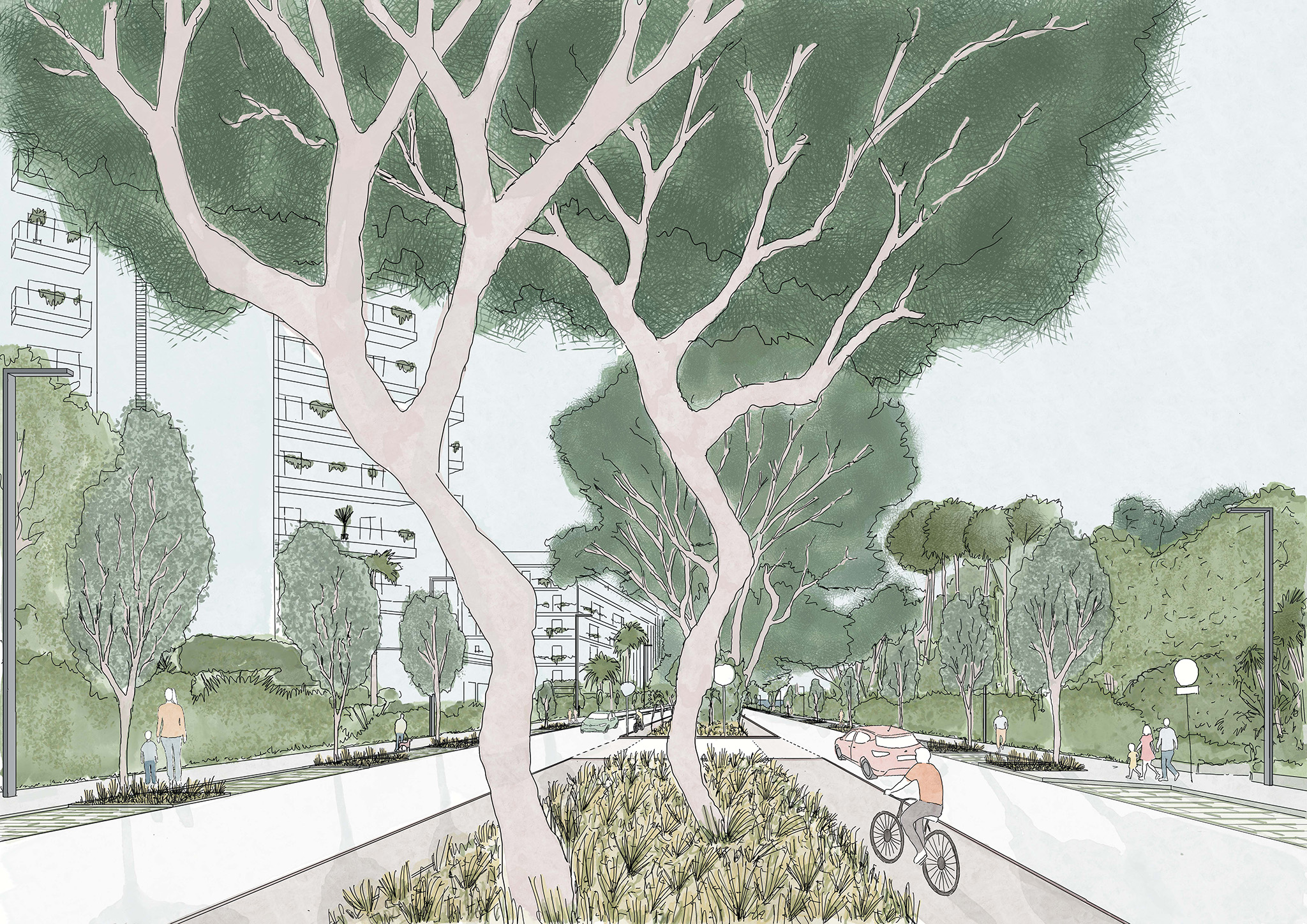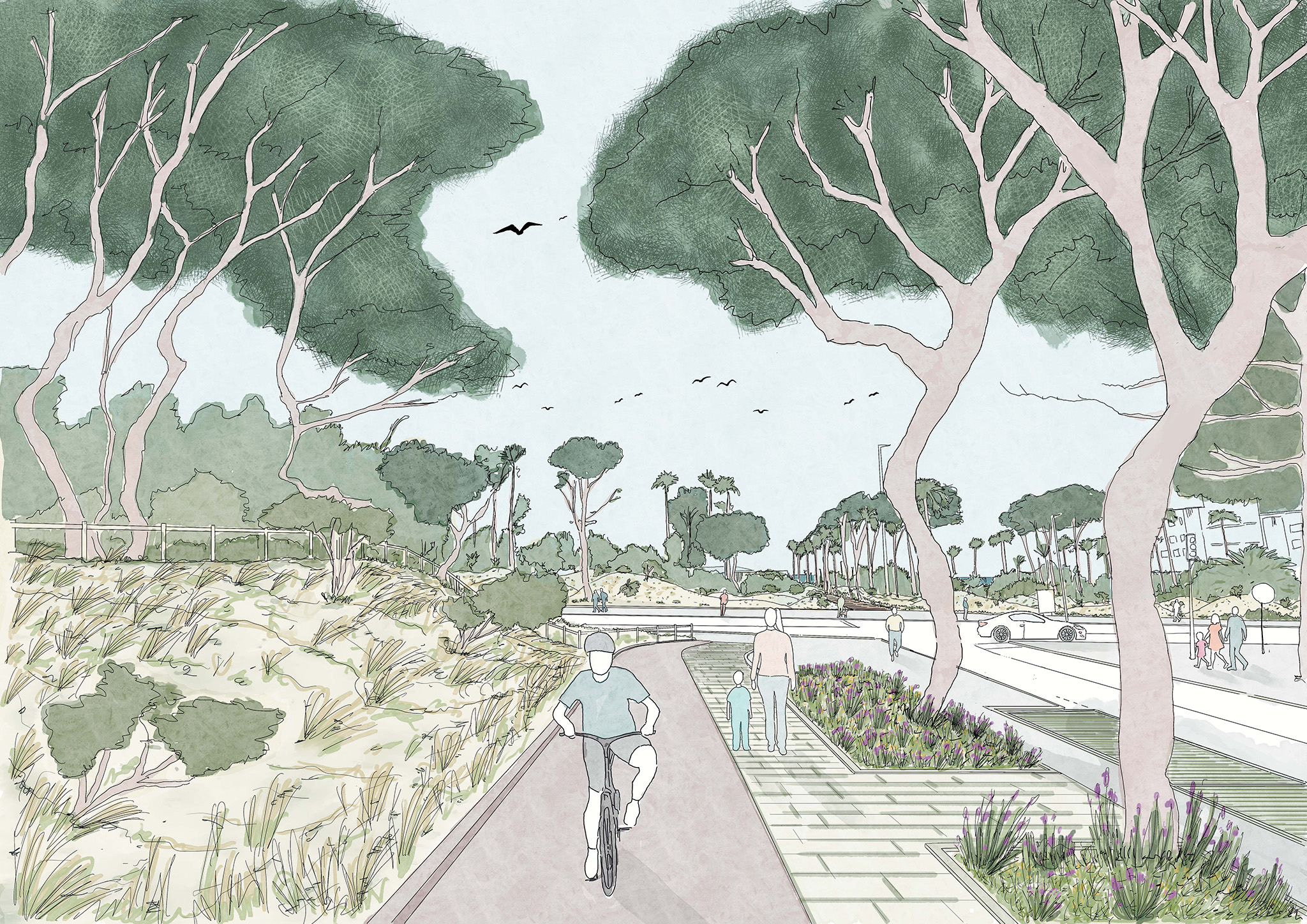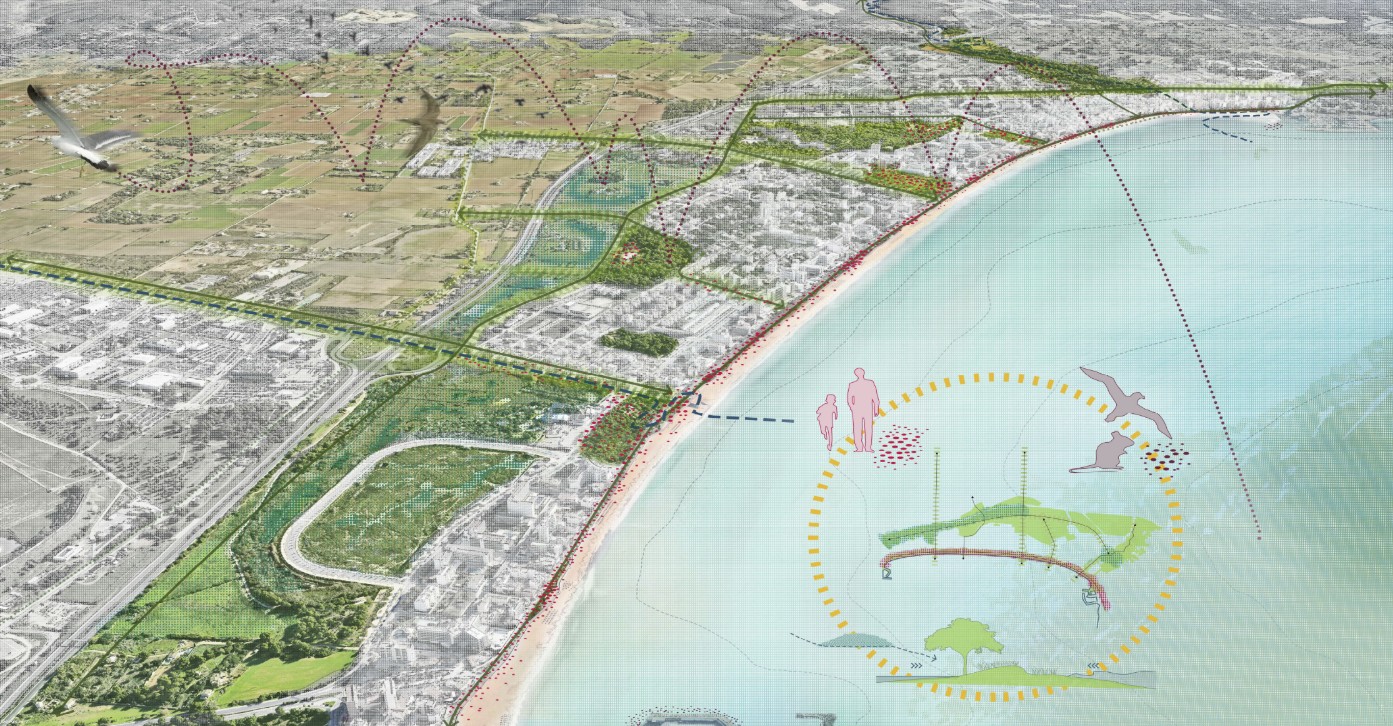
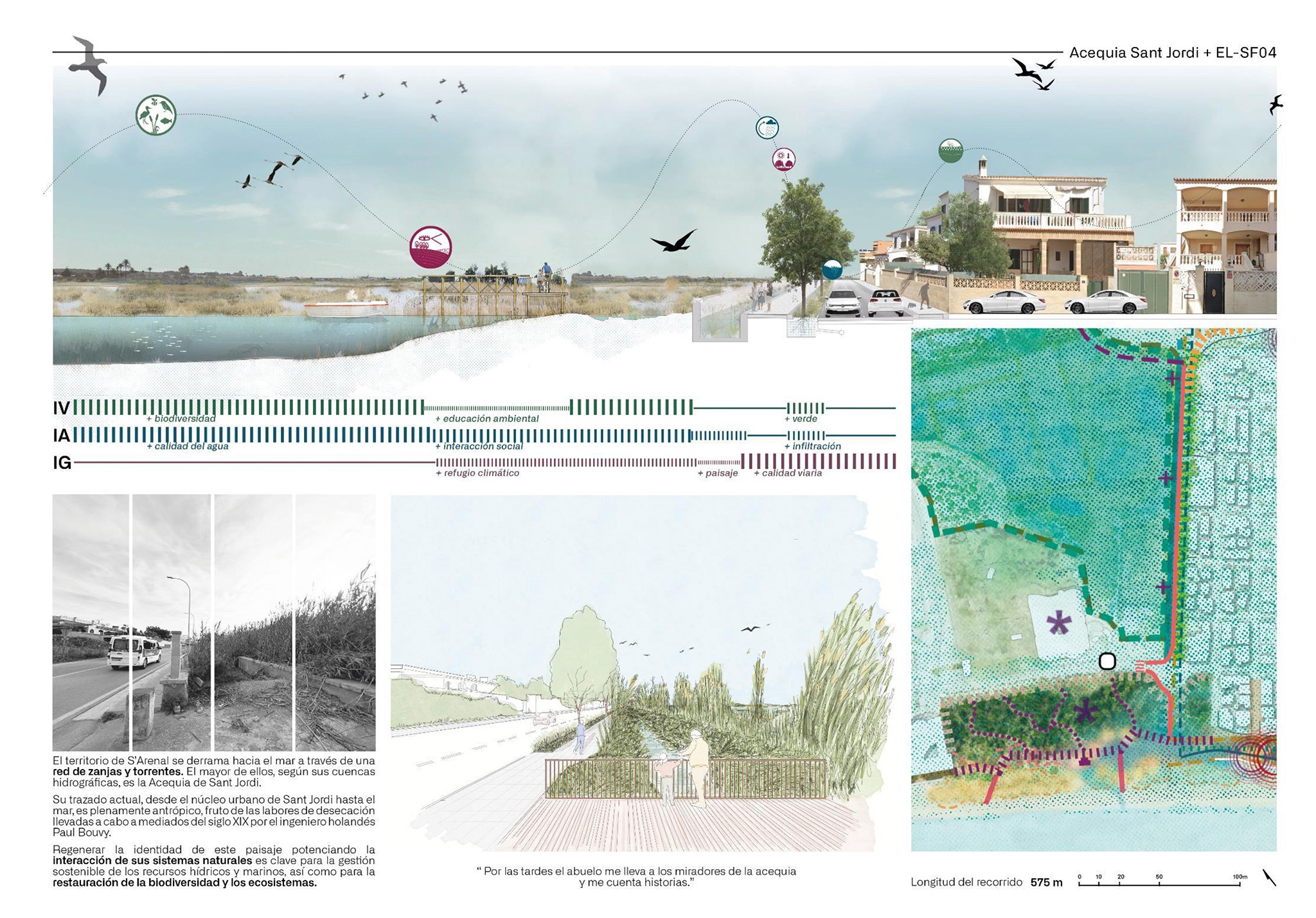
The Plan, developed by LANDLAB + Fiol Arquitectes, focuses on vegetation restoration and the implementation of urban systems and strategies such as aquifer protection, flood risk reduction, and improved thermal comfort.
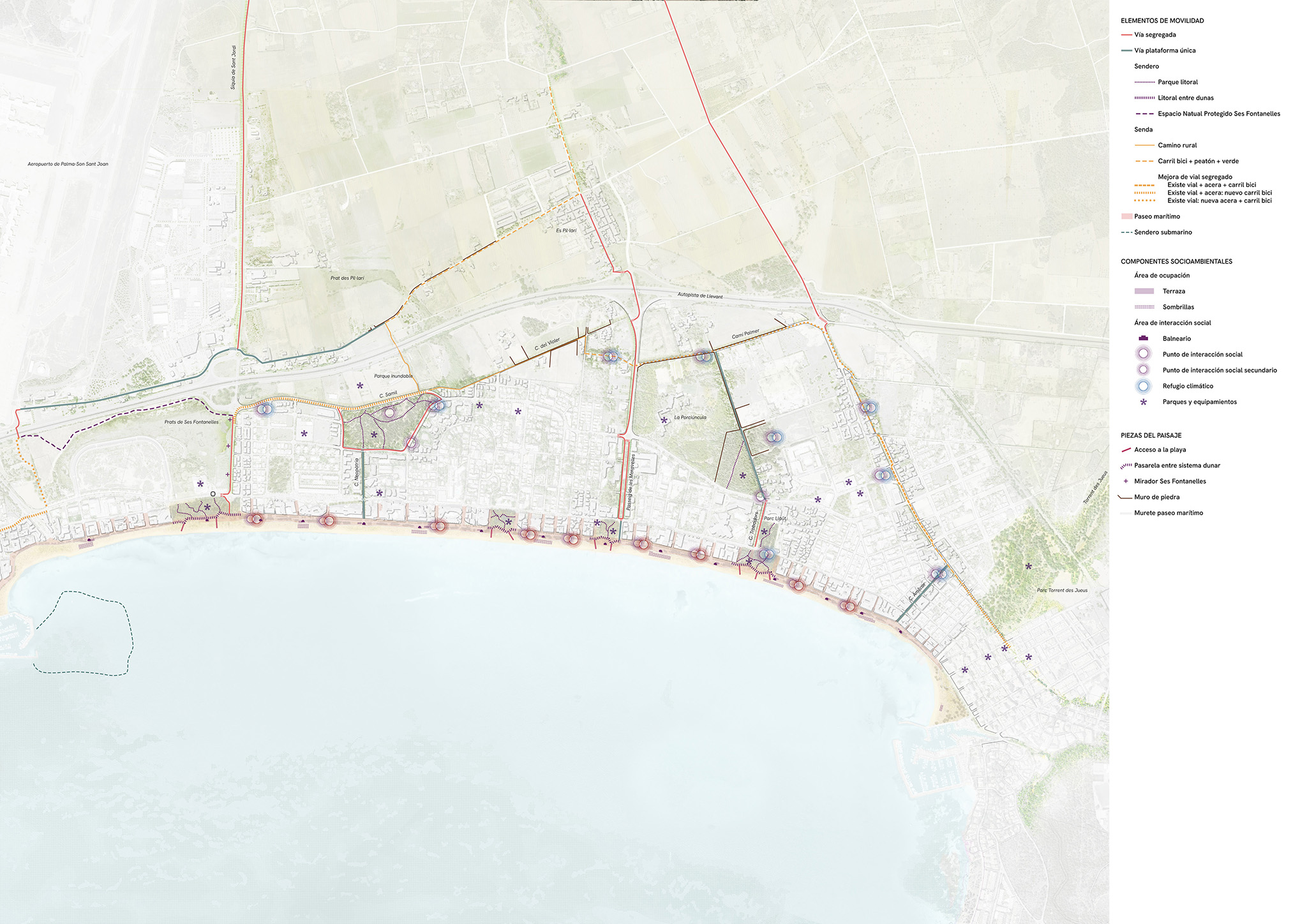
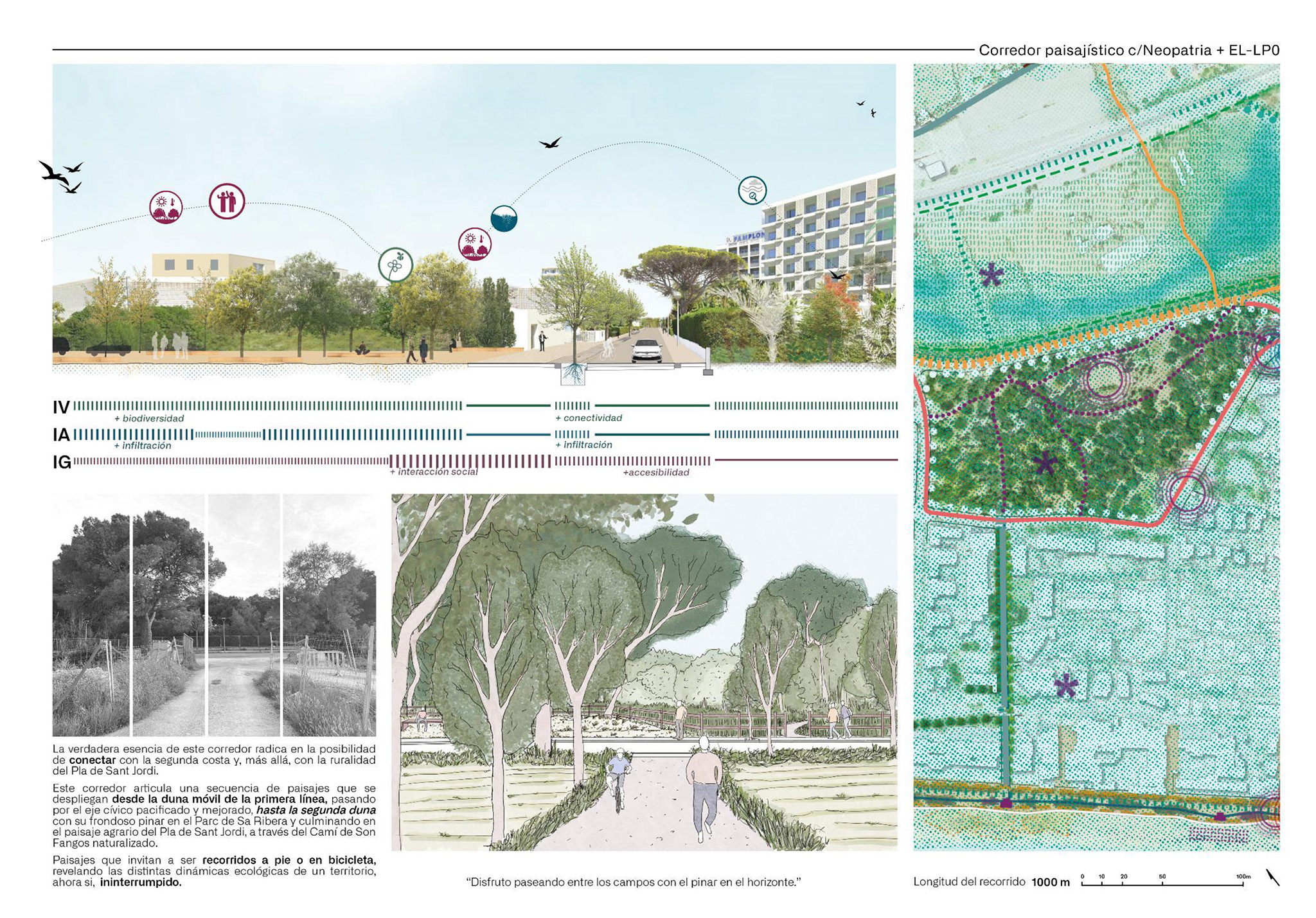
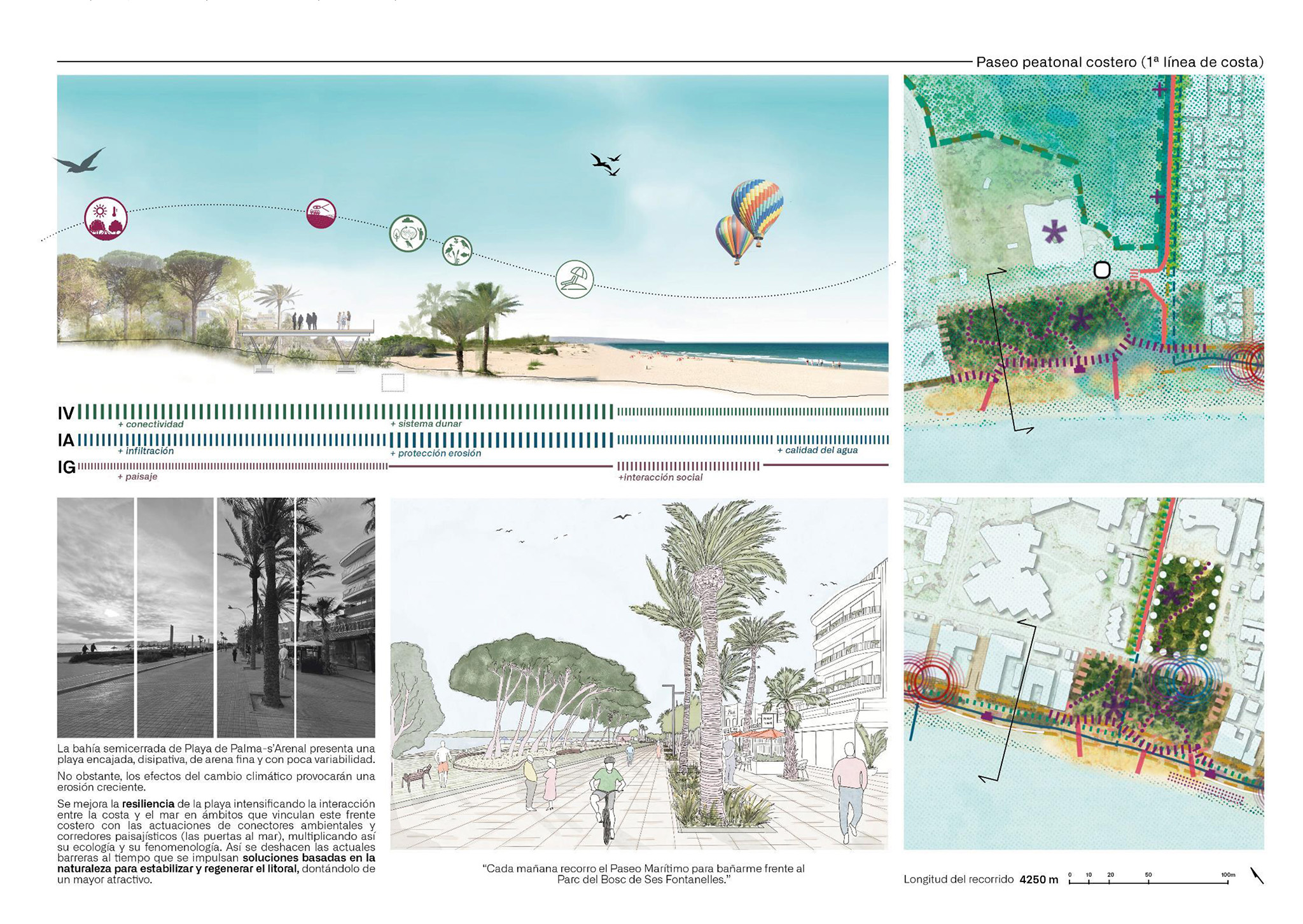
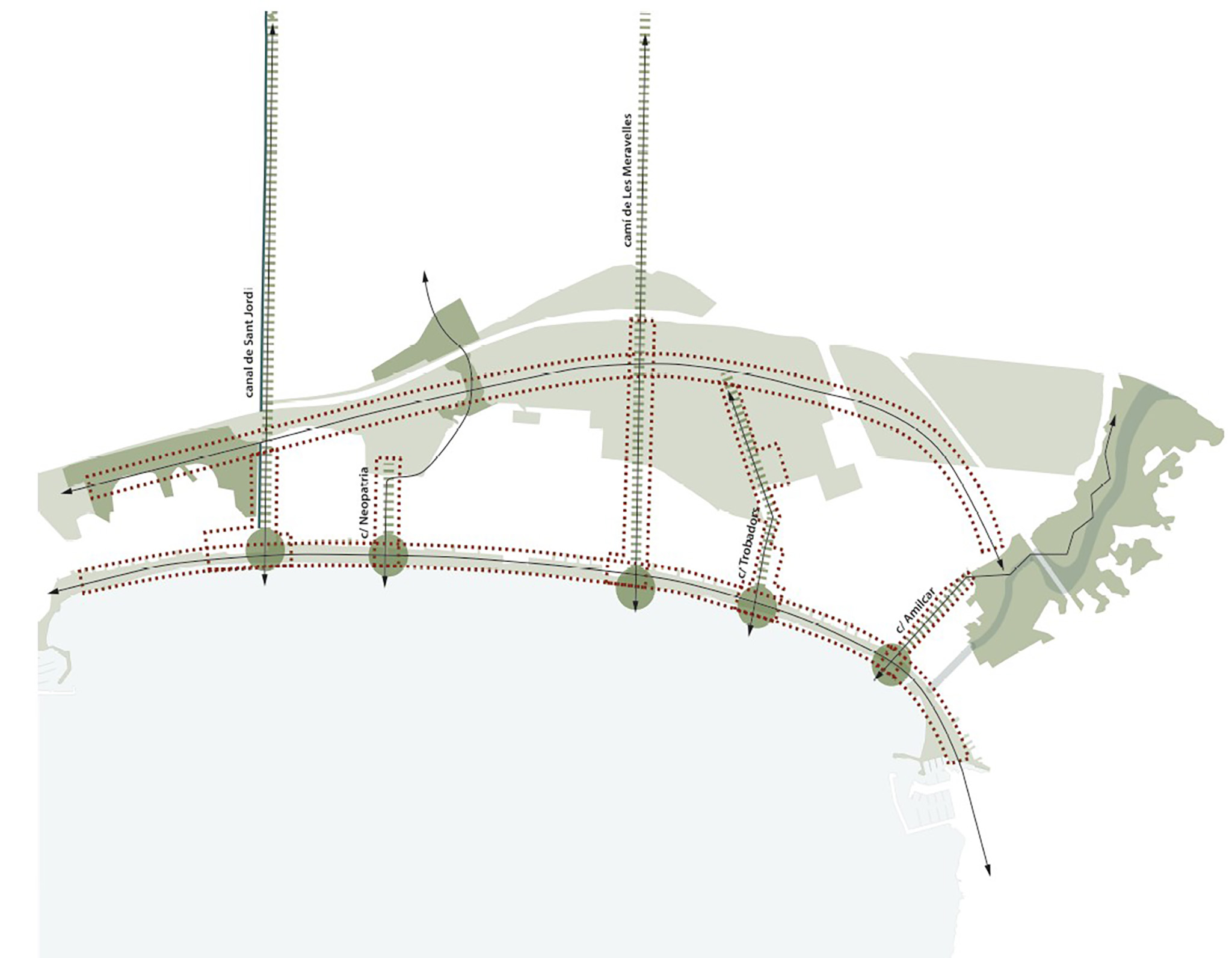
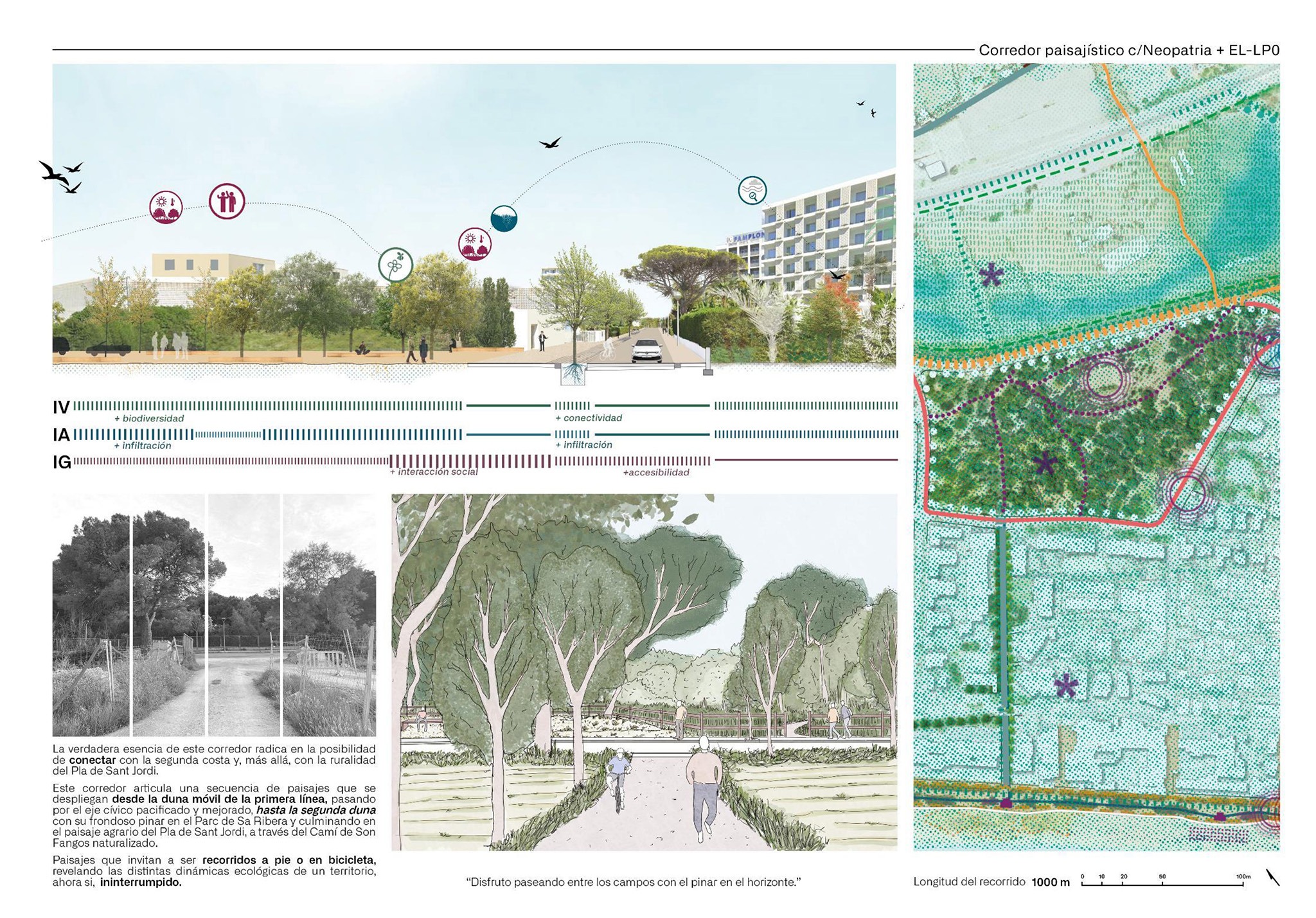
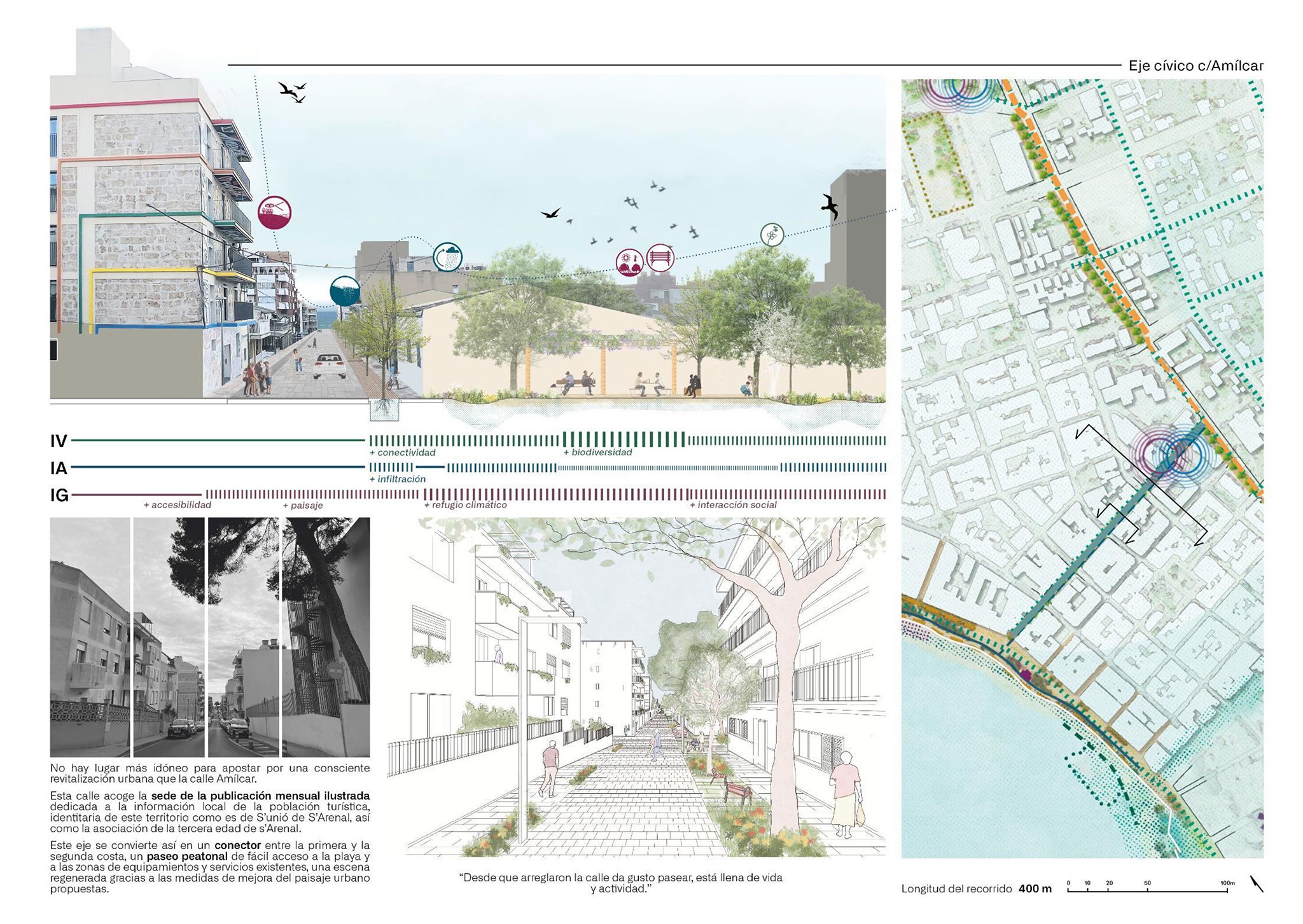
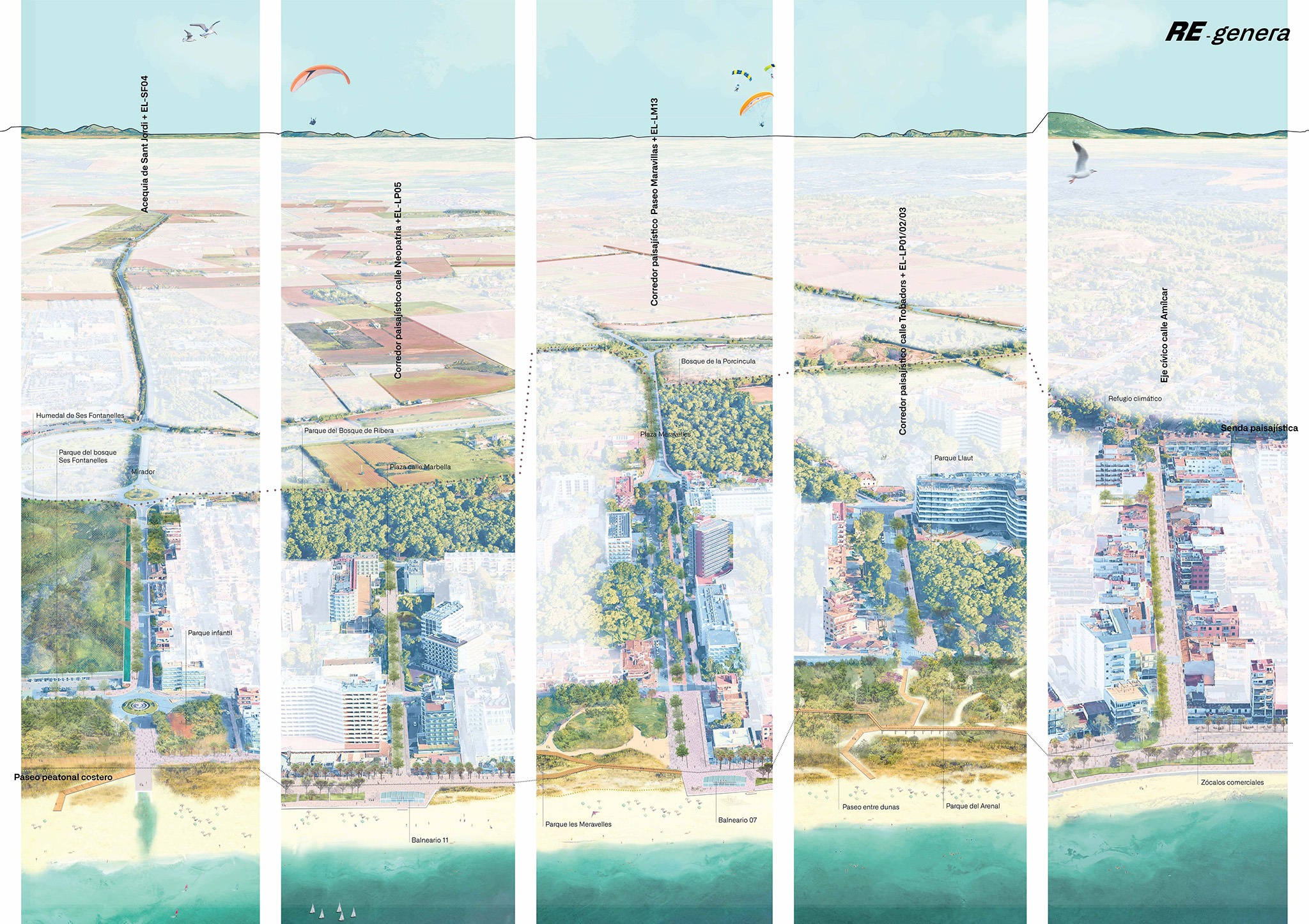
It focuses on developing seven areas of action, such as the ecological restoration of the Ses Fontanelles dune system; the Neopàtria landscape corridor; the revitalization of the Les Meravelles promenade; the reconnection of the dune system and coastal pine forest via the Trobadors axis; the climate-adapted redevelopment of the Amílcar civic axis; the consolidation of a scenic path along the urban-rural boundary; and the regeneration of the boardwalk as a continuous linear coastal park. All these corridors provide the area with a permeable, inclusive, and accessible infrastructure.
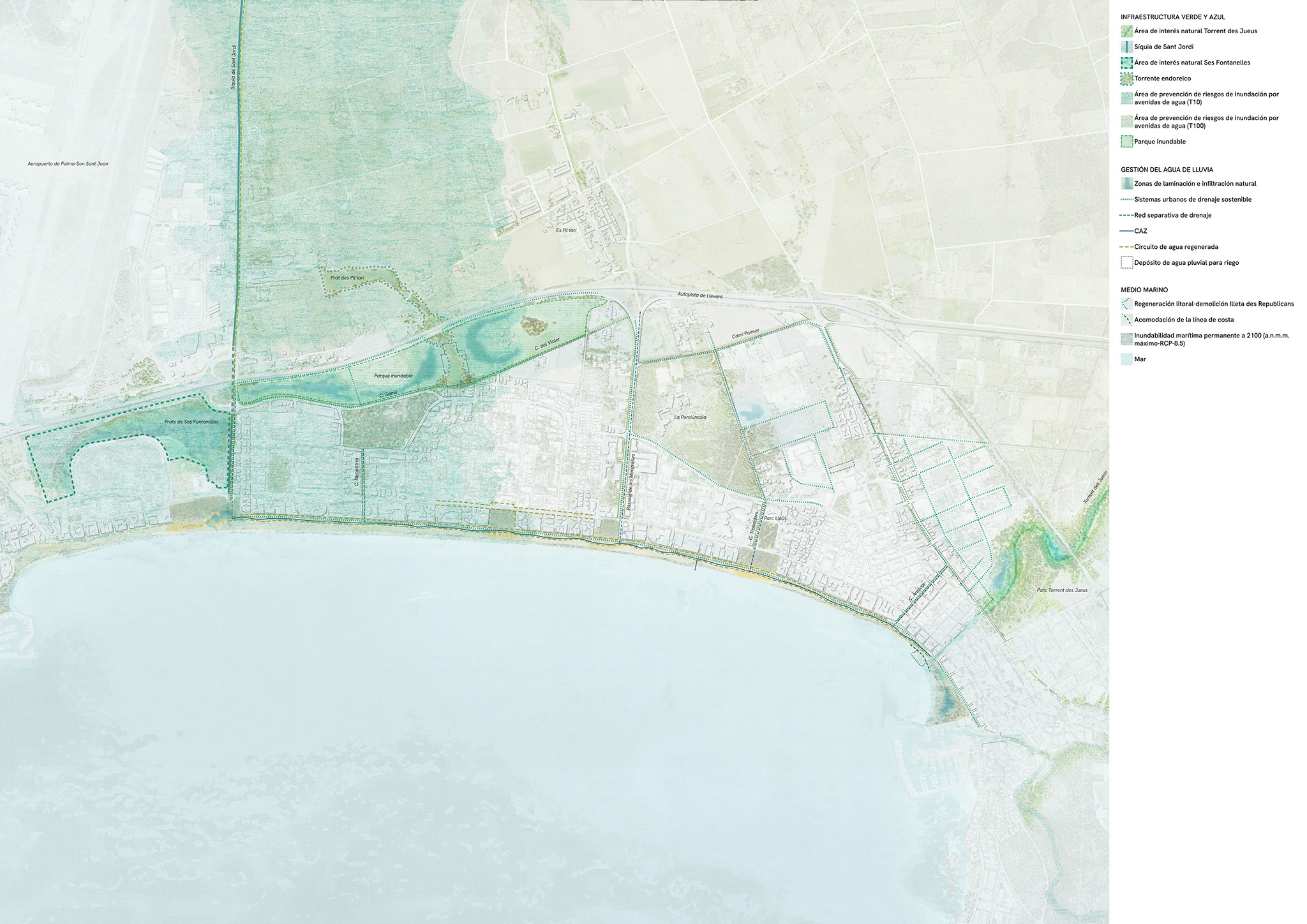
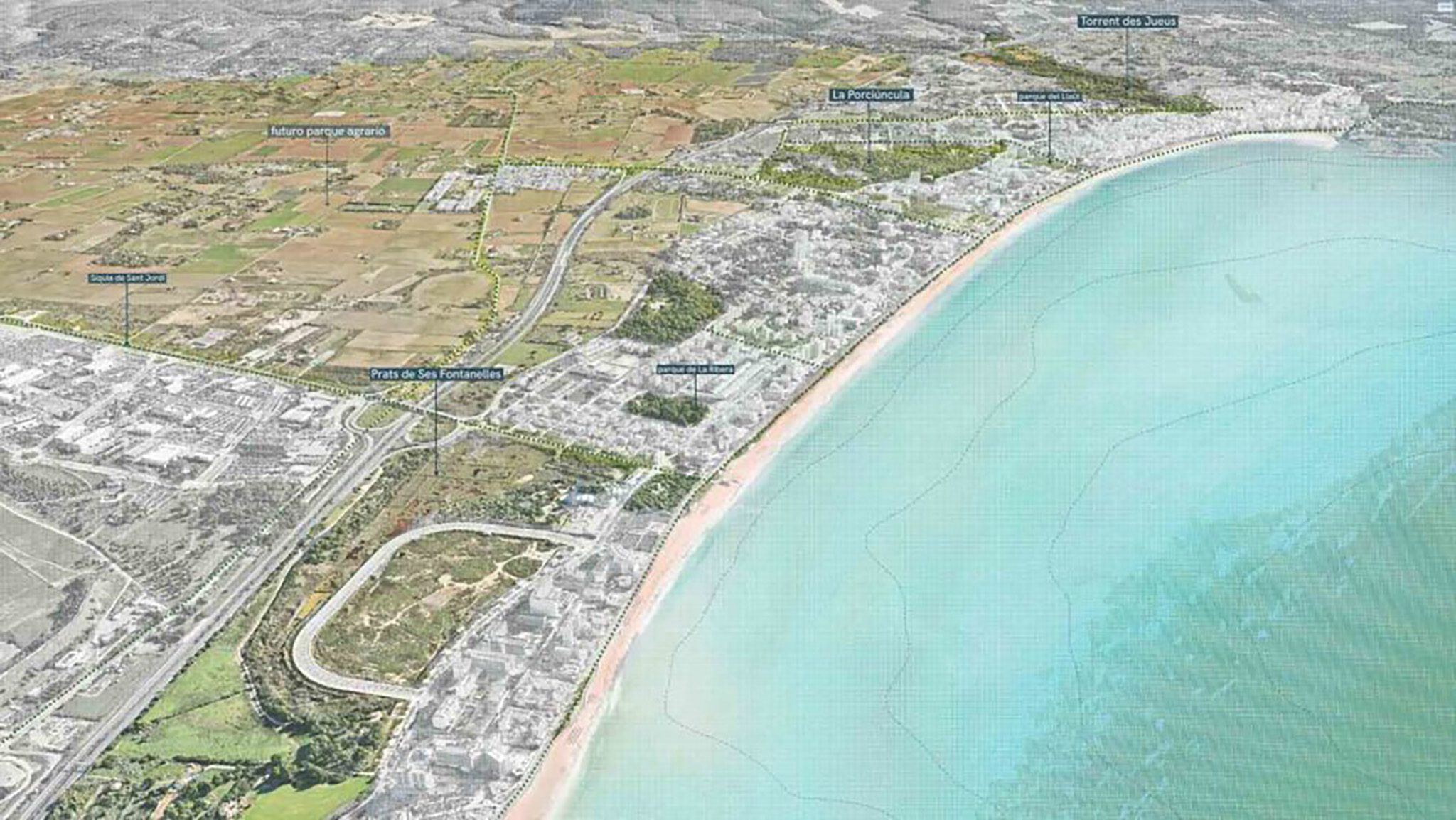
Strategy plan. Strategic Regeneration Plan for Playa de Palma by LANDLAB + Fiol Aquitectes.
Project description by LANDLAB + Fiol Arquitectes
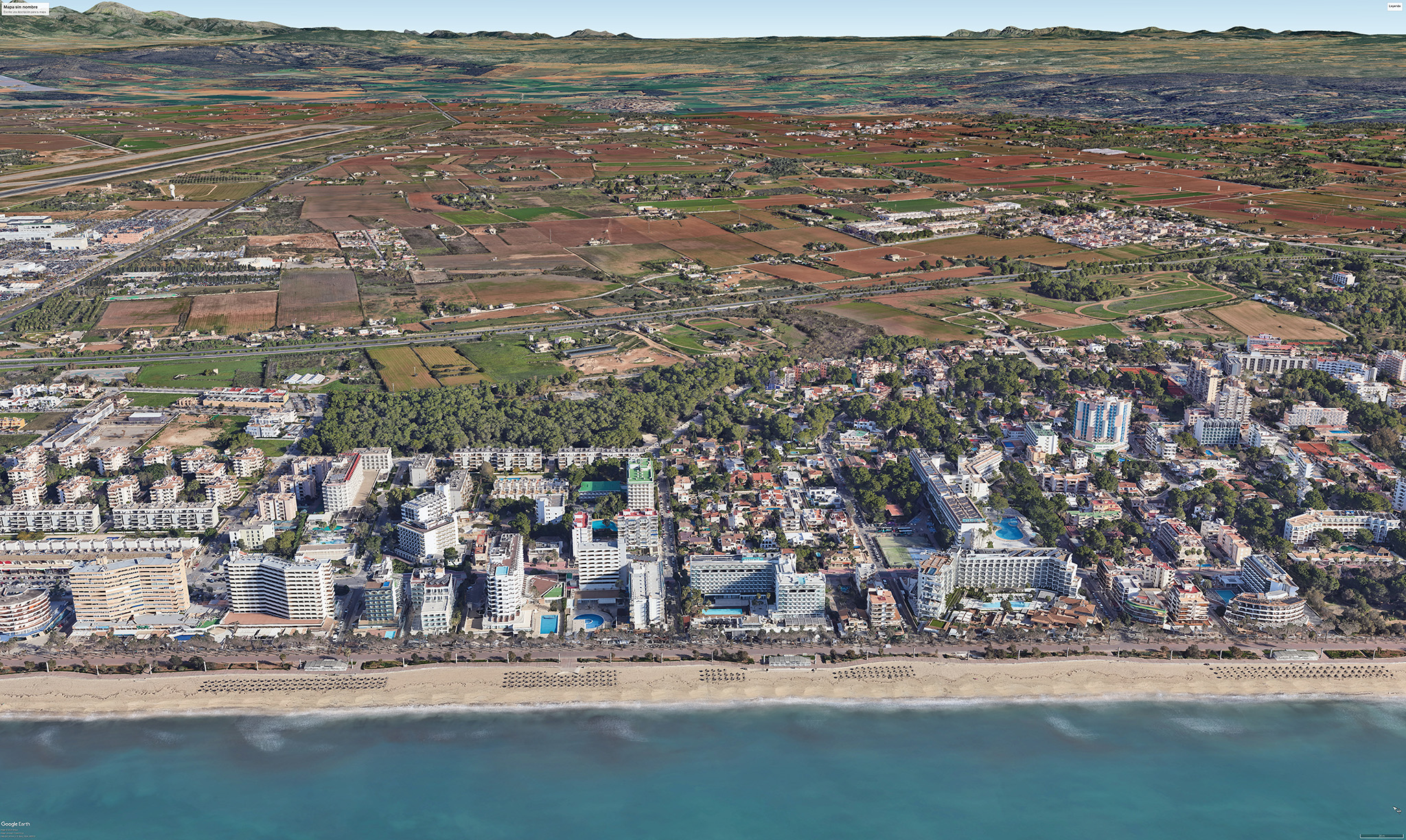
Playa de Palma represents one of the Mediterranean’s most emblematic tourist landscapes and, simultaneously, one of the coastal territories that most clearly reflects the contemporary contradictions between intensive urbanisation, climate vulnerability and the loss of territorial identity. Originally formed upon a former dune and agricultural system closely linked to the Pla de Sant Jordi, its evolution during the second half of the twentieth century was driven by an expansive tourism model based on intensive coastal occupation and the progressive artificialisation of the territory.
Tourism-led development radically transformed the original ecological and landscape dynamics. The partial disappearance of dune systems, the alteration of wetlands, the channelisation of streams and irrigation canals, extensive soil sealing, and the disconnection between the seafront and the inland agricultural landscape generated a territory highly specialised in tourism, yet increasingly vulnerable to environmental and climate-related impacts. The current urban model, largely detached from the physical suitability of the territory and its natural resources, has diminished the adaptive capacity of the coastline and weakened many of the ecological processes that historically structured this coastal landscape.
Within this context, the Strategic Regeneration Plan for Playa de Palma emerges as an innovative proposal for urban and territorial regeneration grounded in landscape architecture and climate resilience. Developed within the framework of the Recovery, Transformation and Resilience Plan – Next Generation EU, the project constitutes Phase I of an integrated process of climate adaptation and transition towards a circular tourism model. Beyond a conventional public-space renewal scheme, the plan proposes a profound transformation in the relationship between tourism, territory and nature, understanding landscape as ecological infrastructure, a support for collective identity, and a metabolic system capable of enhancing the destination’s long-term resilience.
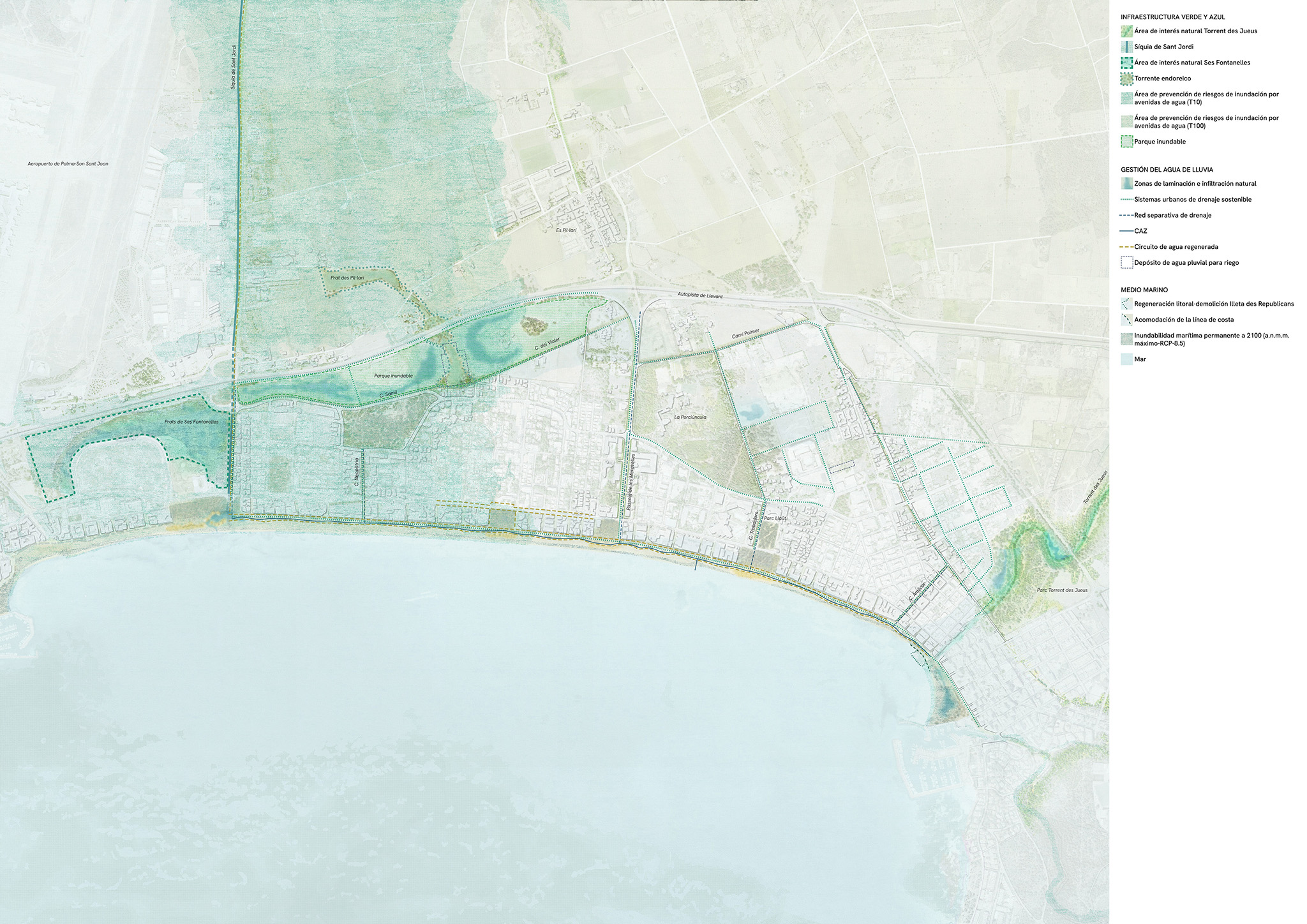
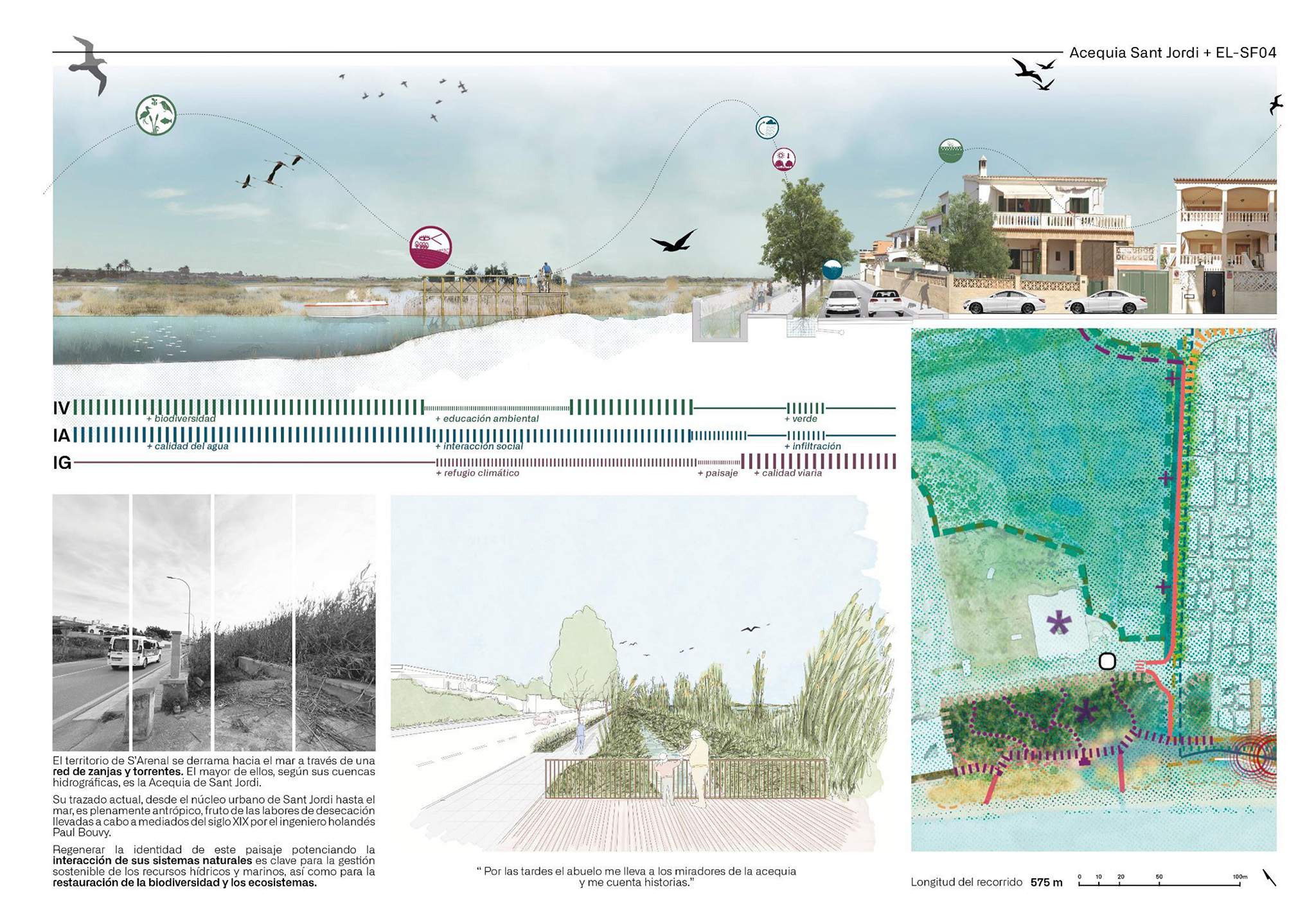
The proposal is based on a multiscalar territorial reading that integrates historical knowledge, ecological assessment and climate change projections. Playa de Palma is currently highly exposed to phenomena associated with global warming, including increased risks of permanent flooding and storm surge inundation, coastal erosion and beach tilting, saltwater intrusion, groundwater alterations, and the progressive degradation of wetlands and coastal ecosystems. Areas associated with the Acequia de Sant Jordi and the Ses Fontanelles system are particularly vulnerable to urban flooding and extreme climate events.
In response to this scenario, the plan defines an operational roadmap for the regeneration and renaturalisation of approximately 38.9 hectares of coastal public space, with an estimated investment of €118 million. The intervention aligns with the Spanish Urban Agenda and Palma’s PG’23 urban framework, ensuring regulatory coherence, technical feasibility and phased implementation capacity.
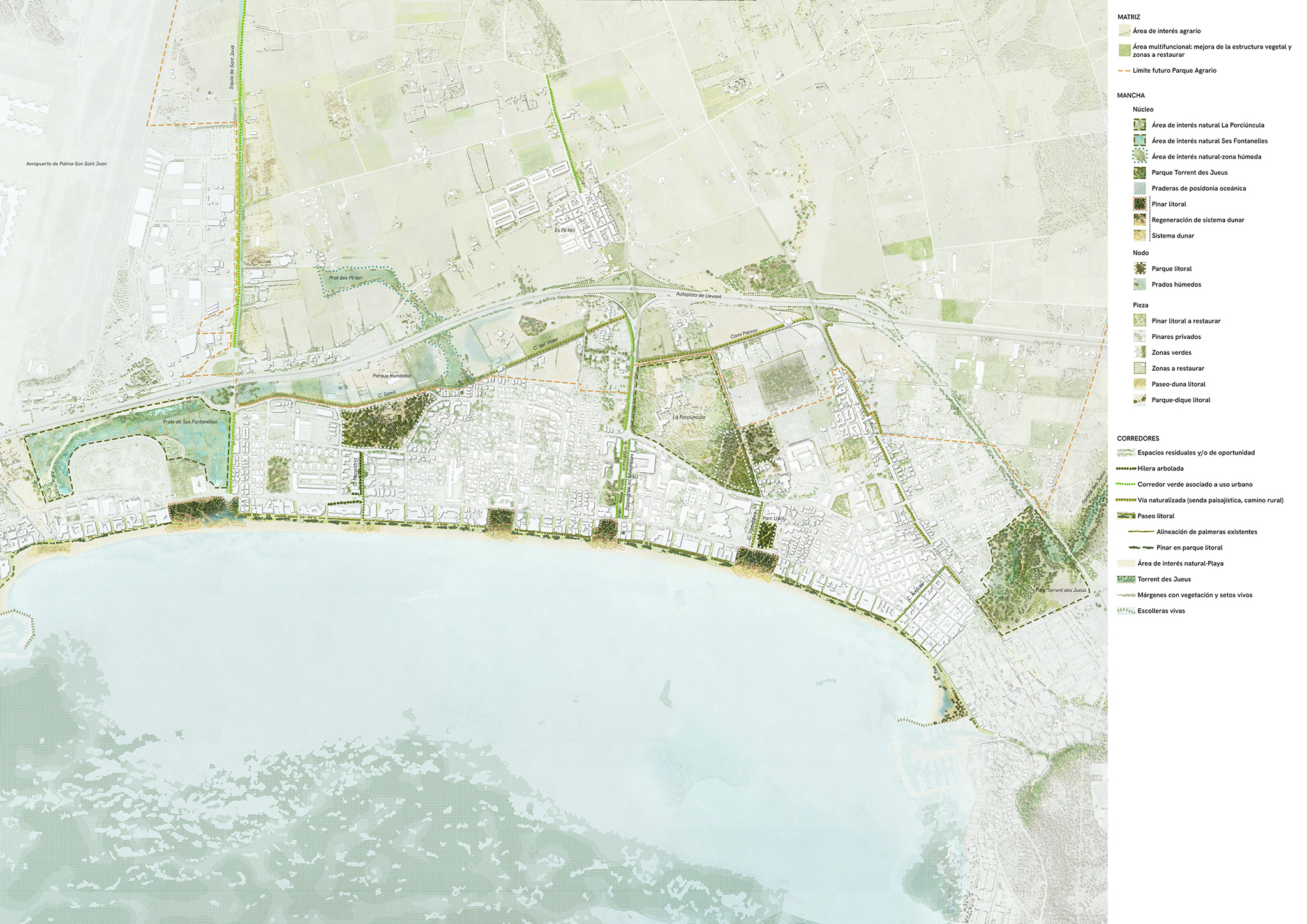
The territorial strategy is structured around a hierarchical network of environmental spaces and corridors reconnecting the seafront with the inland Pla de Sant Jordi landscape. The system is articulated through the coastal pedestrian promenade, an inland landscape transition route between urban and rural environments, and several transversal axes functioning simultaneously as ecological corridors, climate infrastructures and civic spaces. These elements restore the environmental continuity of the territory, improve accessibility and redefine public space as a framework for coexistence, urban health and social cohesion.
One of the proposal’s central concepts is the activation of the territory’s so-called “biological fullness”. From this perspective, non-built spaces — dunes, green corridors, wetlands, permeable areas and vegetated systems — are no longer understood as urban voids or residual spaces, but rather as essential infrastructures supporting ecological, hydrological and social processes. This approach fundamentally redefines the role of landscape within contemporary planning and positions nature as the structuring element of urban regeneration.
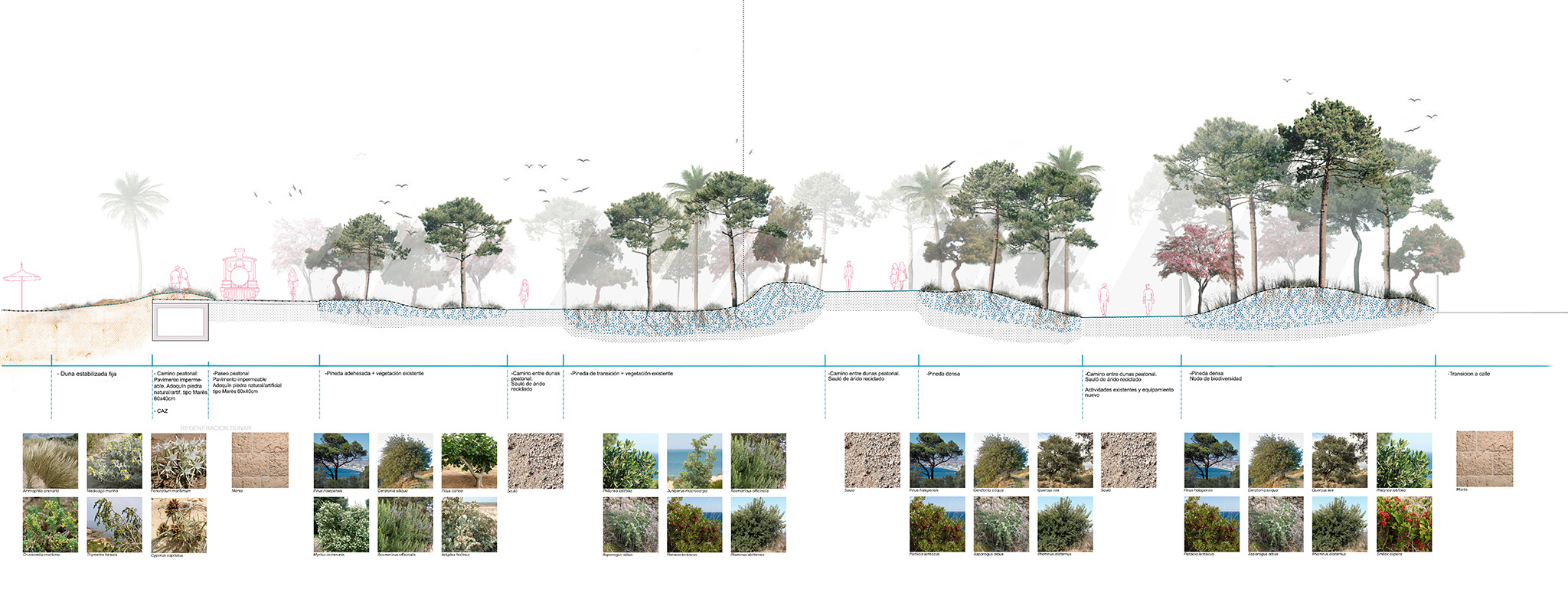
The proposal develops an integrated green, blue and grey infrastructure system based on nature-based solutions and sustainable urban drainage systems (SUDS). The project incorporates strategies aimed at retaining, infiltrating and reusing water, protecting aquifers, reducing flood risk, and simultaneously improving climatic comfort and the habitability of public space. Permeable pavements, rain gardens, bioswales, climate-adapted revegetation and infiltration systems form part of a new metabolic logic for urban space.
Vegetation plays a central role within this strategy. The plan conceives tree planting and vegetated systems as genuine public-health infrastructures capable of regulating microclimates, capturing CO₂, enhancing biodiversity and increasing collective well-being. Priority is given to Mediterranean-adapted and low water-demand species, thereby reducing water consumption and reinforcing the future resilience of the urban system.
The landscape dimension of the project is particularly significant. The proposal does not merely introduce environmental solutions, but also restores historical relationships between the coastline and the inland territory, reclaiming the value of dune systems, irrigation canals, pine groves and agricultural landscapes as fundamental components of territorial identity. The memory of place thus becomes an active design tool and an essential support for reconstructing the spatial and environmental quality of the coastline.
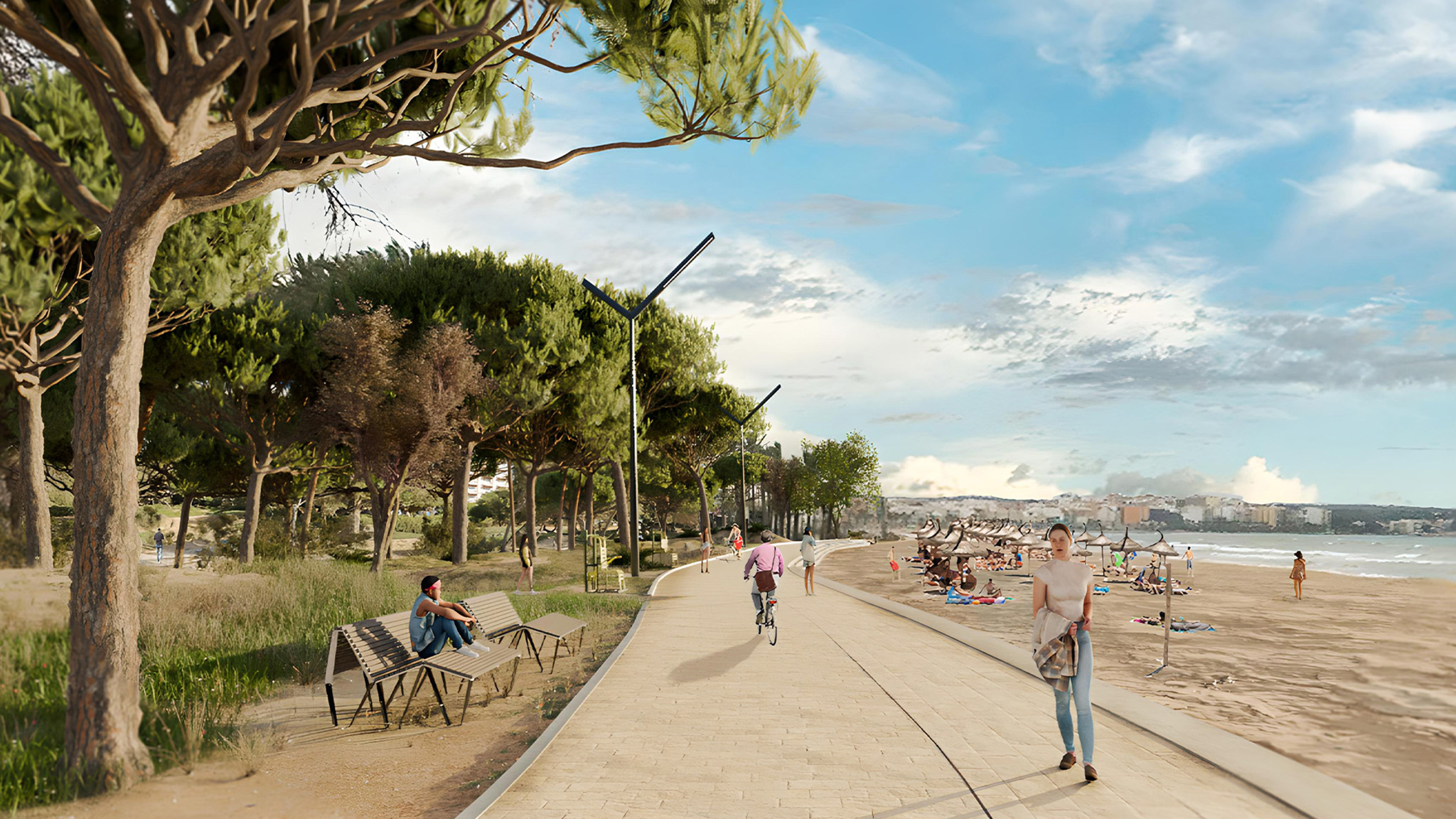
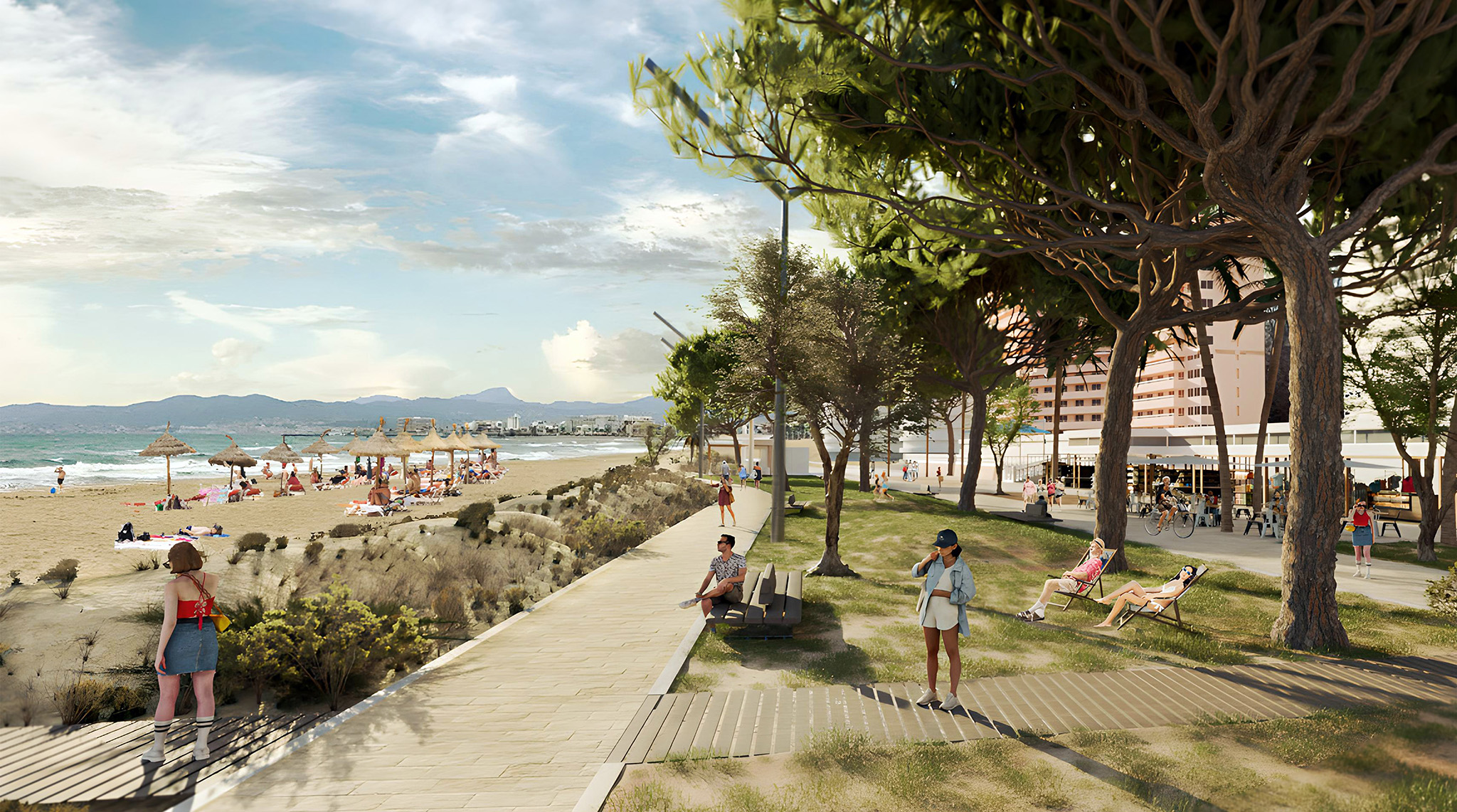
The design is articulated through seven interrelated intervention areas: the ecological restoration of the Ses Fontanelles dune system; the Neopàtria landscape corridor; the revitalisation of the Les Meravelles promenade; the reconnection of the dune and coastal pine systems through the Trobadors axis; the climate-adapted reurbanisation of the Amílcar civic axis; the consolidation of an urban-rural edge landscape route; and the regeneration of the seafront promenade as a continuous linear coastal park.
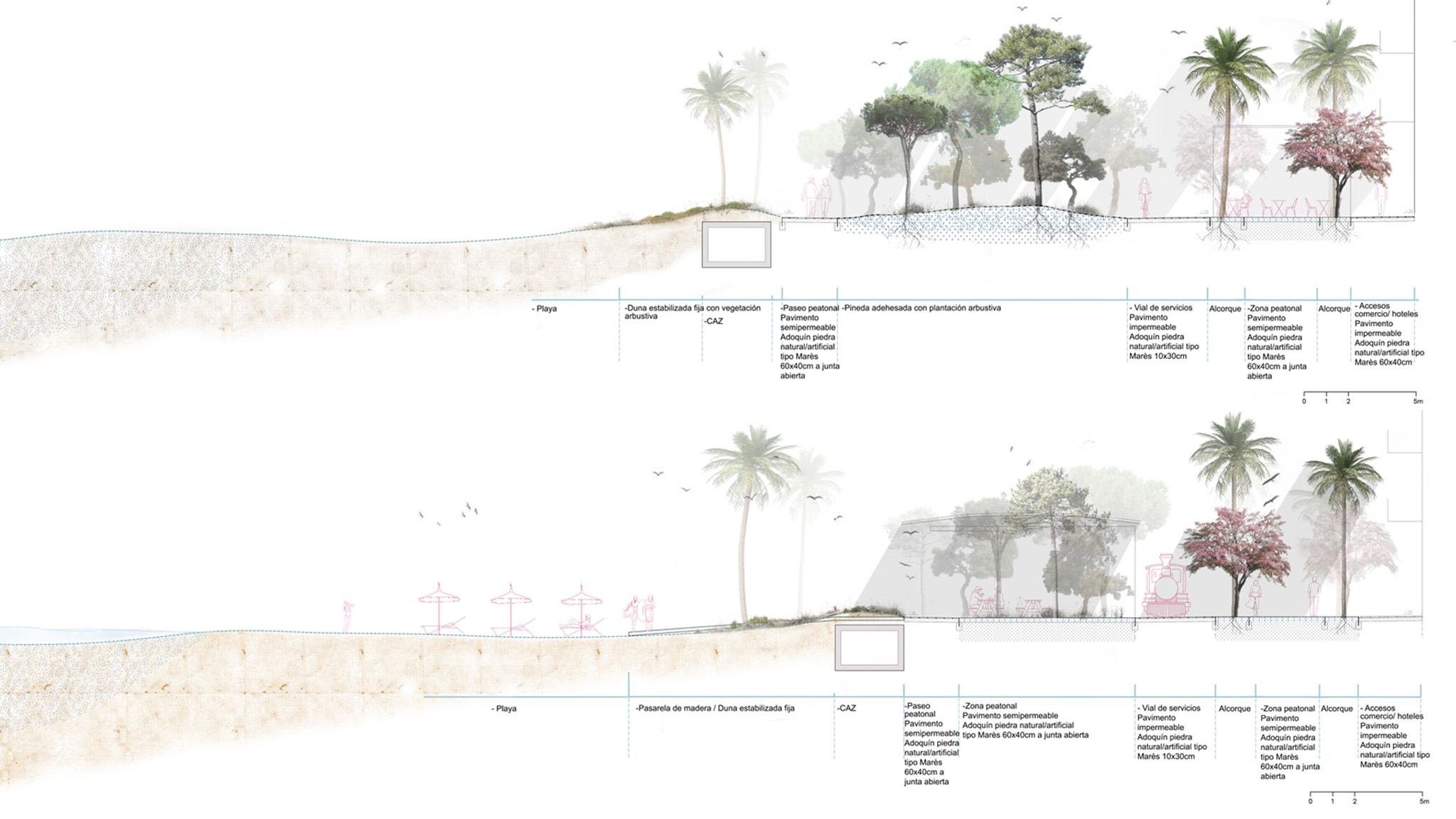
Each of these areas operates simultaneously at local and territorial scales. Environmental corridors improve pedestrian and cycling mobility, introduce biodiversity into the urban fabric, and reinforce ecological connectivity between the coast and inland territories. The seafront promenade is redefined as a permeable, inclusive and accessible public infrastructure capable of accommodating complex environmental dynamics while providing enhanced climatic comfort and urban quality.
The project also incorporates advanced climate-responsive design and materiality criteria derived from the analysis of local conditions such as wind regimes, solar exposure, rainfall patterns, geotechnical characteristics and resource availability. A balanced ratio of 50% permeable and impermeable surfaces is prioritised, together with the use of durable, recyclable and low-embodied-energy materials, preferably sourced locally.
Future implementation is organised through a phased system of priorities capable of reconciling interventions with tourism seasonality and the continuity of the destination’s economic activity. This gradual strategy enables a progressive transition towards a more resilient and sustainable model without compromising the everyday functioning of Playa de Palma.
In the current context of climate crisis and accelerated biodiversity loss, Playa de Palma thus becomes a contemporary laboratory for urban innovation and landscape regeneration applied to mature tourist destinations. The project demonstrates that coastal regeneration can no longer be limited to beautification operations or the functional renewal of tourist spaces, but must instead reconstruct the relationships between ecology, territory, memory and collective life.
The proposal places both people and landscape at the centre of contemporary strategic planning and establishes a replicable model of resilient coastal regeneration for other Mediterranean destinations. In contrast to a tourism model historically based on the intensive exploitation of the seafront, the plan proposes a new urban ecology in which landscape, biodiversity and territorial metabolism become the principal infrastructures for ensuring the future habitability of the Mediterranean coastline.