The registration platform for this year's Bienal Panamericana de Arquitectura de Quito competition is now open. The Colegio de Arquitectos de Pichincha (CAE-P) has been organizing the BAQ every two years in November since 1978. The event is one of the most important on the American continent.

The competition is based on three axes. The first of these is Competition, Academic and Cultural, and this year's theme is Inflexiones: Volver a ver. It will address the debate on architecture at turning points in history.
Since 1978, the Pichincha College of Architects (CAE-P) has been organizing the QUITO PAN AMERICAN ARCHITECTURE BIENNIAL (BAQ) in November of even-numbered years, considered one of the most important architecture events on the American continent, which is made up of three axes: Contest, Academic and Cultural.

In its next edition, BAQ2022 will address the theme: "INFLEXIONS: TO SEE AGAIN", which allows us to see things from different points of view and build bridges between the architecture of the past, present and future. It will be the meeting place that addresses the discussion and debate on architecture around the turning points in history; those that generate questions and demand reflections from those of us who act on it.


As has become a tradition, the BAQ includes the Biennial Competition, recognized around the world for being an open call for projects and publications produced during the four years before each biennial that recognizes the best practices in design and contemporary architecture. In its twenty-two editions, it has received more than 7,000 entries and has rewarded contributions to the practice of architecture, urban planning, landscape, architectural theory, and dissemination.

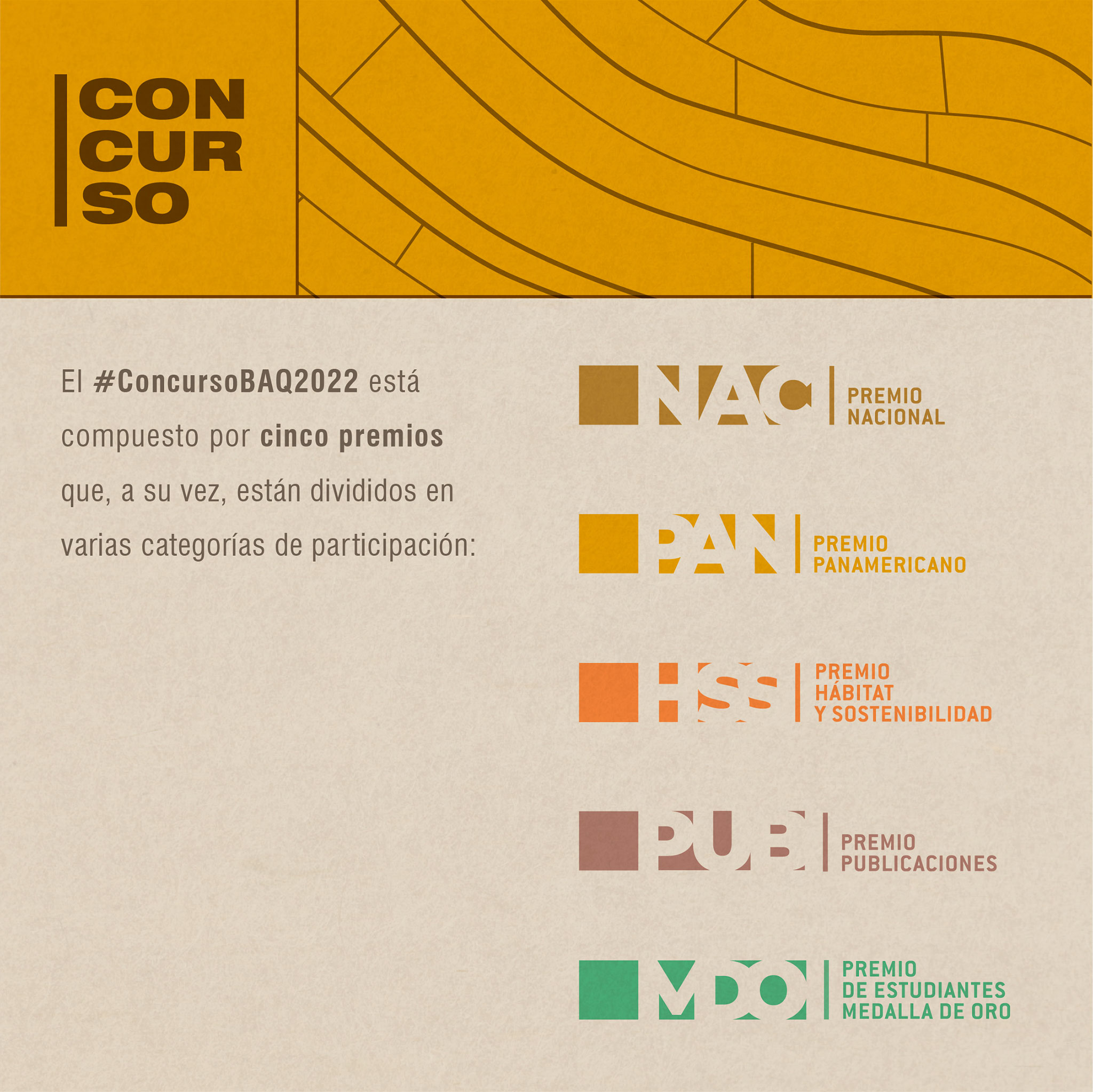
This year, one of the main objectives of the BAQ2022 Organising Committee is to consolidate and deepen both the processes and the products of the Biennial Competition, maintaining the multiplicity of views and practices. This time, 5 prizes have been proposed, which are divided into several categories of participation:
 
● NATIONAL PRIZE. - Projects built in Ecuador.
PAN-AMERICAN PRIZE. - Projects built on the American continent.
HABITAT AND SUSTAINABILITY AWARD. - Projects built all over the world.
● PUBLICATIONS AWARD. - Publications published throughout the Americas.
● GOLD MEDAL STUDENT AWARD. - Academic projects by students from the Faculties and Schools of Architecture of Ecuador.

The registration platform for the BAQ 2022 COMPETITION is now ready. All those interested can do so by clicking on this link: bit.ly/ConcursoBAQ22.

The works that meet the requirements will be part of the exhibition of the Biennial Competition 2022, of the judging process and will be published in the BAQ Digital Archive: www.arquitecturapanamericana.com

More information

+ + copy Created with Sketch.
- + copy Created with Sketch.
Label
Dates
Text
Registration.- 20 June-30 September.
+ + copy Created with Sketch.
- + copy Created with Sketch.
Label
Location Localización
Text
Quito, Ecuador.
+ + copy Created with Sketch.
- + copy Created with Sketch.
Taller de Arquitectura / Mauricio Rocha (b. Mexico City, Mexico, 1965) graduated from the Faculty of Architecture at the National Autonomous University of Mexico (UNAM), Max Cetto Workshop, between 1985 and 1990, obtaining an Honourable Mention. In 1991, he founded Taller de Arquitectura / Mauricio Rocha in Mexico City, which has remained in continuous operation since its establishment.

Over more than 30 years of professional practice (1991–present), he has developed public and private projects at multiple scales, including cultural, educational, institutional, housing and infrastructure buildings, primarily in Mexico, as well as temporary architectural interventions for art exhibitions and museography projects.

He has received numerous awards both individually and as a firm. In 2013, the Faculty of Architecture of UNAM awarded him the Federico Mariscal Chair, the highest recognition granted by this institution for professional practice. In 2014, he was selected as one of 8 architecture firms from the Americas for the Emerging Voices program organized by The Architectural League of New York. His work has received First Prize and Gold Medal on two occasions at the Mexican Architecture Biennial, as well as awards at the Pan-American Architecture Biennial of Quito (BAQ) and the Ibero-American Architecture and Urbanism Biennial (BIAU).

In 2019, he was awarded the Médaille d’Or Palmarès by the French Academy of Architecture, recognizing his professional career. In 2024, he received the Brick Award, an international recognition for architectural works using brick as a primary material.

He has served as a fellow and jury member for the National Fund for Culture and the Arts (FONCA), as well as for national and international competitions, institutions and architecture biennials. He is a permanent jury member of the Marcelo Zambrano Scholarship. He is a member of the National Academy of Architecture and a member of the National Academy of Arts of Mexico.

Mauricio Rocha has taught at several universities in Mexico City, including UNAM, and has delivered lectures and conferences in Mexico, South America, the United States and Europe. His work has been exhibited in Mexico City, New York, Venice, Turin, São Paulo and China. His projects have been published in international journals and books such as Domus, 10x10 (Phaidon), Arquine, Escala, Summa+, The Architectural Review and The Plan. In 2011, he published the monograph Mauricio Rocha Taller de Arquitectura.

Read more
Duque Motta​ is an architectural practice based in Santiago de Chile, founded in 2004 by Rodrigo Duque Motta, first as RDM architecture. 

Their work seeks to build value based on a methodology focused on customer needs and collaborative work; intensively using design as a tool for improvement that multiplies the possibilities; with sensitivity and respect for the physical, cultural and environmental context; and a focus on the definition of identity and construction of human experience.

Rodrigo Duque Motta was born in Santiago, Chile, in March 1976. He received his architecture degree from Pontificia Universidad Católica in 2001. He is Architecture design professor at Pontificia Universidad Católica and has run his own architecture studio since 2003. In 2007 he received the Award of the Architects’ Association of Chile for best architect under 35. In his studio has developed projects in a wide range of areas. In the hotel sector highlights the Casino & Hotel of Talca and the Elqui Domos Astronomical Hotel; in industrial area the development of projects for Quintay and Emiliana Vineyards; in the institutional sphere the Faculty of Economics of UDP. Finnaly in residential area has developed Chile-España building, and Duque House, with which he won the prize for the best work in the residential category at the Architecture Biennale of Santiago in 2004. His works have been published in specialized magazines in more than 20 countries.
Read more

MAPAAC is a practice with offices in Spain and Chile, led by Pablo Núñez, Cristian Larraín, Matías Madsen, and Juan Vicente. They have the capacity to assemble multidisciplinary teams capable of addressing all aspects involved in the planning, design, construction, and analysis of building complexes.

They integrate the experience and knowledge of its partners in the development of large-scale, strategic, and public-use projects (healthcare, educational, sports, research, residential, etc.). The team is capable of confidently approaching professional practice, understanding it as a multidisciplinary, collective project aimed at providing effective, diverse, and natural solutions to complex problems.

Pablo Núñez Paz holds a PhD in Architecture, graduating in 1989 from the Higher Technical School of Architecture of Valladolid (ETSAV). He completed postgraduate studies at the European School of Architecture in Madrid in 1990-91 and revalidated his degree at the University of Chile in 2011. He has taught Architectural Design at ETSAV, in the Spanish Architecture Biennial Workshop, and in the Master's program at the University of Salamanca (USAL). His teaching and research have always been closely linked to his dedication to the design and construction of public buildings and strategic projects with significant landscape components.

Cristián Larraín is an architect, graduating in 2006 from the Pontifical Catholic University of Chile. He has been an assistant professor at the same institution since 2006. His teaching and research have always focused on issues related to design, the environment, and urban planning, with notable works where the study of materials and their relationship to space allows for tailored solutions to the diverse challenges arising from the various commissions he has undertaken.

Matías Madsen Jaime (Santiago, 1979) is an architect with a Master's degree in Urban Development from the Pontifical Catholic University of Chile (2010) and received the Academic Excellence Award in 2000. He was a professor and assistant at the same institution from 2010 to 2018.

Juan Vicente earned his architecture degree from the Madrid School of Architecture (ETSAM) in 1984 and collaborated with Alejandro de la Sota. His work focuses on public architecture, with proposals that emphasize a strong landscape presence from the project's inception. He is interested in researching construction systems that result in cost savings and reduced energy consumption.


Read more
Published on: July 12, 2022
Cite:
metalocus, CARLOS RUBIO
"Registration for the Pan-American Biennial of Architecture - BAQ 2022 competitions is now open" METALOCUS. Accessed
<https://www.metalocus.es/en/news/registration-pan-american-biennial-architecture-baq-2022-competitions-now-open> ISSN 1139-6415
Loading content ...
Loading content ...
Loading content ...
Loading content ...
Loading content ...
Loading content ...
Loading content ...
Loading content ...
Loading content ...
Loading content ...
Loading content ...
Loading content ...
Loading content ...
Loading content ...
Loading content ...
Loading content ...
Loading content ...
Loading content ...
Loading content ...
Loading content ...
Loading content ...
Loading content ...
Loading content ...
Loading content ...
Loading content ...
Loading content ...
Loading content ...
Loading content ...
Loading content ...
Loading content ...
Loading content ...
Loading content ...
Loading content ...
Loading content ...
Loading content ...
Loading content ...
Loading content ...
Loading content ...
Loading content ...
Loading content ...
Loading content ...
Loading content ...
Loading content ...
Loading content ...
Loading content ...
Loading content ...
Loading content ...
Loading content ...
Loading content ...
Loading content ...
Loading content ...
Loading content ...
Loading content ...
Loading content ...