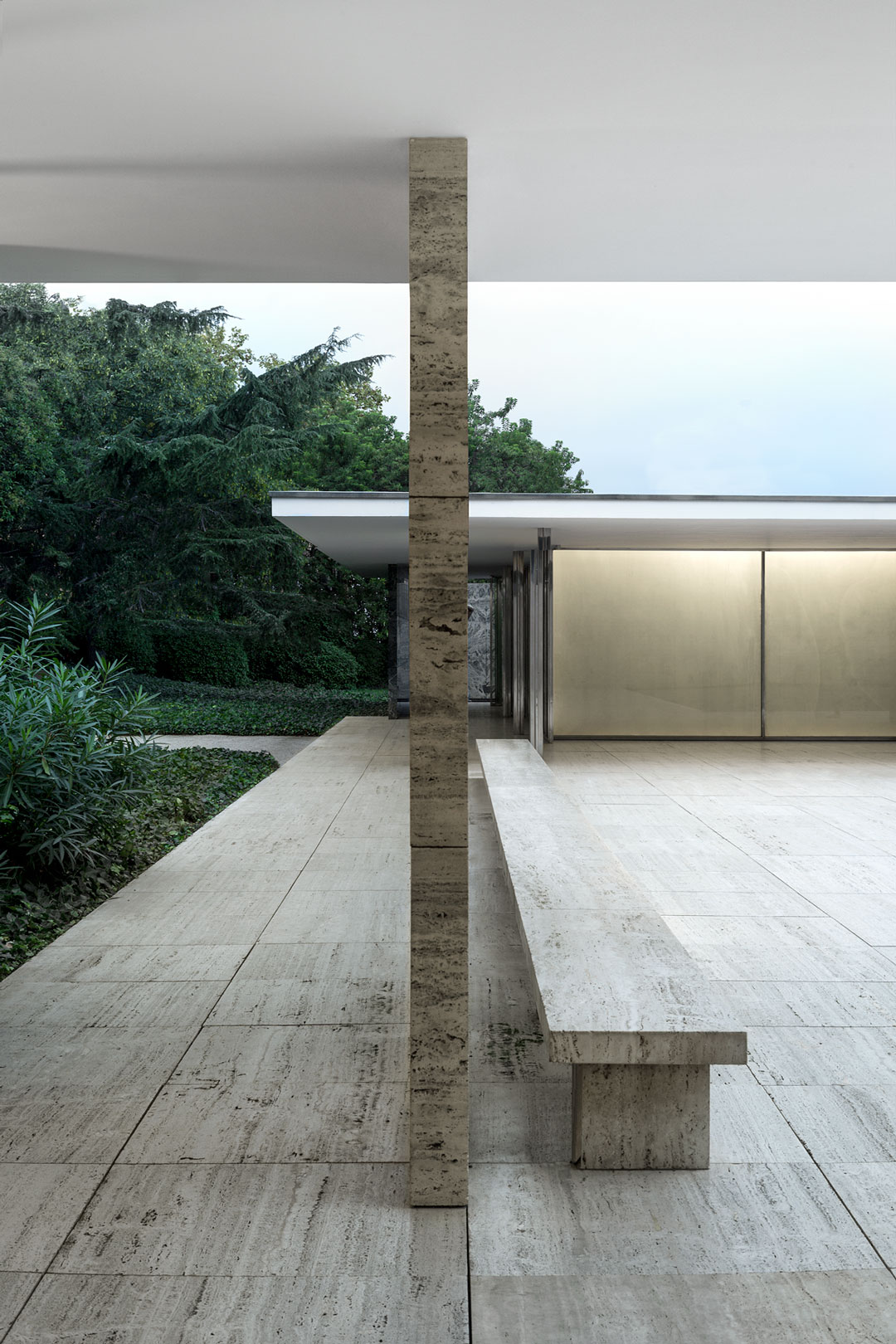
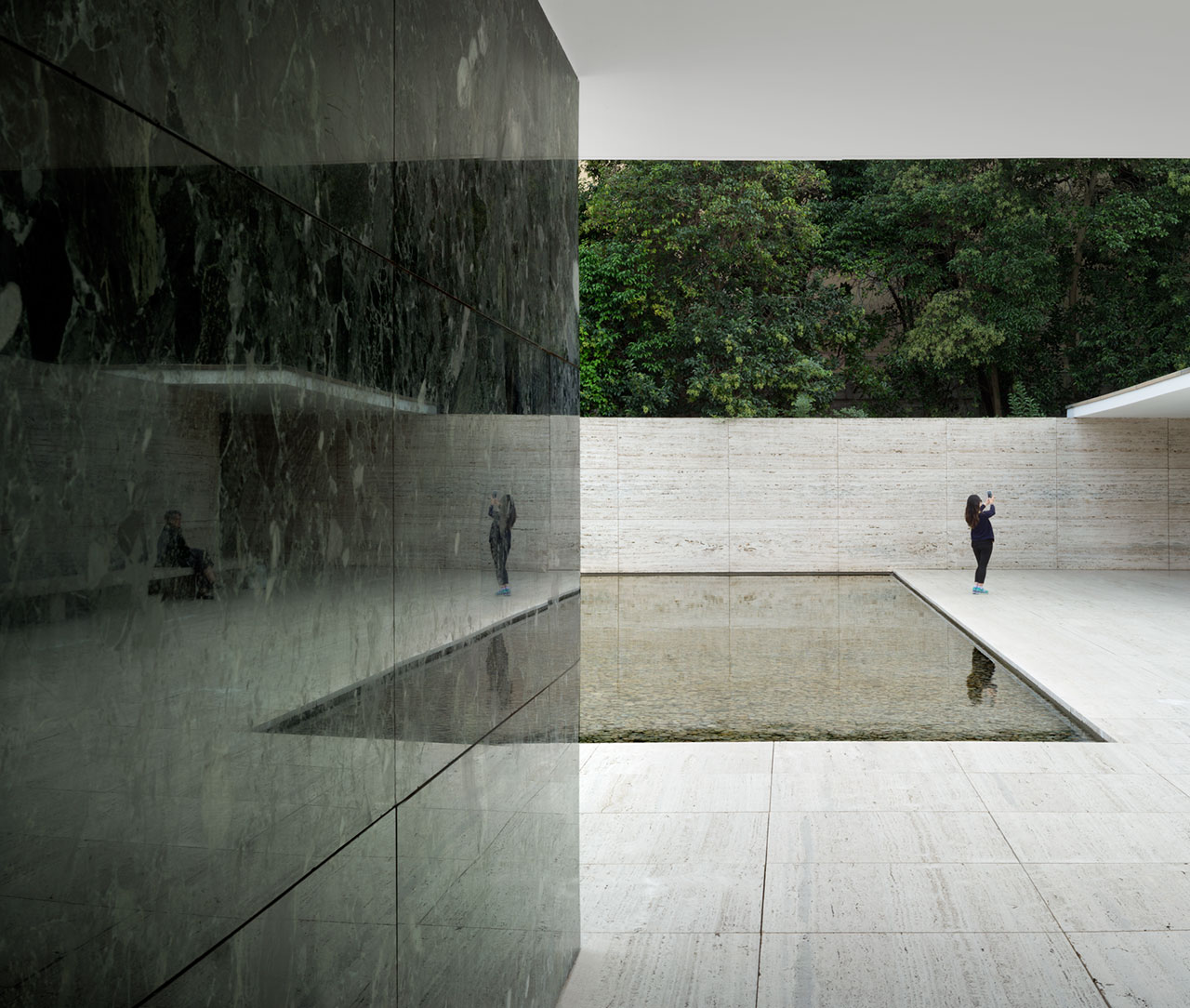
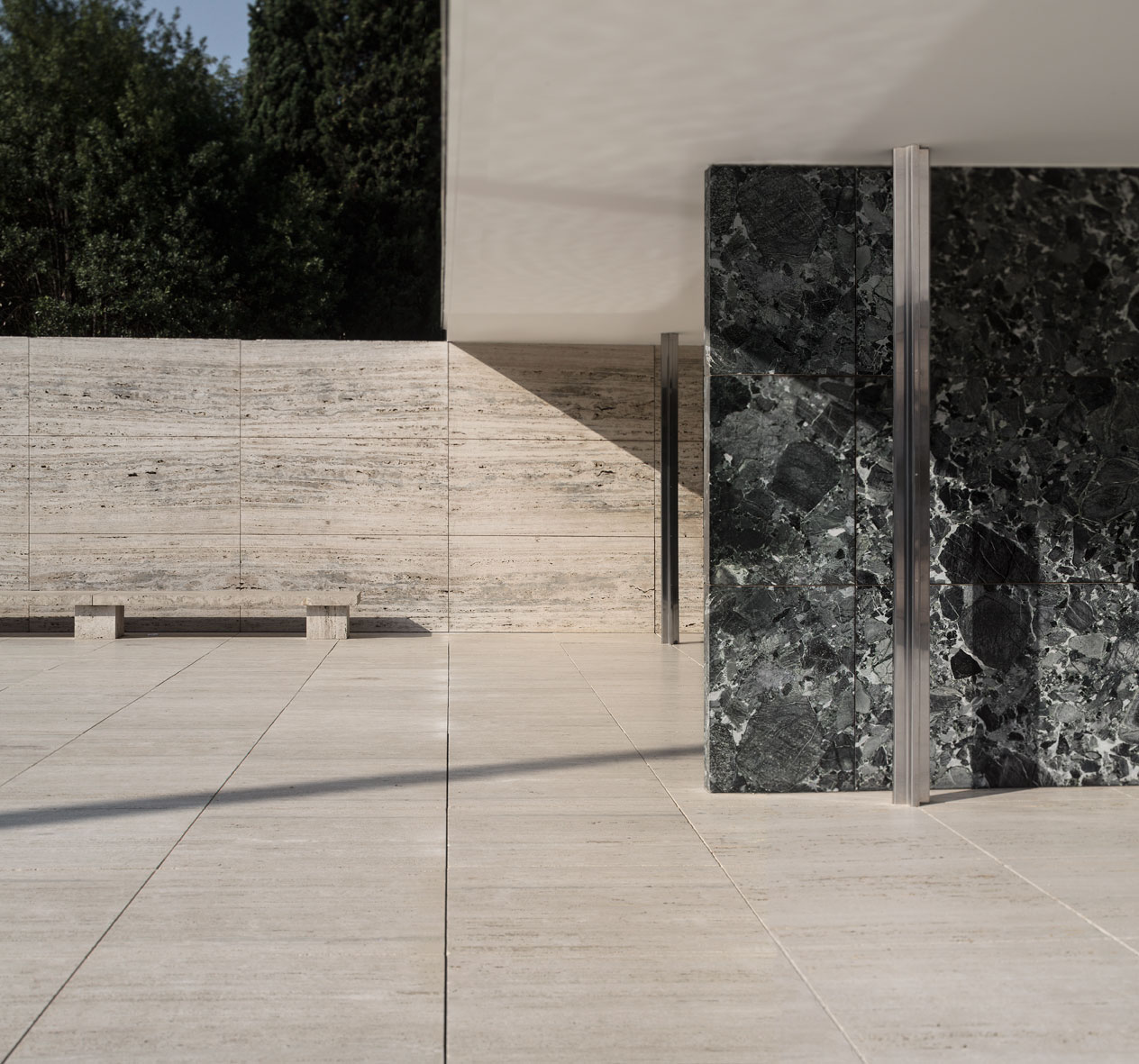
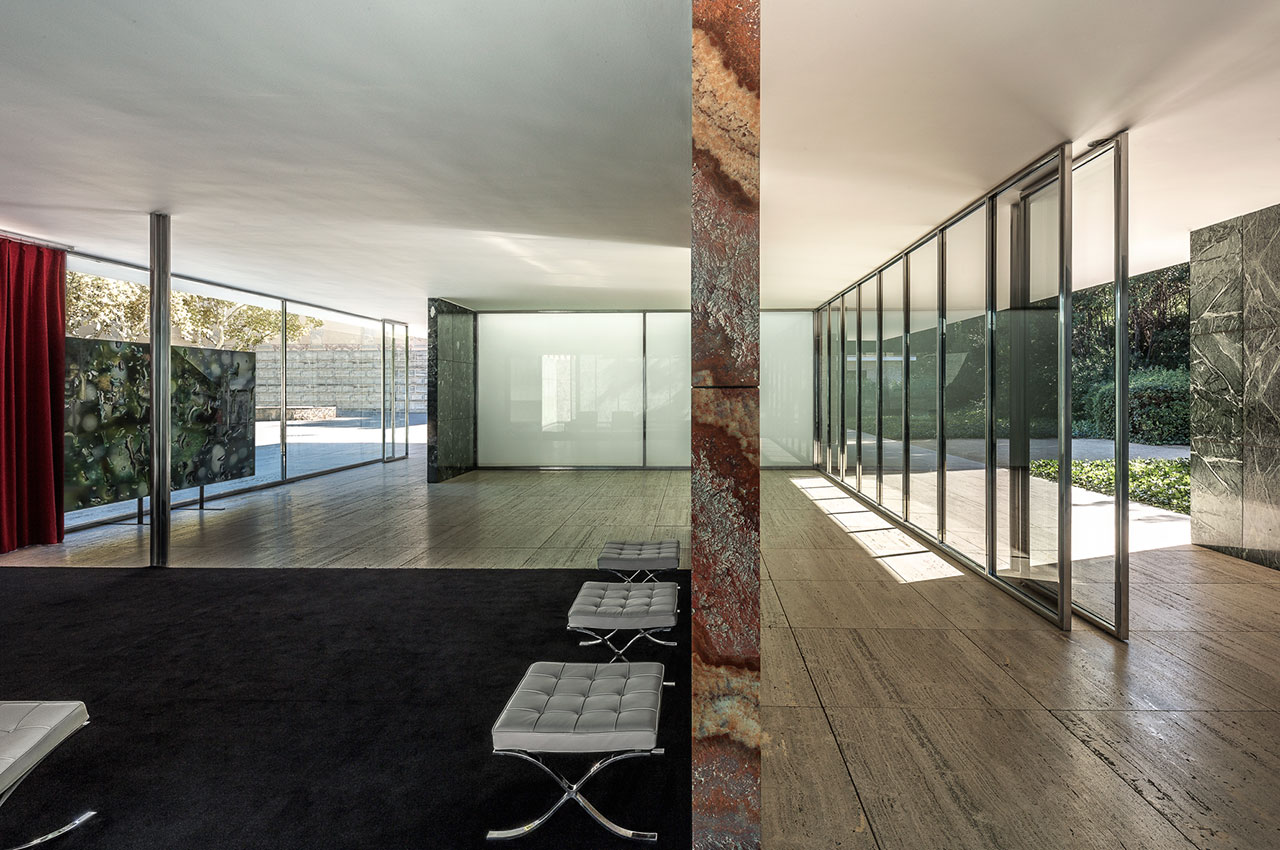
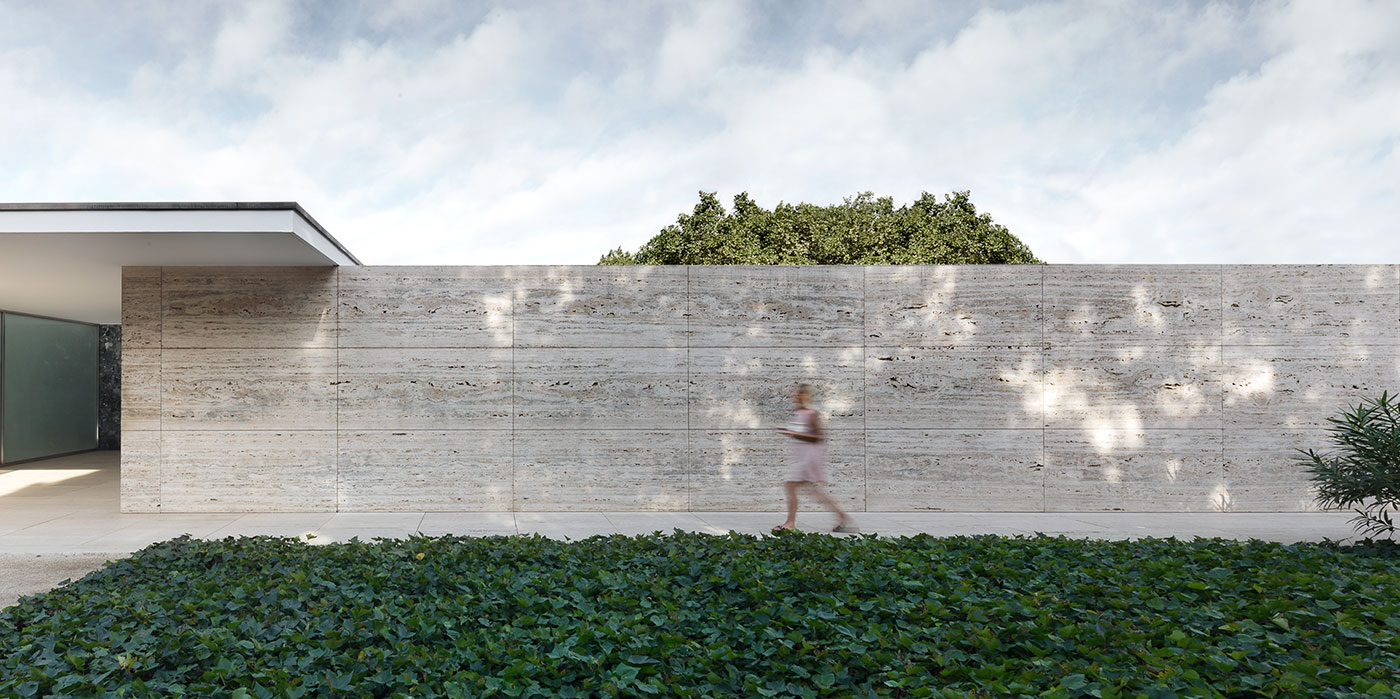
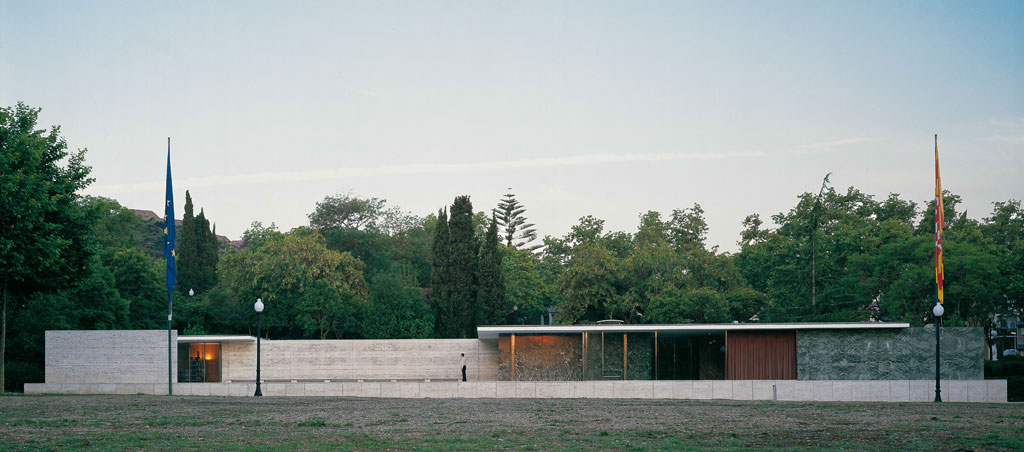
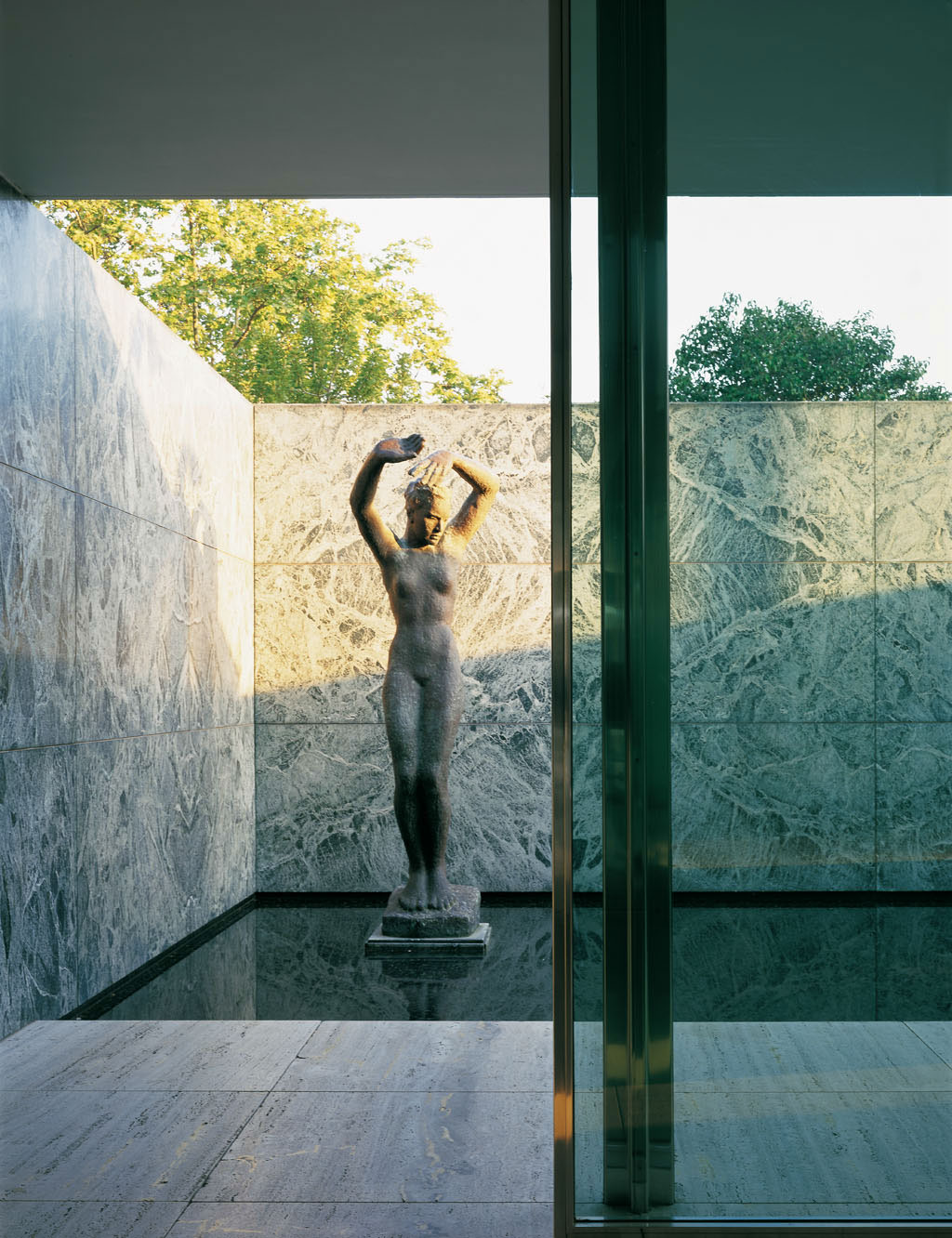
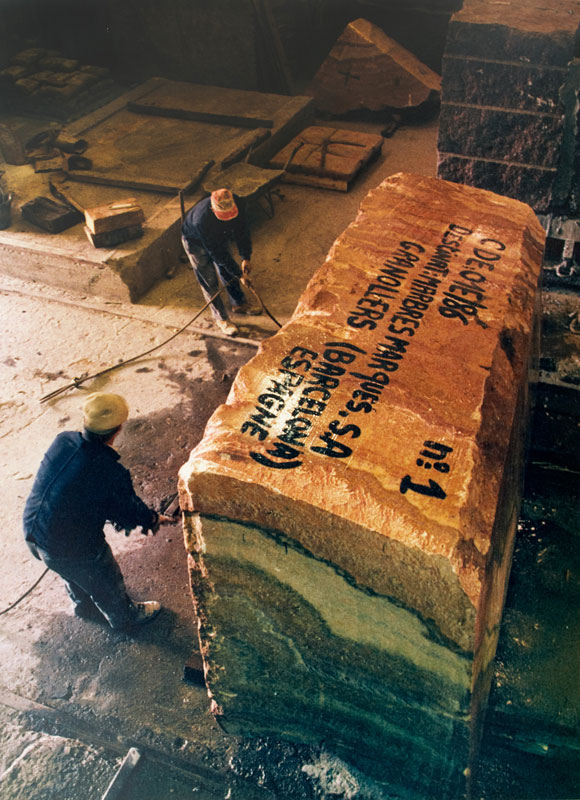
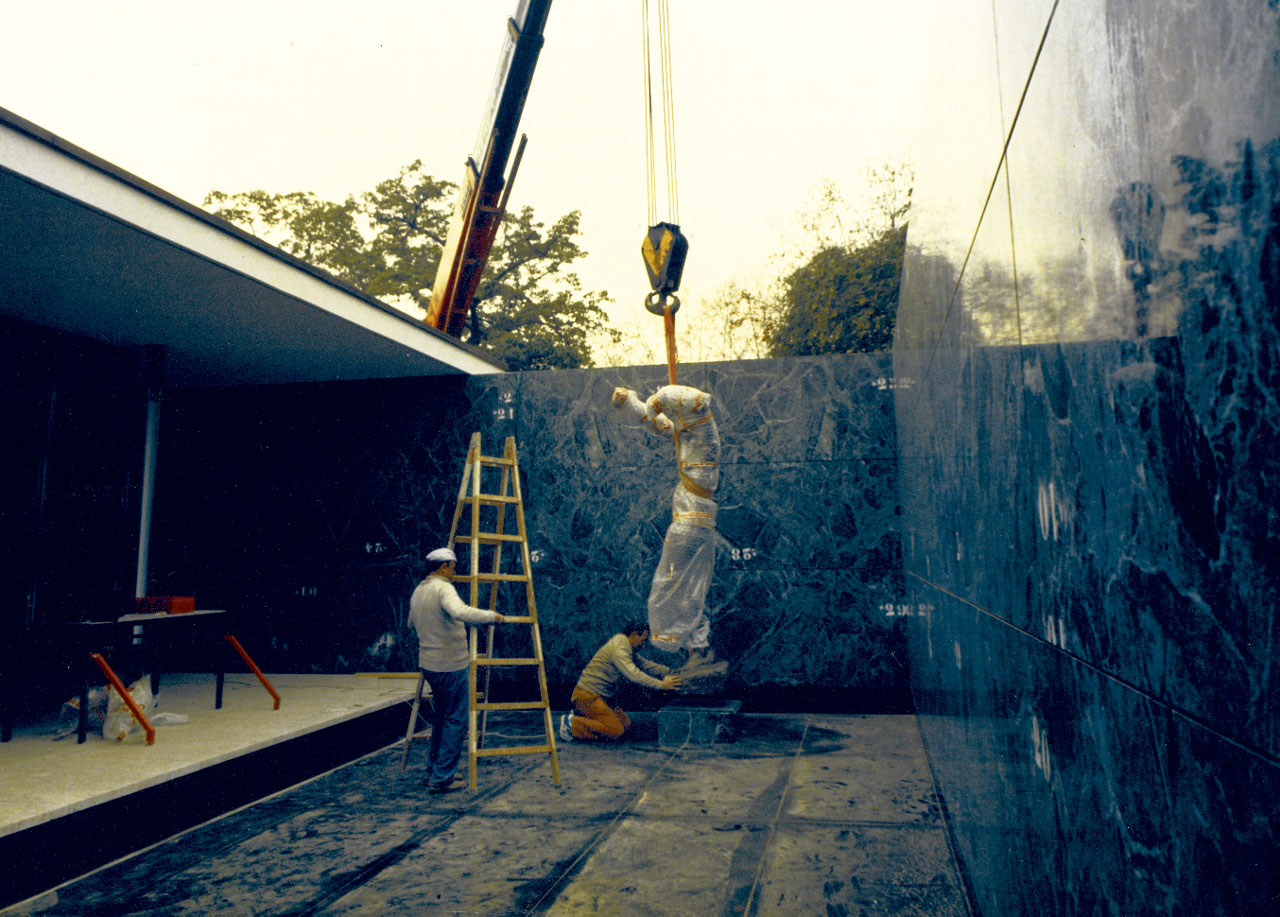
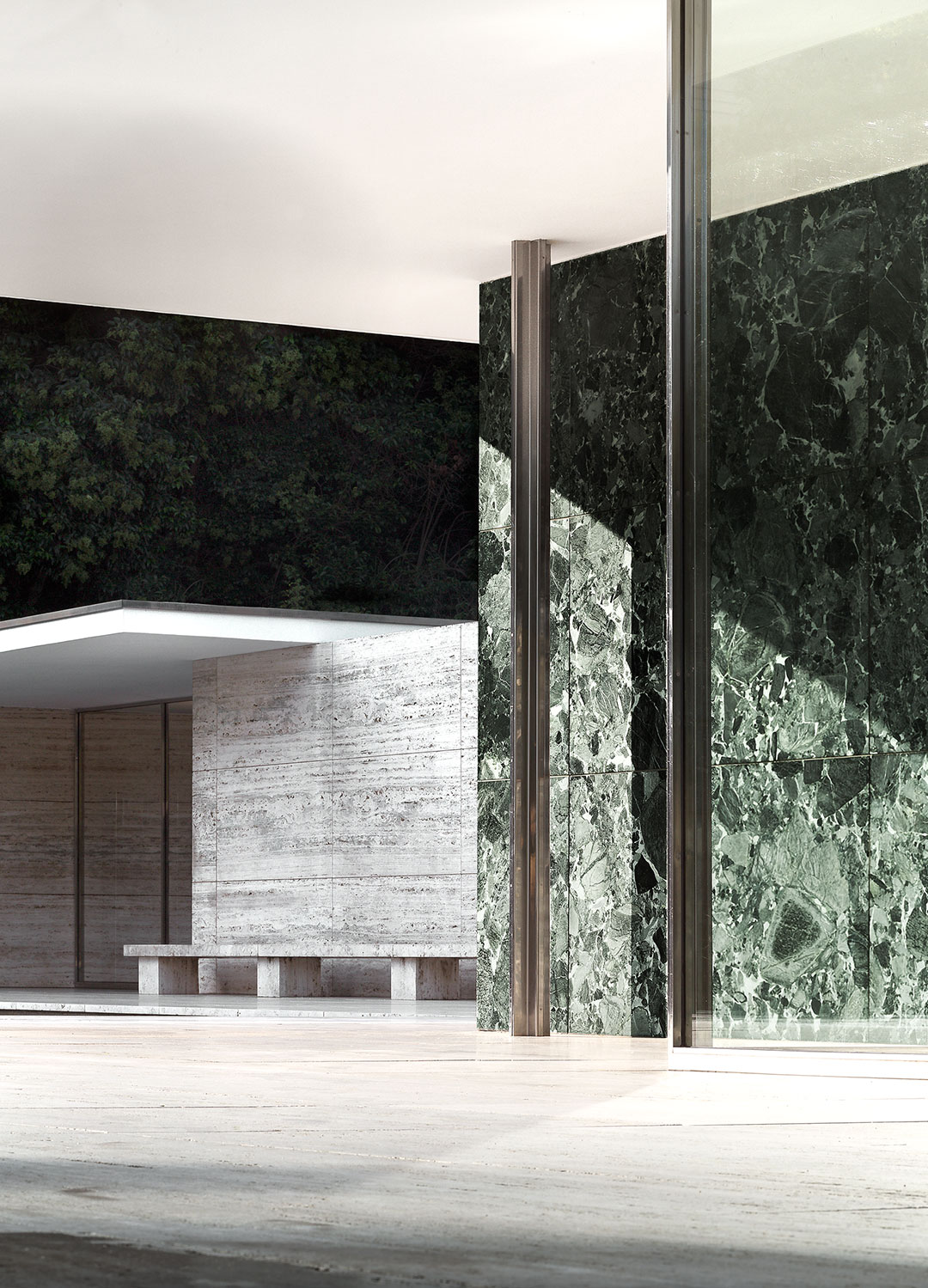
On June 2 1986 the reconstruction of the Mies van der Rohe Pavilion was inaugurated on the same site where it had so briefly stood as part of the 1929 Barcelona International Exhibition; an exceptional event we celebrate this year: thirty years ago we recovered the privilege of tangibly enjoying the experience of being at the Pavilion.

After a brief presentation by Miriam Giordano, the three emcees of event, Ivan Blasi, Victor Sanchez and Antoni Garijo, they tell us from different points of view, what happened on the pavilion during these 30 years. From the Mies van der Rohe Foundation we wish to share this celebration by inviting you to take part in the activities we’ve organised there; to take a new look at the Pavilion with the reinterpretation of the columns that originally stood in front of it; to meet the people who made the reconstruction possible; to recall, through an exhibition, events that have taken place during these last thirty years and to deepen your knowledge of architecture at a symposium.

In addition, they invite you to celebrate it with us through the social networks sharing your images of this 30 years with the hashtag #30miespavilion.

La agenda para los próximos meses será.-

PAVILION. OPEN SPACE
2, 3, 4 and 5 June will be open days in the Pavilion. To highlight this space it will also be a light and sound show during the celebrations.

OPENING

The 1st of June there will be an official event with the presence of the Mayoress of Barcelona, Mrs. Ada Colau, and the Deputy Mayor and President of the Foundation, Mrs. Janet Sanz, to bring together those people who were involved in the reconstruction and in the direction of the Foundation over the past 30 years. Within this event, we will count with a lecture by the architect and doctor of the ETSAB, Fernando Ramos (member of the team that carried out the reconstruction) and professor and vice President of the Foundation, Josep Maria Montaner.

In the evening, we invite you to the Fear of Columns opening party, with a visual show developed by Toni Mira and opened to everybody who loves Barcelona’s architecture and culture.

SYMPOSIUM
CYCLE OF TALKS AND CONFERENCES AROUND THE PAVILION AND Mies van der Rohe
13, 14 and 15 October at CaixaForum

Como clausura de todas las actividades organizadas para la conmemoración de los 30 años se realizará un simposio sobre la figura del Pabellón dentro de la historia del arte y la arquitectura moderna y su papel en la obra de Mies van der Rohe. Estas conferencias también servirán para plantear la evolución de la idea de arquitectura moderna y su relación con la configuración de una imagen de estado moderno a través de la creación de la escuela de la Bauhaus y su vinculación con la República de Weimar. Se contextualizará con la exposición del 29 en Barcelona y como la ciudad de Barcelona se nutre de grandes eventos internacionales para reinventarse y reconfigurar la estructura urbana.

Curator: Juan José Lahuerta. Doctor Architect. Professor of History of Architecture, School of Architecture of Barcelona (UPC) and Head of Collections of the National Museum of Catalan Art.

And, at night, closing party at the Pavilion with live music.
Read more
Read less

More information

Ludwig Mies van der Rohe was born in Aachen on the 27th of Marz of 1886 and died in Chicago on the 17th of August of 1969. He was active in Germany, from 1908 to 1938, when he moved to the USA and where he was until his death. He was also considered a “master” of the Modern Movement, since the 50s, and he was one of the fathers of this movement with Walter Gropius, Le Corbusier and Frank Lloyd Wright.

Mies van der Rohe, who in his childhood was guided by masters such as Hendrik Petrus Berlage or Peter Behrens, always kept tabs on the Villlet-Le-Duc’s rationalism or Karl Friedrich Schinkel eclectic classicism, having a strong connection with the architectural historicism. As he said in his manifesto “Baukunst und Zeiwille” about this: “it is not possible to move on looking back”.

In 1900 he began to work with his father in the stone workshop of the family and shortly afterwards he moved to Berlin to work with Bruno Paul in 1902, designing furniture. He planned his first house in 1907, the “Riehl House” in Neubabelsbers and worked from 1908 to 1911 in Peter Behrens’s studio. There he was influenced by structural techniques and designs based on steel and glass, as the AEG project in Berlin. While he was in Behrens’s studio he designed the Perls House.

In 1912 he opened his own studio and projected a house in The Hague for Kröller-Müller marriage. The studio received few jobs in its first years, but Mies, contrary to architects like Le Corbusier, in his first years already showed an architectural policy to follow, being an architect that changed little his architectural philosophy. To his epoch belonged the Heertrasse House and Urbig House as his principal projects.

In 1913 he moved to the outskirts of Berlin with his wife Ada Bruhn with whom he would have three kids. The family broke up when Mies was posted to Romania during World War I.

In 1920, Ludwig Mies changed his surname to Mies van der Rohe and in 1922 he joined as a member of the “Novembergruppe”. One year later, in 1923, he published the magazine “G” with Doesburg Lisstzky and Rechter. During this period he worked in two houses, the Birck House and the Mosler House. In 1926, Mies van der Rohe held the post of chief commissioner of the German Werkbund exhibition and became his president this year. In this period he projected the Wolf House in Guden and the Hermann Lange House in Krefeld and in 1927, he met the designer Lilly Reich, in the house exhibition of Weissenhof, where he was director, and he planned a steel structure block for her.

In 1929, he received the project the German National Pavilion to the International Exhibition of Barcelona) rebuilt in 1986=, where he included the design of the famous Barcelona Chair.

In 1930, he planned in Brün – present Czech Republic -, the Tugendhat Villa. He managed the Dessau’s Bauhaus until his closure in 1933. The Nazism forced Mies to emigrate to the United States in 1937. He was designated chair of the Architecture department at Armour Institute in 1938, the one that later merged with the Lewis Institute, forming the Illinois Institute of Technology (IIT) and where he took the responsibility to build a considerable extent of the foundations of the Institute from 1939 and 1958. One of the buildings of this complex is the Crown Hall, IIT (1950-1956).

In 1940, he met the person who would be his partner until his death, Lora Marx. He became a citizen of the USA in 1944 and, one year later, he began with the Farnsworth House’s project (1945-1950). During this stage, in 1948, he designed his first skyscraper: the two towers of the Lake Drive Apartments in Chicago, which were finished in 1951. Shortly after, he planned another building of this typology, the Commonwealth Promenade Apartments, from 1953 to 1956.

In 1958 he projected his most important work: the Segram Building in New York. This building has 37 storeys, covered with glass and bronze, which was built and planned with Philip Johnson. He retired from the Illinois Institute of Technology the same year. He also built more towers and complexes as: the Toronto Dominion Centre (1963-1969) and the Westmount Square (1965-1968) and designed the New Square and Office Tower of The City of London (1967).

From 1962 to 1968, he built the Neue Nationalgalerie in Berlin, which would be his last legacy to the architecture. The building that rose as an exhibition hall is made of steel, glass and granite.

He died in Chicago on the 17th of August of 1969 leaving behind a large legacy and influence to the next generations.

The Mies van der Rohe’s most famous sentences are “Less is more” and “God is in the details”.

Read more

José Juan Barba (1964). Architect from the Madrid School of Architecture (ETSAM) in 1991. He received his PhD in Architecture from ETSAM in 2004, graduating summa Cum laude with the doctoral thesis "Inventions: New York vs. Rem Koolhaas, Bernard Tschumi, Piranesi." In 1991, he received a Special Mention in the Spanish National Graduation Awards. Until 1997, he worked as an advisor to several NGOs. In 1992, he founded his architectural practice in Madrid (www.josejuanbarba.com). 

He is an architectural critic and, since 1998, Editor-in-Chief of the internationally acclaimed bilingual architecture journal METALOCUS (Spanish/English), recipient of several national and international awards.

Barba is an Associate Professor at the University of Alcalá and a member of several research groups. He has been invited to participate in numerous international forums on architecture and urbanism, including the II Forum of Mexican World Heritage Cities, Urban Development, History and Modernity, organized by the Pan-American Committee for Urban Development and Historical Heritage; the World Urban Development Forum (FMDU), held in Culiacán, Sinaloa, Mexico; and the International Conference on Architecture and Urbanism from the Perspective of Women Architects. He has also been invited as lecturer and guest critic at numerous national and international institutions, including the National Building Museum, Roma Tre University, Politecnico di Milano, University of Genoa, Université Pierre Mendès France Grenoble, the Madrid and Barcelona Schools of Architecture, National Autonomous University of Mexico, the Faculty of Architecture in Montevideo, the Schools of Architecture of Medellín and Ecuador, Universidad Iberoamericana, IE University, as well as the Schools of Architecture of Zaragoza, Valladolid, Málaga, Granada, Seville, and A Coruña, among others.

He has extensive professional experience in architecture, urbanism, landscape intervention, and territorial regeneration. His work has received numerous awards, including First Prize in the “Gran Vía Posible” competition for Delirious Gran Vía, Madrid; recognition for the Rivers Interpretation Centre in Zamora, awarded and exhibited at the World Architecture Festival 2008; and recognition for the Santa Bárbara Park project in Toledo. He was also awarded the Erich Degner Prize for Architecture (1995), promoted by the BBVA Foundation. His project for a Day Centre for the Elderly was included in Volume 3 of the Madrid Architecture Guide published by the Official College of Architects of Madrid (COAM) in 2007. His work has been widely published in national and international books and journals.

He served as Maître de Conférences at the Institut d’Urbanisme de Grenoble, Université Pierre Mendès France Grenoble, during the 2013–14 academic year, following his appointment through a European open competition. His work has been published internationally. He regularly serves on academic and professional juries, including the editorial competition jury for the journal Quaderns (2011), the selection committee for the European Union Prize for Contemporary Architecture – Mies van der Rohe Awards (2007–present), and the jury panels for EUROPAN 13 (2015–16) and TRANSFER, Zurich (2019). He was also invited to participate in the Biennale di Venezia 2016 as part of the exhibition Spaces of Exception / Spazi d’Eccezione.

He has authored several books, including "The Dark Line. michele&miquel, dA Vision Design" (2024), "CONGRESO ANYWAY. La ciudad de las ciudades" (2020), "#Positions" (2016), and "Inventions: New York vs. Rem Koolhaas, Bernard Tschumi, Piranesi" (2015). He has also contributed to publications such as "Espacio público Gran Vía. La Ciudad del Turismo" (2020), "Spaces of Exception / Spazi d’Eccezione" (2016), "La manzana de la discordia" (2015), and "Contemporary Japanese Architecture: New Territories" (2015), as well as chapters in numerous books, including "Women Architects: A Professional Challenge" (2009), "21st Century Architectures" (2007), "Ruta de la Plata, New Conquerors of Space" (2019), and "The City of Tourism" (2020).

Selected awards include:

•    “SANTIAGO AMÓN” AWARD, award for the promotion of architecture, COAM Madrid, 2000.
•    “PANAYIOTI MIXELI AWARD,” SADAS-PEA, award for the promotion of architecture, Athens, 2005.
•    “PIERRE VAGO” ICAC. International Committee of Art Critics Award, London, 2005.
•    FAD Award 07, Ephemeral Interventions, First Prize, M.C. Escher Exhibition, Arquin-FAD, Barcelona, 2007.
•    World Architecture Festival, Center for Research and Interpretation of the Rivers, Tera, Esla, and Órbigo, Finalist, Barcelona, 2008.
•    Gran Vía Posible, First Prize, Delirious Gran Vía, Madrid, 2010.
•    Reform of the Río Segura Surroundings, Award, Murcia, 2010.

Read more
Published on: May 1, 2016
Cite:
metalocus, JOSÉ JUAN BARBA
"30 years of reconstruction of the Mies van der Rohe Pavilion" METALOCUS. Accessed
<https://www.metalocus.es/en/news/30-years-reconstruction-mies-van-der-rohe-pavilion> ISSN 1139-6415
Loading content ...
Loading content ...
Loading content ...
Loading content ...
Loading content ...
Loading content ...
Loading content ...
Loading content ...
Loading content ...
Loading content ...
Loading content ...
Loading content ...
Loading content ...
Loading content ...
Loading content ...
Loading content ...
Loading content ...
Loading content ...
Loading content ...
Loading content ...
Loading content ...
Loading content ...
Loading content ...
Loading content ...
Loading content ...
Loading content ...
Loading content ...
Loading content ...
Loading content ...
Loading content ...
Loading content ...
Loading content ...
Loading content ...
Loading content ...
Loading content ...
Loading content ...
Loading content ...
Loading content ...
Loading content ...
Loading content ...
Loading content ...
Loading content ...
Loading content ...
Loading content ...
Loading content ...
Loading content ...
Loading content ...
Loading content ...
Loading content ...
Loading content ...
Loading content ...
Loading content ...
Loading content ...
Loading content ...