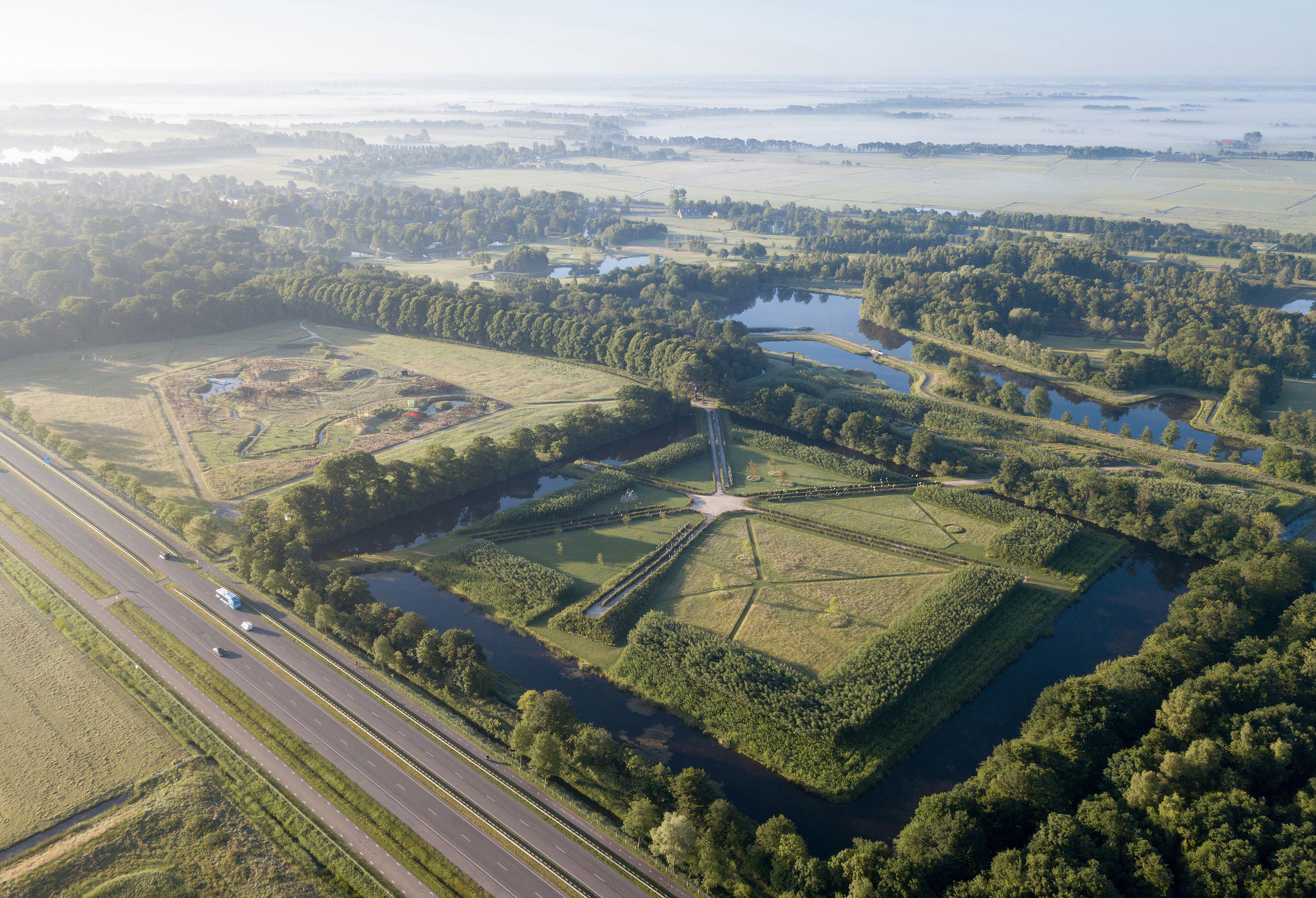
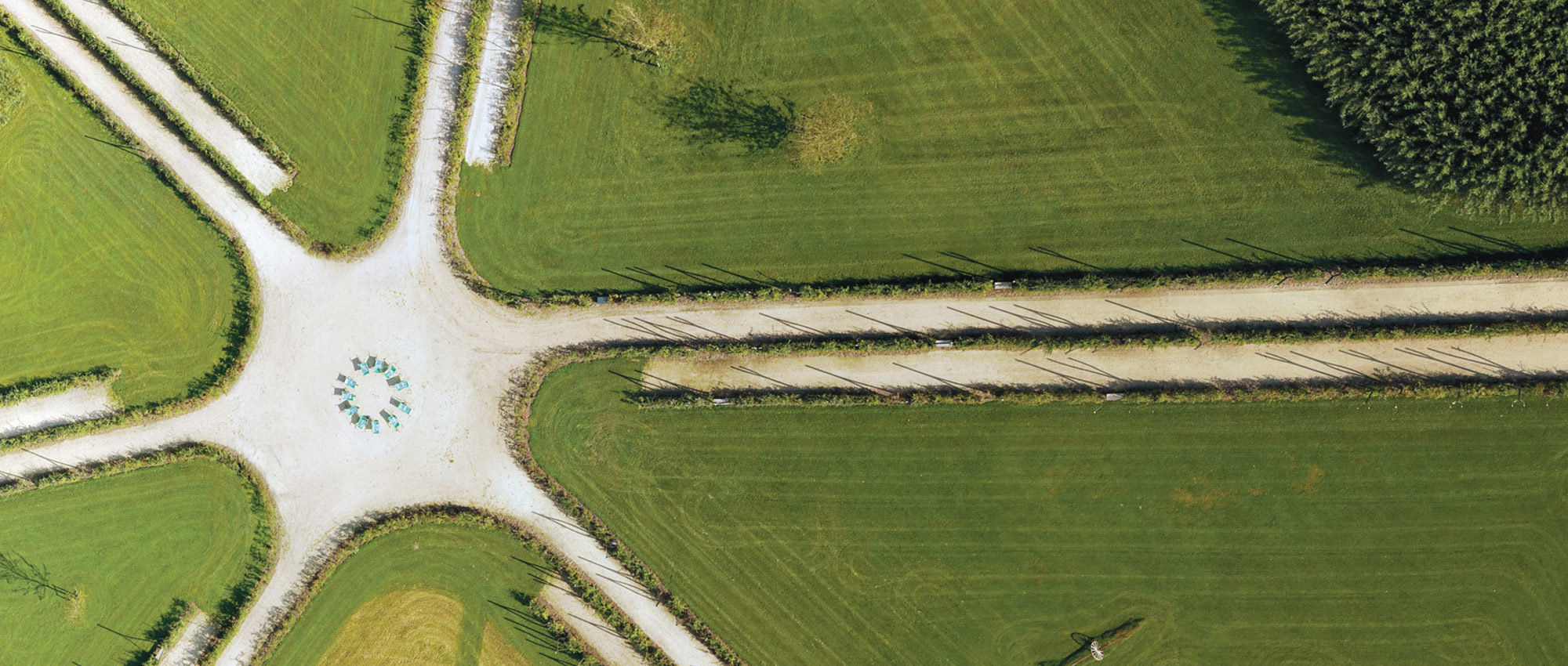
On 13 May Park Groot Vijversburg in Tytsjerk, the Netherlands, already inaugurated officially opened for the public. Vijversburg is a park of international standing, where nature and culture come together.
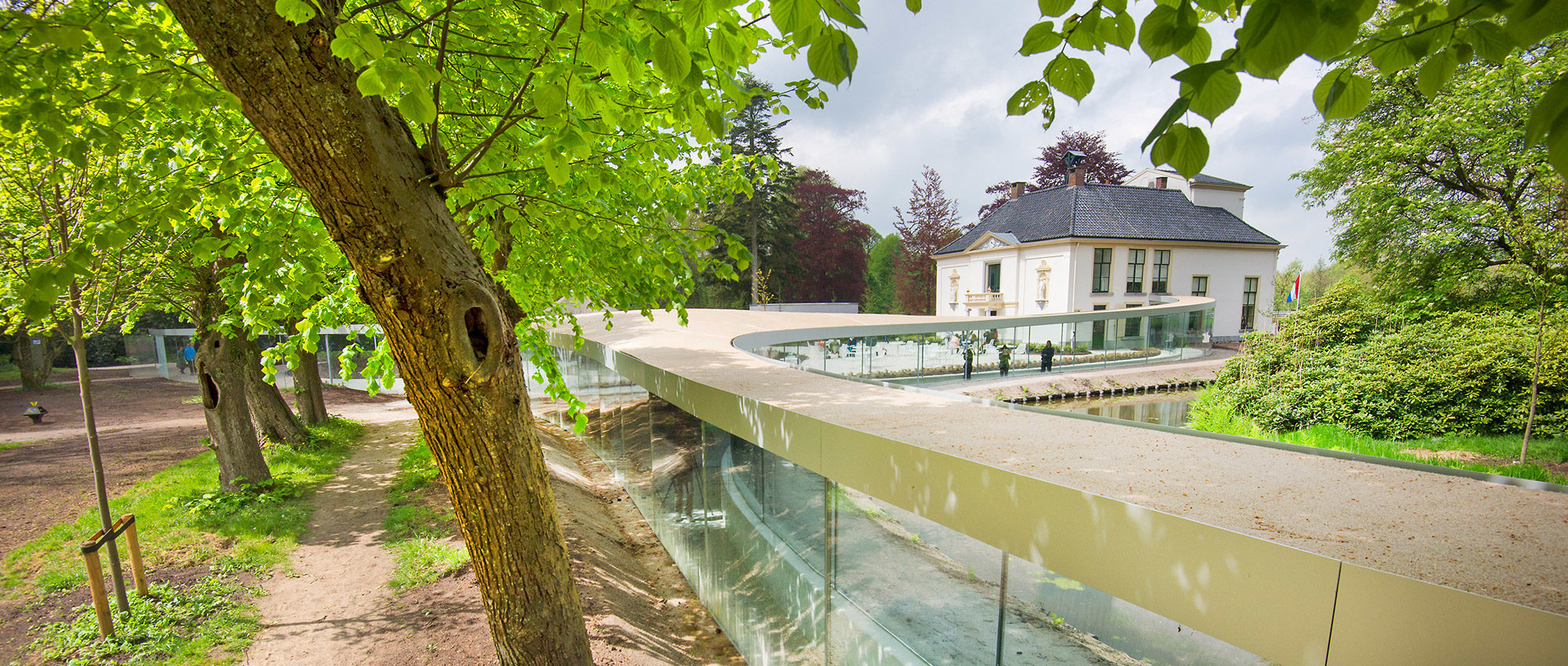
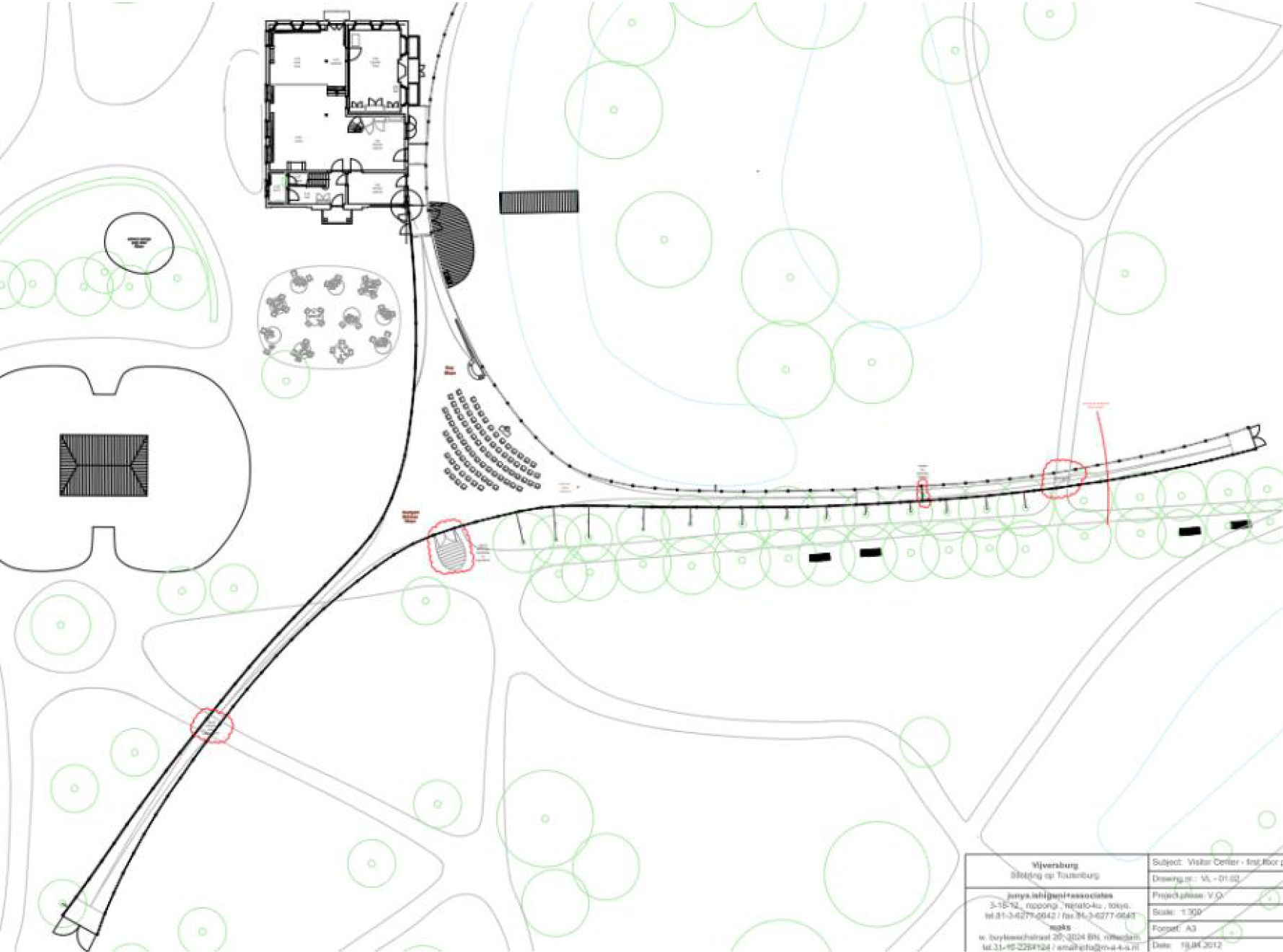
Architects Marieke Kums of Studio Maks and Junya Ishigami were selected after a competition to design the new Visitor Centre, Park Groot Vijversburg. They designed it as an architectural project, with the aspiration of a building being part of the landscape of the park. The visitor centre is positioned next to the historical villa, and will be used for exhibitions, symposia and concerts.

The Villa traditionally forms the heart of the park. The neoclassical Villa Vijversburg was built by the husband and wife team of Looxma-Ypeij in 1844. A tearoom can be found in the Villa, and also a park information desk.

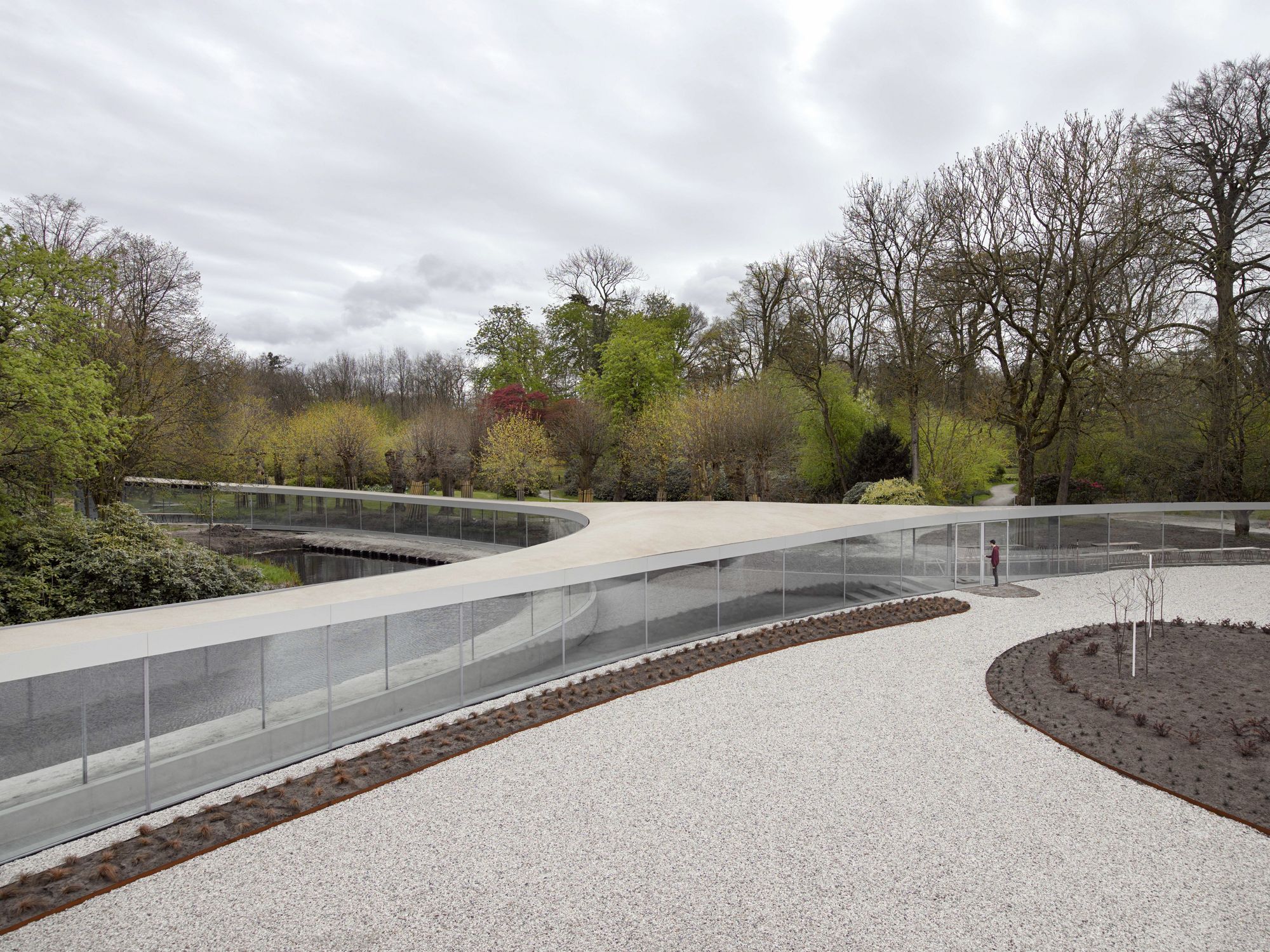
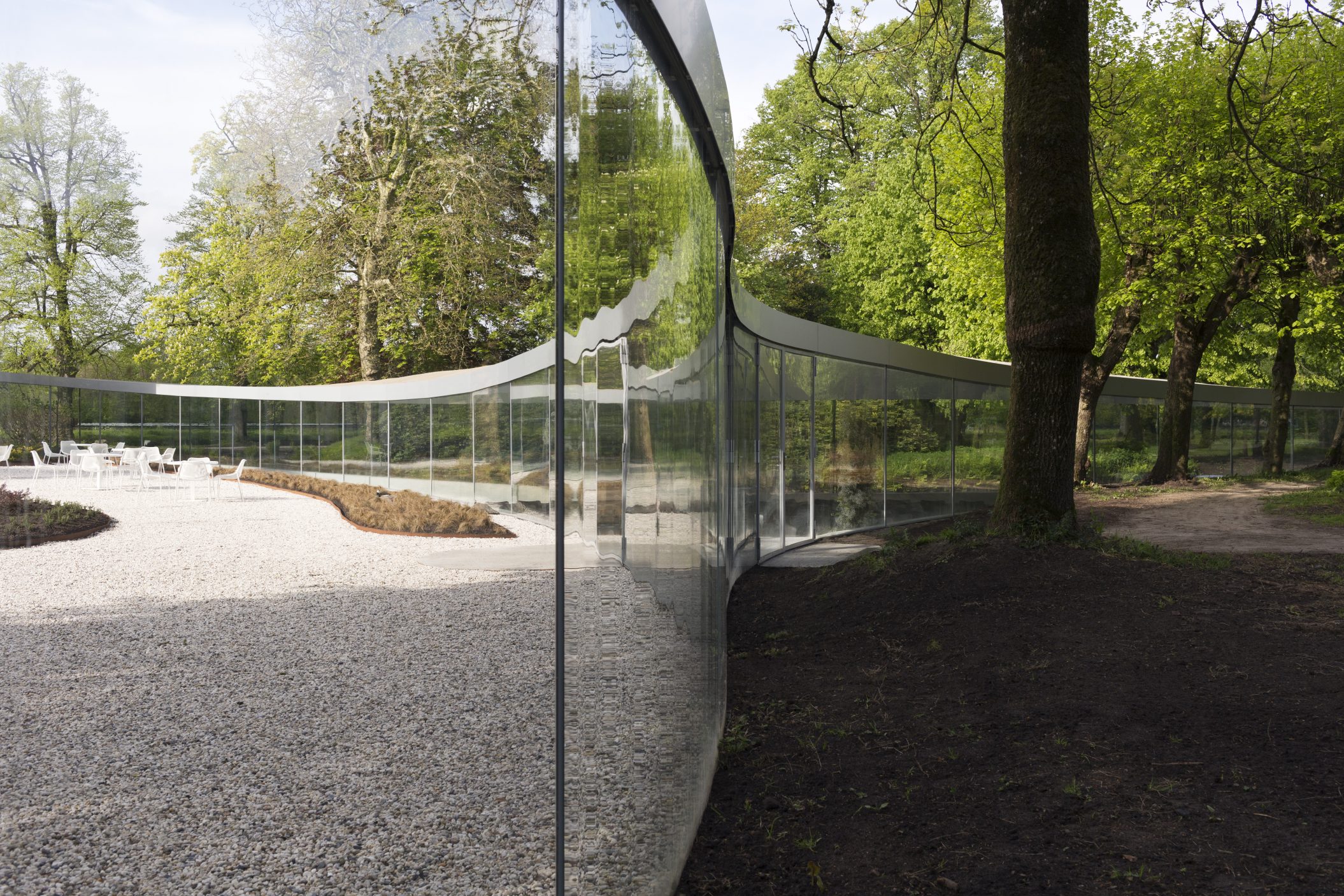
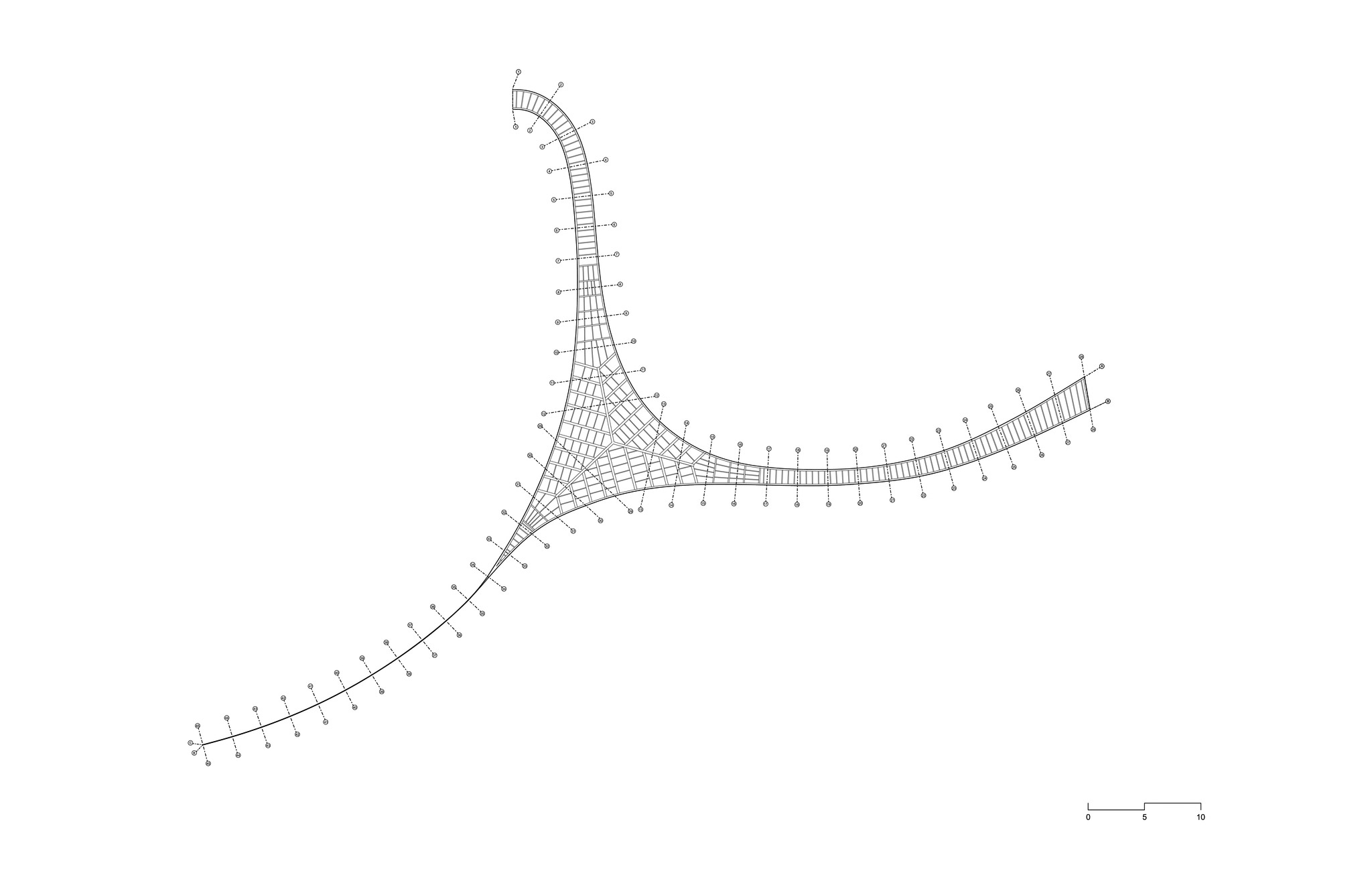
The two architects also designed the new glass Pavilion. The transparent design not only blends in with the natural surroundings of the park, but also keep the historical villa untouched in its appearance. In plan, the shape of the one storey building is as that of a triangle being pulled firmly in three directions while maintaining a central hall. These pulled wings lose their quality of interior space as one progresses along it, leaving only its wall, until they gradually become a path – naturally transforming into a park trail. In this way, the building establishes a large scale similar to that of the generous park, and at the same time, the enclosed space provides small scale ambiance and intimacy. The shape of the building connects to the natural shapes of the park. Furthermore, height differences are being used to create the right relationship with the villa and to optimize the visitor’s experience.

When looking at the plan, two distinctive principle sections can be seen. One is that of the stretched wings, where the span of the roof is limited up to about 2m with a non-obstructed length of about 30-35m. The other one is that of the main hall, that has a triangular shape and a free roof span of about 10m.

The support structure, consisting entirely of glass walls, is a unique feature of the building. The building’s central area has been designated for use for exhibitions, symposia and concerts.

Constructive function of glass
The historic country house has been restored and the park has doubled in surface. Next to the country house, is situated the pavilion for visitors. From the beginning, it was clear that it had to be a minimalist building with lots of glass. Visible construction elements, such as columns, were not desired. ABT suggested that the glass would have a constructive function. Particular attention has been paid to safety. The glass is made in multiple layers to also maintain breakage capacity.

The glass panels of the Vijversburg project are built up with a load carrying laminated inner glass panel and a single outer glass panel (insulated glass). The outer glass plate increases the stiffness of the total glass panel but this is not taken into account. The inner plate is checked in the normal situation with two unbroken glass plates and in the exceptional situation with one broken glass plate. In the extreme event of collapsing of the total glass panel, beams in the roof structure can carry the loads of the roof to the adjacent glass panels. In fact a third load path is created for extra safety.

The historical park contains a rich flora and fauna, as well as botanical gardens and a historical villa. Throughout the year, the park hosts many events such as international exhibitions of contemporary art, musical performances, church services and excursions. The park is close to the main city of Leeuwarden, which will be the cultural capital of Europe in 2018. The park with its visitor centre will play a major part in this.
Read more
Read less

More information

Label
Architects
Text
STUDIO MAKS.- Partner in charge: Marieke Kum. In collaboration with Junya Ishigami & Associates.- Partner in charge.- Junya Ishigami
+ + copy Created with Sketch.
- + copy Created with Sketch.
Label
Design Team
Text
STUDIO MAKS.- Jelmer Buurma, Mira Brethouwer, Christiaan Harmse, Thanasis Ikonomou, Susie Newman, Panos Papanastasis, Gorka Beitia Zarandona. Competition team.- Marieke Kums, Yuka Takeuchi, Yong-il Kim, Eunyong Kim. /// Junya Ishigami & Associates.- Project team.- Wataru Shinji. Competition team.- Junya Ishigami, Wataru Shinji, Hiroaki Takigawa, Taeko Abe
+ + copy Created with Sketch.
- + copy Created with Sketch.
Label
Engineers
Text
Structural.- ABT B.V. & Jun Sato Structural Engineer. Mechanical.- ABT B.V. Civil.- ABT B.V. Building Physics & Climate.- AB. B.V.
ABT B.V. (Han Krijgsman, Diana de Krom, Jeroen ter Haar, Gyuszi Florian)
+ + copy Created with Sketch.
- + copy Created with Sketch.
Label
Consultans
Text
Landscape historical analyses.- SB4
Acoustical.- ABT B.V.
+ + copy Created with Sketch.
- + copy Created with Sketch.
Label
Specifications
Text
Structural System. Manufacturer of any structural components unique to this project.- Glass system: Steinfort B.V. & IFS-SGT special glass technology
Steel.- Matel Metaal
Concrete.- Veenstra B.V.
Exterior Cladding
Metal/glass curtain wall.- Structural glazing.- Steinfort B.V. & IFS-SGT special glass technology
Precast concrete.- On site concrete: Veenstra B.V.
EIFS, ACM, or other.- Jurriens Noord & Friso Bouwgroep
Moisture barrier.- Jurriens Noord & Friso Bouwgroep
Other cladding unique to this project.- Roof edge, anodies aluminum: Hospers
Roofing
Other.- Resin bound gravel: Intercodam in collaboration with Wifra
Windows
Metal frame.- Matel Metaal B.V.
Glazing
Glass.- IFS-SGT special glass technology
Doors
Entrances.- Matel Metaal B.V.
Metal doors.- Matel Metaal B.V.
Hardware
Closers.- Dorma
Interior Finishes
Acoustical ceilings.- STO Isoned B.V.
Resilient flooring.- Concrete flooring, Veenstra B.V.
Furnishings
Chairs.- Fritz Hansen / Arne Jacobsen
Lighting
Interior ambient lighting.- Zumtobel
Downlights.- Zumtobel
Tasklighting.- Zumtobel
Exterior: NA
Dimming system or other lighting controls.- Hiemstra B.V.
Conveyance
Elevators/escalators.- NA
Accessibility provisions.- NA
Plumbing
Reekers .B.V.
Energy
Energy management or building automation system.- Reekers B.V.
Photovoltaic system.- NA
Other unique products that contribute to sustainability: NA
+ + copy Created with Sketch.
- + copy Created with Sketch.
Label
Area
Text
Total Area.- 1,000 sqm (10,764 sqf) / 270.0 sqm Pavilion
+ + copy Created with Sketch.
- + copy Created with Sketch.
Label
Dates
Text
Design.- 2011-2013
Construction.- 2014-2017
+ + copy Created with Sketch.
- + copy Created with Sketch.
Label
Client
Text
Op Toutenburg Foundation / Stichting op Toutenburg
+ + copy Created with Sketch.
- + copy Created with Sketch.
Label
General Contractor
Text
Jurriens Noord & Friso Bouwgroep
+ + copy Created with Sketch.
- + copy Created with Sketch.

Junya Ishigami, was born in Kanagawa Prefecture, Japan, in 1974. He studied at the Musashi Institute of Technology from 1994 to 1998 and subsequently completed his education at the Tokyo National University of Fine Arts and Music, where he studied between 1998 and 2000. After graduating, he worked for Kazuyo Sejima + Associates (SANAA) from 2000 to 2004. That same year, he founded his own architectural practice, Junya Ishigami + Associates.

Throughout his career, Ishigami has questioned conventional understandings of architecture. His approach allows him to work beyond prevailing trends, established principles and traditional definitions, creating new structures and spaces and proposing alternative ways of organizing the environment. Through his projects, he seeks to radically transform the lifestyles associated with modern architecture and enrich them with new values.

His early projects include Table, created in Tokyo in 2005, and T Project, which received first prize in a residential architecture competition sponsored by the Tokyo Electric Power Company that same year. These were followed by Balloon in Tokyo in 2007, the Kanagawa Institute of Technology KAIT Workshop in Kanagawa in 2008, and the Yohji Yamamoto Gansevoort Street Store in New York in 2008. Other significant works include the Japanese Pavilion for the 11th Venice Architecture Biennale in 2008, Art Biotop Water Garden in Tochigi in 2018, the Serpentine Pavilion in London in 2019, KAIT Plaza in Kanagawa in 2020, House & Restaurant in Ube in 2022 and the Zaishui Art Museum in Rizhao, China, completed in 2023.

Ishigami’s work has received considerable international recognition. In 2004, Low Chair and Round Table were acquired by the Centre Pompidou. In 2005, he received the SD Prize for Small Garden of a Row House, the Kirin Prize for Table and first prize in the residential architecture competition for T Project. In 2006, Table was presented by Gallery Koyanagi at Art Basel and was later acquired by the Israel Museum. He subsequently received the Architectural Institute of Japan Prize for KAIT Workshop in 2009, the Golden Lion for Best Project at the 12th Venice Architecture Biennale in 2010, the OBEL Award for Art Biotop Water Garden in 2019 and the Frederick Kiesler Prize for Architecture and the Arts in 2024.

Read more

MAKS is a Rotterdam based studio for architectural designs, strategies and research. It was founded by Marieke Kums in 2009. With an international network of collaborators, the studio is involved in building design and realization and urban planning.

The studio develops projects that engage culture and consciousness, nature and artificiality, surrealism and pragmatism. MAKS strives to go beyond conventional values and scales, as the range of people’s awareness is ever expanding in an age where it’s possible to find out about almost anything in the world in an instant. MAKS’s projects vary from small art installations, to concept studies for the Dutch Museum of National History and renewal projects in the Netherlands and abroad.

Marieke Kums studied at the MIT in Boston and at Delft University of Technology from which she received her MSc Arch degree cum laude. Between 2003 and 2005 she worked with OMA / Rem Koolhaas and from 2006 to 2009 with SANAA / Kazuyo Sejima & Ruye Nishizawa in Tokyo. For SANAA she was in charge of several projects, including a project for the VITRA campus in Weil am Rhein, a museum for Serralves in Porto, and (cultural) masterplans in Dubai and Hong Kong.

Marieke has been invited as a lecturer and guest critic at several universities around the world, such as Academy of Architecture in Amsterdam, the American University of Sharjah, the Yokohama GSA, Princeton, Harvard GSD and the University of Cluj in Romania. She is currently teaching at Delft University of Technology.

Marieke is a founding member of UNION3: an international research and design group focused on the problematic of renewal in European cities.

Read more
Published on: August 16, 2017
Cite:
metalocus, INÉS LALUETA
"Opening the Park Groot Vijversburg by MAKS and Junya Ishigami" METALOCUS. Accessed
<https://www.metalocus.es/en/news/opening-park-groot-vijversburg-maks-and-junya-ishigami> ISSN 1139-6415
Loading content ...
Loading content ...
Loading content ...
Loading content ...
Loading content ...
Loading content ...
Loading content ...
Loading content ...
Loading content ...
Loading content ...
Loading content ...
Loading content ...
Loading content ...
Loading content ...
Loading content ...
Loading content ...
Loading content ...
Loading content ...
Loading content ...
Loading content ...
Loading content ...
Loading content ...
Loading content ...
Loading content ...
Loading content ...
Loading content ...
Loading content ...
Loading content ...
Loading content ...
Loading content ...
Loading content ...
Loading content ...
Loading content ...
Loading content ...
Loading content ...
Loading content ...
Loading content ...
Loading content ...
Loading content ...
Loading content ...
Loading content ...
Loading content ...
Loading content ...
Loading content ...
Loading content ...
Loading content ...
Loading content ...
Loading content ...
Loading content ...
Loading content ...
Loading content ...
Loading content ...
Loading content ...
Loading content ...