

The design by Japanese architect Sou Fujimoto is also a 9,000 square meter museum dedicated to telling the history of music over the last 2,000 years.
The House of Hungarian Music stands out as the most thoughtful part of the proposals that are intended to be carried out in the park. Replacing a dilapidated cluster of Soviet-era exhibition offices, the complex is characterized by a sculptural perforated canopy that dialogues with the surrounding foliage and allows existing tall sycamores to pass through its perforations.
A glass façade, reaching 12m in height in some places, reflects the green surroundings and creates a light presence that directs the eye towards the ceiling. The proposal that won the competition was much lighter and more ethereal, but his clients wanted something warmer and took him to visit the secessionist palace of the Liszt Academy of Music, whose art nouveau ceiling is twisted with golden leaves, with which Sou Fujimoto was inspired to propose a radical change in the project, with "30,000 decorative tree leaves placed on the suspended ceiling".
A glass façade, reaching 12m in height in some places, reflects the green surroundings and creates a light presence that directs the eye towards the ceiling. The proposal that won the competition was much lighter and more ethereal, but his clients wanted something warmer and took him to visit the secessionist palace of the Liszt Academy of Music, whose art nouveau ceiling is twisted with golden leaves, with which Sou Fujimoto was inspired to propose a radical change in the project, with "30,000 decorative tree leaves placed on the suspended ceiling".
"We were enchanted by the multitude of trees in the City Park and inspired by the space created by them. Whilst the thick and rich canopy covers and protects its surroundings, it also allows the sun's rays to reach the ground. I envisaged the open floor plan, where boundaries between inside and outside blur, as a continuation of the natural environment"
Sou Fujimoto.
This is Fujimoto's third project in Europe, after his 2013 Serpentine Pavilion in London and his housing tower in Montpellier, France.
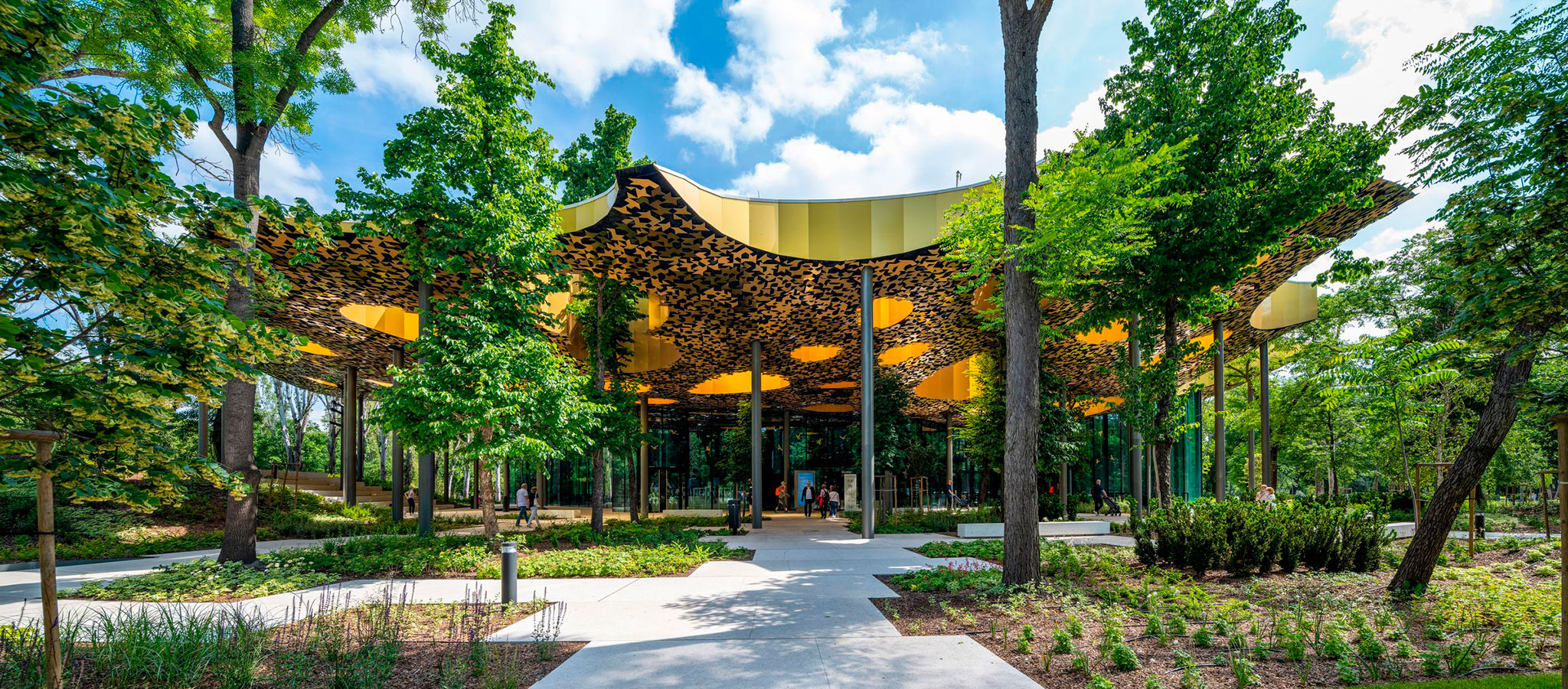
House of Hungarian Music by Sou Fujimoto. Photograph by Iwan Baan. Courtesy of Liget Budapest.
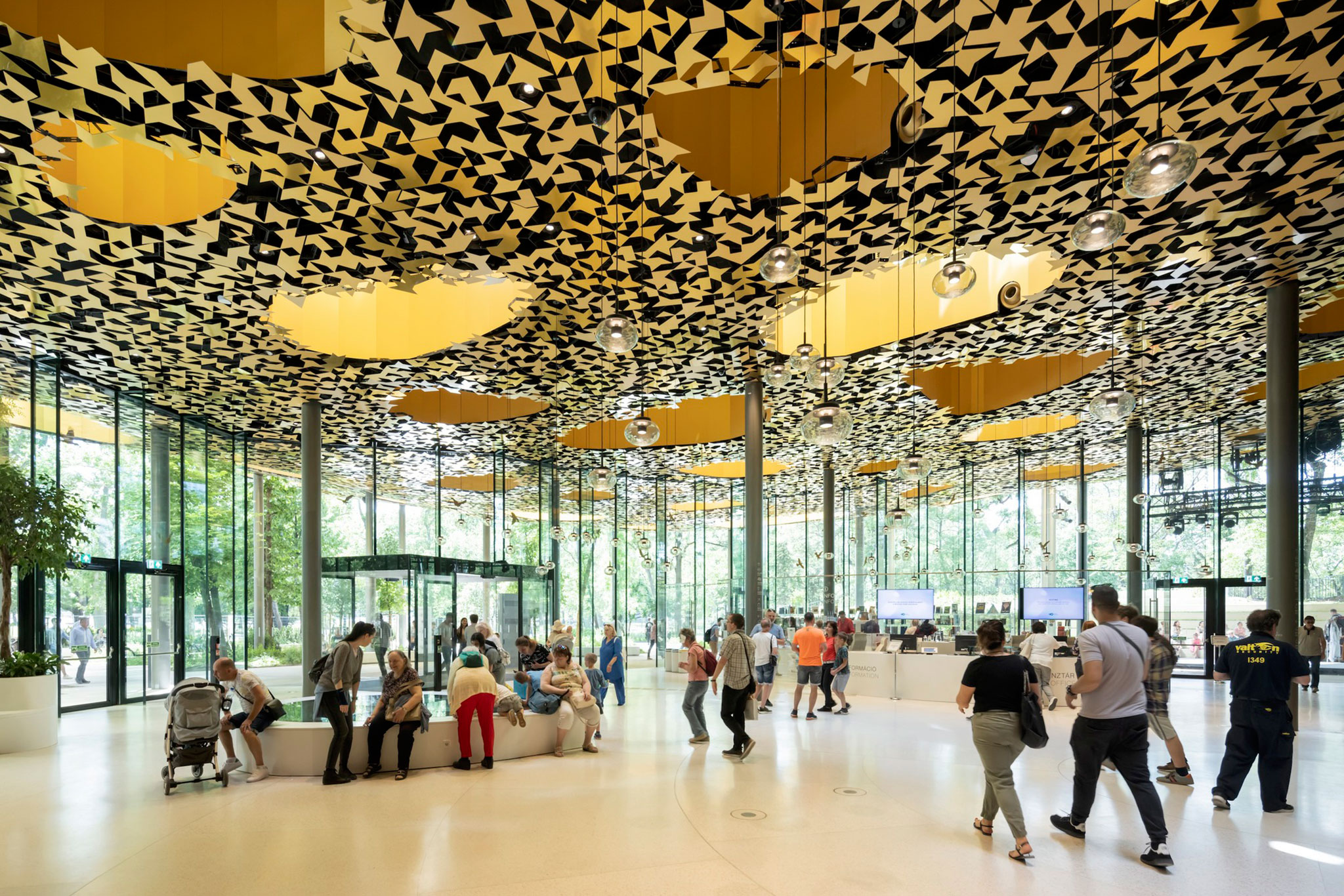
House of Hungarian Music by Sou Fujimoto. Photograph by Iwan Baan. Courtesy of Liget Budapest.
Controversy
The project is the first to be completed in a soon-to-be-opened €120m Museum of Ethnography, in the form of two gigantic curved wedges emerging from the ground, clad in an intricate lace wrapper that nods to Hungarian national dress.
A little further north the €300m National Gallery designed by Japanese architects Sanaa joins reconstruction proposals ranging from a neo-baroque palace to an art nouveau theatre. All this with the construction of the "largest biodome in Europe" in the nearby zoo (still unfinished as funding has run out).
The set of works is immersed in a strong controversy between the right-wing government (its megalomania and its particular vision of democracy) that proposed the set as a recovery of the memory of the Habsburg era, when the park was designed and flanked by majestic palaces of art for the Millennium Exhibition of 1896, and the recently arrived leftist mayor who advocates stopping concrete in one of the most emblematic parks of old Europe.


